I panini di Napoli: what I told my daughter about the sandwiches we ate growing up
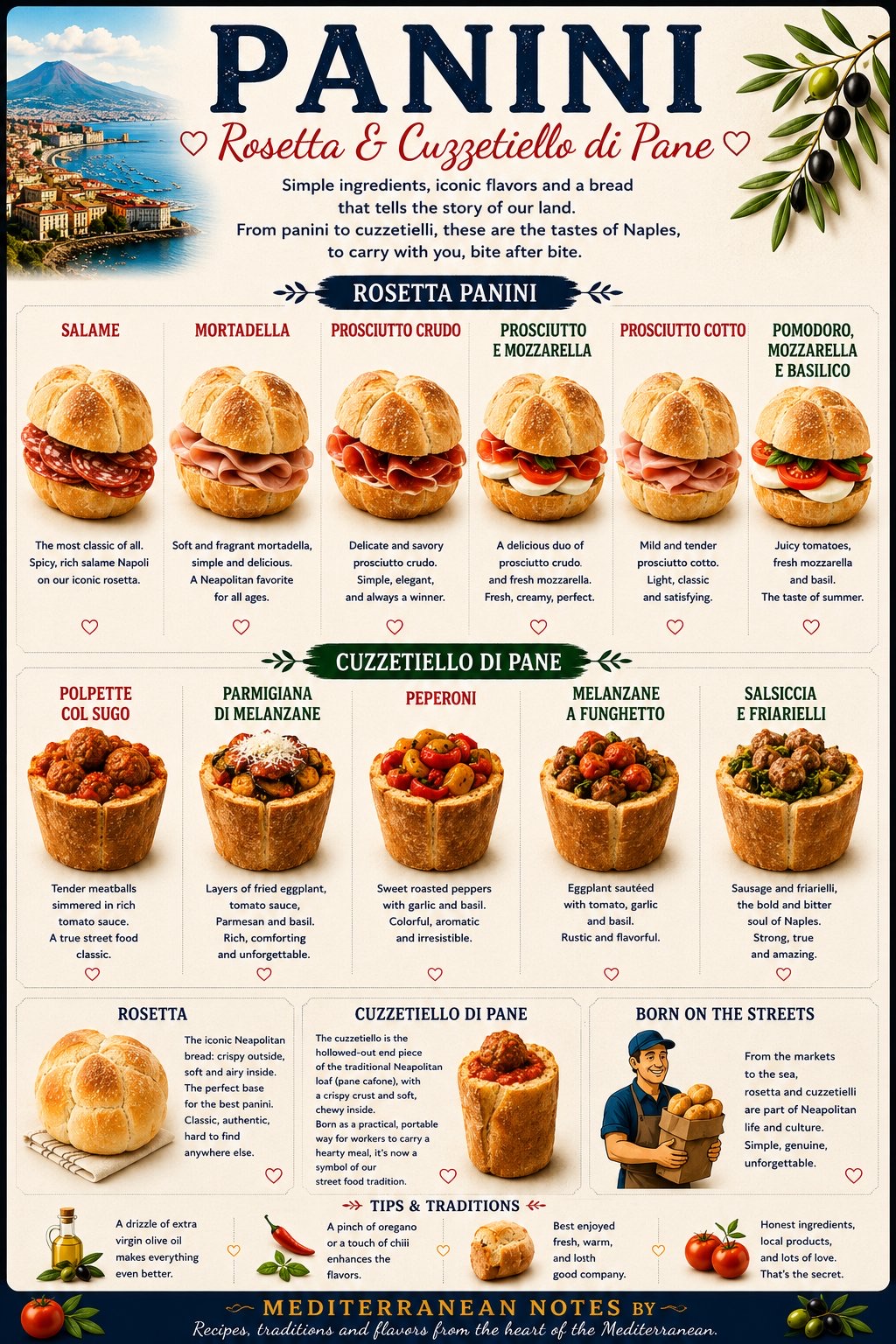
Cuzzetiello con polpette al sugo
The ragù cuzzetiello · Sunday leftovers made portable
Meatballs in Sunday ragù sauce — the same ragù napoletano from this collection — packed into the hollowed pane cafone end. The bread absorbs the tomato sauce as you eat, becoming progressively softer and richer toward the bottom. The original use: Monday's lunch made from Sunday's pot. The sauce that soaks into the bread walls is the reward for eating it correctly — all the way down.
Cuzzetiello con parmigiana di melanzane
The parmigiana cuzzetiello · rich and comforting
Layers of fried eggplant, tomato sauce, Parmigiano and basil — the full parmigiana di melanzane packed into the bread bowl. The fried eggplant's oil and the tomato sauce together transform the bread from the inside out. One of the most satisfying versions, too heavy and too saucy for any other bread format but perfectly contained by the pane cafone end piece.
Cuzzetiello con salsiccia e friarielli
The bold Neapolitan cuzzetiello · street food icon
Grilled or pan-cooked sausage with friarielli — the bitter Neapolitan broccoli rabe sautéed in olive oil and chili. The combination of pork fat from the sausage and the bitter-spicy friarielli is one of the defining flavor combinations of Campanian cooking. In the cuzzetiello, the juices from the sausage soak into the bread. Bold, rustic, filling. The version most common at street food stands.
Cuzzetiello con peperoni
The vegetarian cuzzetiello · colorful and aromatic
Sweet roasted peppers with garlic, basil, and a drizzle of olive oil — the peperoni arrosto from this collection, or the sautéed pepper version. The sweetness of the peppers and their cooking oil soak into the bread in a way that makes this the lightest and most summery of the cuzzetiello variations. Also works with the Genovese — the onion sauce soaks into the bread with particular effect.
My daughter Anna asked me what panini we used to eat in southern Italy growing up. I could think of a few immediately — each one attached to a specific place and time. Mortadella in the park. Salame on the way into school. Prosciutto and mozzarella at the beach. All of them on a rosetta, the Neapolitan bread roll that is impossible to find here in the US. This post is the answer to her question.
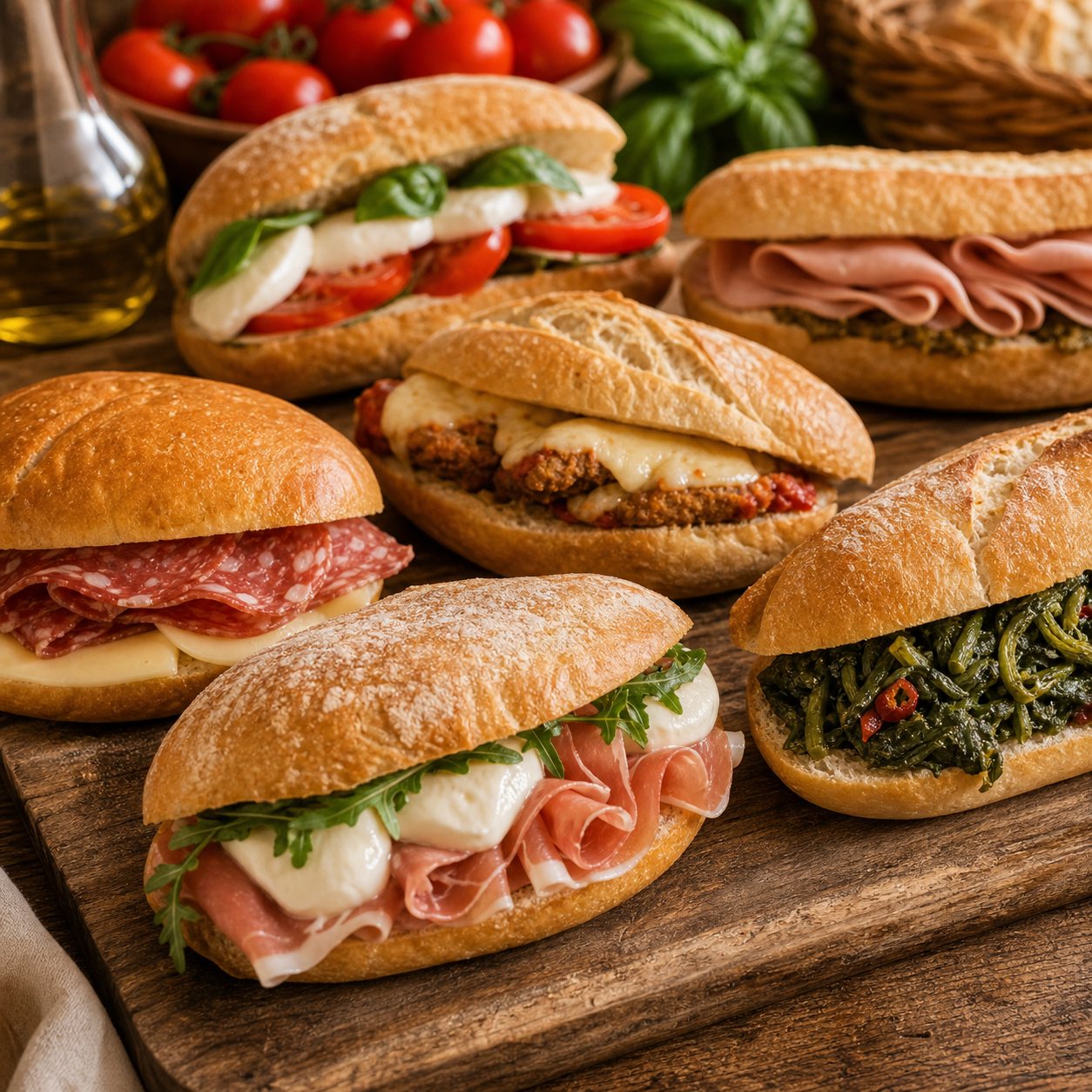
The Neapolitan panino is not a sandwich in the American sense. It is simpler, more specific, and more dependent on the quality of its individual components. Where an American sandwich tends toward abundance — multiple meats, multiple cheeses, multiple sauces layered until the bread is structural support for a vertical construction — the Neapolitan panino tends toward restraint. One charcuterie at a time. That is the way you do it in Italy. Sometimes cheese alongside, but not necessarily, and never cheese that competes with the meat — the cheese is there to add creaminess and fat, not to introduce a second flavor that fights with the first. The bread is the rosetta — the iconic Neapolitan roll, crispy on the outside, soft and airy inside, light and fragrant and strong enough to hold every filling without losing its structure — and in the US it is, for practical purposes, impossible to find. This is one of the things worth bringing back from Italy in your bag, alongside the pasta.
Most of the panini in memory were eaten as merenda — the Italian mid-morning snack, around ten in the morning, which is as foreign a concept to American eating culture as the frittata as a dinner main course. In school, in the break between morning lessons, everyone produced something from their bag. The salumeria near the school in Caserta was where you bought the panino with salame on the way in, for a price that was nothing, eaten quickly before the first bell. The royal park in Caserta, where families came on Sundays and school groups came for field trips, was where you ate the mortadella panino on the grass at midday. The beach was where you brought the prosciutto and mozzarella, wrapped in paper, warm from the morning by the time you opened it.
And then there was the panino that was not bought but declared. "Mettitelo tra due fette di pane" — put it between two slices of bread — my father said it constantly, a staple expression in our house, and it had nothing to do with the rosetta. It applied whenever there was pane casareccio or pane cafone on the board and something on the table that would fit perfectly between two slices: insaccati, a leftover slab of parmigiana, broccoli e friarielli, the peperoni from lunch. It was less a recipe than a philosophy — the recognition, mid-meal, that whatever this was, it would be even better as a panino. He was almost never wrong.
The rosetta — called rosetta in Rome and rosetta pane or simply il panino in Naples — is a specific bread with a specific structure. Crispy and somewhat blistered on the outside, almost hollow inside, light and airy in a way that allows it to absorb a little of the fat from the charcuterie without becoming soggy. The crust provides resistance. The interior accommodates the filling without the bread overwhelming it. The shape — a round roll scored in a flower pattern across the top — is as recognizable as the taste. In Campania, as with regular pane casareccio, it was available at every corner bakery fresh each morning, and there was no reason to think much about it because it was simply always there. It is only in its absence, as with so much of this collection, that its specific quality becomes fully apparent.
The rule of one charcuterie at a time is not a rule anyone stated explicitly — it is simply how panini were made and eaten. A panino con salame is salame in a rosetta, and the point is the salame, and the salame is good enough not to require company. A panino con mortadella is mortadella in a rosetta, soft and fragrant and faintly pink, and its specific flavor — the mild sweetness, the tiny fat cubes, the pistachios in the better versions — is what you are tasting, and adding a second cured meat would create confusion rather than richness. The cheese, when present, is not a competing flavor but a textural element: scamorza or provola for meltiness if the panino is warmed (though these panini are never warmed — another rule), mozzarella for freshness and dairy fat alongside the prosciutto. But these panini are eaten cold and at room temperature, as they come from the salumeria or from the bag. Warming them would change them into a different object and a different experience.
The rules of the Neapolitan panino
One charcuterie at a time. This is how you taste what you are eating.
Never warm the panino. These are cold sandwiches, eaten at room temperature or fresh from the salumeria. Heat changes the texture of the bread and the character of the charcuterie. The panino con salame must taste of salame. The panino con mortadella must taste of mortadella. Heat turns them into something else.
Cheese is optional and textural, not a second filling. Scamorza or provola adds creaminess. Mozzarella adds freshness. Neither is required, and the version without is often the better one because it lets the charcuterie speak more clearly.
The bread is the rosetta. If you cannot find it, a good crusty roll with a soft interior is the closest approximation. A soft sandwich loaf is not a substitute and will not produce the same result.
The panini I remember — for Anna
Panino con la mortadella
The park panino · Royal Palace of Caserta · Sunday lunch
Soft, fragrant, faintly pink mortadella on a rosetta — the one I remember most clearly from the park at the Royal Palace of Caserta, eaten on the grass at midday. Mortadella is the most underrated Italian charcuterie: mild and sweet with fat cubes and in the better versions pistachios, entirely different in character from American bologna which shares its name and nothing else. No cheese needed. The mortadella is the whole thing. Best eaten slightly warm from being in the bag all morning.
Panino con il salame napoletano
The school panino · Caserta · morning merenda
Spicy, rich salame Napoli on a rosetta, bought from the salumeria near the school on the way in, eaten in the break between morning lessons for almost nothing. The salame napoletano is firmer and spicier than most northern Italian salami — a specific flavor that carries the whole panino. One filling, no additions. The rosetta's crust against the salame's spice is the combination, and nothing else is required.
Panino con prosciutto e mozzarella
The beach panino · summer · university days
Prosciutto cotto or crudo — the cooked version for the beach, usually — with a slice of fresh mozzarella in a rosetta. The one brought to the beach wrapped in paper, the one carried to university in Naples. The mozzarella is the cheese that works with prosciutto because it adds dairy fat and freshness without competing flavor. Eaten at room temperature after a morning in the bag, the mozzarella slightly warm, the prosciutto slightly sweated. This is not a flaw. This is the beach panino exactly as it should be.
Panino con scamorza o provola
The cheese panino · simple and excellent
Just smoked scamorza or provola on a rosetta — no meat, no additions. The smoked cheese alone, with its slightly rubbery texture and faint smokiness, is a complete panino. Common in Campania where scamorza and provola are the everyday cheeses of the table. The version that most surprises people who expect a panino to contain cured meat: the cheese is sufficient and it is very good.
Panino con friarielli
The vegetable panino · on regular sliced bread
Friarielli — Neapolitan broccoli rabe, sautéed with garlic and chili in olive oil — on regular sliced bread rather than a rosetta. This is the sandwich that belongs to the other bread tradition: not the charcuterie panino on the crispy roll but something softer and more substantial, the bread absorbing the olive oil from the friarielli. Sometimes with sausage alongside; often without. The vegetable version, made at home rather than bought at the salumeria.
Panino con Pecorino e Parmigiano
The cheese-only classic · simple Italian flavor
Slices of Parmigiano Reggiano and Pecorino Romano together on a rosetta — bold, salty, intensely flavored. No meat. The aged cheese paired with the crispy crust produces a combination that tastes more complex than its two ingredients suggest. A panino that sounds too simple and tastes better than expected. Another case where less is the correct choice.
Panino con tonno, pomodoro e insalata
The summer panino · light and fresh
Good canned tuna — in olive oil, well drained — with ripe tomato slices and a little lettuce, a drizzle of olive oil. The summer panino when you want something light. The tuna must be in olive oil and it must be good tuna; the tomato must be ripe. This is not a complicated sandwich but it requires its ingredients to be genuinely good, because there is nothing to hide behind.
Panino con peperoni arrostiti e provola
The roasted pepper panino · warm flavors
Sweet roasted peppers — the peperoni arrosto that appear elsewhere in this collection — with smoked provola on a rosetta. The sweetness of the roasted pepper against the smokiness of the provola is one of the classic Campanian flavor combinations. A more substantial panino, more appropriate as a lunch than as a morning merenda.
Il cuzzetiello — the other Neapolitan bread vessel
Alongside the rosetta, Naples has another bread tradition that belongs to the same street food culture but operates on a completely different scale: the cuzzetiello di pane. Where the rosetta is a small roll carrying a single elegant filling, the cuzzetiello is the hollowed-out end piece — the heel, the culetto — of a traditional pane cafone loaf. The soft crumb inside is pulled out, leaving a sturdy bread bowl with a thick, crispy crust that can hold the heaviest, sauciest, most abundant Neapolitan fillings without falling apart. It is a different object from the rosetta in every way: bigger, more substantial, more aggressively filling, born not from elegance but from practicality.
The cuzzetiello started as a working-class solution to a specific problem: how to carry a hot, saucy meal to work or to the fields without losing the sauce along the way. The bread bowl contains the contents. You eat the container along with what it contains. Nothing is wasted and nothing requires a plate or cutlery. It was also a way to use Sunday leftovers productively — the remaining ragù, the leftover parmigiana, the sausage and friarielli from the night before — stuffed into the end of the pane cafone and carried out as Monday's lunch. It is, in this sense, a companion piece to the frittata 'e maccarune: the same cucina povera logic of turning what is there into something better.
The fillings that go inside a cuzzetiello are the richest and sauciest dishes in the Neapolitan repertoire — the ones that would never work inside a rosetta. Polpette al sugo. Melanzane alla parmigiana. Salsiccia e friarielli. Peperoni in tomato sauce. La Genovese, which soaks beautifully into the bread walls as you eat. The bread absorbs the sauce and the oil and becomes, by the end, as much a part of the eating experience as the filling. It is now sold at specialized shops and bakeries throughout Naples as a street food — hot versions to go, as the modern version puts it — but its origins are purely domestic and entirely practical.
A note on the rosetta
The rosetta is genuinely impossible to find in the United States in a form that resembles the original — but the difficulty starts earlier than that. It is hard to find even in other parts of Italy. When I was in Bologna I went looking for it in bakeries and found nothing close. Bologna has its own excellent bread traditions — the pane ferrarese, various local rolls — but the rosetta, as the Neapolitans and Campanians know it, simply does not exist there. It is a southern thing, and specifically a Campanian thing, and in Caserta it was everywhere: at the corner bakery, at the bar, at the salumeria, warm in the morning and in every bag at school. Something so present and ordinary that you never thought of it as particular or local until you went somewhere else and found it was not there.
What makes it specific and unreplicable is not the shape — the flower-scored surface is easy to imitate — but the structure. The original rosetta has an almost hollow interior: the dough rises in a way that creates a large air pocket inside, so that when you cut it open you find mostly crust and a thin layer of soft bread rather than a dense crumb. This near-hollowness is what makes it the perfect carrier for charcuterie: the crust provides resistance and crunch, the airy interior gives the filling space without the bread overwhelming it. The charcuterie and the bread arrive in the same bite in the right proportion. It is light enough that the filling is the point, and strong enough that it holds everything without collapsing. There is a reason it became the canonical Campanian panino bread and not something heavier.
Replicating it requires a specific dough hydration and a baking temperature that traps steam inside the roll as it bakes, inflating the interior and setting the hollow structure before the crust closes. Most home ovens cannot fully achieve this. Most American bakeries have no reason to try. If you cannot find it — and outside Campania you likely cannot — a good ciabatta roll comes closest: crispy outside, open and airy inside, strong enough to hold a filling without dominating it. A good sourdough roll also works. What does not work is anything soft, anything pre-sliced, anything dense. The rosetta is a light bread. That lightness is not incidental. It is the whole point.
Anna, now you know. When we go back to Italy you will have all of these, with the right bread, in the right places. The mortadella panino in the park at the Royal Palace is still the one I recommend starting with. Sit on the grass. Eat it while it is still fresh from the bakery. That is the correct way.
Buon appetito, Anna — e buon panino.