Friarielli: the green that was always at home — without the anchovies
Olive oil, garlic, and chili — and nothing else. My father didn't like fish, and anchovies in particular, so the friarielli at our table were always the pure version. They still are. Stored ready in the refrigerator, reheated with a flash in the pan, sometimes tossed with pasta. A staple that never really left.
My father had a specific and firm position on anchovies. He didn't like fish in general, but anchovies carried a particular weight of disapproval — possibly, as I always suspected, because he had eaten too many of them at some point before I was born and the memory had not been kind. The exact origin was never fully explained. The result was clear: no anchovies in anything, ever. And since he didn't like anchovies, we didn't have anchovies. This is how household food culture works.
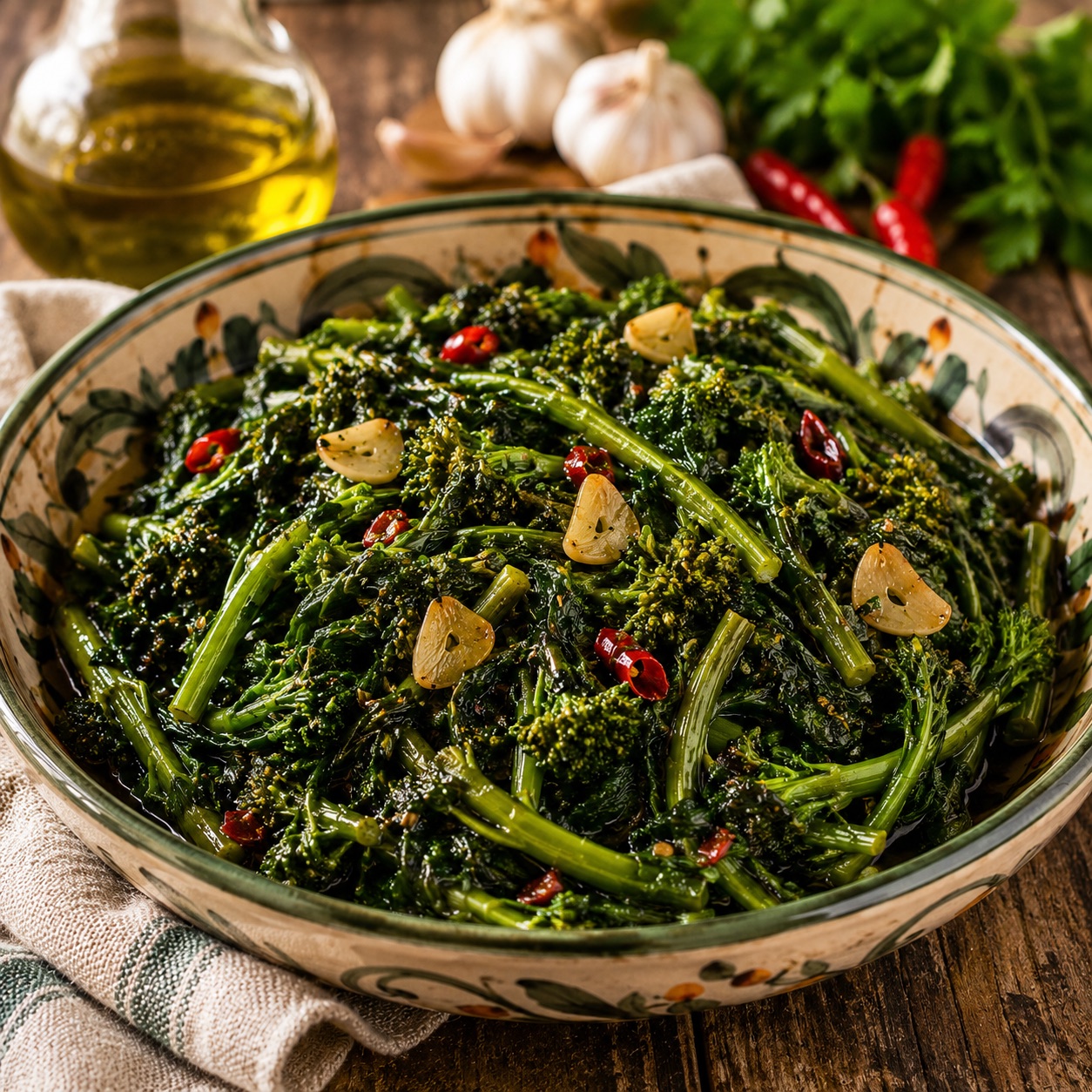
The friarielli, therefore, were always made the pure way — olive oil, garlic, chili pepper, nothing else. This turns out to be exactly the right way to make them. The canonical Neapolitan recipe calls for anchovies in some versions, but the scoppiettati tradition — cooking the greens raw directly in the pan without blanching first, covered for the first few minutes to wilt with their own steam — produces something so intensely flavored from the olive oil and garlic and the natural bitterness of the greens that the anchovy, when it appears, is an addition rather than a foundation. Ours was the version without. It was sufficient.
The name friarielli is Neapolitan specifically — in the rest of Italy the same vegetable is called cime di rapa (broccoli rabe in the United States, rapini in other contexts). In Naples they are year-round, not seasonal, though they peak in the colder months. Kept cooked in the refrigerator — stored in the olive oil and juices from the pan — they are one of those practical staples that make weeknight cooking much simpler: heat a pan, add a splash of olive oil, warm the friarielli through, and the side dish is ready in three minutes.
The pasta application is the logical extension: leftover friarielli, or deliberately cooked-ahead friarielli, tossed with just-drained pasta and a splash of cooking water. This is the Neapolitan version of the Pugliese classic pasta alle cime di rapa — not identical, because the Pugliese version uses a specific technique with the greens cooking in the pasta water itself, but the result is close enough and the spirit is the same. Bitter greens, garlic, olive oil, pasta. One of the most nutritionally complete pasta combinations available.
Glucosinolates, sulforaphane, and why bitter greens are protective
Friarielli — broccoli rabe — belong to the Brassicaceae family alongside broccoli, kale, cabbage, and mustard greens. The characteristic bitterness comes from glucosinolates: sulfur-containing compounds that are cleaved by the enzyme myrosinase when the plant tissue is damaged (cutting, chewing, cooking) into isothiocyanates and indoles — the biologically active compounds that have attracted the most research attention. Sulforaphane, the isothiocyanate derived from glucoraphanin in broccoli-family vegetables, is one of the most studied phytochemicals in cancer prevention research, with documented activity as an inducer of Nrf2-mediated antioxidant and detoxification pathways. The scoppiettati method — cooking raw friarielli directly in olive oil and steam, without blanching — preserves more glucosinolates than blanching in water, which leaches these compounds significantly. The heat of the pan partially inactivates myrosinase but not completely, and the gut microbiome provides alternative myrosinase activity that continues the conversion to active isothiocyanates in the large intestine. Vitamin C content is high in raw friarielli (approximately 20–30 mg per 100 g) but heat-labile; the brief initial covered cooking followed by high-heat uncovered cooking represents a reasonable trade-off between flavor development and nutrient preservation. Vitamin K1, folate, calcium, and iron are all present at meaningful concentrations and are more heat-stable than vitamin C. Garlic contributes allicin and its organosulfur derivatives. The generous olive oil in which the greens cook provides the medium for fat-soluble carotenoid absorption and adds its own phenolic antioxidants. This is, per ingredient cost and cooking time, one of the most nutritionally dense dishes on this blog.
The recipe — scoppiettati, the Neapolitan way
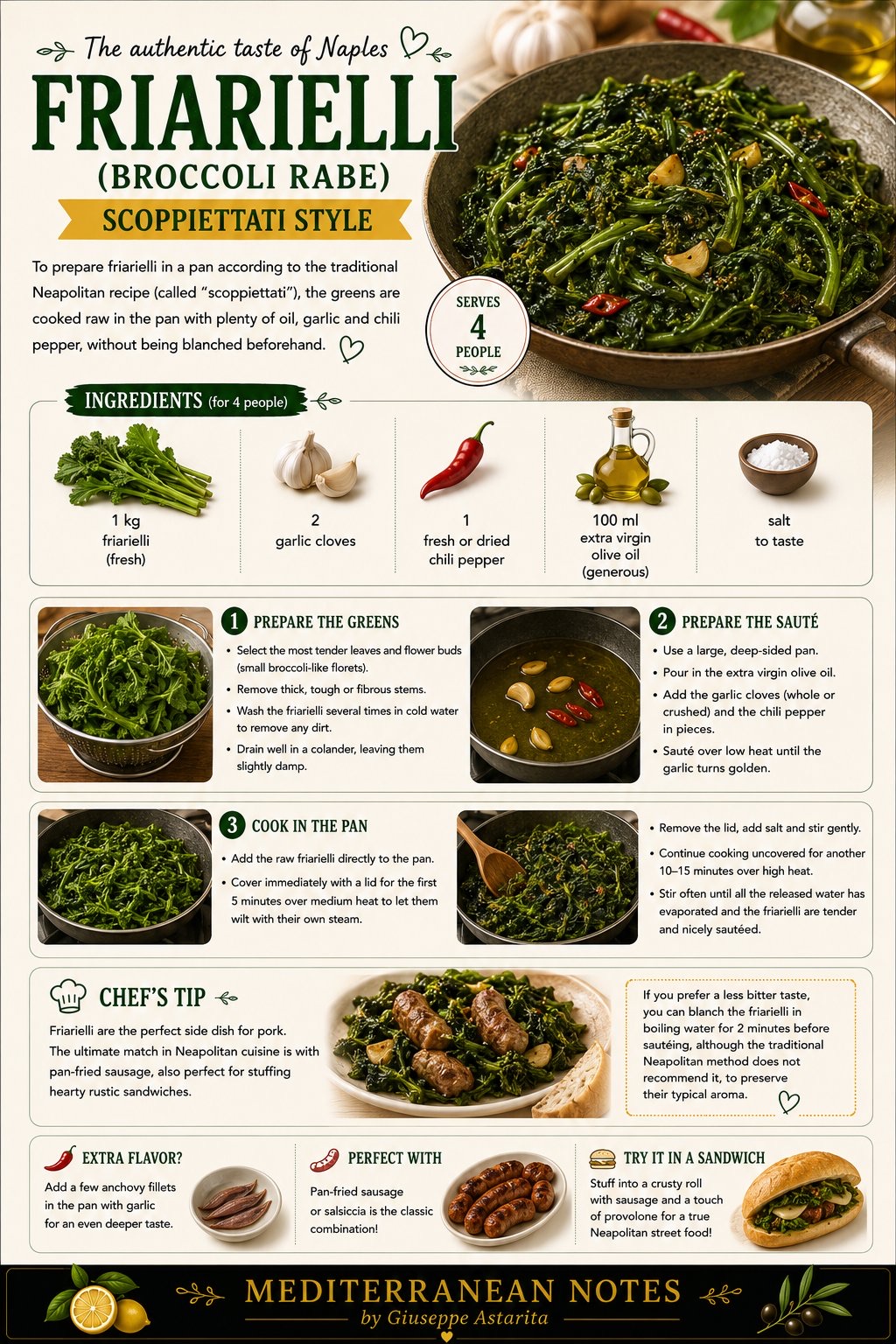
The defining technique is scoppiettati: the greens go into the pan raw, not blanched. Covered first to wilt with their own steam, then uncovered over high heat until all the liquid evaporates and the greens are tender and well-sautéed. No water added, no separate boiling pot. One pan.
Ingredients · serves 4
Method
Prepare the greens. Select the tender leaves and small flower buds — these are the best part. Remove any thick, fibrous stems. Wash the friarielli several times in cold water to remove dirt. Drain in a colander, leaving them slightly damp — this moisture helps them steam in the first phase of cooking.
Build the soffritto. In a large, deep-sided pan, pour in the olive oil. Add the garlic cloves and chili. Sauté over low heat until the garlic turns golden — about 3–4 minutes. If using anchovies, add them now and let them melt into the oil.
The pan needs to be large enough to hold 1 kg of raw greens, which is a significant volume — they will reduce dramatically, but they start high. A wide, deep-sided pan with a lid.
Cook the friarielli — scoppiettati. Add the raw, damp friarielli directly to the pan. Cover immediately with a lid and cook over medium heat for 5 minutes — the steam from the damp greens wilts them rapidly. Remove the lid, add salt, and stir gently. Continue cooking uncovered over high heat for another 10–15 minutes, stirring often, until all the released water has evaporated and the greens are tender, concentrated, and well-sautéed in the olive oil.
The high heat at the end is important — it drives off the excess water and lets the greens fry slightly in the olive oil rather than stew. The finished friarielli should be dark green, slightly oily, and intensely flavored. Not soupy.
Make-ahead and storage. Cooked friarielli keep in the refrigerator for 3–4 days, stored in their own oil. To reheat: a splash of olive oil in a pan, the friarielli from the refrigerator, high heat for 2–3 minutes. They are ready immediately. This is the version to make in larger quantities specifically for weeknight use.
If you prefer less bitterness, blanch the friarielli in boiling water for 2 minutes before the pan step. The traditional Neapolitan method does not recommend this — it reduces the characteristic aroma — but it works well for those unaccustomed to the full bitterness of the raw-to-pan method.
What to do with them
As a side dish — the standard
Alongside pork in any form: sausage pan-fried and served next to the friarielli is the classic Neapolitan combination. Also good alongside grilled chicken, or simply on their own with bread to soak up the olive oil from the plate. The bread is not optional.
Over pasta — the weeknight version
Toss leftover friarielli with just-drained pasta and a splash of the cooking water. A little extra olive oil, a handful of Pecorino or Parmesan if you like, a pinch of chili. This is the Neapolitan answer to pasta alle cime di rapa — not identical to the Pugliese original but deeply good, and ready in the time it takes to boil the pasta.
In a panino — Neapolitan street food
Friarielli and sausage in a crusty roll, sometimes with a slice of provolone. This is one of the classic Neapolitan street food combinations — sold from friggitorie and eaten standing up. At home: cook the sausage in the same pan after the friarielli, stuff both into a good roll. That is all.
On pizza
Friarielli and sausage is also a classic Neapolitan pizza topping — one of the most beloved and most specifically Neapolitan combinations, rarely found elsewhere in Italy. If you are making pizza at home and have leftover friarielli, this is the obvious application.
Buon appetito.