Il Pane in Campania
The bread that was always at the table — and the rule we broke every day
In Campania, bread was not a side dish and it was not optional. It was a condition. You sat down to eat and the bread was already on the table, and if for some reason it was not there, someone got up to find it before the meal could begin. This is not hyperbole. It was almost impossible to eat without it — not because the food was insufficient, but because bread was the frame around the meal and the meal did not make sense without it.
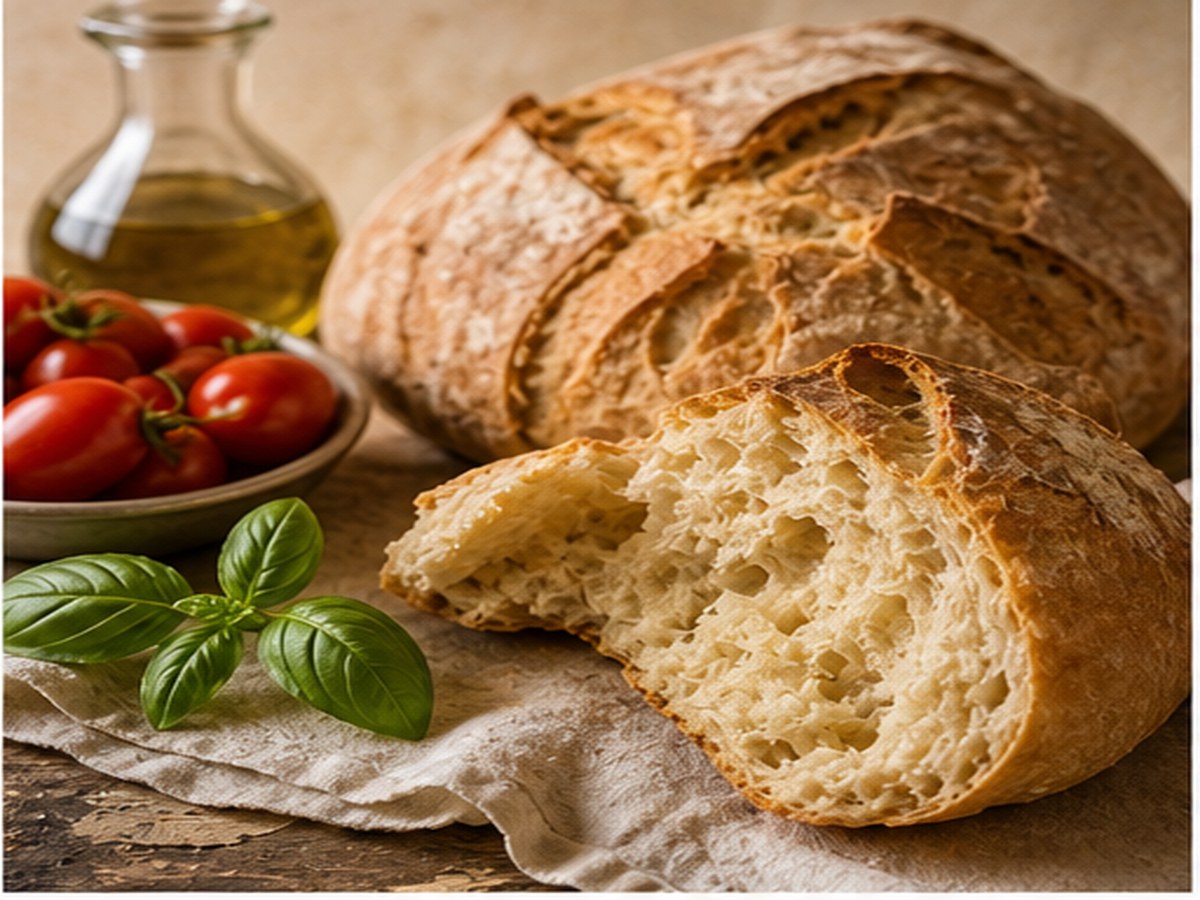
There is a phrase in the infographic — il pane è sacro, bread is sacred — that is not decorative. In the Catholic south of Italy, bread carries a weight that goes beyond nutrition. It appears in the Lord's Prayer. It is broken and shared at Mass. When a piece of bread falls on the floor, you pick it up and kiss it before setting it aside. This relationship with bread is not a matter of gastronomy; it is theological, historical, and embedded in a civilization that spent centuries at the edge of hunger and learned to treat the thing that stood between them and that edge with reverence. The bread at the Campanian table was never just bread. It was the symbol of abundance when there was abundance, and the measure of dignity when there was not.
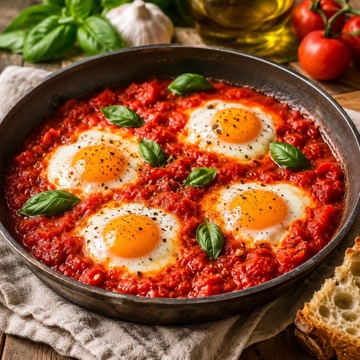
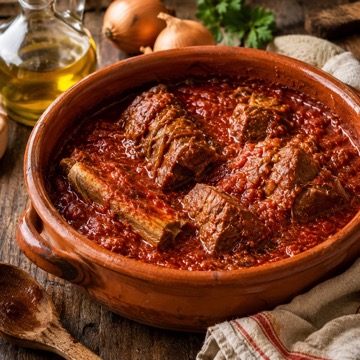
Growing up in Caserta, the bread was always there. Every meal — pasta, soup, meat, fish, vegetables, anything — was accompanied by bread, and the bread stayed on the table from the beginning to the end. It was used to eat with — broken and used to scoop and to dip and to accompany — and it was used to clean the plate at the end, the act called la scarpetta: the little shoe, the piece of bread that wipes the plate clean so that nothing is wasted and every last bit of sauce or oil or cooking liquid is consumed. The scarpetta is not considered elegant in formal company. At home it was mandatory. To leave sauce on the plate without making the scarpetta was to leave something behind that had been made for you, and this was a form of ingratitude that the table did not tolerate.
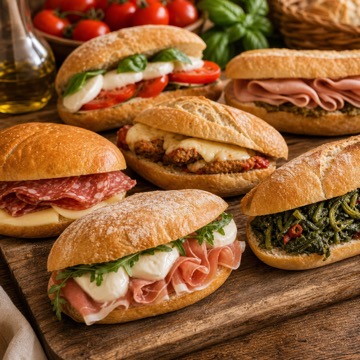
It is also the bread of my father's favourite sentence — "mettitelo tra due fette di pane", put it between two slices — pronounced over anything on the table that deserved promotion: salumi, parmigiana, peperoni, friarielli. With a casareccio loaf on the board, almost everything qualified.
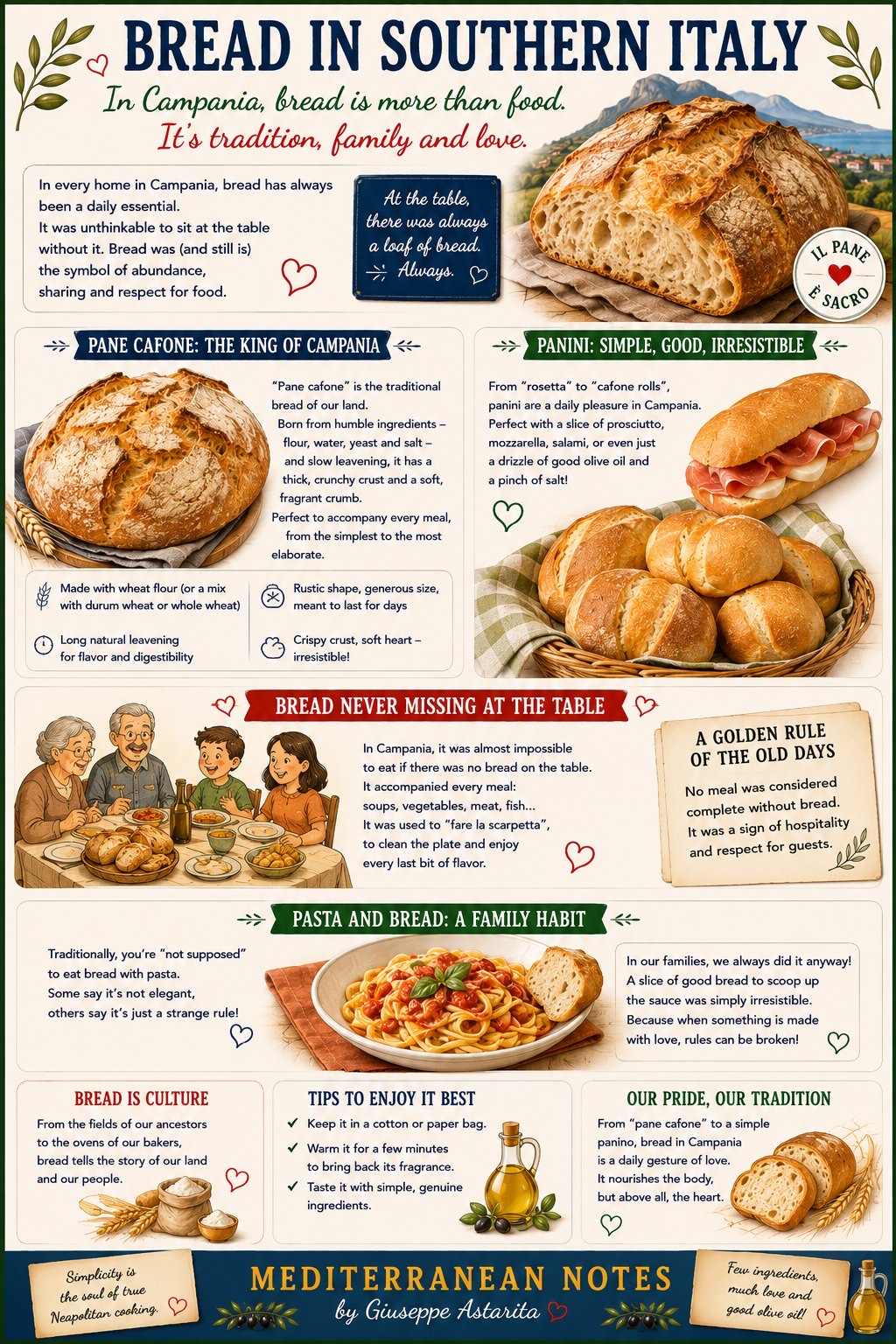
Il pane cafone — the bread of Campania
The bread of Campania is called pane cafone — literally, the peasant's bread, the rude man's bread, with all the complicated class associations that word carries in southern Italian culture. Cafone was an insult, a word for the rural poor, the person without manners or refinement. The bread that carries this name is the opposite of insulting: it is a large, rustic loaf with a thick, hard crust and a soft, open, fragrant crumb, made with flour, water, yeast, and salt, leavened slowly and baked in a hot oven until the crust is deeply golden and the interior has the characteristic irregular holes of a well-fermented dough. It is the bread that came from the communal ovens — the forni a legna — where in the old days each family brought their shaped loaves to be baked together, the oven belonging to the community rather than to any single household.
Pane cafone is a large bread, meant to last. A single loaf could be the bread for a family for two or three days, and it improved rather than deteriorated over the first day or two — the crust softening slightly, the interior settling into a texture that was ideal for the scarpetta. Old pane cafone, slightly stale, was used for pane cotto — bread cooked in broth or olive oil — and for the various preparations that across southern Italy absorbed yesterday's bread into something new rather than wasting it. Nothing was wasted. The bread served until it was finished, and when it was finished you went to the bakery for more.
The panino is the other essential form — the small roll, the individual bread, the thing you eat in one sitting rather than over several days. In Campania the rosetta, the cafone roll, the ciabattina — these filled the bakery display alongside the large loaves and served a different function: the quick meal, the midmorning snack, the lunch taken to school. A slice of prosciutto, a piece of mozzarella, a few olives and a drizzle of olive oil — the panino required nothing elaborate to be good. I wrote a whole post on the panini of Naples for Anna: the cuzzetiello, the rosetta, the michetta — each shape with its own logic and its own best filling. The panino is a universe of its own.
The bread with pasta — the rule everyone knew and nobody followed
The rule exists, and it is real, and food writers and Italian grandmothers from other regions have been known to invoke it with genuine conviction. The logic behind it is approximately this: pasta is already a carbohydrate, bread is already a carbohydrate, and combining them is either unnecessary or vulgar, depending on who is explaining it. In sophisticated company, eating bread with pasta signals that you have not been properly taught. There are restaurants in Italy that do not put bread on the table during the pasta course for this reason.
In Campania, at home, none of this mattered in the slightest. The bread was on the table. The pasta arrived. You ate the pasta and you tore a piece of bread and you used it to accompany what was on your fork, or to mop the sauce that was beginning to pool at the edge of the bowl, or simply because the bread was there and you were hungry and it was good. The scarpetta at the end was inevitable. The bread was never wasted. The rule was something that happened in other people's houses, not ours.
I have thought about why this rule exists and I think it has less to do with nutrition or gastronomy than with class signaling — the attempt, in the nineteenth and twentieth centuries, to distinguish bourgeois eating habits from peasant ones. The peasant ate bread with everything because bread was the constant, the foundation, the one thing that was always there. The bourgeois ate each course separately, in the French manner, with bread as a specific accompaniment rather than a continuous presence. The rule against bread with pasta is a rule against peasant eating, which means it is a rule against the way people actually ate when they were hungry and the food was good. In Campania, where the pasta was very good and the bread was very good, following the rule would have required leaving sauce on the plate, which was not something anyone was willing to do.
The scarpetta — and why the plate must be clean
The scarpetta — literally, the little shoe — is the act of using a piece of bread to clean the plate after a meal. The term comes from the shape the bread makes as it moves across the plate, held between the fingers at an angle like a small shoe scraping a surface. It is the final act of the meal, the acknowledgment that what was served was good enough to want every last drop of. A plate cleaned with a scarpetta is a compliment to the cook. A plate left with sauce is a mild rebuke.
In formal contexts the scarpetta is considered bad manners. At every family table I sat at growing up in Caserta, it was considered good sense. The sauce was made for a reason. The oil was good. The tomato had cooked for a long time. Leaving it on the plate was not refinement; it was waste. The bread existed, in part, to prevent this waste. The scarpetta was not an afterthought — it was built into the logic of the meal from the beginning. You made enough sauce knowing that the bread would be used to finish it. The two were planned together, even if no one consciously planned them.
Pane cafone is made with a long, slow fermentation — traditionally overnight or longer at cool temperatures. This extended fermentation allows wild yeasts and lactobacilli bacteria to produce lactic and acetic acids alongside the carbon dioxide that leavens the dough. The organic acids produced during long fermentation do several things: they give the bread its characteristic mildly sour, complex flavor that quickly-fermented bread lacks; they lower the pH of the dough, which inhibits the mold growth that would cause the bread to spoil quickly; and they partially break down the phytic acid in the flour, increasing the bioavailability of minerals including iron and zinc. A properly long-fermented pane cafone, with its thick, hard crust, can remain good for two to three days at room temperature — the crust acts as a barrier against moisture loss, and the acid environment inside inhibits spoilage. This is why the bread of southern Italy was baked in large loaves meant to last several days rather than the small, quickly consumed rolls of northern European traditions.
The thick crust develops its color and crunch through the Maillard reaction — the same browning mechanism at work in the crusts of the baccalà fritto and the grilled vegetables in this collection. At oven temperatures above 140°C, the sugars and amino acids on the bread surface react to produce hundreds of aromatic compounds. The thick crust of pane cafone, developed over a longer bake at high temperature, contains a higher concentration of these compounds than a thin-crusted bread — which is why it smells so strongly when cut and why the crumb inside, protected from direct heat by the crust, retains its moisture and softness.
The bread in Massachusetts
In Massachusetts, the bread is not the same. This is a fact I have accepted without ever fully making peace with it. There is good bread here — sourdough from serious bakeries, Italian-American bread from old-school bakeries in certain neighborhoods — but it is not pane cafone, and the difference is not a matter of recipe or technique but of flour, water, air, and the specific microbial environment of a particular place. The wild yeasts in Campania are not the wild yeasts in New England. The wheat is different. The way the bread ages is different. You can make a very good bread here, and I sometimes do, but it will not taste the way I remember.
What I do is buy the best bread available — from a bakery, not a supermarket, always the same day — and use it the way I was taught: with everything, from the beginning of the meal to the end, without apology, and with a proper scarpetta that leaves the plate clean enough that the dishwasher could almost skip it. The girls do this too. They have been taught. The rule about not eating bread with pasta has not been mentioned at our table and will not be.
Some things travel. The bread of Campania, in its exact form, does not. But the relationship with bread — the idea that it is always there, that it accompanies everything, that it is used to clean what was good enough to clean — this travels perfectly. It requires no special ingredient. It requires only the decision to put the bread on the table and leave it there until the meal is finished.
Il pane è sacro —
e la scarpetta è obbligatoria.