Frittata 'e maccarune: what my mother knew that I didn't yet
My parents came to visit me in California. We were getting ready to go on a road trip to the national parks. My mother made frittata di pasta to bring with us. I was almost offended — I wanted them to experience the real American on-the-road food, maybe a McDonald's somewhere on Route 1. Now I fully appreciate what she understood that I didn't. She was right. She was completely right.
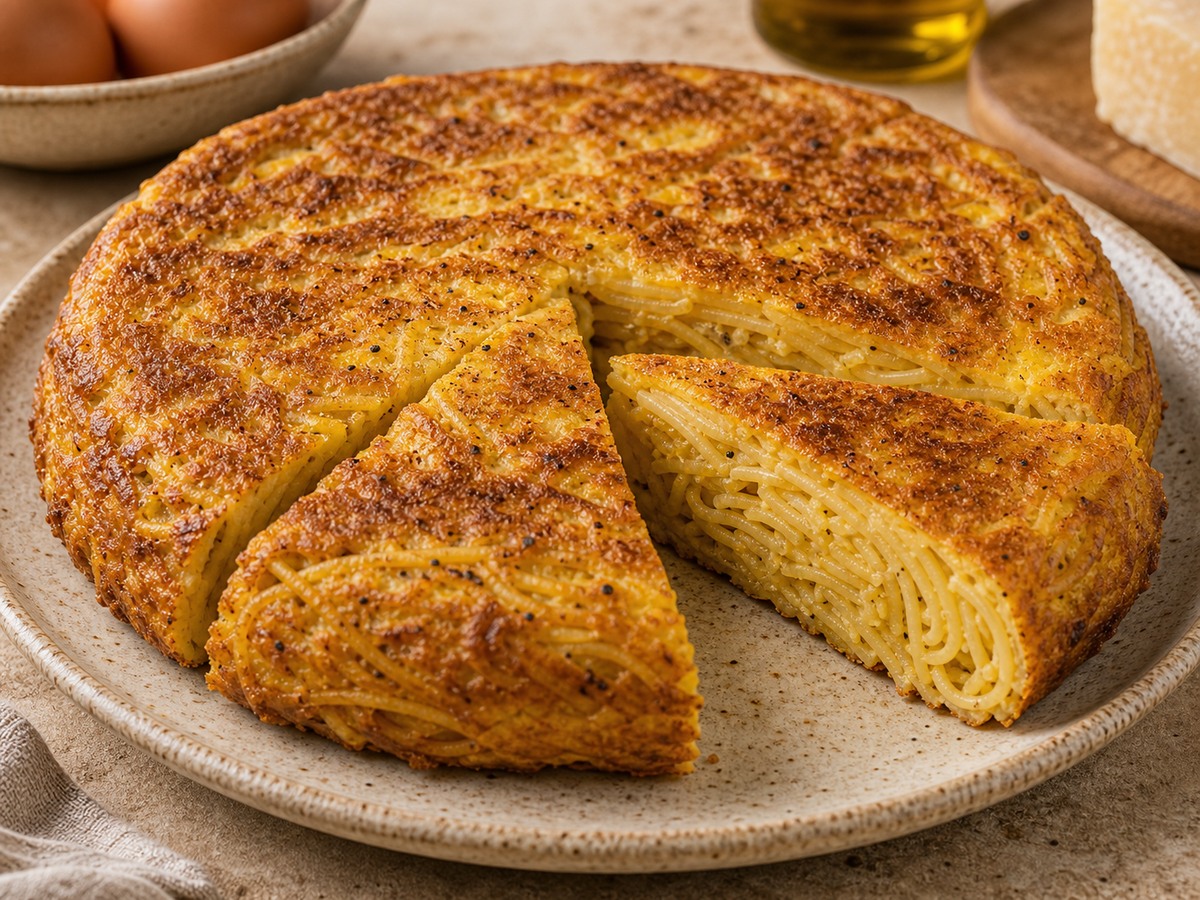
The frittata 'e maccarune — the pasta frittata, in Neapolitan dialect — is one of the great inventions of Campanian cucina povera. It is born from a simple and correct observation: leftover pasta should not be thrown away, because leftover pasta plus eggs plus cheese produces something better than the original pasta and considerably better than whatever you would have made instead. The logic of not wasting food — which was not a trend or a virtue in the Campanian kitchen but simply the way things worked — produced a dish that is now sold in the streets of Naples and at the friggitorie and rosticcerie as a street food, sometimes in the full large frittata form and sometimes as the smaller frittatina di pasta, which is the palm-sized fried version wrapped in paper and eaten standing up. Both are excellent. The home version, made with whatever leftover pasta was in the refrigerator, is the original and in many ways the best.
At home we made it with leftover spaghetti, usually. Nothing added beyond the eggs and the Parmigiano or Pecorino — no ham, no scamorza, no elaborate fillings. The simplest version: pasta, eggs, cheese, salt, pepper, olive oil, and a pan. The result was crispy on both sides, soft and cohesive in the middle, with the cheese melted into the egg and the pasta holding everything together. It was the kind of meal that demonstrated something important about Italian cooking generally — that the same care and skill applied to a Sunday ragù applies equally to a Monday leftover frittata, and that the result of applying that care is always worth eating.
The California story matters because it illustrates something that takes time to understand from inside the experience. When my mother packed the frittata for the road trip, she was not being backward or unaware of the local food options. She knew what food was for — not just for calories, not just for novelty, but for continuity, for comfort in an unfamiliar place, for carrying something of home into the landscape you are moving through. A slice of frittata di pasta eaten by the road somewhere in California, surrounded by a landscape my mother had never seen before and would never see again, was still a recognizable thing, something made from her hands in a kitchen she knew, tasting of what she knew how to make. McDonald's would have been a completely different experience — valid, interesting even — but the frittata was home in a foil parcel. I understand this now. I didn't then.
The frittata is also, separately from all of this, one of the best things you can make for a picnic or a day at the beach or a long drive. It travels without refrigeration for several hours, it improves slightly as it cools and the layers set, it can be eaten with hands, it requires no plates or cutlery, it does not leak, it does not require reheating, and it tastes as good at room temperature as it does warm. There is no better travel food in the Italian repertoire. This is what my mother understood without needing to articulate it. She had been making this for picnics since before there was a concept of travel food.
Egg protein chemistry and what happens when you bind leftover pasta
The frittata di pasta is a straightforward application of egg protein chemistry, but a few things are worth understanding. When eggs are beaten and mixed with cold leftover pasta and cheese, the egg proteins — primarily ovalbumin, ovotransferrin, and lysozyme — surround the pasta strands and the cheese particles in a liquid matrix. During cooking at medium-low heat, these proteins denature and coagulate progressively from the outside in, forming a network that holds the pasta and cheese in suspension and eventually sets into the cohesive, sliceable texture of the finished frittata. The critical technical point is that this coagulation must happen slowly — medium-low heat with a lid for the first side — so that the egg sets throughout without the exterior burning before the interior is cooked. High heat sets the surface too quickly, producing a tough exterior and an undercooked or rubbery interior. The milk added to the egg mixture (a small amount, 2–3 tablespoons) delays coagulation slightly by diluting the protein concentration, producing a softer, more moist interior texture — this is the same principle as adding milk to scrambled eggs. The cheese — Parmigiano, Pecorino, or both — melts into the egg network and provides additional protein and calcium, but its primary contribution is flavor: glutamate from the aged cheese amplifies the overall savory character of the dish in the same way it does in every other preparation in this collection where Parmigiano is used as a finishing or binding ingredient. The frittata's excellent travel properties are a direct consequence of its chemistry: once the egg proteins have fully coagulated and cooled, the structure is stable at room temperature for several hours, the fat from the cheese and the olive oil prevents the surface from drying out, and the pasta provides structural support that prevents the frittata from crumbling when sliced. It is, from a food science perspective, exactly the right format for portable food.
The recipe
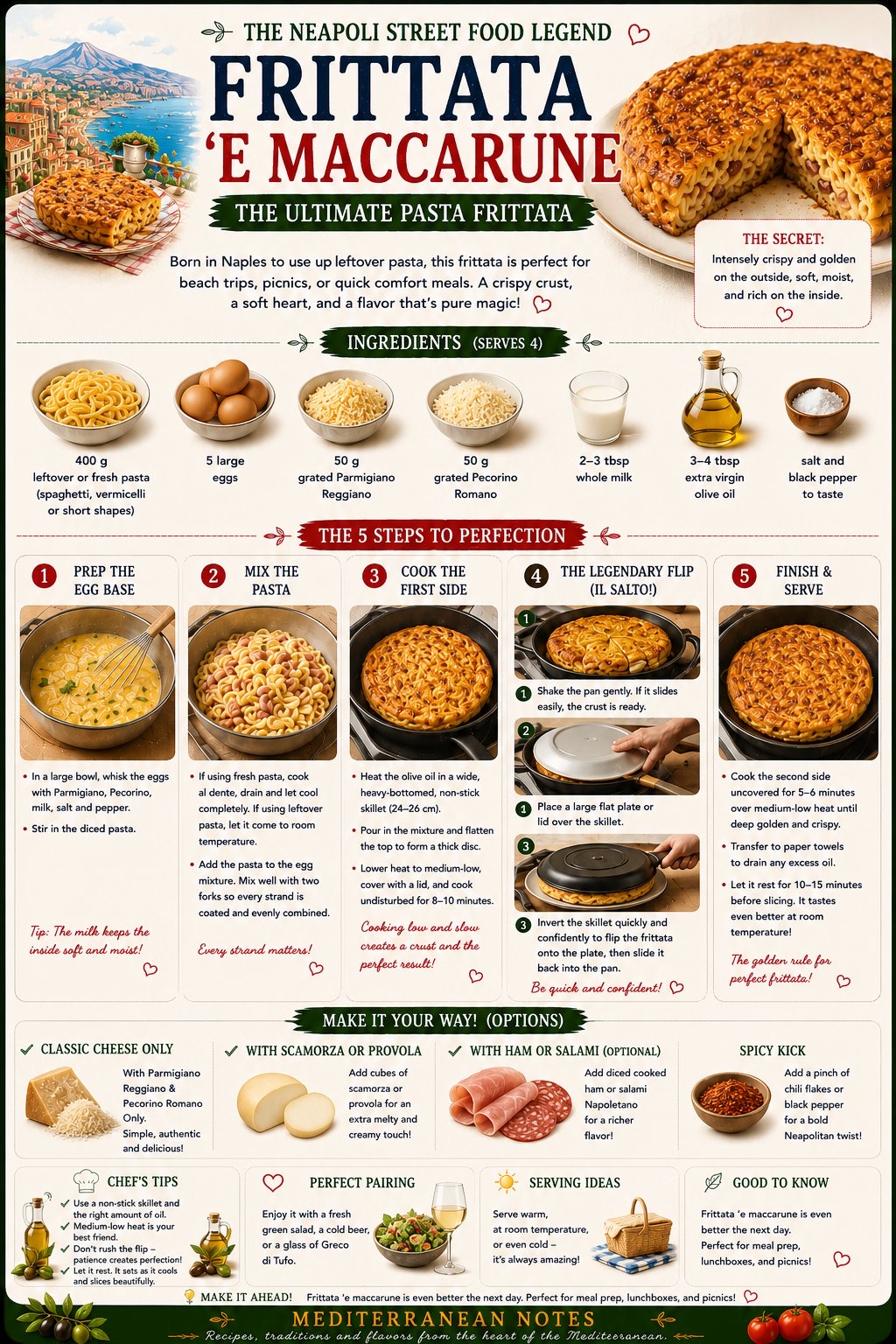
The simplest version — the home version, the leftover version. Spaghetti or vermicelli, eggs, Parmigiano and Pecorino, salt and pepper. Nothing more is required. Serves 4.
Ingredients
Method
Make the egg base. In a large bowl, whisk the eggs with the Parmigiano, Pecorino, milk, salt, and plenty of black pepper until well combined. The mixture should be uniformly yellow and slightly frothy.
The milk is not optional if you want a soft interior. It delays the egg from setting too fast and keeps the center moist rather than dense.
Combine with the pasta. If using fresh pasta, cook al dente, drain, and let cool completely before using. If using leftover pasta — which is the correct and original version — let it come to room temperature. Add the pasta to the egg mixture and mix well with two forks until every strand is coated and evenly distributed. The pasta should not clump.
Cook the first side. Heat the olive oil in a wide, heavy-bottomed non-stick skillet (24–26 cm) over medium heat. Pour in the pasta-egg mixture and press gently to form an even disc. Lower the heat to medium-low, cover with a lid, and cook undisturbed for 8–10 minutes. The surface should look mostly set and the edges should be visibly golden when you lift them with a spatula.
Do not rush this side. Low and slow creates the crust and ensures the interior is cooked before the flip.
The flip — il salto. Shake the pan gently. If the frittata slides freely, the crust is ready. Place a large flat plate or lid over the skillet. In one quick, confident motion, invert the skillet so the frittata falls onto the plate, then slide it back into the pan with the uncooked side down. Be quick and decisive — hesitation produces a broken frittata.
If the flip makes you nervous, an alternative: place the pan under a grill/broiler for 3–4 minutes to set the top without flipping. The result is slightly different but still excellent.
Finish the second side. Cook the second side uncovered over medium-low heat for 5–6 minutes until deep golden and firm. Transfer to a plate lined with paper towels to drain any excess oil. Let it rest for 10–15 minutes before slicing. It is better at room temperature than hot — the structure sets, the flavors consolidate, and it slices cleanly.
Variations — though the simplest is already the best
Classic — cheese only
Parmigiano and Pecorino, nothing else. The home version, the leftover version, the original. The pasta flavor comes through cleanly because there is nothing competing with it. This is what my mother made. This is the one to start with.
Con scamorza o provola
Add cubes of scamorza or provola to the egg-pasta mixture before cooking. They melt into pockets of stretchy cheese distributed through the interior. The Neapolitan version most common in the street-food context, where the melting cheese is part of the appeal.
Con prosciutto cotto o salame
Add diced cooked ham or Neapolitan salami for a richer, more substantial frittata. The version that turns the leftover-pasta dish into something that can serve as a main course at the table rather than a travel snack. Still very simple. Still excellent cold the next day.
La frittatina di pasta
The street-food version: smaller individual frittatas fried in more oil, sometimes coated in batter and deep-fried, sold wrapped in paper at Neapolitan friggitorie. The same preparation in a different format — palm-sized, eaten standing up, with a cold beer or a glass of Greco di Tufo. The rosticceria version of the home classic.
The frittata is better the next day. Make it the night before if you are taking it somewhere — wrap it in foil when completely cold, refrigerate, and bring to room temperature before eating. It slices cleanly, travels without any preparation, and does not require anything alongside it. My mother knew this. She had been making it for road trips before road trips in the American sense were a concept she had encountered. The national parks of California were new to her. The frittata was not.
Buon appetito — e buon viaggio.