Tortano e Casatiello Napoletano
The King of the Easter Table
The same leavened ring, the same filling of salami and provolone and crumbled hard-boiled egg — but one name or the other depending on what you do with the raw eggs before it goes in the oven. And alongside it, always, the casatiello dolce. Easter in Naples meant abundance, and abundance meant both.
The Easter table in a Neapolitan family was not a modest thing. Lent had been forty days — quaresima, the long fast before Easter, with its restrictions on meat and fat and the rich foods that defined normal Campanian cooking. Then Holy Saturday arrived and the kitchen began. By Easter Sunday the table held things that had not appeared since the previous Easter: the tortano or casatiello salato, the casatiello dolce, the pizza rustica, eggs in various forms, cured meats that had been put aside. It was not abundance for its own sake. It was abundance after scarcity, which is a different thing — you tasted the forty days in every bite.
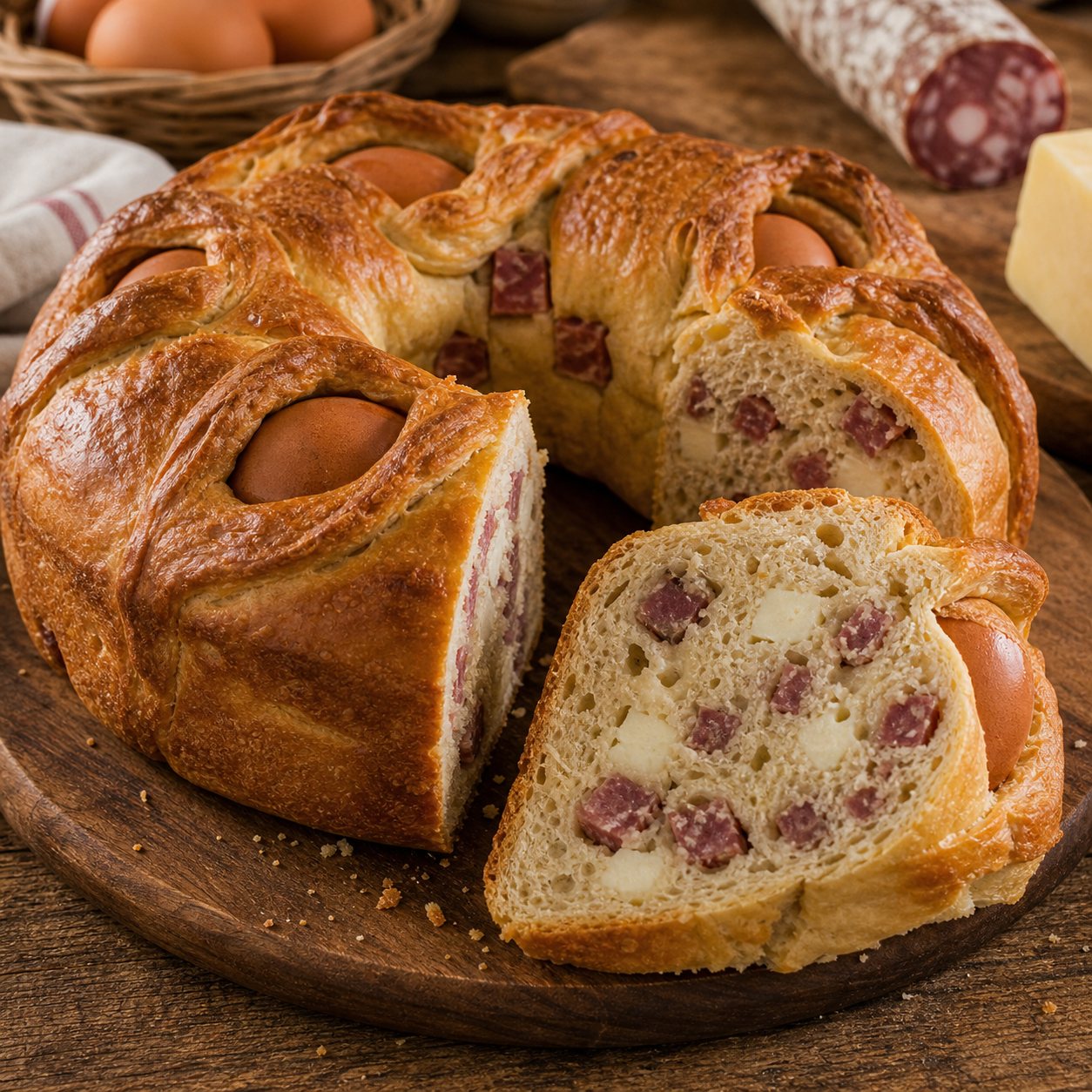
The tortano is a large savory ring — a ciambellone salato — made with a leavened dough based on flour, water, yeast, and lard. The lard is not optional and not replaceable with butter or olive oil without changing the character of the bread: strutto — in Neapolitan dialect, 'nzogna — gives the dough a particular softness and a faint savory depth that you do not get from other fats. The filling goes inside the rolled dough before it is shaped: cubed salami, pancetta, sharp provolone, Pecorino Romano, and hard-boiled eggs crumbled or sliced through the mixture. You roll the dough tight around all of it, seal the ring, let it rise a second time, and bake it long and slow until the crust is deep brown and the kitchen smells of everything that is inside it.
Tortano or Casatiello? — the one rule that separates them
The dough is identical. The filling is identical. The difference is what happens before the second rise: if the hard-boiled eggs stay inside the dough mixed through the filling, the ring is called tortano. If instead you press whole raw eggs into the surface of the shaped ring and hold each one in place with two thin strips of dough crossed over it — like a small cage — before the final rise and baking, it becomes casatiello. The eggs bake in their shells and set inside their cross of dough. The crosses are not decoration; they are structural. The symbolism — the egg as rebirth, the cross as Easter — is built directly into the form of the bread. One decision at the shaping stage, two names, centuries of tradition.
My memory of Easter morning in Caserta is inseparable from both of these breads on the table at the same time — the salato and the dolce side by side. The casatiello dolce is a completely separate preparation despite sharing the name: a sweet leavened cake enriched with eggs, sugar, and often a citrus flavoring, tall and soft, somewhere between a brioche and a colomba in texture. It is the sweet counterpart to the savory ring, and the two together on the Easter table formed a kind of symmetry — fat and rich, salt and sweet, the same festive abundance expressed in opposite directions.
The casatiello dolce was lighter but no less serious. It took patience to make — the dough needed long rises, the kitchen had to be warm, you couldn't rush it. When it came out of the oven tall and golden it meant Easter had actually arrived.
The theological logic behind the Easter table is straightforward and ancient: Lent restricted fats, meats, eggs, and dairy — precisely the ingredients that define Campanian festive cooking. Breaking the fast with foods that are dense with those exact things is not coincidental. The casatiello salato is practically a catalog of prohibited Lenten ingredients compressed into a single ring: lard in the dough, cured pork inside, eggs throughout, sharp aged cheese. Eating it on Easter Sunday was the point. The richness was the message.
I have not made either of these at home in Massachusetts, partly because they require a full day of work and the right kind of attention to leavening that is hard to give on a weekday, and partly because they are things I associate so specifically with that table in Caserta that making them elsewhere feels like a partial approximation. But I think about them every Easter. The smell of the tortano baking — lard and pepper and provolone coming through a closed oven door — is one of those smells that is stored somewhere more permanent than ordinary memory.
Why lard makes a better Easter bread — and what Lent did to the body's metabolism
Strutto — rendered pork lard — has a higher fat content and a different fatty acid profile than butter: it is richer in monounsaturated fats (primarily oleic acid, the same fat that dominates olive oil) and has a higher smoke point, which means it remains stable through the long baking time the tortano requires. In the dough, lard coats the gluten strands differently from butter, producing a more tender, slightly flakier crumb that also stays soft longer after baking. This was practically important for a bread meant to last several days across the Easter holiday. The lard is not a shortcut or a cheaper substitute for butter; it is the correct fat for this specific bread and produces a result that butter cannot replicate.
The Lenten fast has a metabolic dimension that is worth noting. Forty days of restricted fat and animal protein — the traditional quaresima observance — produces measurable changes in lipid metabolism: lower circulating triglycerides, shifts in LDL particle distribution, and in some cases reduced inflammatory markers. Breaking this fast suddenly with a meal extremely rich in saturated fat, cholesterol from eggs, and cured meats would produce a pronounced metabolic response — elevated postprandial lipemia, a sharp rise in circulating chylomicrons as the gut processes the unaccustomed fat load. This is not an argument against eating casatiello. It is an observation that the body registers the end of Lent as clearly as the calendar does. The feast was designed to be felt.
The recipe — Tortano (ring mold 28–30 cm)
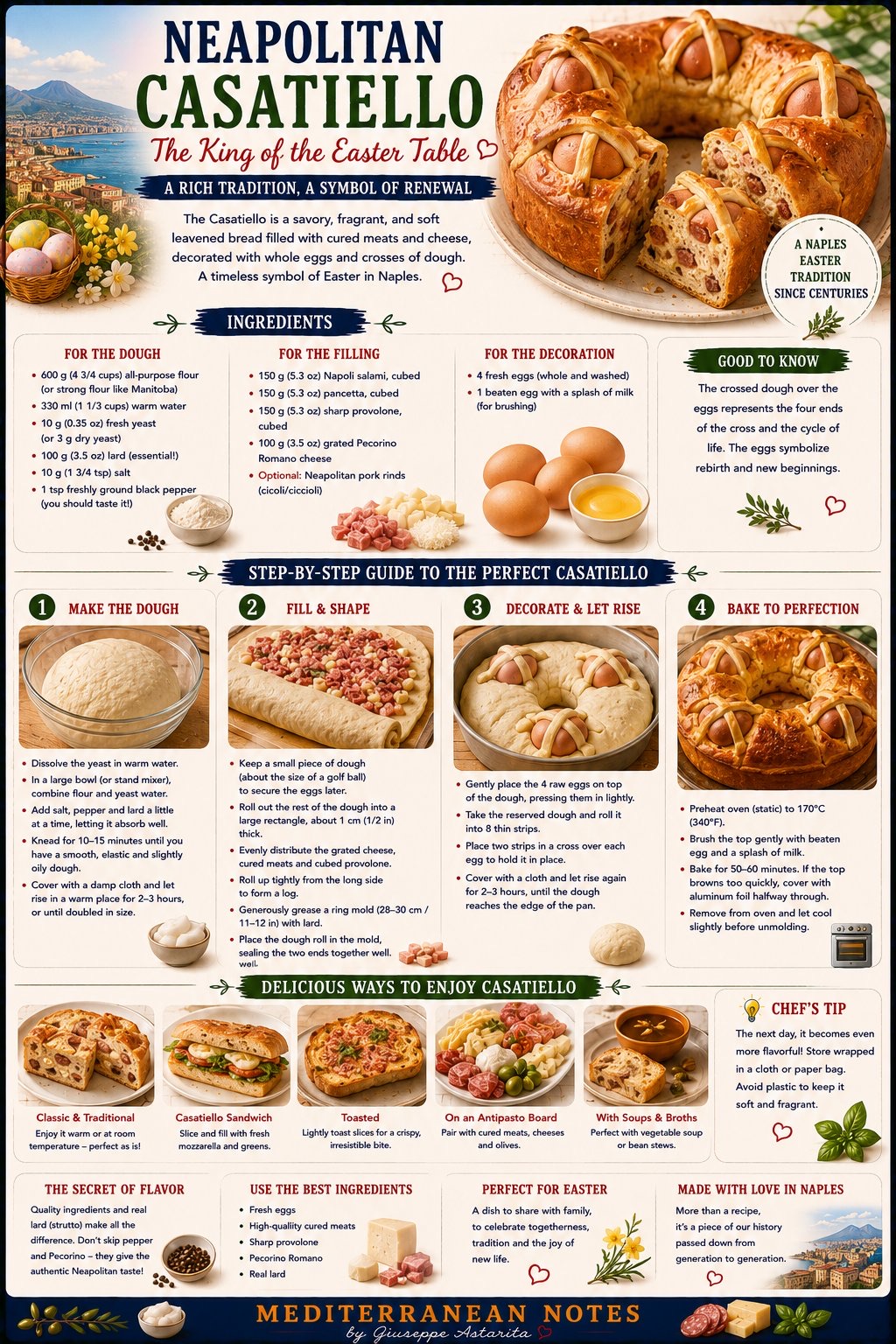
Casatiello napoletano — il re della tavola di Pasqua. Click to enlarge.
For the dough
600 g
All-purpose flour (00 or strong flour)
330 ml, warm
Water
10 g fresh / 3 g dry
Yeast
100 g — essential
Lard (strutto)
10 g
Salt
generously
Freshly ground black pepper
For the filling
150 g
Napoli salami, diced
150 g
Pancetta, diced
150 g
Sharp provolone, diced
100 g
Pecorino Romano, grated
4, hard-boiled
Eggs, roughly crumbled or sliced
For casatiello only — decoration
4, raw and washed
Whole eggs (pressed into the surface before the final rise)
1
Dissolve the yeast in the warm water. In a large bowl or stand mixer, combine flour and yeast water. Add the lard a little at a time, letting it absorb between additions. Add the salt and a generous amount of black pepper. Knead for 10–15 minutes until the dough is smooth, elastic, and slightly tacky. Cover with a damp cloth and leave to rise in a warm place for 2–3 hours, until doubled.
The dough should feel soft and slightly oily from the lard. Do not add more flour to compensate — the stickiness disappears as the gluten develops. A warm kitchen (24–26°C) speeds the rise significantly; a cold one slows it. Both work; just adjust the time.
2
Once risen, punch down and roll out on a floured surface to a large rectangle about 1 cm thick. Distribute the grated Pecorino evenly across the surface, then scatter the diced salami, pancetta, and provolone. If making tortano, add the crumbled hard-boiled eggs now. Season with more black pepper. Roll up tightly from the long side into a cylinder, keeping the filling inside.
3
Grease a ring mold (28–30 cm) generously with lard. Place the roll in the mold and join the two ends together, sealing them well. If making
casatiello: press 4 whole raw eggs into the top of the ring at even intervals, and place two thin strips of reserved dough in a cross over each egg to hold it in place. Cover with a cloth and let rise again for 2–3 hours until the dough reaches the rim of the pan.
The second rise is as important as the first. A casatiello that has not fully proofed before baking will be dense and heavy. Be patient. It is ready when the dough is visibly puffed and fills the mold to the top.
4
Brush the top with beaten egg and a splash of milk. Bake in a preheated static oven at 170°C (340°F) for 50–60 minutes. If the top browns too quickly, cover loosely with foil halfway through. The casatiello is done when it is deep golden all over and a skewer inserted into the dough (not the filling) comes out clean. Cool slightly in the mold before unmolding.
It is better the next day. Wrap in a cloth — not plastic — and store at room temperature. The lard in the dough keeps it soft for several days, and the filling intensifies overnight.
On the casatiello dolce — the sweet ring
The casatiello dolce shares nothing with the salato except the name and the leavened ring format. It is a sweet, enriched dough — eggs, sugar, butter or lard, sometimes flavored with citrus zest or anise liqueur — baked tall in a cylindrical mold. The texture sits between a brioche and a panettone: soft, pull-apart, fragrant. It requires even more patience than the salato, with long cold rises that develop flavor over twelve to twenty-four hours. On the Easter table it sat beside the casatiello salato as its mirror image — the same festive abundance, the other direction. Both were necessary. Neither was optional.
Variations and the question of what goes inside
With ciccioli — pork rinds
Some Neapolitan families add ciccioli — the crispy rendered remains of the pork fat after making lard — directly into the filling. They add texture and concentrated pork flavor. If you can find them at an Italian butcher, they are worth including. They were a traditional addition in households where the lard was made at home.
With caciocavallo
Substituting some or all of the provolone with aged caciocavallo gives a sharper, nuttier flavor to the filling. The combination of caciocavallo and Pecorino Romano — both sharp, both aged — makes a more pungent casatiello than the milder provolone version. Both are traditional depending on the family and the province.
The Easter picnic version
The tortano travels as well as the
pizza rustica and is similarly good cold. Sliced the day after baking, packed in cloth, it holds its structure and actually improves in flavor. The Easter Monday picnic — Pasquetta — was a fixture in Campanian family life, and the casatiello salato was always part of what you brought.
The naming by region
Within Naples and the province, which version gets which name can vary by neighborhood and by family. Some use tortano and casatiello interchangeably for the salato version regardless of whether the eggs are inside or on top. The distinction described here is the strict one — but do not argue with a Neapolitan grandmother about what her version is called. She is right.
Easter in Caserta meant the end of something and the beginning of something else, and the table expressed it without needing to say so. The quaresima was over. The kitchen had been working since the day before. Everything that had been set aside for forty days came back at once, richer for the waiting.
Buona Pasqua — e buona abbondanza.