Parmigiana di melanzane: ready for Sunday dinner, better the next day
The parmigiana was always made in the morning. After an abundant Sunday lunch with pasta and meat and everything else, nobody wanted to cook again in the evening — and nobody had to. The parmigiana was already there, at room temperature, waiting. Meglio il giorno dopo. Better the next day. This is always true.
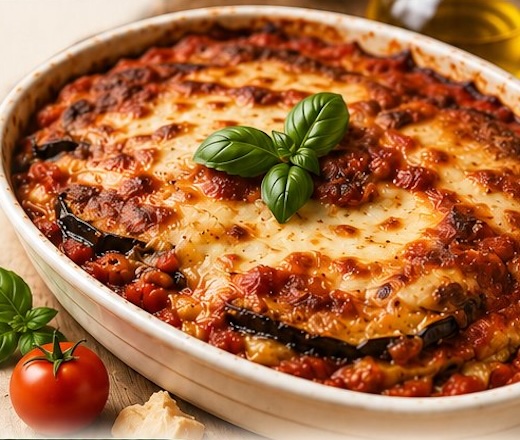
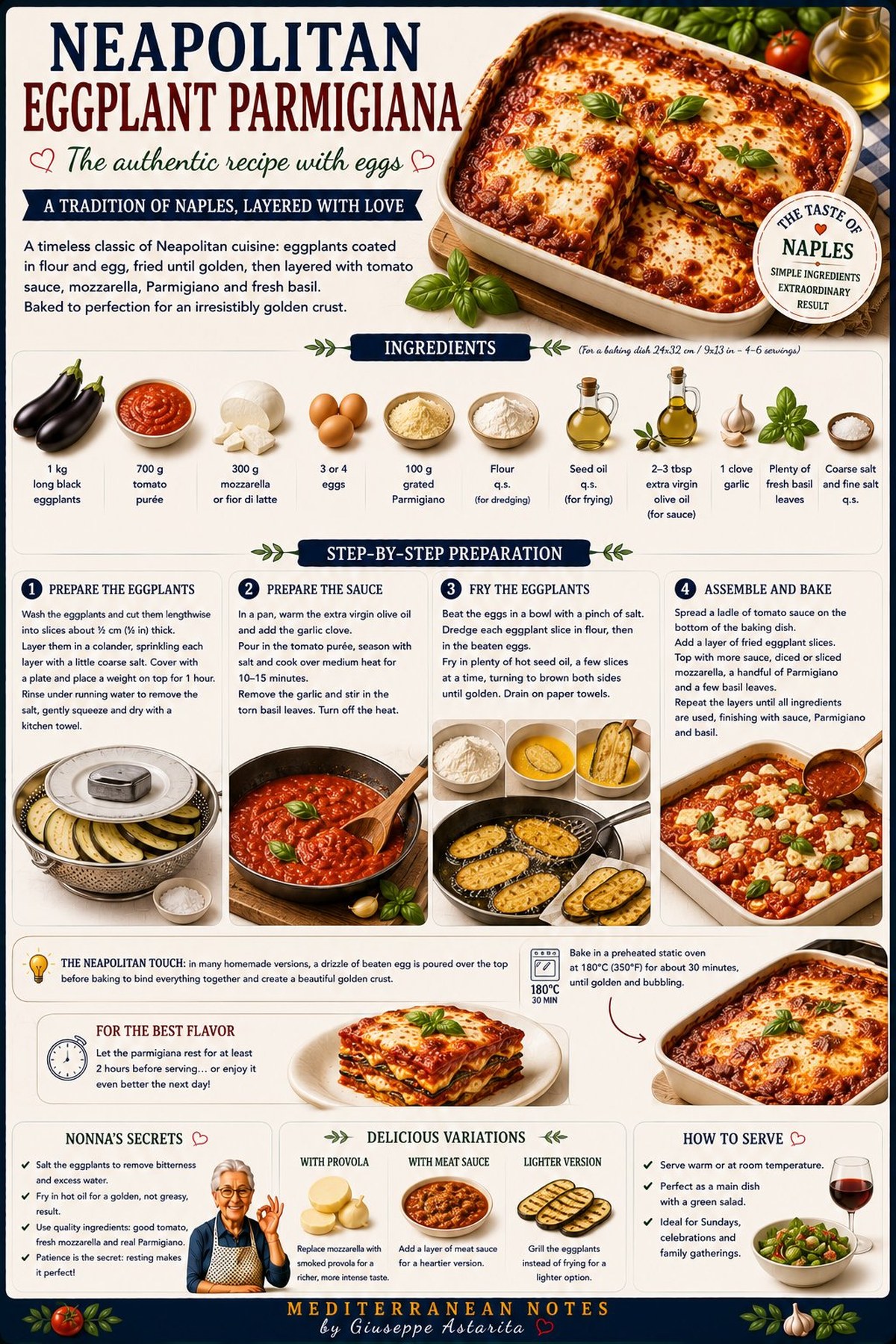
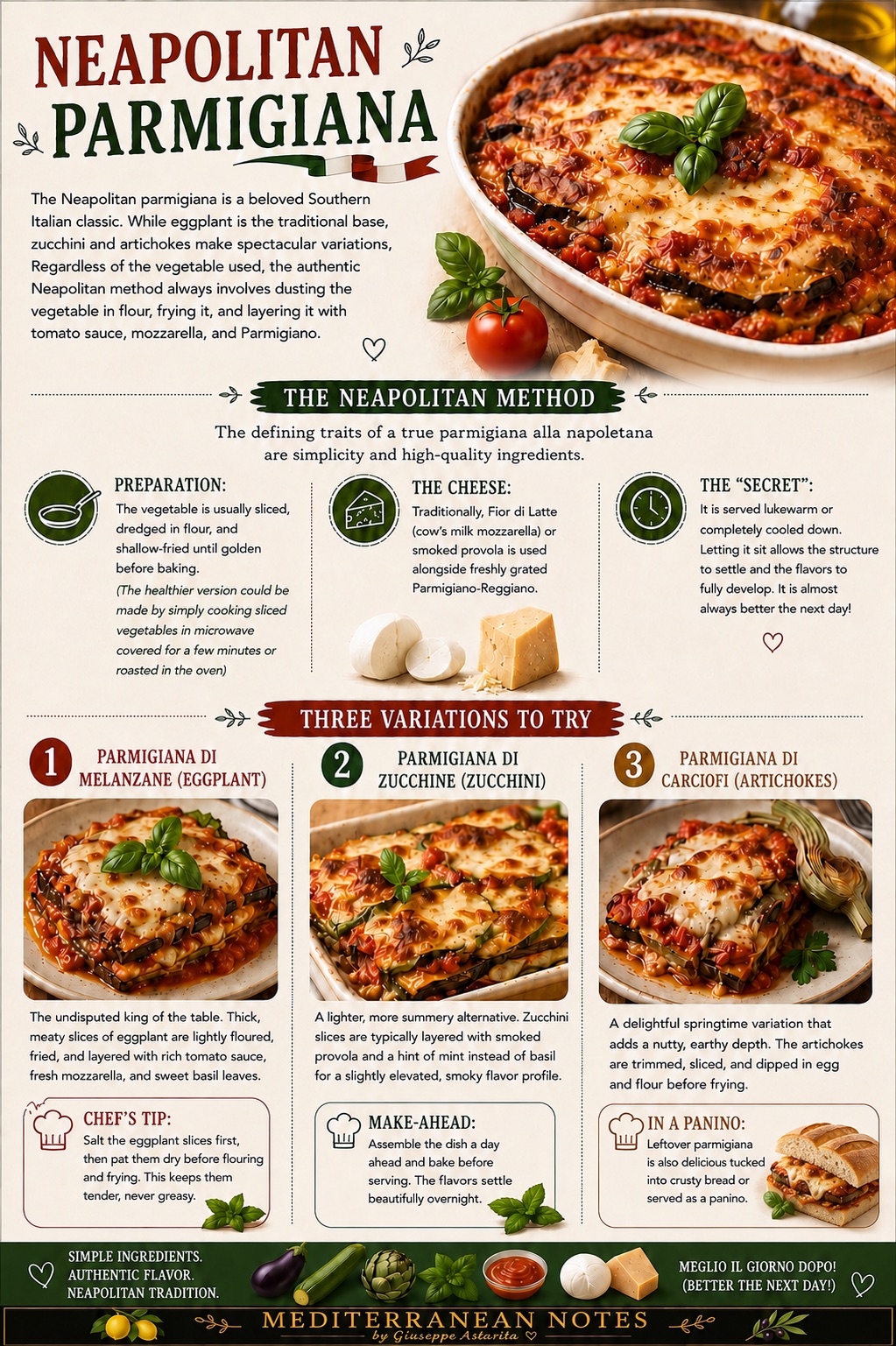
The parmigiana di melanzane is one of those dishes that belongs to the Italian table so completely that arguing about its origin — Campania versus Sicily versus Calabria, each with a compelling historical claim — misses the point. It is everywhere in southern Italy, made differently in every household in details that matter enormously to the household in question, and recognizable everywhere as the same dish. In Naples, the definitive version uses eggplant sliced lengthwise, floured, fried until golden, layered with a simple tomato sauce, fior di latte or Parmigiano, and fresh basil — baked until the layers settle and the top is golden and slightly charred at the edges. No béchamel. No breadcrumbs. No complication.
The Sunday timing is its own tradition — as specific as the meal structure itself. You make the parmigiana in the morning, while the ragù is also on the stove, while the kitchen is in its productive weekend mode. By the time Sunday lunch is finished — pasta first, then meat, then the long table and the talking — the parmigiana has been sitting for several hours and has become something better than it was when it came out of the oven. The layers have compressed. The tomato sauce has settled into the eggplant. The cheese has set. You slice it cleanly and eat it at room temperature for dinner, and it requires nothing from the kitchen except a serving dish.
My mother made three parmigianas on rotation — eggplant, zucchini, and artichoke — depending on the season and what the market had. Not the same one every Sunday. Artichokes in spring. Zucchini through the summer. Eggplant most of the year, the one she returned to most often because it kept the best and the eggplant was always available. All three made Sunday morning, all three served Sunday dinner — never at lunch. Sunday lunch was for the ragù and the pasta and the meat; the parmigiana was the lighter evening meal, already assembled and rested for hours by the time it was needed. And Monday morning — the leftover, between two thick slices of pane casareccio or pane cafone. Not a sandwich with anything else inside. Just the parmigiana cold in the bread, eaten before school or work — my father's "mettitelo tra due fette di pane" made flesh. This was, without negotiation, the best version. My mother knew this and made enough deliberately.
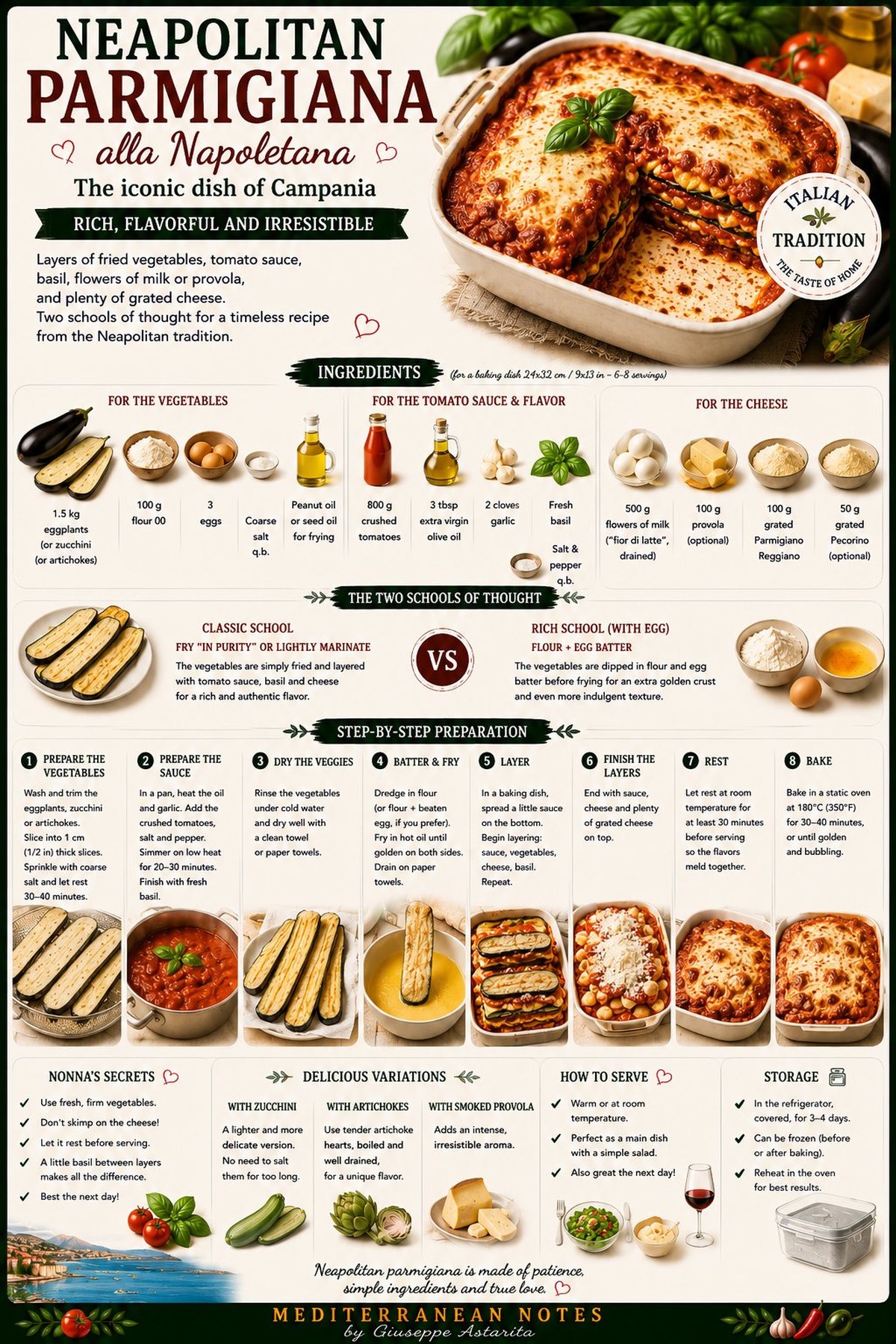
The traditional Neapolitan preparation — my mother's version, and the version that belongs to the Sunday table — dips the floured eggplant slices in beaten egg before frying. This is the indorare e friggere method: flour first, then beaten egg, then hot seed oil. The egg coat creates a more substantial crust with a richer, denser texture that holds up through the long bake and improves further overnight. This is the version you want for the Sunday parmigiana, for the panino the next morning, for any occasion where it matters. The lighter version — floured and fried without egg — is valid and produces something more delicate, appropriate for summer or when you want less richness. The microwave and air-fryer alternatives — detailed in the methods below — are genuinely useful for weeknights. But the egg version is the original, and it is the best.
Eggplant oil absorption — how cooking temperature changes how much fat it takes on
Eggplant absorbs a remarkable amount of oil in the pan — a single large one can take on 80–150 ml depending on slice thickness and oil temperature. That oil is olive oil, with its oleic acid and phenolic antioxidants, but it changes the caloric density of the dish substantially; the microwave and air-fryer methods absorb a fraction of it, which is why those versions genuinely taste lighter. Pre-salting helps in every method: it draws out water, reducing oil uptake when frying and improving texture otherwise.
The rest of the dish earns its keep too: the tomato layers deliver lycopene, whose bioavailability is highest when cooked with fat — which the oil and cheese provide in abundance — and the skin, kept on by the lengthwise cut, carries nasunin, the same anthocyanin discussed in the melanzane sott'olio post. And the overnight rest is chemistry, not superstition: Maillard products formed on the fried surfaces diffuse slowly into the surrounding layers, which is why the next-day parmigiana tastes deeper than the fresh one. Meglio il giorno dopo has a mechanism.
The recipe
Ingredients · serves 6
The eggplant
The layers
Three methods for the eggplant
The egg-and-flour method is the traditional one — the one that produces the best result for the Sunday parmigiana and the Monday panino. The other two are genuine alternatives for lighter occasions or weeknight cooking.
The traditional
Floured and fried in oil
Salt and drain the slices for 30–60 minutes. Pat dry. Dredge in flour (shake off excess), dip in beaten egg (traditional version), and fry in hot olive oil until golden on both sides. Drain on paper towels. The richest result — the proper crust, the texture that defines the classic parmigiana.
The lighter
Air fryer
Salt and drain. Pat dry. Brush lightly with olive oil on both sides. Air fry at 200°C for 10–12 minutes, turning once, until golden and dry on the surface. No immersion in oil — substantially lighter, still with a surface that layers well. The closest to the fried version without frying.
The quickest
Microwave steam
Salt and drain briefly. Arrange in a single layer on a microwave-safe dish, cover, and cook on high for 4–5 minutes until soft and slightly collapsed. No oil required at this stage. The slices will be soft rather than golden — a genuinely different texture, but they layer well and the finished parmigiana is light and still excellent.
Assembly and baking
Prepare the tomato sauce. Sauté a clove of garlic in olive oil, add 500 ml of good passata, a few basil leaves, salt. Simmer 15 minutes. Simple. The sauce should be loose — it will thicken in the oven.
Layer the parmigiana. In a deep baking dish, spread a thin layer of tomato sauce on the base. Add the first layer of eggplant slices, slightly overlapping. Spoon sauce over, scatter slices of fior di latte, torn basil, and a generous dusting of Parmigiano. Repeat — eggplant, sauce, fior di latte, basil, Parmigiano — until all the eggplant is used. Finish with sauce, fior di latte, and an abundant final layer of Parmigiano for the golden crust.
Drain the fior di latte overnight in a colander. Wet mozzarella releases liquid during baking and makes the parmigiana waterlogged. This step matters.
Bake. Preheat oven to 180°C (350°F). Bake uncovered for 35–40 minutes, until the top is deep golden and the edges are bubbling. Let rest for at least 20–30 minutes before cutting — the layers need to set, and the parmigiana is served lukewarm or at room temperature, not hot. Cut with a sharp knife in clean downward motions.
Meglio il giorno dopo. If you can make it the morning or the evening before, do. The flavors consolidate overnight and the layers compress into something more unified than the freshly baked version. Refrigerate covered, bring back to room temperature before serving.
The three Neapolitan parmigianas
Di melanzane — eggplant
The original and the undisputed king. Meaty, rich, deeply flavored — the eggplant absorbs the tomato and cheese and becomes something entirely its own. The one made for Sunday dinner, the one that defines the word parmigiana in Campanian cooking.
A lighter summer version. Zucchini sliced lengthwise, salted, dried, and treated the same way. The flavor is more delicate — sometimes smoked provola is used instead of fior di latte, and mint replaces basil, for a version that is distinctly its own rather than a lesser eggplant substitute.
A springtime version, more elaborate. Artichoke hearts trimmed and sliced thin, dipped in egg and flour and fried. Earthy and slightly bitter where the eggplant is sweet and rich — a completely different character, appropriate for when artichokes are in season and at their best.
With smoked provola
Substituting all or part of the fior di latte with smoked provola — or smoked scamorza — adds a layer of smokiness that changes the profile of the dish substantially. Particularly good in the zucchini version. The smoked cheese also melts differently, producing a denser, more cohesive layer.
Buon appetito — e meglio il giorno dopo.