Ogni Famiglia Ha la Sua Ricetta
Every Family Has the Real Recipe. And Every Other Family Is Wrong.
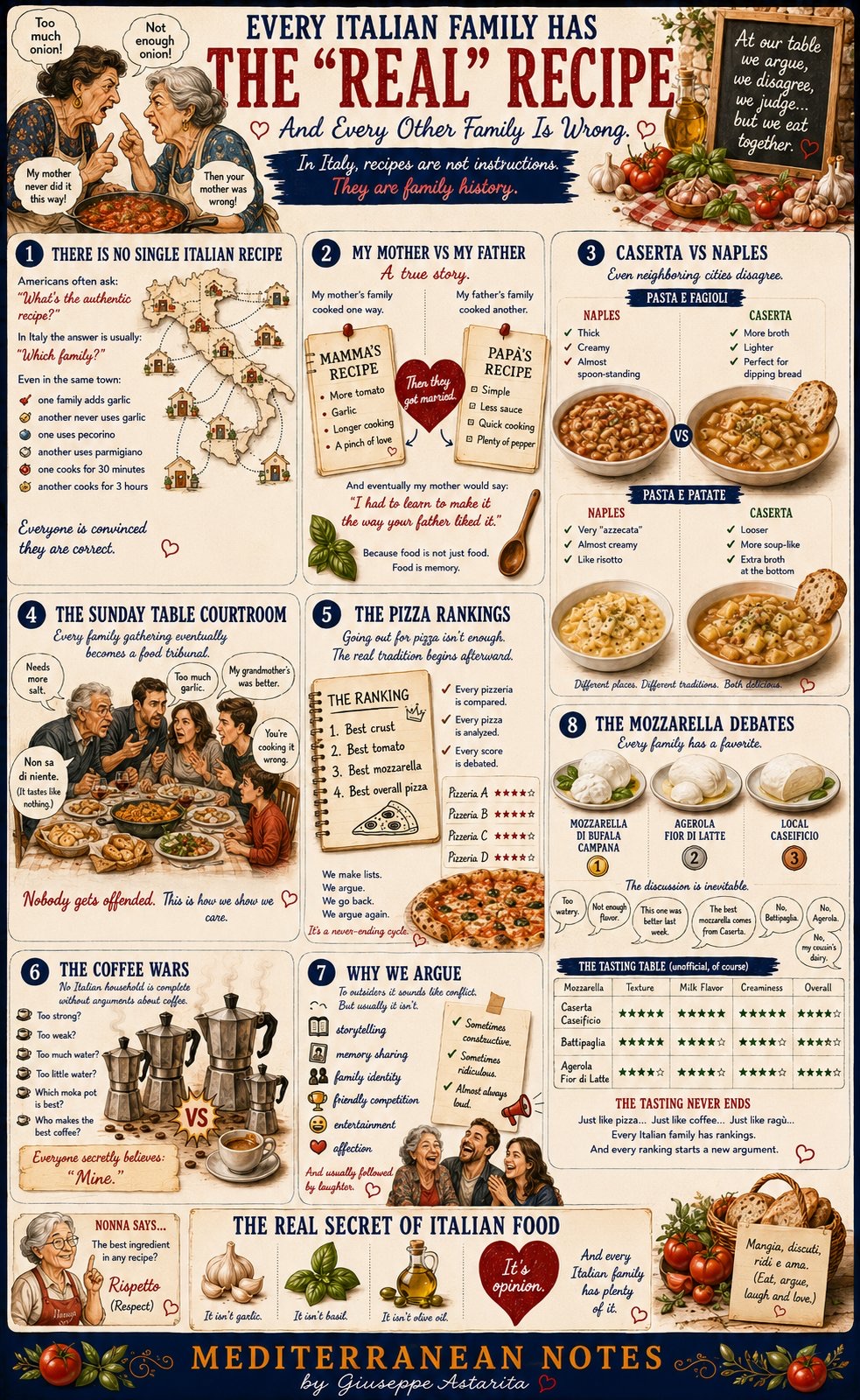
In Italy, recipes are not instructions. They are family history. My mother's family cooked one way. My father's family cooked another. When they got married, my mother said she had to learn to make things the way my father liked them. That sentence explains a great deal.
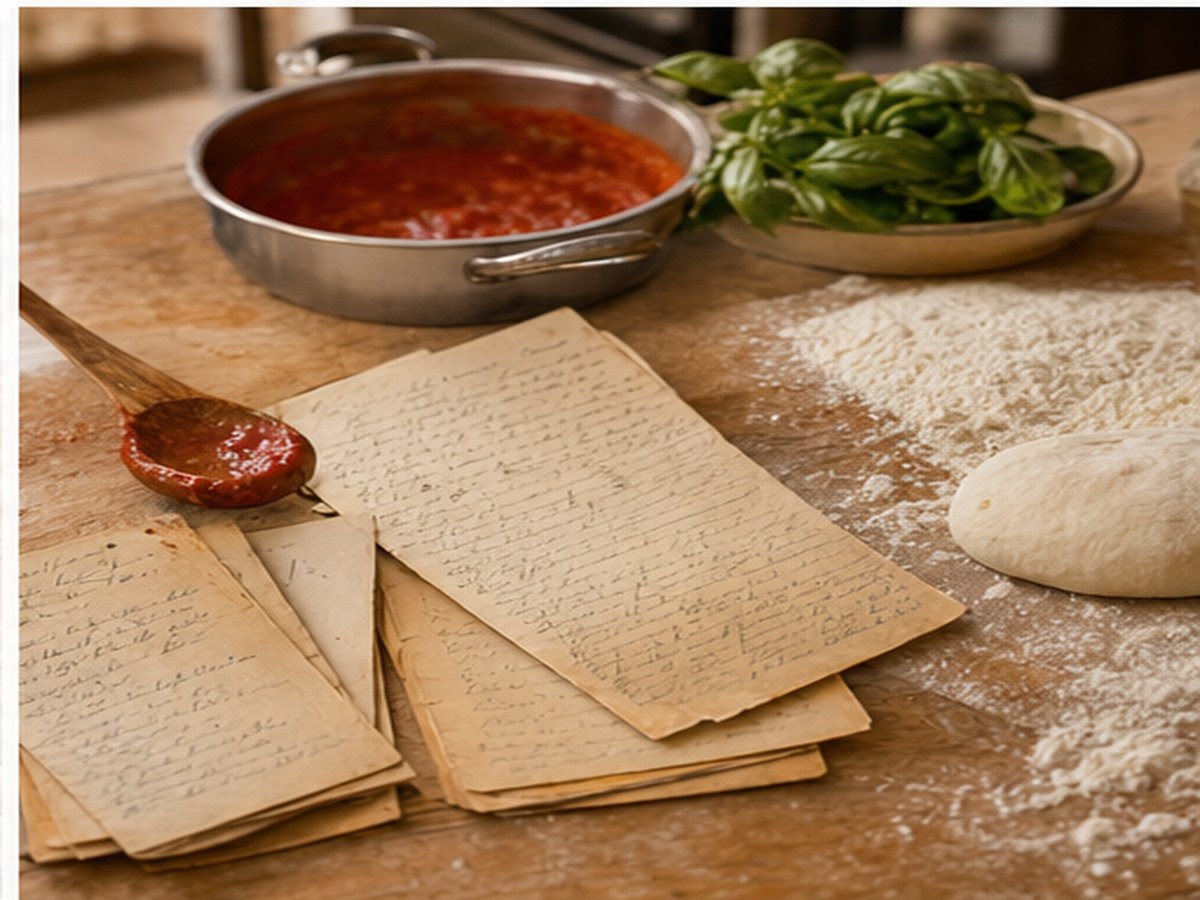
If you ask an Italian what the authentic recipe for a dish is, the answer is almost never a list of ingredients. It is a question: which family? Even in the same town, on the same street, the ragù napoletano made in one apartment differs from the one made three floors above it — one uses more tomato, one cooks it longer, one adds a pinch of sugar, one would consider sugar an offense. Everyone is convinced their version is correct. Everyone has a reason. And the reason is almost always the same: this is how my mother made it, or my grandmother, or the aunt who was considered the best cook in the family.
My mother's family and my father's family came from different parts of the Campanian culinary tradition, and when they married those traditions had to negotiate. My mother's instinct was toward denser, more concentrated preparations — the pasta e patate more azzeccata, the sauces slower and thicker. My father's family made things lighter, with more broth, simpler in texture. My mother learned to make certain dishes the way my father's family liked them — and eventually that became the version we ate at home. She said it matter-of-factly, without resentment. This is how kitchens work when two families combine: one tradition adapts to the other, or more precisely, the two traditions find the version that makes the table work. The result is never exactly either original. It is a third thing.
This is worth understanding before reading any recipe on this blog, because every dish described here comes from that specific kitchen — my mother's adaptation of her own tradition toward my father's preferences, filtered through what was available in Caserta in those decades, shaped by the aunts and grandmothers whose versions were the benchmarks against which everything was measured. When I write that a sauce should simmer for two hours, or that the potatoes go into the pot with the chicken, or that the pasta e fagioli in Caserta has more broth than the Neapolitan version — these are not universal rules. They are descriptions of how it was done in one specific set of kitchens in one specific city. Other families in the same city did it differently. Both are correct.
Caserta is not Naples. It is about thirty kilometers north of Naples, in the province of the same name, and the cooking there shares the same foundations — tomatoes, olive oil, pasta, the same vocabulary of ingredients — but the proportions and the textures differ in ways that matter to anyone who grew up with one version and encounters the other. The differences are not large enough to constitute separate cuisines. They are exactly large enough to produce an argument.
A Neapolitan eating the Caserta pasta e fagioli might say it is too watery. A Casertano eating the Neapolitan version might say it has too little broth to eat comfortably with bread. Both observations are accurate from within their own reference point. The argument that follows is not really about the dish. It is about which table is home.
When we went out for pizza in Naples or Caserta, we ranked. This was not casual. Each pizzeria was evaluated on crust, tomato, mozzarella, and overall execution. Notes were compared. Scores were debated. A pizzeria that had been excellent on the previous visit might be demoted if something had changed — the mozzarella seemed different, the crust was less charred, the cornicione was too thick or not thick enough. The list was updated after each visit and the rankings were never considered final. There was always the possibility that somewhere better existed and had not yet been found.
The debate at the table during and after eating was loud and specific. Troppo sale or non c'è abbastanza sale — too much or not enough salt — were the most common criticisms. The mozzarella was too watery, the tomato too acidic, the base burned underneath — a sign, someone would always say, that they had not swept the oven floor properly, il forno sporco. Or the opposite fault: left in too long, the mozzarella bruciata, scorched brown and oily across the top. Nobody was unkind to the staff. The conversation was entirely among ourselves, entirely about the food, and entirely serious. This was how we showed we cared about what we were eating.
The thing being judged has changed shape since then. What is served now as pizza contemporanea has a cornicione puffed so high and so hollow that we call it a canotto — a rubber dinghy — and the disc in the middle has shrunk in proportion, so the whole pizza arrives looking smaller than the ones I grew up with. The old shape needed no name when it was the only shape; now it has one. A pizza spread wide and thin, edge to edge, the rim low and the base reaching past the plate, is called a ruota di carro — like a cartwheel. Which of the two is better is exactly the kind of question the table was built for, and it has kept the ranking arguments going into another generation.
The mozzarella debate follows a fixed structure. First, the agreement that mozzarella di bufala Campana DOP is the correct reference point — this much is settled. Then the disagreement begins: which caseificio makes the best one? Caserta, Battipaglia, Aversa, a specific small producer someone's cousin knows? The answer changes depending on who is speaking and when they last visited. Every family has a preferred source and a reason for preferring it, and the reason is usually a combination of genuine quality assessment and the simple fact that it is the mozzarella they grew up eating, which makes all other mozzarella taste slightly wrong by comparison.
What is consistent across all versions of this argument is the standard: freshness above everything else. A mozzarella eaten warm at the caseificio on the day it was made is the benchmark. Everything is measured against that. The mozzarella in the supermarket three days after production is a different object. Both carry the same name. Only one is what the argument is actually about. See the mozzarella di bufala post for the full account.
Coffee arguments in a Campanian household concern: the moka pot versus the bar espresso; which moka pot is best; how much water; how much coffee; whether the coffee should be packed tightly or loosely in the filter; whether the flame should be high or low; which brand; whether the coffee at home is better or worse than the bar downstairs. These are not abstract questions. Every person in the household has a position and the position was formed early and does not change. My father had his way of making coffee. My mother had hers. I grew up understanding that both were correct in their own estimation and that agreeing with one meant implicitly criticizing the other. The safest position, which I eventually adopted, is to say the coffee is good and mean it — because in a house where people care this much about making it, it always is.
It would be easy to read all this judgment as pointing outward — at the pizzeria, at the other family's ragù, at whoever made the coffee. It does not. The most critical audience for anything cooked in a Campanian kitchen is the person who cooked it. My mother would carry a dish to the table, sit down, taste it before anyone else had lifted a fork, and deliver the verdict herself: something was missing, the salt was short, it had not come out the way it did last time. Nobody needed to say it. She had already said it.
Non sa di niente — it tastes of nothing — is the phrase kept for that moment. It is not aimed at bad cooking; bad cooking has obvious faults you can name and fix. It is aimed at food that is technically correct and still empty: right ingredients, right method, no flavor, nothing behind it. It is the harshest thing that can be said about a plate, and we say it most readily about our own. Being able to taste that absence in something you made with your own hands, and admit it out loud at your own table, is the same instinct that makes all the other arguments worth having.
Nobody got up and left. Nobody stopped eating. The argument was usually followed by someone taking a second portion, which was the real verdict. At our table we argued, we disagreed, we judged — and we ate together. That order of events is the key to understanding everything else.
What this means for the recipes on this blog
Every recipe on this blog is one version — the version that was made in my family's kitchen in Caserta, shaped by my mother's tradition and my father's preferences and whatever negotiations happened between the two over the years I was present at that table. It is not the only correct version. The ragù napoletano made in the apartment three streets away was probably different in some detail that mattered to the people who made it. The pasta e fagioli in Naples has less broth than mine. The mozzarella ranking depends entirely on which caseificio you grew up visiting.
I describe these recipes as specifically as I can because specificity is where the memory lives — not in "a tomato sauce" but in two hours of pappuliare on the lowest flame, with the lid propped open and the smell already in the hallway by ten in the morning. The general version of a dish is available everywhere. What is available only here is the particular version that was made in those particular kitchens, by those particular people, for those specific reasons. If your family made it differently, your family is also correct. The argument is part of the point.
The posts on this blog — a reading guide
Each of these posts is one family's version of a dish. Read them in any order. Disagree with any detail. That is the correct response.
Mangia, discuti, ridi e ama.