Il Pane nel Sugo
A Sunday Ritual, a Taste of Home
Not a recipe. A ritual. While the sauce simmered on Sunday morning and the kitchen filled with the smell of it, someone — always — cut a piece of bread and went straight to the pot.
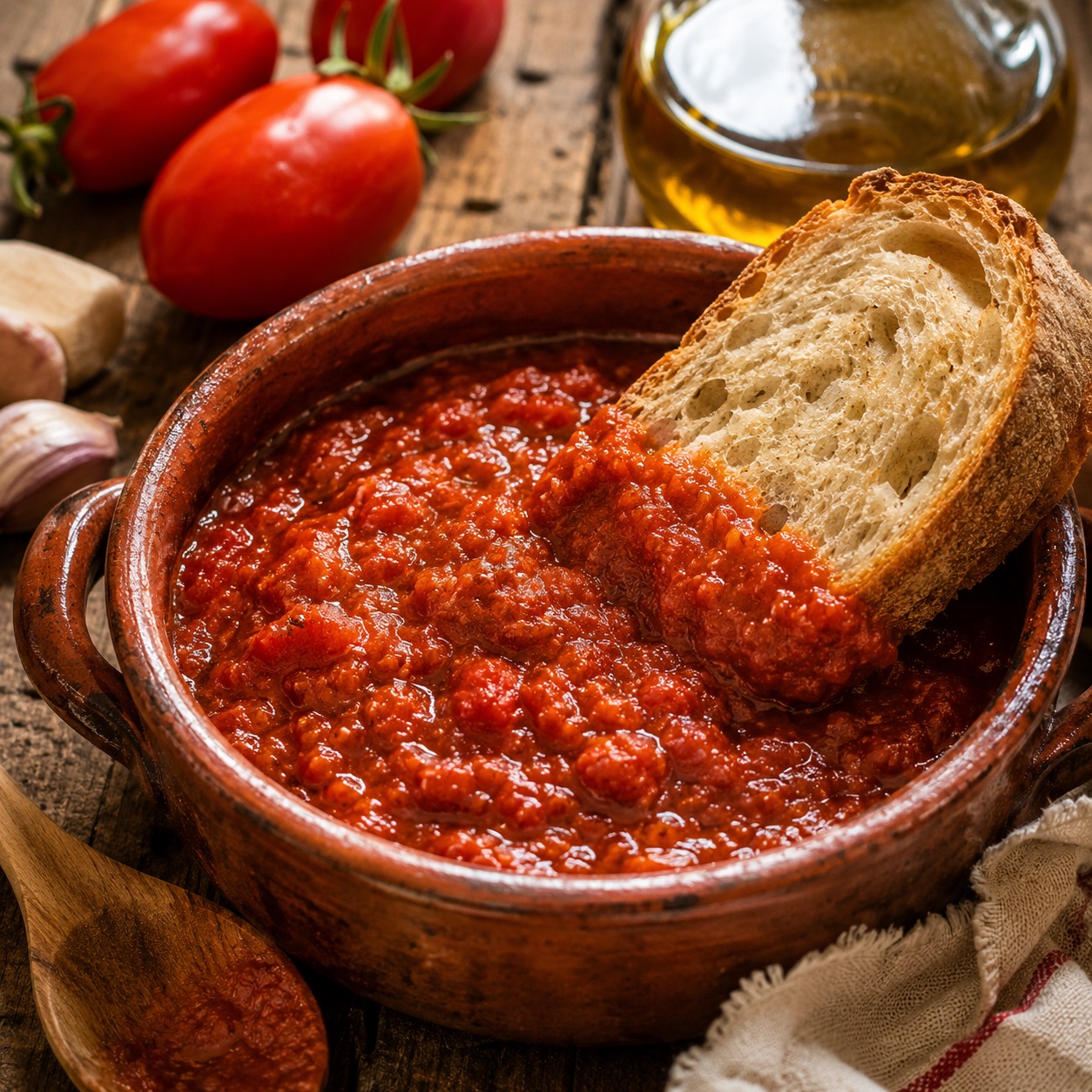
The sauce went on the stove early on Sunday mornings. Whether it was the ragù napoletano, the sugo con salsiccia, or the finto ragù did not matter — what mattered was that it was on, it was cooking low, and the smell of it was already moving through the apartment by ten in the morning. The pappuliare, that slow irregular bubble, meant hours still to go before lunch. And somewhere in those hours, before anyone sat down, before the pasta went in the water, before the table was set, a piece of bread disappeared into the pot.
This was not a secret. Everyone knew it was happening. It happened in every kitchen on every Sunday in Campania and it was not considered theft or impatience — it was considered the correct way to check if the sauce was ready. No fork, no spoon, no plate. Just the bread and the pot. You pressed the bread against the bottom where the sauce was most concentrated, where the sugars from the tomatoes had begun to caramelize slightly against the hot surface, and you ate it standing up at the stove. That was the best taste of Sunday. It happened before the pasta, before the second course, before any of the formal part of the meal. The sauce at that moment was at its most itself — uncut by pasta, undiluted, just the sauce and the bread and the kitchen.
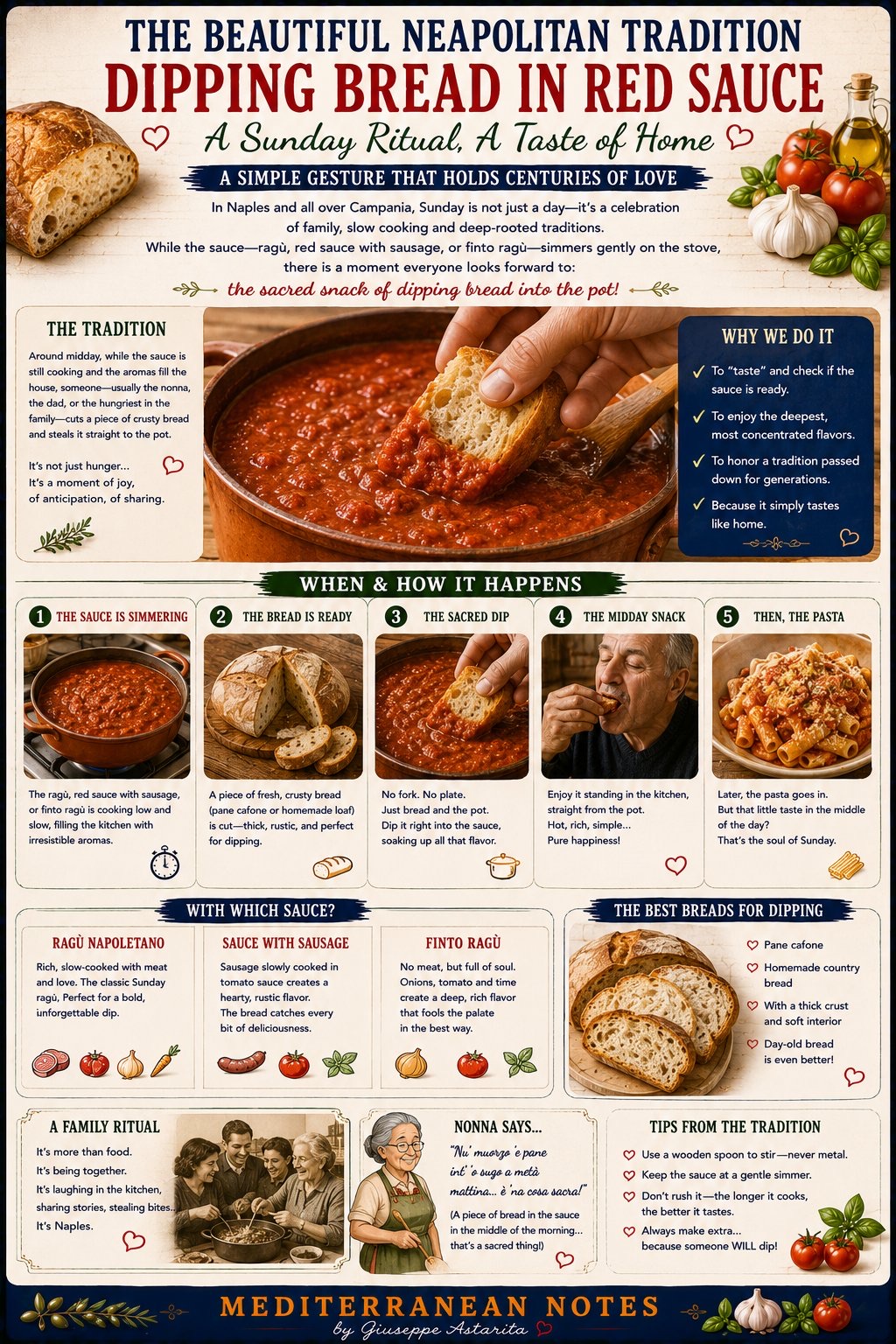
è 'na cosa sacra!"
The nonna, the infographic says — and it is right about this — was often the one who did it first, which gave everyone else permission. Once one person had gone to the pot, it was open. You could go back twice and it was still not considered a problem, as long as you did not drain the pot before lunch. The bread had to be the right kind: pane cafone, the dense rustic loaf with the thick crust that holds its shape when you press it into a hot sauce without immediately dissolving. Day-old bread was even better — drier, more absorbent, it soaked up the sauce more completely and left nothing behind on the bread itself.
It happened again after the pasta too — the scarpetta at the end of the plate, the piece of bread used to clean the remaining sauce in a single sweep before the plate went to the kitchen. This is not the same gesture as the midmorning dip, though it uses the same materials. The midmorning bread in the pot is anticipation. The scarpetta at the end of the plate is completion. They are different rituals with different emotional weights, and both were mandatory.
My father added a third habit of his own, one that isn't nearly as universal as the scarpetta — eating bread with the pasta itself, not just before it or after it. The moment a plate of pasta was in front of him, before the first forkful, he asked the same two questions, every time, in whatever order the mood took him: C'è un po' di pane? Dov'è il pane? Is there a bit of bread? Where's the bread? It didn't matter that bread had already made its rounds in the pot an hour earlier. He wanted it on the table again, right there, for the meal itself — not a common practice, but his, without fail.
I still do this. In Massachusetts, on the Sundays when I make any of the three sauces, I do exactly what was done in Caserta: a piece of bread, pressed against the bottom of the pot, mid-cooking, standing at the stove. It does not require explanation to anyone in the kitchen with me. It is simply what you do when there is a sauce on the stove and you are in the room with it. The sauce tells you when it is ready, and the bread is how you listen.
A slow-simmered tomato sauce changes continuously as it cooks. In the first thirty minutes the dominant flavors are bright and acidic — the raw tomato character is still present, the volatile acids have not yet evaporated, the fat from the meat or olive oil has not fully integrated. By the halfway point, something different is happening: the water content has reduced substantially, concentrating the natural glutamates and sugars in the tomatoes, the collagen from any meat has begun converting to gelatin and is making the sauce slightly viscous, and the Maillard compounds from the initial browning are distributing evenly through the liquid. The sauce at this midpoint — an hour into a two-hour simmer — is at a particular moment of transition: it has lost its rawness but has not yet reached the deep, round, almost sweet character of the fully finished sauce. That midpoint flavor is what you get with the bread at midmorning. It is not worse than the finished sauce. It is different — brighter, slightly more aggressive, more complex in a different direction.
Bread is the correct vehicle for this tasting because of its porosity. The open crumb structure of a good country loaf — pane cafone in particular, which has large, irregular air pockets — acts as a sponge for the emulsified fat and water of the sauce. When you press bread against the bottom of a hot pot, capillary action draws the sauce up into the crumb, distributing it evenly through the interior while the crust remains firm enough to hold the whole piece together. A fork or spoon gives you the sauce on top of something. The bread gives you the sauce inside something. The two experiences are not equivalent, and the tradition understood this without needing to articulate it.
The three Sunday sauces
The infographic says sempre farne in più — perché qualcuno lo farà. Always make extra, because someone will dip. This is correct. It is the only rule that applies universally across all three sauces, all three kitchens, all three generations of this particular Sunday tradition. The sauce knows it will be visited before it reaches the table. Make enough.
Buona domenica — e buon muerzo.