Mediterranean Notes · Giuseppe Astarita
A Note from My Kitchen
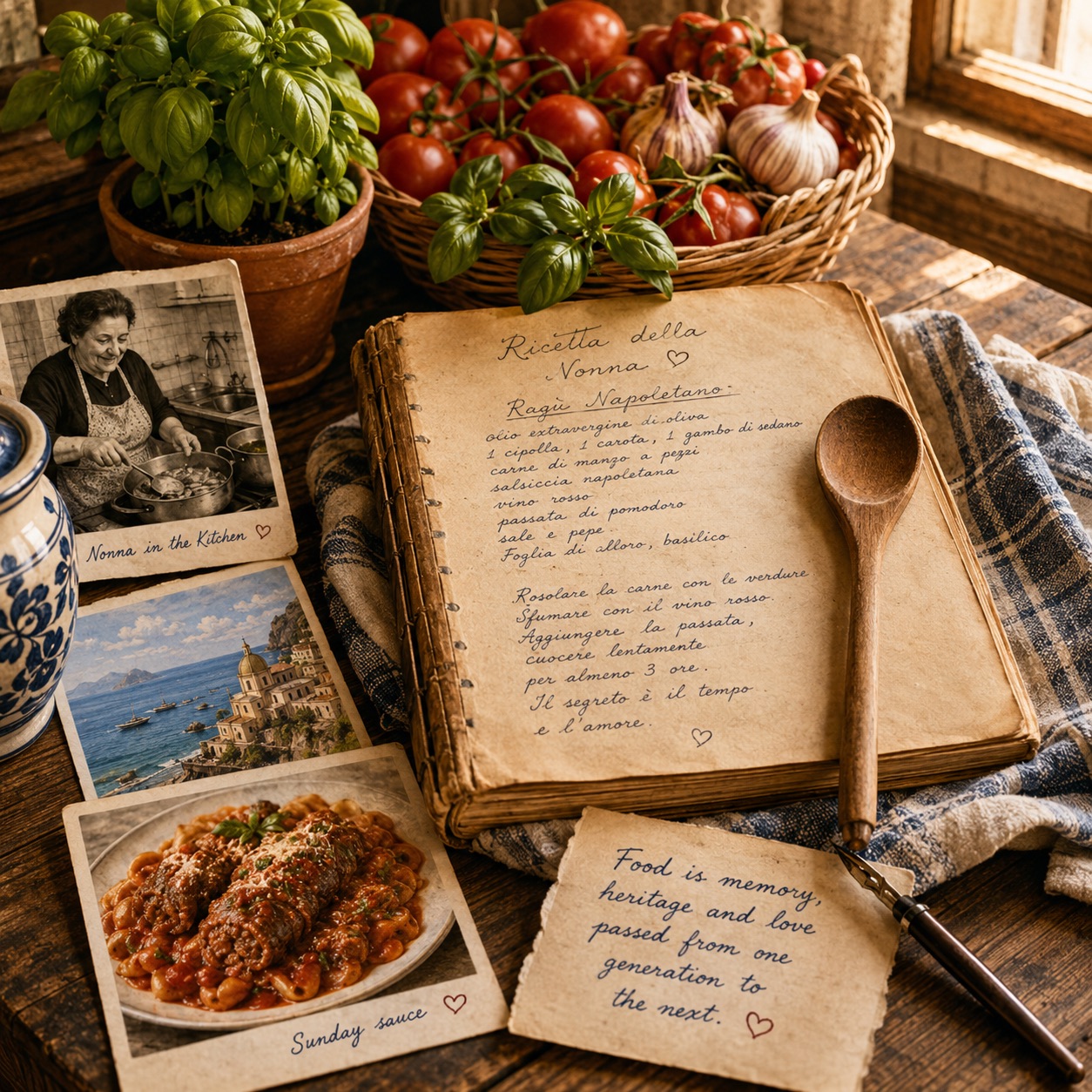
Why I collect and share these recipes — for my daughters,
and for the memory of where we come from.
Think about how much of our life is actually spent eating — looking for food, buying food, going to places to consume it, traveling specifically to eat something. It is more than we account for. If you asked me for my biography I would say: let's start with food habits. It seems like a good place to begin. A tour around my memories of lost food in southern Italy is, in the end, a tour around a life.
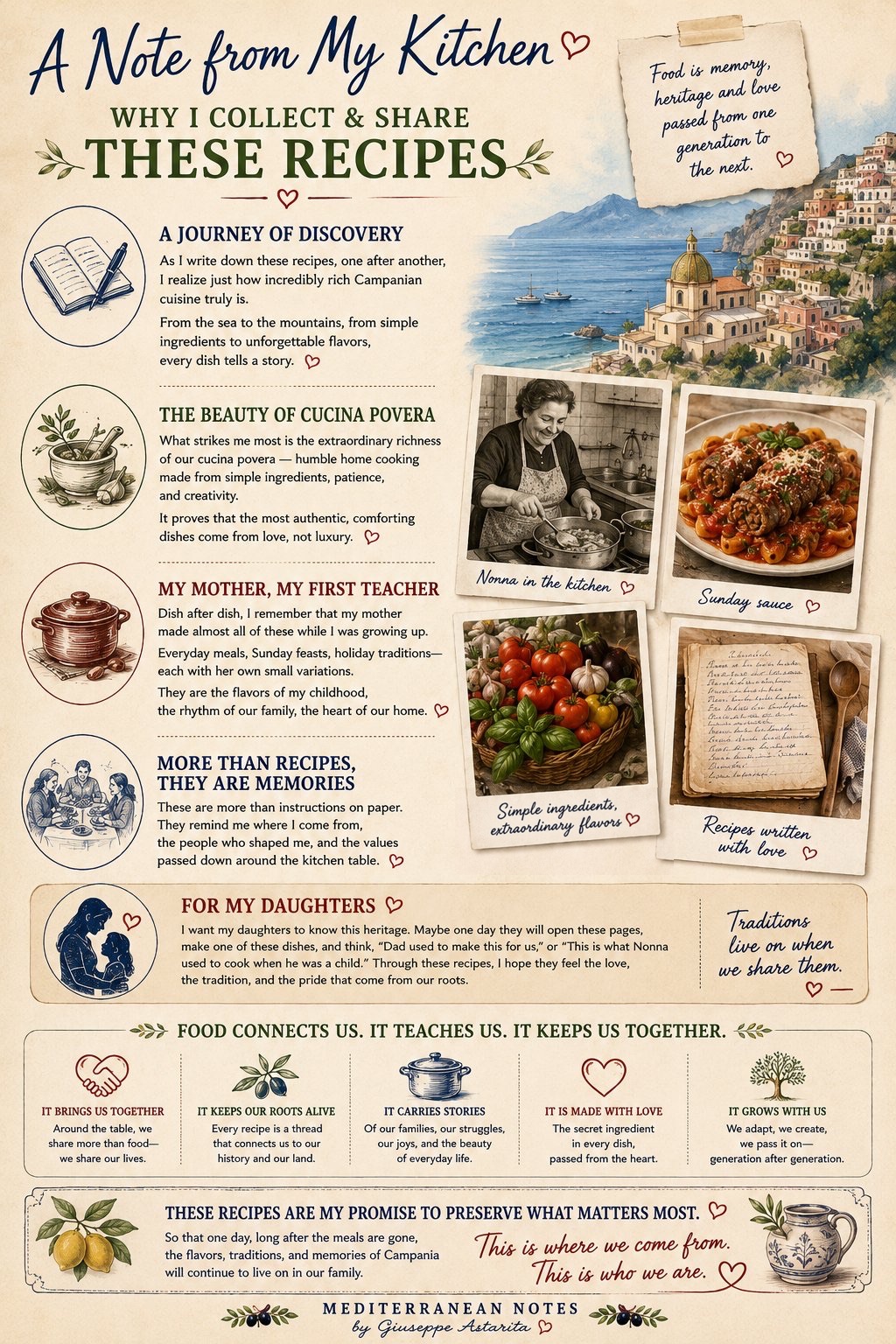
As I write down these recipes, one after another, I realize just how extraordinarily rich Campanian cuisine truly is. Not the famous dishes that people know around the world — the pizza, the ragù, the babà — though those are here too. What strikes me most, moving through dish after dish, is the extraordinary depth of the cucina povera: the humble home cooking built from simple ingredients, patience, and creativity. The cooking that happened not in restaurants but in small kitchens in Caserta and the surrounding towns, at stoves that had been in the same family for decades, by women who measured nothing and knew everything.
Dish after dish, I find myself remembering that my mother made almost all of these while I was growing up. Some were everyday meals — the spinach dressed with olive oil and lemon juice, the bean salad my father assembled in summer without heating anything, the frittata di spinaci that appeared on weeknight tables and improved the next morning in a panino. Others were reserved for Sundays: the ragù that began early in the morning and filled the house with its smell before noon, the parmigiana made in the morning and served at dinner, the braciole that simmered for hours until the sauce was ready for the pasta. And others still were for specific occasions and specific seasons: the struffoli at Christmas, the chiacchiere at Carnival, the insalata di rinforzo that was reinforced daily from the twenty-fourth of December through the Epiphany.
There were a few exceptions — dishes that came from outside Campania and that we made anyway, simply because we liked them. My father had a particular fondness for the carciofi alla romana, the whole artichokes stuffed with mentuccia and braised upside-down in the Roman manner, and for the carciofi alla giudia of the old Roman-Jewish kitchen. From the North there were the uccelletti scappati — “the little birds that escaped,” rolls of veal standing in for game — and the ragù alla bolognese, made our way, without pancetta. These were never the heart of our table, which was and remained Neapolitan to its bones. But every family keeps a handful of adopted recipes it has no historical claim to and cooks all the same — and ours happened to come from Rome, with a little of the North.
Each family had its own small variations. The exact proportion of the ragù, the specific mix of spices in the mostaccioli, whether the calzone was made with salame or prosciutto cotto, how long to leave the porcini in the sauce before adding the pasta. These variations are not errors or deviations from a canonical recipe — they are the signature of the family, the accumulated decisions of cooks who made the same dish hundreds of times and adjusted it toward what they preferred. My mother's version is not the same as her neighbor's version or her sister's version. None of them are wrong.
The beauty of cucina povera
What strikes me most, as I document these recipes, is the proof that the most comforting and authentic food does not come from luxury. It comes from limitation — the limitation that forces creativity, that makes a cook find a use for yesterday's bread and turn it into the filling of stuffed peppers, or take the stale crumbs and build a crust for baked anchovies that is better than any elaborate preparation. The cucina povera of Campania is not poverty as deprivation but poverty as ingenuity. It is the knowledge of how to make something extraordinary from something ordinary, and it is the culinary philosophy that produced almost everything in this collection.
The breadcrumb that replaces cheese in the spaghetti ru puveriello is not a substitute but a different ingredient producing a different and in some ways superior result. The stale bread soaked in water and squeezed dry that forms the filling of the puparuoli mbuttunati produces a texture and a flavor that fresh bread cannot replicate. The vinegar that preserves the peperoni sott'aceto and the zucchine alla scapece is not merely a preservative but the flavor that defines those dishes — remove the vinegar and you have a different preparation entirely. In the cucina povera, necessity and result are the same thing, and that is why the food is so good.
She made almost all of it. I mean this literally — moving through this collection dish by dish, I find myself recognizing each one as something she cooked at some point. The everyday preparations and the occasional ones. The cucina povera standards and the rarer dishes that required specific ingredients or a specific occasion. She tried everything the Campanian kitchen offered, and she tried it for us, for the family at the table. Seafood was always a treat for her — a pleasure she looked forward to and shared with particular satisfaction with the people at the table who appreciated it as she did. The effort she put in was continuous and largely invisible to me as a child, because the food simply appeared: a full three-course lunch every day, a dinner that had been thought about, the seasonal dishes in their season, the special preparations for the occasions that warranted them.
My appreciation for what she did has grown every year since I left, and grows faster now that I am a parent myself. Not just appreciation for the cooking — for the transmission. She was teaching us, every day, how to eat, what to value, what a table is for. Mangia che ti fa bene — eat, it is good for you — was the shortest possible statement of a philosophy I am still learning to fully articulate. The Mediterranean life we lived without naming it. The seasonal discipline. The variety. The ritual of the shared table. These were not cooking lessons. They were lessons in how to live, delivered at lunch, every day, without being announced as such.
My mother, my father, my sister Laura — and the table we shared
My mother was the cook. She ran the kitchen with authority and without measuring anything, and what she produced in it was the food I grew up eating and the standard against which I measure everything I cook now. The ragù, the parmigiane, the pastina in brodo when someone was ill, the struffoli at Christmas that she made in quantity and gave away in tins. The contorni that appeared alongside every meal as a matter of course — the spinaci all'insalata dressed with olive oil and lemon juice, the fagiolini, the cauliflower in all its variations. The frittata that appeared on Tuesday evenings when there was not much else. She made these things without special occasion or announcement. They were simply what was on the table.
Most of these meals were shared by the four of us — my mother, my sister Laura, my father, and me — sitting around the table together. This is a detail that seems obvious but is worth stating, because the table is where the food became memory rather than simply nourishment. The ritual of sitting down together, the specific dishes on specific evenings, the way certain meals belonged to certain days of the week: all of this is what I am trying to preserve here, not just the recipes themselves but the context in which they existed. The frittata was Tuesday. The ragù was Sunday. The calzone was whenever we went to pick it up near the station. My sister ate the same things I ate and knows the same flavors I know, and that shared reference is something that twenty years of distance from Caserta has not diminished.
My father did not cook in the way my mother cooked. He had a small repertoire — the spaghetti aglio e olio, the spaghetti al limone, the bean salad he assembled in summer with red onion and vinegar and basil, the uova al purgatorio that he made when he wanted something specific. He ate around the fish my mother prepared — the baccalà, the vongole, the anchovies — but his dishes were his and he made them with evident pleasure. I have written about the trattoria near Piazza Municipio in Naples where he took me to eat pork chops with papaccelle when I was a child, and about how he mentioned that they soaked the pork in milk. I did not understand yet why the milk mattered. I was simply eating the best pork chop I had ever tasted.
The table at home was four people, but the wider family was much larger, and at the holidays it made itself fully present. Christmas, Easter, the great seasonal celebrations brought in everyone. On my father's side: Zia Ada e Dodò, Dodà e Nennè, Zia Palma e Zio Rosario — and Nonna Titti, at whose house we used to eat on Sunday afternoons. On my mother's side: Zia Tina e Zio Ettore, Zio Tonino e Zia Pina, Zia Antonietta e Zio Enzo, Zia Teresa e Zio Enzo, Zia Camilla e Zio Mario. And all my cousins. What strikes me now, looking back, is that each of them had a signature — something specific that was theirs and that I associate with them to this day. The lentils of Zia Ada. The chicken cacciatore of Zia Tina. The cotoletta of Zio Ettore. The bell peppers of Dodà. Every family gathering was also a survey of the same Campanian culinary tradition seen through many different hands, and no two versions were quite the same.
One memory that stays with me particularly: making tomatoes in jars in September at Zia Pina's and Zio Tonino's house. The end-of-summer preservation ritual — the tomatoes at their peak, processed and sealed into jars that would last through the winter — was a collective undertaking involving the whole family. This is one of the oldest of the Campanian food traditions, the cucina povera logic applied to abundance rather than scarcity: the summer's surplus preserved against the winter's need. I was young and I did not think of it as a tradition. I thought of it as a long afternoon at Zia Pina's house with a lot of tomatoes and a lot of people. Looking back, it was one of the most complete expressions of what this collection is about — food as collective labor, as seasonal ritual, as the practical preservation of something that matters.
My mother also took care of her own mother — Nonna Totto — and often came back late for lunch. On those days I started to cook the meal myself, waiting for her to return. But it is not quite right to say she never taught me. She did teach me, in the way that mothers teach: sometimes deliberately, sometimes without noticing she was doing it. I remember making polpette with her as a child — standing at the counter, rolling the meat mixture between my palms, the specific weight and size she expected. I remember helping her make tiramisù, whipping the heavy cream by hand, learning by feel when it was done. These were things she showed me directly. Other dishes she simply made while I watched, and the memory came back years later — not as a lesson recalled but as a detail surfacing unexpectedly, the specific gesture or proportion or smell, arriving complete and unannounced while I was cooking something else entirely.
What has stayed with me most, I think, is not any specific technique but the spirit of improvisation she cooked with. If something went wrong, it was not a big deal. There was always a plan B, and the plan B was often just as good. If a string of the crostata breaks, you press it back together — nobody at the table will know. If there is not quite enough dough, you make the layer thinner and fill it generously. If the lasagna runs short of pasta before the dish is full, you find a solution. What mattered, in the end, was not the perfection of the result but the love you put into making it. This is perhaps the most important thing this collection contains — not the recipes themselves but the attitude behind them. Cook with care. Do not be afraid of imperfection. There is always a solution. And what you make with love will be good.
Writing all of this down, I have been surprised by how much I had to say about each recipe — memories I did not even know I had, surfacing one by one as I worked through the collection. So much of my life was built around these rituals and these dishes, these specific flavors at specific times of year and specific moments in a specific kitchen. I did not think of it that way while it was happening. It was simply life. Looking back, I understand it differently. It is not just food. It is the structure the days were organized around, the language in which the family expressed what it valued, the way the culture transmitted itself without anyone deciding to transmit it. It is part of me — part of who I am — in a way that I am only now beginning to fully understand.
These are the people these recipes come from. Not from restaurants or cookbooks but from kitchens in Caserta and the trattorias and friggitorie of the surrounding territory, from a tradition transmitted through watching and doing and the occasional afternoon alone in a kitchen waiting for someone to come home. This collection is my attempt to write down what was taught to me and what I taught myself — and to pass on, alongside the recipes, the spirit in which they were made.
For Anna and Carolina
One of the reasons I started documenting these recipes is for my daughters. Anna was born in 2016 and her sister Carolina in 2022, and they are growing up in Massachusetts rather than in Caserta, surrounded by the food of New England rather than the food of Campania. They eat most of what I make — the bean pastas with lenticchie, piselli, and beans several times a week, the frittata for dinner, the paccheri col ragù which was their grandmother's Sunday dish, the homemade pasta and pizza and gnocchi — and they decline other things, as children do, with the certainty of those who have not yet developed the tastes that will come later. The girls will not eat some fish, and the parmigiana is still under negotiation. I remain patient.
I hope that one day they will read these pages and decide to make one of these dishes themselves. Perhaps they will think, "Dad used to make this for us," or "This is what Nonna used to cook when he was a child." Perhaps they will look at the recipe for the insalata di fagioli e cipolle and remember the summer afternoons when their father told them that their grandfather made this dish without heating anything and ate it alongside bread, and that it was the taste of summer in Campania in a way that no elaborate preparation could replicate. Perhaps that will be enough. Perhaps Anna or Carolina will make the bean salad themselves one day, and the taste of it will carry something from Caserta across the distance and across the years.
Food has a remarkable way of carrying stories across generations. It is perhaps the most reliable vehicle we have for memory — more reliable than photographs, more sensory than written accounts, more immediate than anything else. The smell of Sunday ragù is the smell of childhood in Campania for anyone who grew up with it in the house, and no amount of time or distance removes that association. The taste of a slightly burned calzone from a paper cone near a train station is still specific and still present forty years later. The sweetness of a pork chop soaked in milk and cooked with papaccelle in a trattoria near Piazza Municipio is still there when I make the dish now.
These recipes are a promise
These recipes are my small attempt to preserve those stories — so that the flavors, traditions, and memories of Campania continue to live on long after the meals themselves are gone. So that Anna and Carolina, if they ever want to know what their grandmother cooked on Sunday mornings and what their grandfather ate in summer and what the old man near the station in Caserta sold from his wood-fired oven, can find it here. Imperfectly, inevitably, because no written recipe captures exactly what was made in a specific kitchen by a specific person on a specific Sunday in 1985. But close enough to be useful. Close enough to be worth making. Close enough that the dish that comes out of the oven will carry something of the original, even now, even for children who do not yet know what they are eating.
Because this is where we come from. And in many ways, it helps make us who we are.
How this collection grew beyond what I intended
I should be honest about how this collection actually came to be, because it did not arrive fully formed. It started with one purpose and became something different — something larger and harder to name — almost without my deciding to make it so.
The first impulse was the simplest: I wanted to write down the recipes I was already cooking for Anna and Carolina. The bean soups, the frittata, the pasta al ragù on Sunday, the gnocchi di patate they asked for. Practical documentation, so the girls would have them one day in a usable form. That was the first layer.
Then I started writing down the recipes I grew up with — the dishes my mother made, my grandmother's Sunday ragù, the things that came from specific kitchens and specific hands and that I had never formally documented anywhere. These were not the same recipes I was cooking for my daughters. Some of them I had not made in twenty years. Some I had not thought about in twenty years and only remembered when I started writing. That was the second layer, and it was already more than I had planned.
Then something else happened. Once I was in the territory of memory, the food did not stay separate from everything surrounding it. I started writing about the gelateria on summer afternoons, about the bar at the beach and the Cornetto from the freezer chest, about the Coppa del Nonno my father always chose. About the merendine in the school bag — the Girella, the Kinder Brioss, the crackers with cold milk at four o'clock. About the uova di Pasqua and the calza della Befana and the struffoli at Christmas and the chiacchiere at Carnival and the granita on a July morning before going to the beach. About the pan carrè and the Nutella and the formaggino from the refrigerator door. About things that were not recipes at all but were food — food as the texture of daily life, the specific objects and rituals and small pleasures that made a childhood in Caserta in the 1980s what it was.
That became the third layer, and it is the one I had not anticipated. This collection is now, in some significant part, a portrait of a specific time and place: a boy growing up in southern Italy in the 1980s, in a particular food culture, at a particular moment in its history. Not a timeless Campanian tradition as it has always existed and always will — but a snapshot. A timestamp. The culture I grew up in is evolving, as all cultures do. Some of what I am writing about here is already changing. Some of it, in a generation or two, may exist only in documents like this one.
The salumeria where a man behind a counter sliced your capocollo to order while you watched is rarer than it was. The specific afternoon ritual of crackers and merendine at four o'clock belongs to a generation in a way it may not belong to the next. The gelateria that makes everything fresh from local ingredients every morning, with the pozzetti sunk into the counter and the gelataio who knows your order — this still exists, but it competes now with things that did not exist when I was a child. The brioche col tuppo filled with warm dough and cold gelato is still one of the great things in the world, but the world that produced it as an unremarkable daily pleasure is not exactly the same world my daughters are growing up in, even when they visit Italy.
I do not think this collection will prevent anything from changing. That is not its purpose and it would be the wrong purpose. But it can be a record — specific, personal, with names and places attached — of what it was like to grow up in that kitchen, at that table, in that city, at that time. So that Anna and Carolina can know it. So that whoever reads this can find it. So that the flavors and the rituals and the small specific pleasures of a Campanian childhood in the 1980s do not disappear entirely when the people who lived them are no longer here to describe them. That is what this grew into. I think it is the right thing for it to have become.
There is one part of this collection I came to late, and I want to be honest about that too. I am not a baker, and growing up, dessert was never really the point of a meal for me — it came at the very end, almost an afterthought, and for most of my adult life I quietly filed sweets under things that were probably bad for you and best kept at a distance. It's only in the second half of my life that I've started to actually look at what my mother made for us — for breakfast, for a birthday, for a holiday — and see it for what it is: not just sugar and flour, but real technique, real history, real intention. The sponge cakes, the layered creams, the patience a pastiera or a crostata actually asks for — I understand now that I was looking at complexity and calling it indulgence. I'm still not much of a baker. But I've stopped mistaking that for not caring.
passed from one generation to the next.