Meat · Secondo · Campanian Tradition
Uccelletti Scappati
The escaped little birds. Thin pork wrapped around pancetta and sage, rolled tight, threaded on skewers, and braised until golden and tender. A dish that asks nothing of you but patience for the last fifteen minutes.
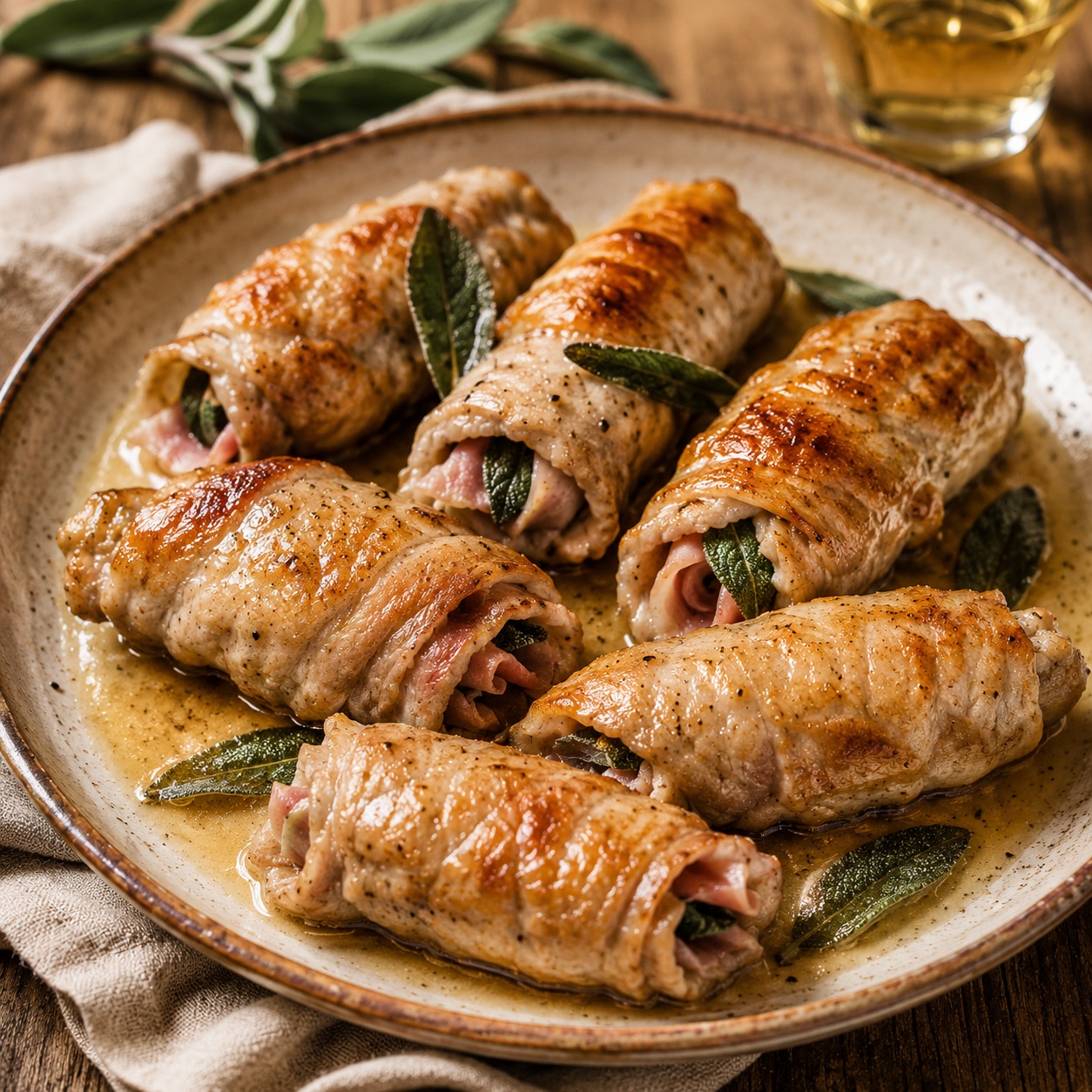
The name explains the joke. Uccelletti scappati — escaped little birds — are the dish you make when you have no birds. The small rolls of thin meat wrapped around sage and pancetta, threaded onto wooden skewers with alternating pieces of filling between them, are shaped and presented to resemble what would have been on those skewers if you had been able to catch anything that day. The birds escaped. You made do with what you had. The result is, most people agree, better than the birds would have been.
The dish originates in the northern Italian countryside tradition — the Lombard and Veneto habit of skewering small game birds between sage leaves and pancetta on a spit over fire — and arrived in Neapolitan home cooking through the same route that many northern preparations traveled southward: via military movement, trade, and the general tendency of good ideas about meat and fat and fire to cross regional borders without documentation. By the time the dish appears in Campanian kitchens it is already adapted: pork loin rather than game, braised in a pan rather than roasted on a spit, finished with white wine rather than the rendered fat of the original. The Neapolitan version is not lesser. It is simply different, the same concept interpreted through what was available and how the southern kitchen prefers to cook meat — gently, in liquid, covered, for longer than you think necessary.
The sage is not optional. Sage and pork have a specific relationship that goes beyond mere compatibility — the aromatic compounds in fresh sage (primarily thujone, camphor, and borneol) are fat-soluble and migrate into the fat of the pancetta during cooking, perfuming the entire roll from the inside outward. Dried sage does not work. The leaf must be fresh, placed flat against the meat before rolling, present at each joint on the skewer where it continues to release its oils into the surrounding fat throughout the braise.
Pork loin is the most traditional choice for the Campanian version — affordable, available, and thin enough to roll easily when pounded flat. Veal (vitella) gives a more delicate result and is what many Neapolitan families prefer for a special occasion. The slice must be very thin — 3–4 mm after pounding — so the roll is compact and cooks quickly without drying. If the butcher will not slice it thin enough, ask. This is not a negotiation you can skip.
Why the braise works — and why white wine is the right liquid
After browning, the uccelletti finish cooking covered in a small amount of white wine, creating a braise rather than a roast. The covered environment traps moisture released by the meat and converts the pan into a humid, pressurized cooking environment where the temperature at the meat surface is limited to around 100°C rather than the dry-heat temperatures of open roasting. This prevents the muscle proteins from contracting aggressively and squeezing out moisture — the mechanism that makes overcooked braised meat tough.
White wine serves three functions: its alcohol dissolves fat-soluble flavor compounds that water cannot; its acidity helps break down collagen in the connective tissue of the pork, contributing to tenderness; and its residual sugars caramelize slightly on contact with the hot pan surface, adding a subtle sweetness to the cooking liquid that counterbalances the salt of the pancetta. A splash of broth added midway keeps the environment moist without diluting the wine flavor already in the pan.
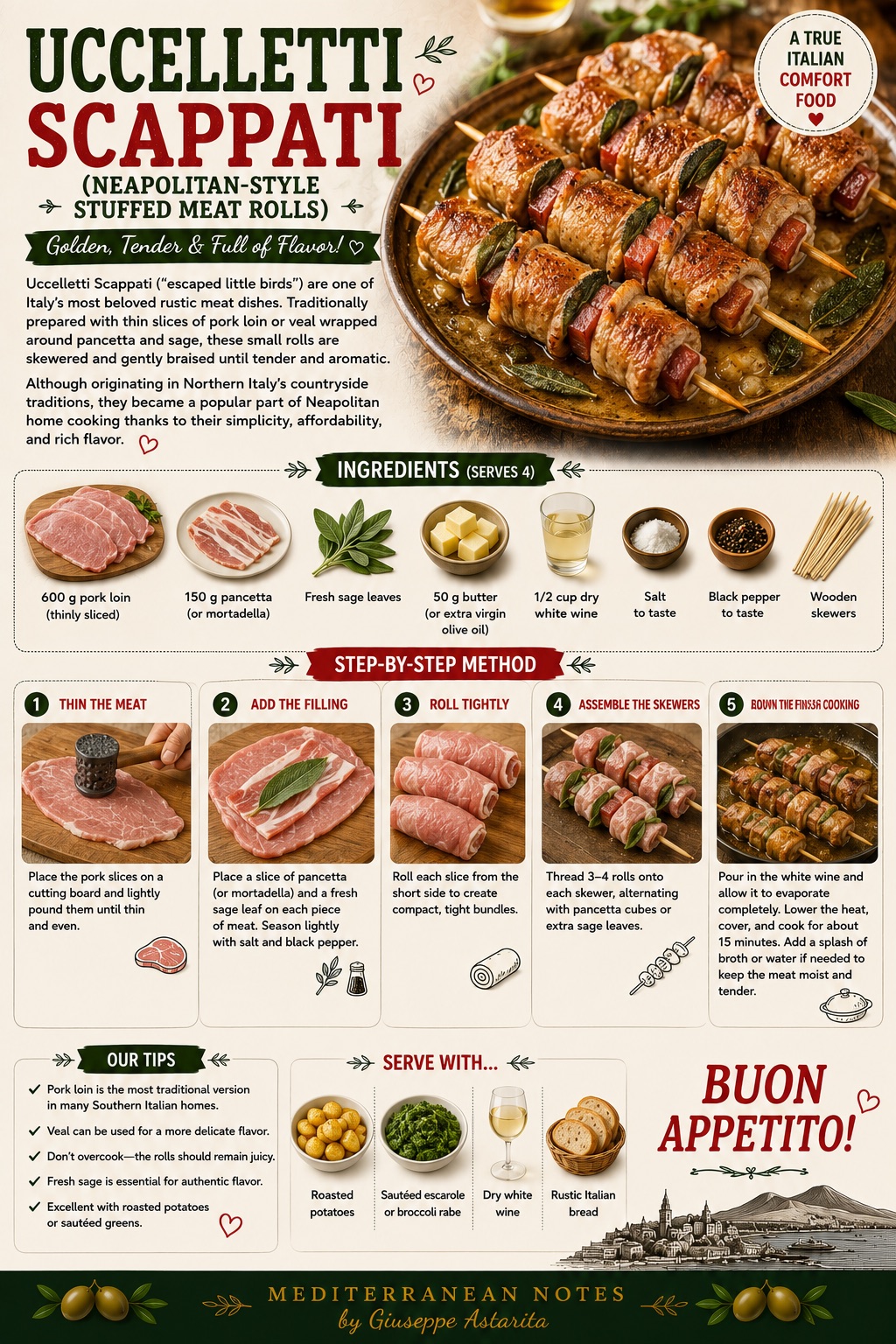
Tap to enlarge — Uccelletti scappati: metodo, ingredienti, consigli
Recipe — Uccelletti Scappati
Serves 4 · Active time 25 min · Total about 45 min
- 600 g pork loin thinly sliced — 3–4 mm after pounding
- 150 g pancetta or mortadella — sliced, plus extra cubes for skewering
- Fresh sage leaves one per roll, plus extra for the skewers
- 50 g butter or extra virgin olive oil, or both
- ½ cup dry white wine
- Salt and black pepper
- Wooden skewers soaked in water 20 min before use
- Splash of broth or water if needed during braising
Variations
The uccelletti scappati are one of those dishes where the name matters as much as the preparation. It is a self-deprecating joke and a piece of kitchen philosophy simultaneously — the acknowledgment that the birds got away, that what you have is what was left, and that what was left turns out to be quite good. The cucina povera operates on exactly this logic. The birds escaped. Nobody is hungry.