Spaghetti al Limone
My father's pasta — the one I didn't expect
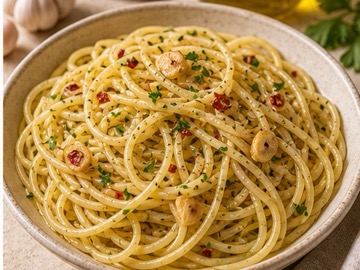
At home, it was mostly my mother who cooked. My father had two dishes he made his own — spaghetti aglio e olio and this one, al limone. I had returned from the United States for a visit and was quietly hoping for something more elaborate. He served me the lemon pasta instead. I could not really complain.
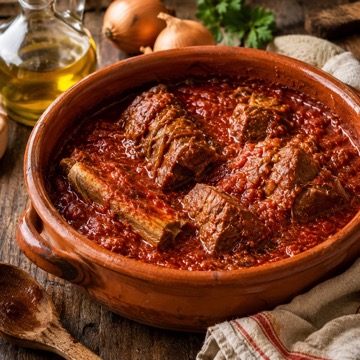
At home, the kitchen belonged to my mother. The Genovese, the Sunday ragù, the frittata, the things that took time — those were hers. My father had two dishes he made his own: spaghetti aglio e olio and spaghetti al limone. They were not occasion dishes. They were the dishes he made when he was cooking, which was not often, and they took perhaps fifteen minutes each. When I came back from the United States expecting something more elaborate, he made the lemon version. I had been away for months. I had been thinking about ragù.
My initial reaction, I will admit, was mild disappointment. I had been away. I had been eating American food for months. I wanted something more specifically Campanian, something I could not find anywhere else, something that required an afternoon and a particular ingredient from a particular market. Lemon pasta did not feel like that. It felt easy. It felt like something you could almost make anywhere, with almost any lemon.
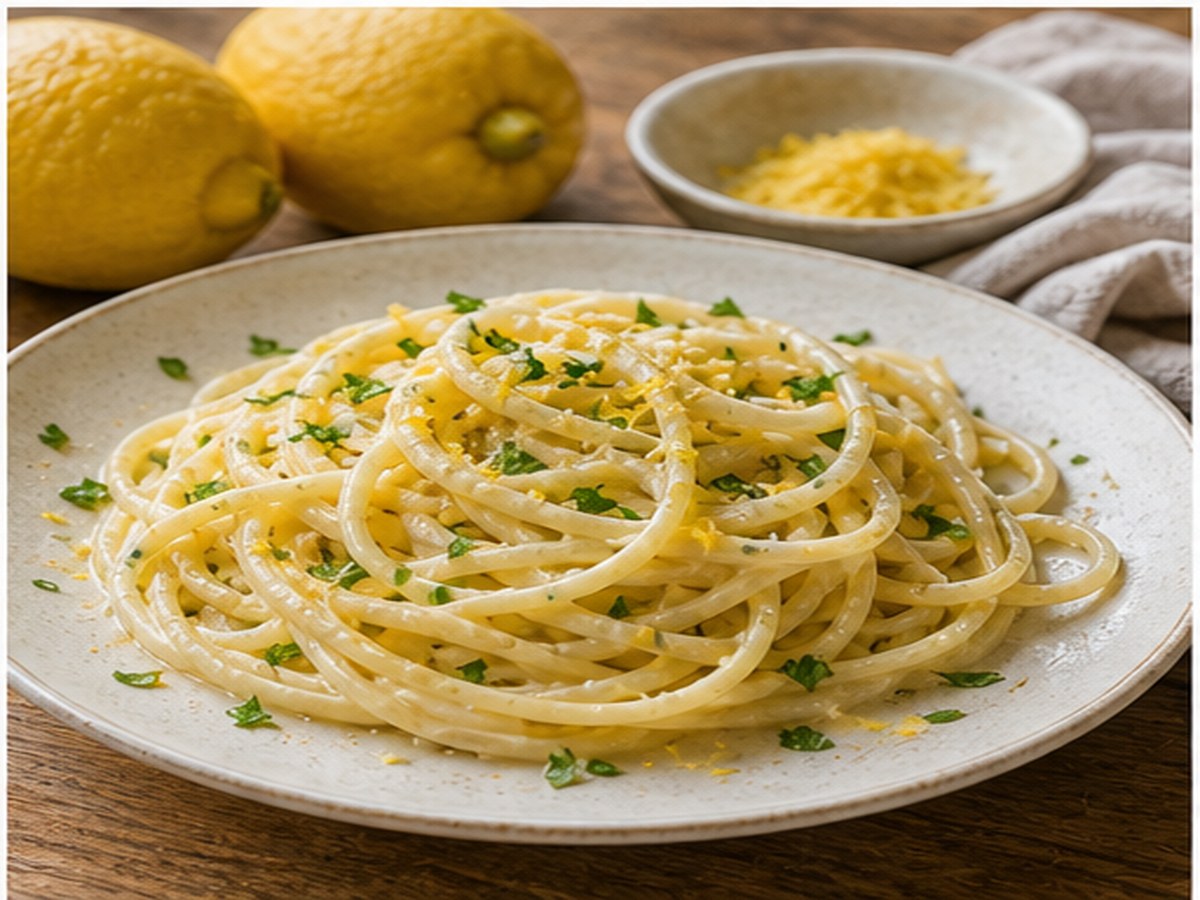
The key word is almost. He ate it and I ate it and it was very good, and then I understood what I had been missing in my thinking about the dish: it is not a showcase for technique, it is a showcase for the lemon. With a mediocre lemon — the kind available year-round in US supermarkets, picked green and allowed to yellow in transit — you get a pasta that is decent, bright, vaguely acidic, pleasant enough. With a Campanian lemon, the sfusato amalfitano or the limone di Sorrento, the ones that grow thick-skinned and heavy and aromatic along the coast south of Naples, you get something different. The zest is intensely perfumed, almost floral. The juice is less sharp than most lemons and more complex. The pith is thick enough to contribute bitterness in balance with the acid. The whole dish opens up into something that has nothing mediocre about it.
My father was not thinking about any of this. He was doing what he always did: making something good with what was available. In Caserta, in the years when we were growing up, good lemons were simply available. The Amalfi coast is not far. The markets had the right fruit and he bought it without considering it a special ingredient, because it was not special — it was just the lemon that lemons should be. I think about this occasionally now when I am looking at the options at a grocery store in Massachusetts and trying to decide which of them is the least compromised.
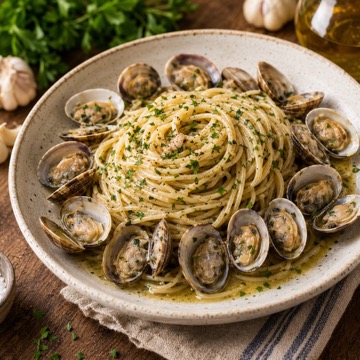
The dish itself has no fixed canonical form in the way that vongole does, or carbonara does. There are versions with cream, versions without; versions that use only zest, versions that add juice; versions finished with Parmigiano, versions finished with ricotta, versions finished with neither. My father's version was simple: olive oil, garlic, zest, juice, pasta water, Parmigiano. No cream. The emulsion between the starchy water and the olive oil created a sauce that was neither heavy nor thin. It coated the spaghetti without weighing it down. The lemon stayed present throughout — not as an accent but as the point.
The flavor of a lemon comes from two sources: the aromatic compounds concentrated in the zest, primarily limonene and linalool, and the organic acids in the juice, primarily citric acid. These two fractions contribute different things to a dish. The zest is where the perfume lives — limonene is the compound responsible for the bright citrus character you smell when you cut fresh zest, while linalool adds a floral note that is more pronounced in certain varieties. The juice provides acidity, which in cooking has the effect of sharpening other flavors and creating the perception of brightness.
Campanian lemon varieties — the sfusato amalfitano from the Amalfi coast and the limone di Sorrento from the Sorrento peninsula — are distinct because they are harvested ripe and have unusually thick, oil-rich peel. This means more limonene and linalool per gram of zest, and a more aromatic outcome in cooking. The juice is also less aggressively sour than many commercial varieties: the citric acid concentration is balanced by a higher sugar content, which softens the sharpness. The result in a dish like this is lemon flavor that is complex and fragrant rather than one-dimensionally acidic.
The technique of building the sauce off the heat matters for the same reason: limonene is volatile, meaning it evaporates quickly when heated. Adding zest at the end, after the pan has come off the flame, preserves the aromatic compounds that would otherwise cook off. The pasta water is equally important: the starch released by the spaghetti during cooking acts as an emulsifier, binding the olive oil and lemon juice into a cohesive sauce rather than a separated one. This is the same principle at work in aglio e olio and in the sauce for vongole — pasta water is not a filler, it is a structural ingredient.
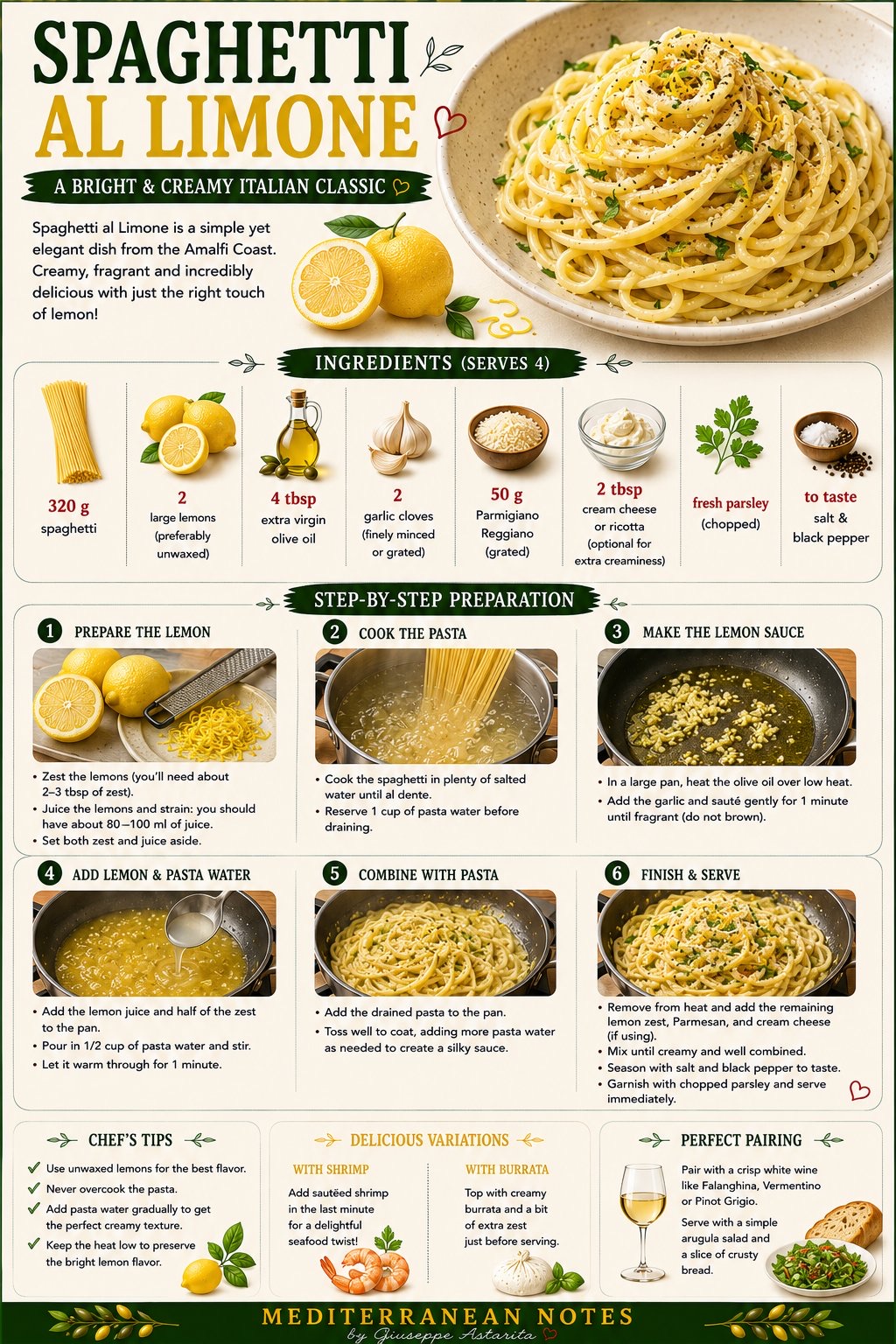
The recipe
For four people. Use the best lemon you can find — unwaxed, preferably from southern Italy if you can source them. The recipe works with a good organic lemon, but the Campanian varieties are a different experience. No cream in this version; if you want extra creaminess, a small spoonful of ricotta stirred in at the end is the right addition, not heavy cream.
Variations
My father did not make variations. He made the dish. The variations are for when you have had it enough times to know what you are departing from.
Buon appetito — e grazie, papà.