Culture & Traditions · The Land
I Prodotti della Campania
Campania officially boasts over 550 PAT — Prodotti Agroalimentari Tradizionali — recognised by the Italian Ministry of Agriculture. This is not a statistic. It is a way of understanding why this region's food tastes the way it does.
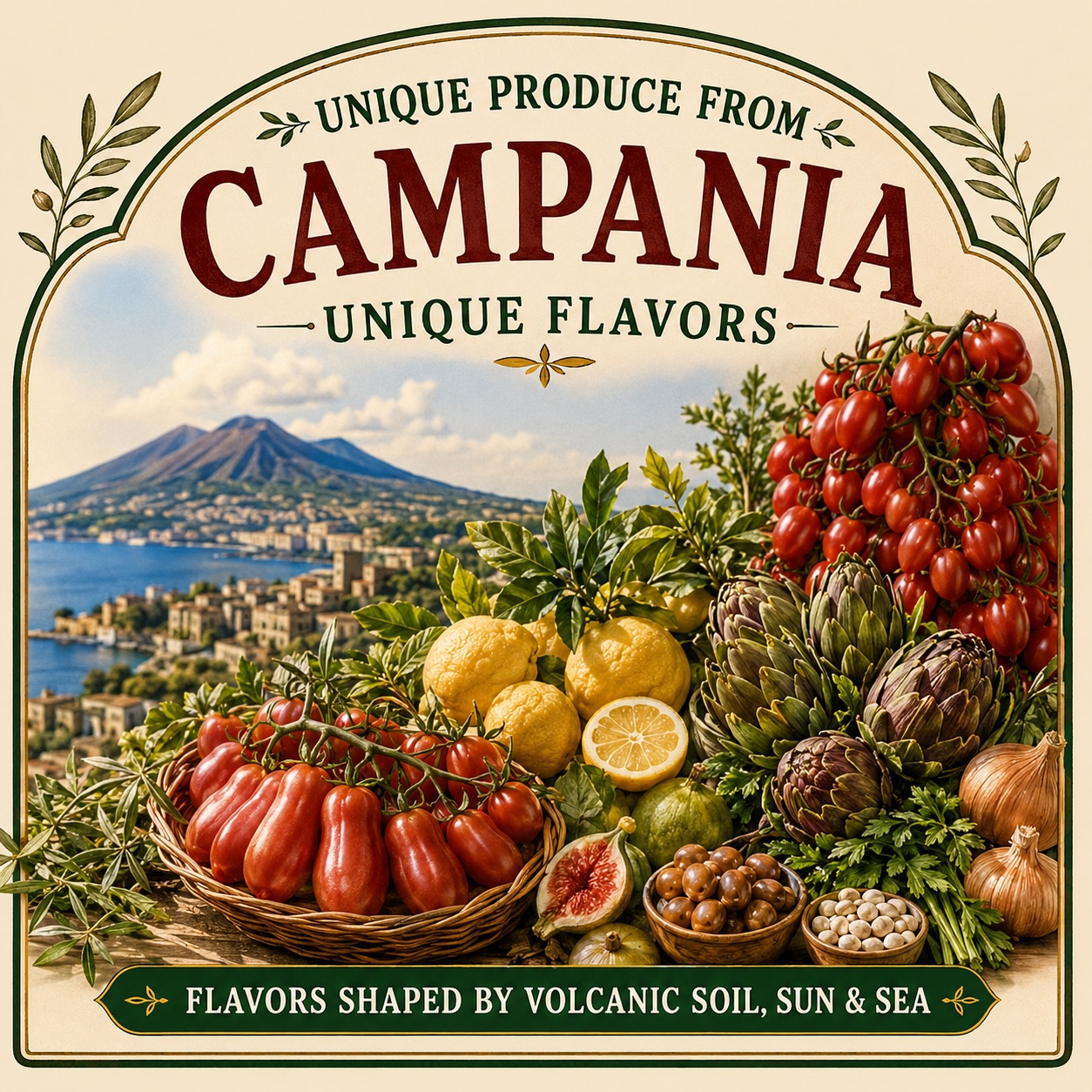
Campania officially boasts over 550 PAT — Prodotti Agroalimentari Tradizionali, Traditional Agri-Food Products recognised by the Italian Ministry of Agriculture. This massive number means that almost every single village, hill, and valley across Naples, Salerno, Caserta, Avellino, and Benevento guards its own specific micro-variety of seed, fruit, or vegetable cultivated the exact same way for centuries. The number places Campania among the most biodiverse food regions in all of Europe, ahead of Tuscany, ahead of Sicily, behind only Veneto in the national ranking — but with a density of variety per square kilometre that few regions anywhere can match.
This is philosophically important, not just culinarily. It means that Campanian cooking cannot be fully reproduced outside Campania. A San Marzano tomato grown in the Netherlands from the same seed variety is not the same tomato. A Carciofo Violetto di Schito transplanted to Piedmont is not the same artichoke. The volcanic soil of the Vesuvian plains, the mineral-rich alluvial deposits of the Sele river, the limestone hillsides of the Cilento, the altitude of the Irpinia highlands — these are not interchangeable backgrounds. They are the recipes themselves, encoded in the land across generations of cultivation so specific that it became inseparable from place. The food and the territory are not related. They are the same thing.
The volcanic soil of Vesuvius is the recurring explanation. Lava broken down over millennia into a mineral-rich substrate gives its tomatoes a balance of acidity and sweetness that growers in other regions cannot replicate simply by planting the same seed. The sea moderates the climate of the coast. The altitude variation — from sea level to the Apennine highlands at over 1,800 metres — produces a range of microclimates within a small area, each capable of nurturing something that cannot grow ten kilometres away.
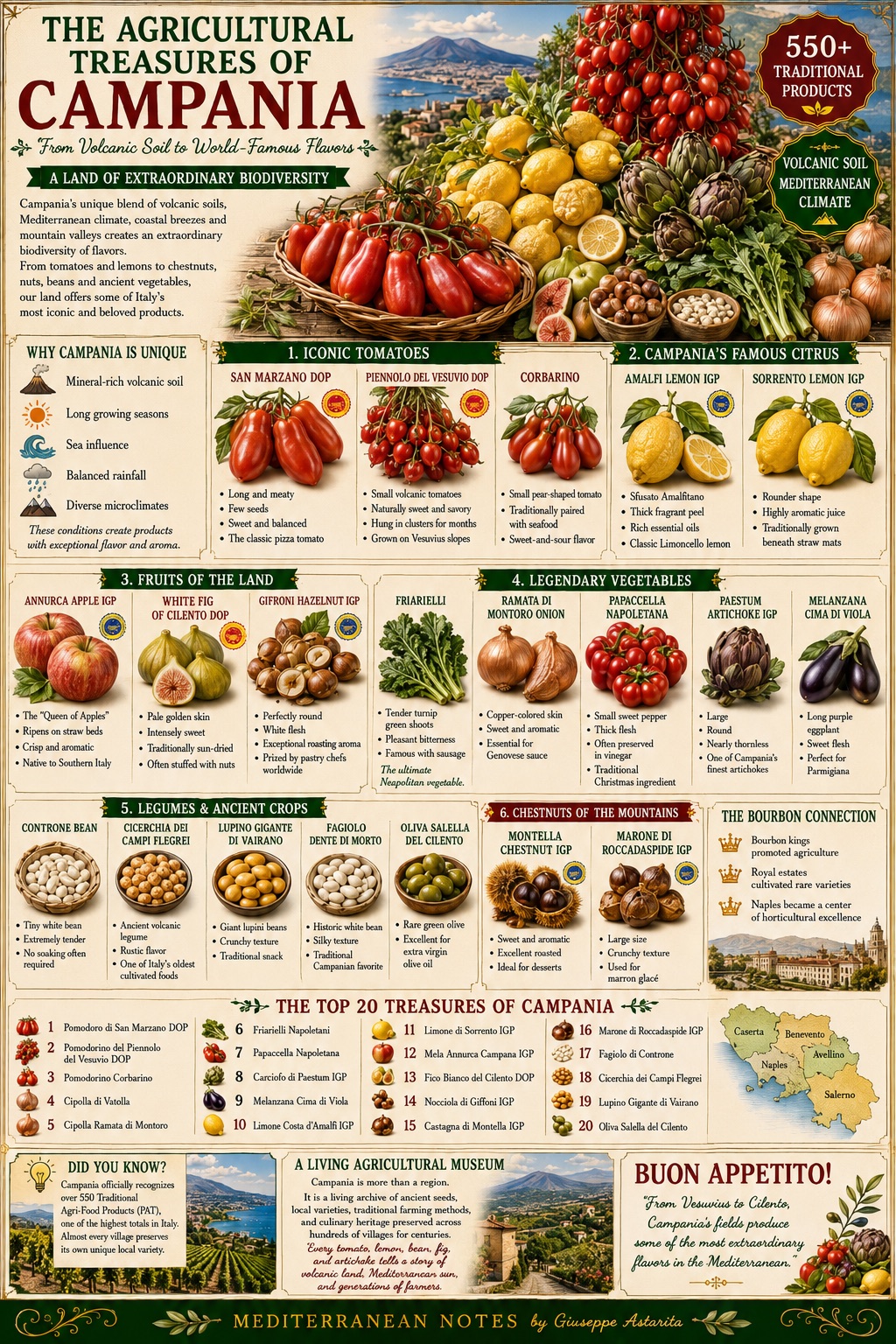
Tap to enlarge — I prodotti della Campania: dalla San Marzano alla Nocciola di Giffoni
What follows is not a complete list — 550 products would require their own encyclopaedia. It is the produce that appears, directly or by name, in the recipes on this site: the ingredients that are not interchangeable with generic substitutes, and that explain why specific dishes taste the way they do when made in Campania and differently when made elsewhere.
Tomatoes
Pomodoro di San Marzano
The canonical pelati tomato — long, meaty, low in seeds, with a specific ratio of sweetness to acidity developed in the volcanic alluvial plains south of Naples. The basis for authentic Neapolitan pizza sauce and most tomato-based sughi.
Pomodorino del Piennolo del Vesuvio
Small, oval, with a characteristic pointed end. Grown on the slopes of Vesuvius, harvested in clusters and hung from the ceiling (piennolo = pendulum) where they concentrate their flavour for months. The tomato in spaghetti al pomodoro fresco and the scarpariello.
Pomodorino Corbarino
Small, pear-shaped, with a sweet-sour flavour traditionally used in fish sauces. Grown on the hills between Nocera and the Amalfi hinterland. Very different from the Piennolo — less concentrated, more delicate.
Citrus
Limone Costa d'Amalfi (Sfusato Amalfitano)
Elongated, with an exceptionally thick rind rich in essential oils. The rind is the point — it is what makes limoncello and the delizia al limone taste the way they do. The flesh is intensely aromatic.
Limone di Sorrento
Rounder than the Sfusato, cultivated under traditional pagliarelle (straw mats) that protect the fruit from cold. High acid content, deeply aromatic. Used in pastry and directly in cooking.
Artichokes
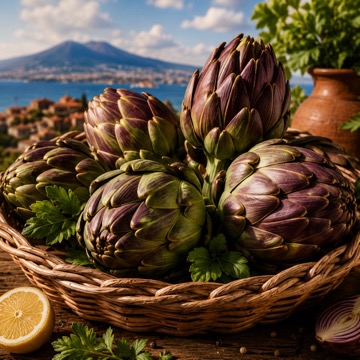
Carciofo Violetto di Schito
No spines. Tender inner leaves. Grown in volcanic soil between Pompei and Castellammare — the artichoke variety that defines spring in Campania. Used in the carciofi stufati, frittata di carciofi, and carciofi indorati e fritti. See the artichoke hub for all preparations.
Carciofo di Paestum
Round, nearly spineless, with a characteristic violet shade. From the Sele plain near the ancient Greek temples of Paestum. Slightly larger than the Schito variety, with a more pronounced mineral flavour from the alluvial soil.
Onions
Cipolla di Vatolla
The enormous sweet Cilento onion — mild enough to eat raw, almost impossible to cry over while cutting. Less common than the Montoro for la Genovese, but excellent when you can find it — and worth seeking out. Its full story is in the Cilento post.
Cipolla Ramata di Montoro
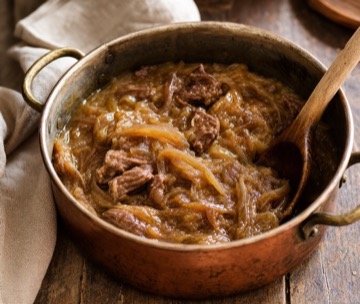
Copper-skinned, sweet, and extraordinarily resistant to long cooking — it does not disintegrate but softens into silkiness. The renowned traditional onion for la Genovese napoletana — its sweetness and structural resilience through five hours of slow cooking make it the benchmark. Also excellent in any preparation requiring long-cooked onion.
Vegetables
Friarielli Napoletani
The young flowering shoots of Brassica rapa — not quite broccoli rabe, not quite turnip greens, but the Neapolitan variety with a specific bitterness that no other region produces. The canonical pairing: salsiccia e friarielli.
Papaccella Napoletana
A small, flat, heavily ribbed sweet pepper endemic to Campania — also spelled pupaccella in dialect. Thick flesh, few seeds, a sweetness that survives pickling in red wine vinegar. Served at Christmas in the insalata di rinforzo and cooked with pork in braciole con papaccelle, one of the most specifically Neapolitan meat dishes.
Melanzana Cima di Viola
An elongated, deep-purple eggplant with compact flesh and very few seeds. The preferred variety for an authentic parmigiana di melanzane — its density and low water content allow it to fry without becoming waterlogged.
Fruit & Nuts
Mela Annurca Campana
The only apple native to Southern Italy. Harvested green and left to ripen on straw beds (aiulai) in the sun, developing its characteristic deep red colour and aromatic flavour. The "queen of Italian apples" — and a PAT that most Italians outside the South have never tasted.
Fico Bianco del Cilento
An ultra-sweet, pale-skinned fig traditionally sun-dried and stuffed with walnuts, almonds, or citrus rind (fichi impaccati). A confection that requires no sugar — the fruit is sweet enough on its own. From the same Cilento hills as the Cipolla di Vatolla.
Nocciola di Giffoni
A perfectly round hazelnut with white flesh and intense roasting aroma, considered one of the finest in the world by pastry chefs. Used by Ferrero for Nutella and across Italian pasticceria. Grown in the hills of Salerno province.
Castagna di Montella
Sweet chestnut from the Irpinia highlands — excellent roasted, in marron glacé, or in the caldarroste of autumn. The altitude and specific microclimate of Montella produce a consistently sweet, firm texture that flat-land chestnuts cannot match.
Legumes & Ancient Crops
Fagiolo di Controne
A tiny white bean with an almost paper-thin skin that makes it cook without soaking and digest easily. Very sweet flavour. Used in soups and stewed with olive oil and sage. One of the most prized legumes in Campania — nearly unknown outside it.
Cicerchia dei Campi Flegrei
An ancient legume — between a chickpea and a flat pea — grown on volcanic Phlegraean soil since Roman times. Rustic and mineral in flavour, used in thick winter soups. Considered a superfood in ancient Rome; now being rediscovered after near-extinction.
These are the products that appear most directly in the recipes on this site. The full PAT list of 550+ covers aged cheeses (Provolone del Monaco, Caciocavallo Podolico), preserved meats, seafood preparations, breads and pastries, wines, and olive oils — all the way down to specific preparations of single villages that exist nowhere else and are practised by a handful of families. Each one is a form of encoded memory: how people in a specific place grew and cooked something, refined over generations, and then kept doing exactly that way because it worked. The 550 is not an achievement to be proud of. It is a responsibility to maintain.
Does any of this still matter?
It is a fair question. Times change fast. People move, ingredient lists shift, supermarkets carry the same twelve varieties of tomato everywhere, and a good cook in a city far from Campania makes the best of what is available — and often makes something excellent. New culinary expressions exist that have nothing to do with tradition. Fusion works. Improvisation works. The idea that a dish must be made only this way, with only these ingredients, from only this place — it can start to sound like nostalgia at best, gatekeeping at worst.
But there may be a reason why people, over centuries, settled on these particular combinations of ingredients — and not only for flavour. Some ingredients, combined in specific ways, synergize. They enhance each other's absorption. They balance each other's toxic load. The olive oil in a frittata is not just fat — it carries the fat-soluble carotenoids from the vegetables into the bloodstream in a way that eating the same vegetables without fat cannot. The lemon on the artichoke is not just brightness — it preserves the iron. The tomato cooked with olive oil releases lycopene in a form the body can use; raw, it cannot. The pairing of legumes and grains that appears throughout the cucina povera of this region predates modern knowledge of amino acid complementarity by centuries, but it was nutritionally correct. People arrived at these combinations by observation, by survival, by the slow accumulation of knowledge that looks like tradition but is actually applied biochemistry without the vocabulary to describe it. The recipe is the result. The 550 PAT are 550 solved problems, handed down without explanation because the explanation was unnecessary — it worked, so you did it again.
This collection is also part of my life and my memories. A record of times that pass by and change. Of a kitchen in Campania with a bowl of lemon water on the counter and someone standing at the sink saying things about iron. Of dishes that appeared at specific moments of the year and nowhere else. Of flavours that are harder and harder to find the further you get from where they were made.
Maybe one day you will be able to make all of these, or some of them. And when you do, I hope you also read the stories behind them — the memories that come with them. Because that is what they are really carrying.