La Genovese Napoletana
One Sauce, Endless Magic
Is it a lost secret? A sauce that Naples kept mostly to itself for centuries — no tomato, no garlic, just onions and beef and time — while the rest of the world decided Neapolitan cooking meant ragù. Comforting, weekday-adjacent, and always in two separate courses. The pasta first. Then the meat. Never together.
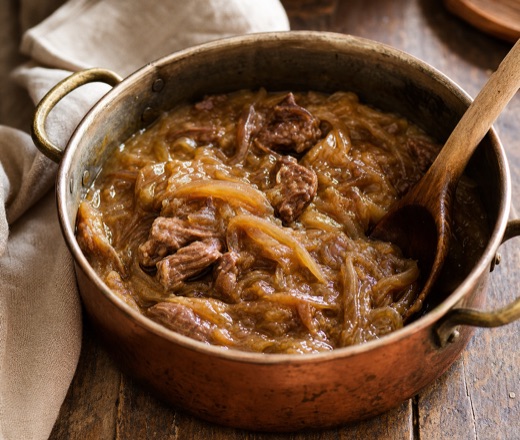
The Genovese is one of those Neapolitan preparations that surprises people who thought they knew Neapolitan cooking. No tomato. No garlic. No herbs beyond an optional bay leaf. Just onions — extraordinary quantities of onions, as many onions as there is meat, sometimes more — cooked with beef for three to five hours until the onions dissolve entirely into a sweet, amber-colored, almost creamy sauce and the meat becomes so tender it falls apart under a fork. The result does not taste of onions in the way that raw or lightly cooked onions taste. It tastes of something deeper and sweeter and more complex, a flavor that reads as meaty and savory without being either, a flavor that the Neapolitans recognized as one of the great things their kitchen could produce and that somehow remained largely unknown outside the city until relatively recently.
The name is the first question anyone asks. Why is a Neapolitan sauce called Genovese — Genoese, from Genoa? The honest answer is that nobody fully agrees. The most plausible theory is that Genoese cooks or merchants who settled in Naples during the period of Aragonese rule in the fifteenth and sixteenth centuries brought an onion-based preparation with them and it was absorbed into the Neapolitan kitchen under their name. There is also a theory that it was invented in Naples with no Genoese connection whatsoever and the name is simply a historical accident. A third version says the name comes from a neighborhood of Naples. Whatever the origin, by the time anyone was writing recipes down it was firmly Neapolitan — specific to Naples in the way that the ragù napoletano is specific to Naples, a preparation that defined the city's cooking identity even though it carried another city's name.
The memories I have of this sauce are weekday memories more than Sunday ones — which is unusual for a preparation that takes this long, and which reflects something about how it was made. A piece of beef put on the stove in the morning with a very large quantity of sliced onions, left to cook slowly while the day went on, producing a sauce by lunchtime that required no active attention after the first half hour. It is in this sense the anti-ragù: where the ragù requires commitment and surveillance and a Sunday morning, the Genovese can be left alone. The onions release enough moisture to prevent scorching, the beef self-bastes in its own juices, and the cook can leave the kitchen and return hours later to find a sauce that is ready.
And now — before going further — the important clarification about how it is eaten, which is non-negotiable and apparently not obvious to everyone outside Italy.
They are not served together. They are not on the same plate.
The sauce, once the cooking is done, is separated from the meat and used to dress ziti or paccheri — the pasta comes first, as the primo piatto, with the Genovese sauce coating the pasta richly and a sprinkle of Parmigiano or Pecorino over the top. Then the meat — which has given most of its flavor to the sauce and has been cooking for hours in the onion — comes out as the secondo piatto, sliced or pulled apart, served with a little of the remaining sauce alongside and perhaps some mashed potato or bread to soak up what is left. These are two distinct courses of the same preparation, and they are eaten in sequence with a pause between them. In the United States the instinct is often to combine everything on one plate and eat it simultaneously. This is not the same dish. The pasta tastes of the sauce and nothing else. The meat tastes of the onion and the hours and itself. Both deserve the attention of their own course.
Onions at scale behave differently from onions as an ingredient. A single onion added to a sauce contributes flavor; a kilogram of onions cooked slowly with meat over three hours contributes structure, body, and a profound sweetness that cannot be produced any other way. The process is primarily one of progressive caramelization and Maillard browning at very low temperature: as the onion cells break down and release their water, the fructooligosaccharides — the complex sugars responsible for raw onion's pungency — hydrolyze into simple fructose and glucose, which then undergo slow caramelization as the water evaporates. At the same time, the amino acids released from both the onion and the beef react with these sugars via Maillard reactions, producing hundreds of aromatic compounds — the amber color, the complex savory-sweet flavor, the depth that distinguishes a properly made Genovese from a quickly cooked onion sauce.
The absence of tomato and garlic is not an oversight. Tomato would introduce acidity that competes with the sweetness developing from the onion reduction; garlic would add a sharp aromatic note that sits on top of rather than integrating with the long-cooked flavor compounds. The Genovese works precisely because it has fewer ingredients than most comparable slow preparations — each element is present at sufficient quantity and for sufficient time to contribute fully, without competition. The beef's collagen converts to gelatin over the long cooking time and gives the sauce its body and its glossy finish. The wine deglazes the initial browning and provides acid to balance the sweetness during the early stages, then evaporates and leaves its fruit behind. Everything else is time.
The base recipe — serves 4–6
The golden rule: as many onions as meat. At least equal weight; traditionally slightly more onion.
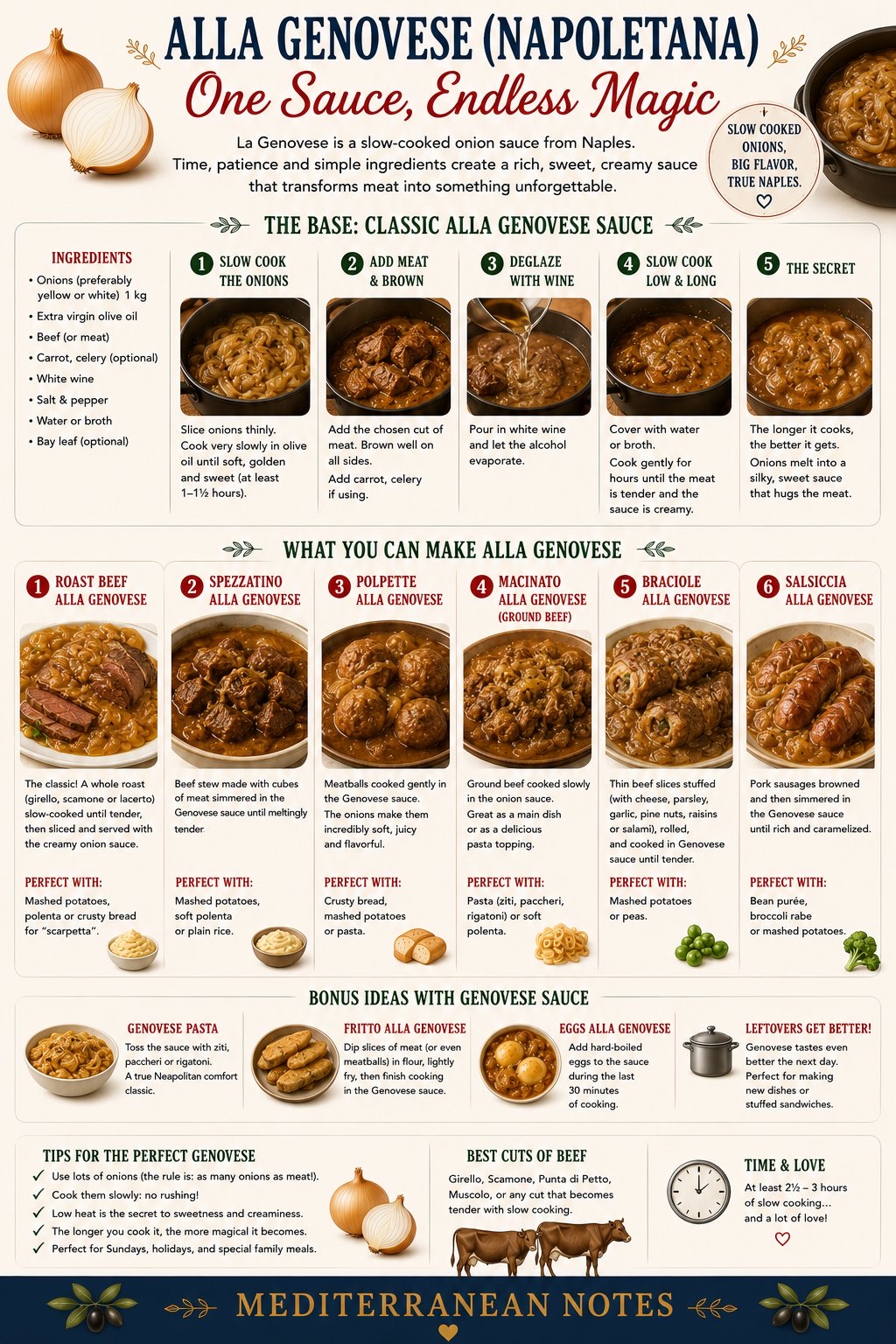
The preparations — one sauce applied six ways
The Genovese is one of those sauces that rewards anyone who takes the time to understand it properly. It asks for patience — the onion hour cannot be shortened without producing an inferior result — and it asks for restraint: resist the urge to add garlic, resist the urge to add tomato, resist the urge to combine the pasta course and the meat course on the same plate. The sauce has been doing this for at least five centuries in Naples and has not needed any of those additions. It does not need them now.
Buon appetito — prima la pasta, poi la carne.