Campanian kitchen · Fruit · IGP · Vesuvius · Tradition · All seasons
I Frutti Iconici di Napoli
Gifts of Vesuvius and the Mediterranean — four protected fruits of Campania
Four fruits. All IGP protected. All born from the same volcanic soil and Mediterranean climate that makes Campania one of the great agricultural territories of Europe. The Crisommola, the Melannurca, the Percoca, and the Limone di Sorrento. Simple, natural, authentic: this is Naples.
When people talk about Italian food, they talk about pasta, pizza, mozzarella, olive oil — the canonical exports. Less often do they talk about the fruit, which in Campania is a subject of comparable seriousness. The volcanic soil of the Vesuvius slopes and the surrounding provinces produces a range of fruit varieties that are not quite replicable anywhere else: the minerality of the soil, the particular intensity of a Mediterranean sun that is also moderated by sea air and by altitude, and the centuries of agricultural attention from farmers who have been cultivating these varieties in this specific territory since Roman times combine to produce results that a geographer would call terroir and that anyone who has eaten a ripe crisommola from Vesuvius or a Melannurca finished on the straw melai would recognize as immediately as they recognize the flavor of a Campanian San Marzano tomato. It is not the same thing grown somewhere else. It is a different thing that only grows there.
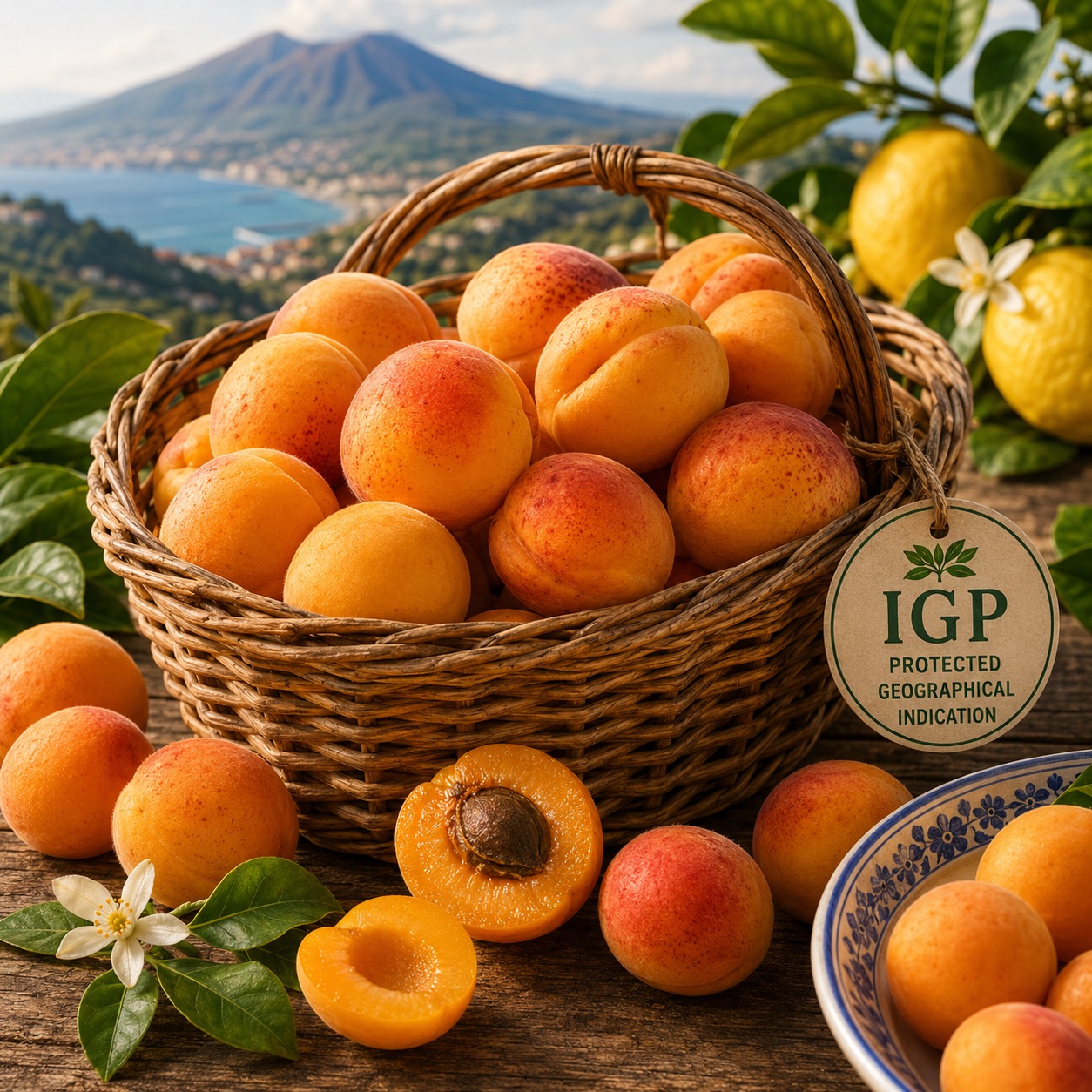
All four of the fruits on this page carry the IGP designation — Indicazione Geografica Protetta, Protected Geographical Indication — which is the European Union's certification that these products are produced in a specific territory according to specific traditional methods and that the geographical origin is essential to their character. IGP is not just a marketing label. It is a legal guarantee with annual inspections, strict production protocols, and defined production zones. These four fruits can only be called by their protected names if they come from their specific Campanian territories. A lemon from Sicily, however excellent, is not a Limone di Sorrento. A peach from Emilia is not a Percoca. The geography is the product.
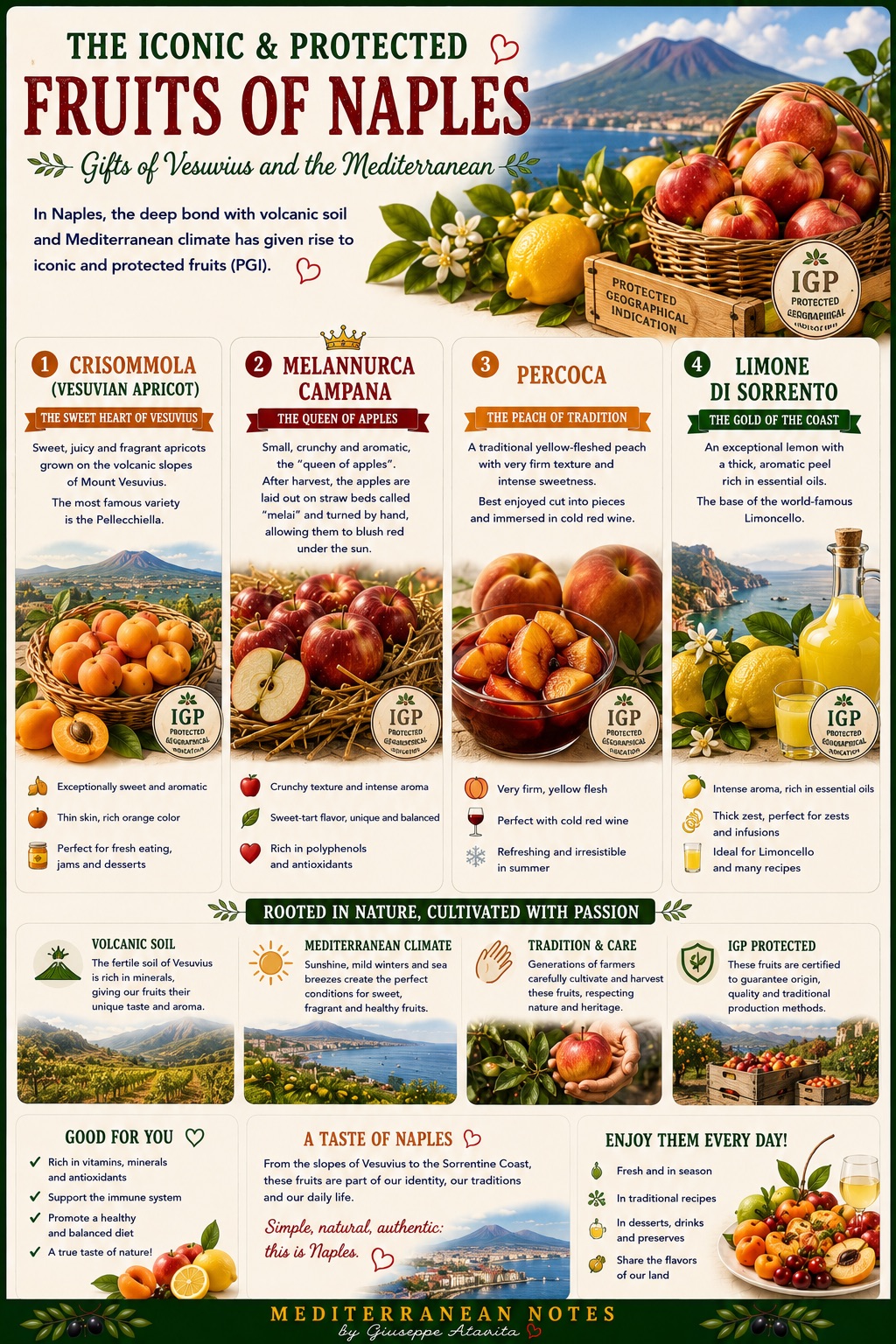
The crisommola — the Neapolitan dialect name for the Vesuvian apricot — is not a fruit that travels. This is its first and most honest characteristic. The Pellecchiella, the most celebrated variety, has a thin skin that splits at a touch, an orange flesh so saturated with sugar and aromatic compounds that it begins fermenting within hours of peak ripeness, and a fragrance so concentrated that a single fruit in a room changes the smell of the room. None of these qualities are compatible with the refrigeration, the packaging, and the days-long logistics of modern fruit distribution. The Pellecchiella is picked by hand when ripe, sold the same day, and eaten that day or the next. No later. This is not a constraint imposed by the market — it is a constraint imposed by the fruit's own biology, and it is the same biology that produces the extraordinary flavor.
Growing up in Caserta, the crisommole appeared in June and early July at the fruit vendors, piled in the small yellow-orange pyramids that are their visual signature, and they were not a fruit you planned to buy — you bought them when you passed the vendor and they were there and they were ready, because they might not be there tomorrow and they would not wait. Eaten fresh off the skin — the thin membrane separating easily with a thumbnail — or sliced into a macedonia di frutta, or made into a jam that concentrated their fragrance into a preserve that lasted until winter and tasted like summer compressed into a spoonful. In the United States they are essentially absent. A crisommola from Vesuvius eaten on a July morning in Campania is one of the most specific and non-transferable experiences of the region.
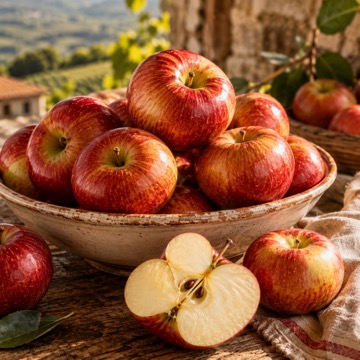
The Melannurca Campana is the opposite of the crisommola in almost every practical characteristic: long storage life (months in a cool dry place), available from autumn through late spring, physically robust and easy to transport, consistent across the season. It is also the opposite in its relationship to time — where the crisommola demands immediate eating, the Melannurca improves with patience, its post-harvest sun-finishing on the straw melai requiring weeks of careful hand-turning before the apple reaches its characteristic deep red color, intense aroma, and perfect sweet-tart balance.
My father ate one every evening after dinner. Small, crisp, aromatic — the correct ending to a meal that required nothing added to it. For him it was a daily habit, not a saying, though he quoted the saying every time. The Melannurca is exceptionally rich in polyphenols and procyanidins — among the highest of any commercially cultivated apple variety — which gives the "one apple a day" tradition here a specific biochemical basis beyond the general principle.
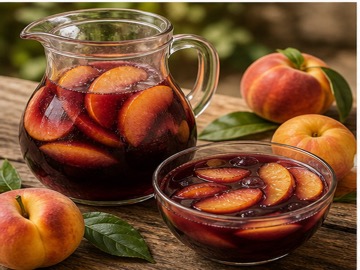
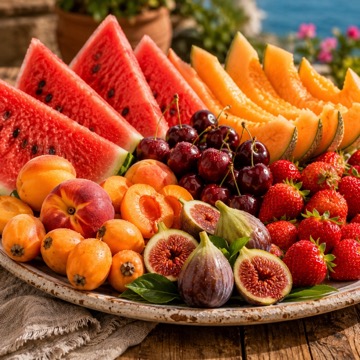
The percoca — also spelled percoche, plural of percoca — is a firm, yellow-fleshed clingstone peach that is essentially unlike the soft, fragrant peaches that define the category elsewhere. Where a typical summer peach is juicy, fragrant, and collapses on contact, the percoca is dense, slightly resistant to the bite, less immediately aromatic when eaten fresh, and entirely suited to two specific uses for which the soft peach is completely wrong. The first is the fruit plate — the firm flesh holds its shape when cut into large wedges and does not release excess liquid into the other fruits alongside it. The second, and the more distinctively Campanian use, is the vino e percoche: the percoca cut into pieces and immersed in a pitcher of chilled red wine (traditionally a Gragnano or a light Campanian rosso) for at least an hour, then eaten with a spoon along with the wine-soaked fruit. This is the Neapolitan sangria, and it requires the percoca specifically. A soft peach would be waterlogged and disintegrated within twenty minutes. The percoca, with its dense structure, absorbs the wine for an hour and comes out as something better than either the fruit or the wine was alone.
My father always had vino e percoche in summer. He did not overthink the wine — whatever was on the table — and the result was always good because the percoche were the right percoche and they were given enough time. That is the whole recipe.
The Limone di Sorrento is a large, intensely aromatic lemon grown on the terraced hillsides of the Sorrentine Peninsula and the Amalfi Coast — one of the most visually dramatic agricultural landscapes in the world, where the lemon groves are strung along steep hillsides above the sea, shaded by woven reed pergolas that protect the fruit from direct sun and slow its ripening to produce a thicker, more aromatic peel. The peel is the point. Where most commercial lemons are valued for their juice, the Limone di Sorrento is valued primarily for its zest — the thick, essential-oil-rich outer layer that contains the aromatic compounds responsible for the lemon's characteristic intense fragrance. The essential oil content of the Sorrentine peel is significantly higher than that of most other lemon varieties, which is why this lemon became the basis of Limoncello, the lemon liqueur that is produced by macerating the zest (never the juice) in high-proof alcohol and then diluting with a sugar syrup.
The Limone di Sorrento appeared in our kitchen in Caserta primarily as a flavoring rather than a fruit to eat fresh. The zest went into pastiera, into the sfogliatella filling, into the peel-infused syrup for struffoli. The juice went into the fish preparations — the scarpetta liquid in the acqua pazza pan, the lemon alongside the polpettone di tonno. A few slices alongside a piece of grilled fish. The whole lemon's presence in the kitchen was pervasive and largely unannounced — it was simply always there, its fragrance emerging from the zest whenever a knife broke the peel, one of the most specific and reliable smells of the Neapolitan kitchen in any season.
Cosa li rende straordinari — the shared foundation
Volcanic soils derived from basaltic lava flows — like those surrounding Vesuvius — have a specific mineral composition that differs significantly from sedimentary agricultural soils. High potassium content (from the feldspar minerals in volcanic rock) directly accelerates sugar synthesis in fruit by activating the enzyme sucrose synthase, which catalyzes the conversion of glucose and fructose to sucrose in the fruit's vacuoles — the cellular compartments where sugars are stored. High phosphorus levels support root development and overall plant vigor. The porous, well-draining structure of volcanic soil creates conditions of mild water stress during fruit ripening — the plant absorbs enough water to support growth but experiences slight limitation during sugar accumulation, which is associated with higher sugar-to-acid ratios and more concentrated aromatic compound profiles in the fruit. This mechanism — controlled water stress producing more flavorful fruit — is the same principle behind regulated deficit irrigation in premium viticulture and behind the intense flavor of fruits grown on the thin, stony soils of the Vesuvian slopes compared to those grown in deeper, more water-retentive agricultural soils. The aromatic compounds responsible for the specific fragrance of each fruit — the esters and aldehydes of the crisommola, the terpene-based essential oils of the Limone di Sorrento, the polyphenol-derived aromas of the Melannurca — all accumulate at higher concentrations in the volcanic soil environment than they would in less mineralogically complex soils.
I think about these four fruits when I walk through the produce section of an American supermarket in summer and find peaches that have been picked green for transport and ripened in controlled atmosphere storage, apples that have been held in cold rooms for six months, lemons bred for juice yield and uniformity of appearance, and apricots that look correct but taste of almost nothing. These are not bad products by the standards of the system that produces them. They are exactly what that system optimizes for: shelf life, uniformity, transportability. The four Campanian IGP fruits optimize for none of those things. They optimize for flavor, for a specific connection to a specific territory, for the kind of taste that makes you stop what you are doing when you eat them. This is not efficiency. It is the right choice, and it produces the right result, and it has been producing the right result for two thousand years in the same volcanic soil.
Semplice, naturale, autentico: questo è Napoli.