Melanzane sott'olio: my mother's jars, and a summer that lasted all year
Every year when eggplants were in season, my mother made tens of jars. Cutting, salting, draining, the vinegar bath, the layers of garlic and chili and olive oil. The kitchen smelled of it for days. And then the jars were in the pantry, and the summer was preserved inside them, and we ate it all year long.
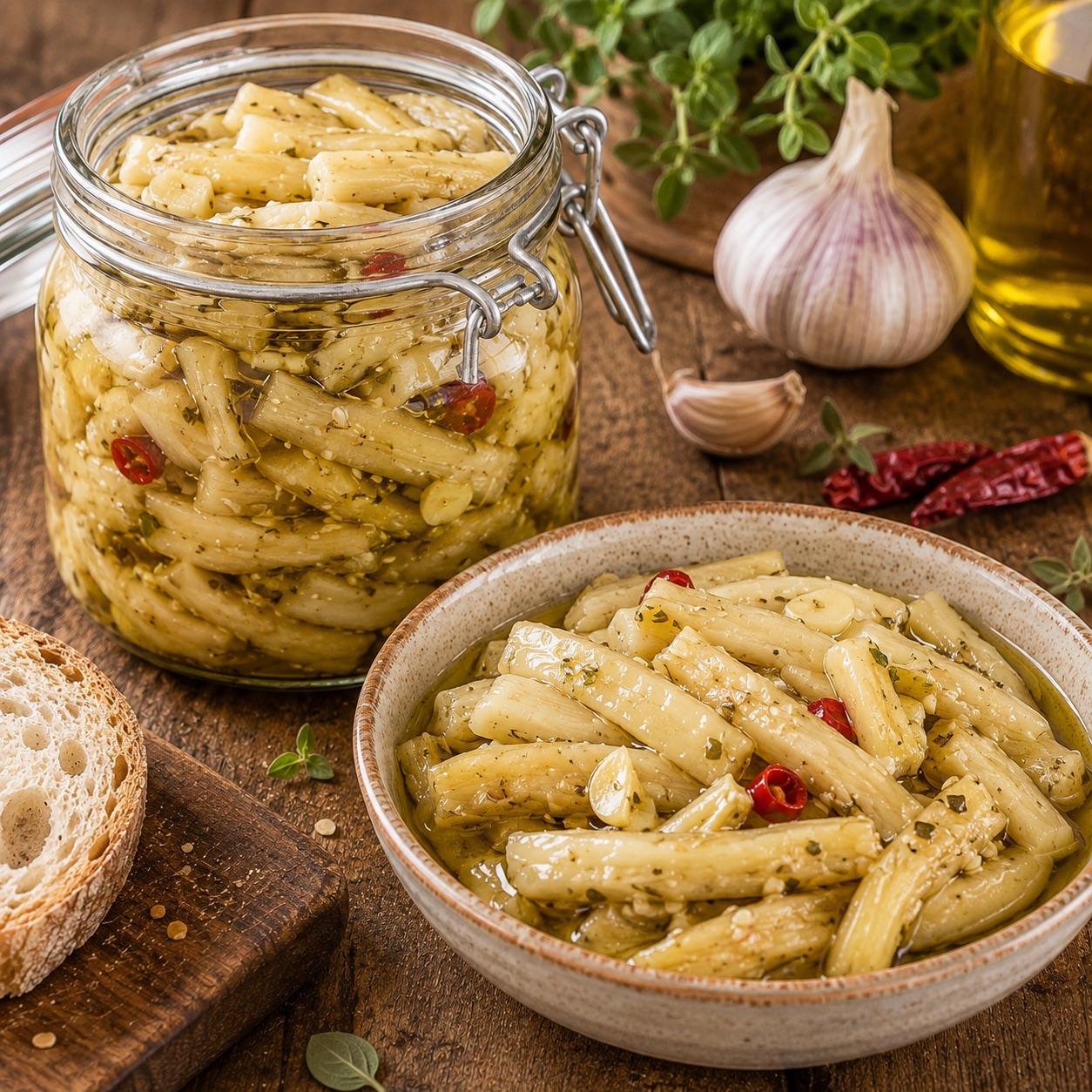
This is one of the foundational recipes of the southern Italian pantry. When eggplants arrive in August in Campania — abundant, cheap, in every market — Italian families have been making this preserve for generations. It is not a formal or complicated process, but it requires time and attention and a willingness to spend a day in the kitchen that produces something lasting. My mother made it in quantity: not two or four jars but tens of them, enough to last through the autumn and into the winter, to have always available for the moments when a plate needed something and the pantry provided the answer without any cooking required.
The eggplant can be cut different ways — thinner strips for a more delicate texture, larger chunks for something more substantial that holds its shape when placed on a plate. Both work. The process is the same: salt to draw out the bitter water, drain for several hours under weight, a brief bath in water and vinegar to cook them slightly and acidify them (which is what makes the preserve safe), then layer into sterilized jars with garlic, chili, oregano or mint, and cover completely with extra-virgin olive oil. The patience required is mostly waiting — the salting and draining, the cooling, the minimum week in the jar before opening. Better after a month.
If you have followed this blog through the summer dishes, you have already encountered these jars. They appear in the gattò di patate — a few slices alongside the potato bake as the sharp counterpoint to all that richness. In the rice salad — a handful cut into pieces, contributing their preserved oil and vinegar to the dressing. In the melanzane a funghetto post they are mentioned as the side that cuts through the heat of the dish. They are one of the most versatile things in the Campanian pantry, which is why a serious household makes enough of them to last the year.
Food safety — this is important
Preserving vegetables in oil carries a risk of botulism — Clostridium botulinum — if the acidity of the product is insufficient. The vinegar bath in this recipe is not optional and cannot be shortened: it is the step that acidifies the eggplant and creates an environment in which botulinum spores cannot germinate. Never use an oil-only method for long-term preservation of eggplant; it is not safe. Use sterilized jars and lids. Ensure the eggplant is completely submerged under oil at all times — any eggplant exposed to air above the oil level can develop mold. For additional safety, the sealed jars can be processed in a water bath at boiling for 20–25 minutes to create a vacuum seal. Store in a cool, dry, dark place. If a jar smells off when opened, discard it without tasting. These are old precautions, applied by every Italian household that has been making this preserve safely for generations.
Salt, acid, and oil — the three-barrier chemistry of traditional preservation
The melanzane sott'olio preparation is a case study in traditional food preservation chemistry that anticipates modern food safety principles. The double barrier against Clostridium botulinum — acidity from the vinegar bath plus oxygen exclusion from the oil covering — creates conditions in which the anaerobic bacterium cannot thrive even without refrigeration. The acetic acid from the vinegar (white wine vinegar typically contains 5–6% acetic acid) drops the pH of the eggplant tissue to below 4.6, which is the threshold at which botulinum toxin production is inhibited. This pH reduction is achieved in the brief 2–3 minute cooking step in the water-vinegar mixture — short enough to keep the eggplant firm and flavorful, long enough to acidify the tissue. From a nutritional standpoint, the preserved eggplant retains nasunin (the anthocyanin antioxidant of the purple skin), chlorogenic acid, and the phenolic compounds of the eggplant flesh, now in an olive-oil matrix that provides an excellent absorption medium for these fat-soluble and partly fat-soluble antioxidants. The garlic preserved in oil alongside the eggplant undergoes slow enzymatic changes over the weeks of storage, producing allyl thiosulfinates and their derivatives that deepen in flavor as the jar ages. The minimum one-week, better one-month waiting period before opening is not merely about flavor development — the acid and oil need time to equilibrate throughout the jar and stabilize the microbiological environment of the product.
The recipe
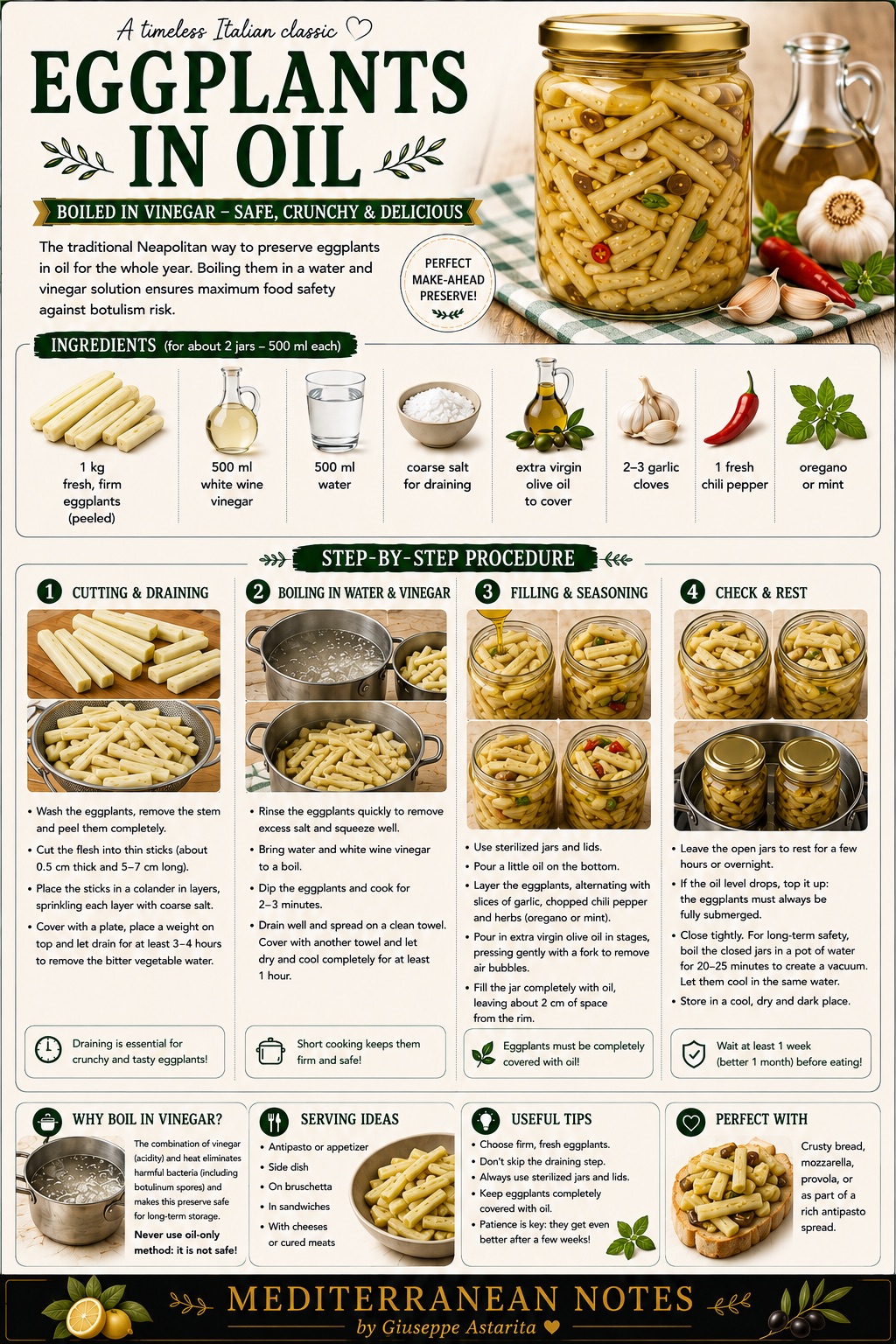
Ingredients · makes about 2 × 500 ml jars
Method
Cut and salt. Wash the eggplants, remove the stem, and peel them completely. Cut the flesh into slices about 1 cm thick, then into strips about 1 cm wide — or larger chunks if you prefer a more substantial texture. Place the strips in a colander in layers, sprinkling each layer generously with coarse salt. Place a plate and a weight on top. Let drain for at least 3–4 hours — ideally overnight. The salt draws out the bitter dark water; do not skip or shorten this step. The drained eggplant should feel noticeably drier and slightly limp.
The longer the draining, the firmer and less bitter the finished preserve. Overnight in the refrigerator under weight gives the best result.
Rinse and cook in vinegar. Rinse the eggplant strips under cold running water to remove excess salt. Squeeze firmly with your hands to remove as much liquid as possible. Bring the water and vinegar to a boil in a large pot. Add the eggplant strips and cook for exactly 2–3 minutes — no more. They should be slightly cooked but still firm; overcooked eggplant becomes mushy in the jar. Drain immediately and spread on a clean kitchen towel. Cover with another towel and press firmly to remove as much liquid as possible. Leave to cool and dry for at least 1 hour.
Do not overcook. The texture of the finished preserve depends entirely on stopping this step at 2–3 minutes. Set a timer.
Fill the jars. Use sterilized jars and lids — boil them in water for 10 minutes and let dry completely before using. Pour a little olive oil in the bottom of each jar. Add the eggplant in layers, alternating with slices of garlic, pieces of chili, and a pinch of oregano or dried mint. Press down gently between layers to remove air pockets. Pour extra-virgin olive oil in stages, pressing with a fork to eliminate air bubbles. Fill to cover the eggplant completely, leaving about 2 cm of space from the rim. The eggplant must be entirely submerged in oil.
Rest and check. Leave the open jars to rest for a few hours or overnight. The oil will be absorbed slightly and the level may drop — top up with more olive oil as needed until the eggplant is fully covered again. Close the lids tightly. For additional safety and longer shelf life, process the sealed jars in a pot of boiling water for 20–25 minutes to create a vacuum seal. Let cool completely in the water. Store in a cool, dark, dry place.
Wait at least 1 week before opening. The flavors need time to develop. Better after a month. The jars that survive that long are the best ones.
Where these jars appear in this kitchen
On bread — the simplest use
A slice of good bread, a few strips of melanzane sott'olio with some of their oil. A pinch of oregano if it is not already in the jar. This is a lunch that requires nothing else and is better than it sounds, which is already good.
With cheese and cured meats
On an antipasto plate alongside provolone, scamorza, or aged pecorino, with a few slices of salami or prosciutto. The acidity of the preserve cuts through the fat of the cheese and meat in exactly the right way.
Alongside the gattò di patate
A few slices beside a portion of the Sunday potato bake — the sharpness against the richness. This combination is mentioned in the gattò post as one of the two classic side pairings. It works because it needs to.
In the rice salad
Cut into pieces and mixed into the insalata di riso, their preserving oil contributing to the dressing. One of the key ingredients in the family version of the rice salad — the version without tuna, built from the pantry.
With grilled or roasted meat
A few strips alongside roasted pork, grilled sausage, or a simple roast chicken. The acidity provides exactly the counterpoint that rich meat needs, without requiring any additional sauce or preparation.
The oil itself
The olive oil in the jar — after the eggplant is gone — is infused with garlic, chili, and eggplant flavor and is excellent drizzled on bread, pasta, or bruschetta. Do not discard it. It is the last gift of the jar.
Buon appetito — e buona conserva.