'O purè alla napoletana: the mashed potatoes my mother made
Egg yolks stirred in off the heat. Pecorino Romano grated very fine so it melts without graining. Cold butter added to warm milk so the emulsion holds. A bowl of this with a salad and a few greens on the side was a complete meal when I was a child — one of the most nutritious things on the table, though I did not know that at the time. I just knew it was good.
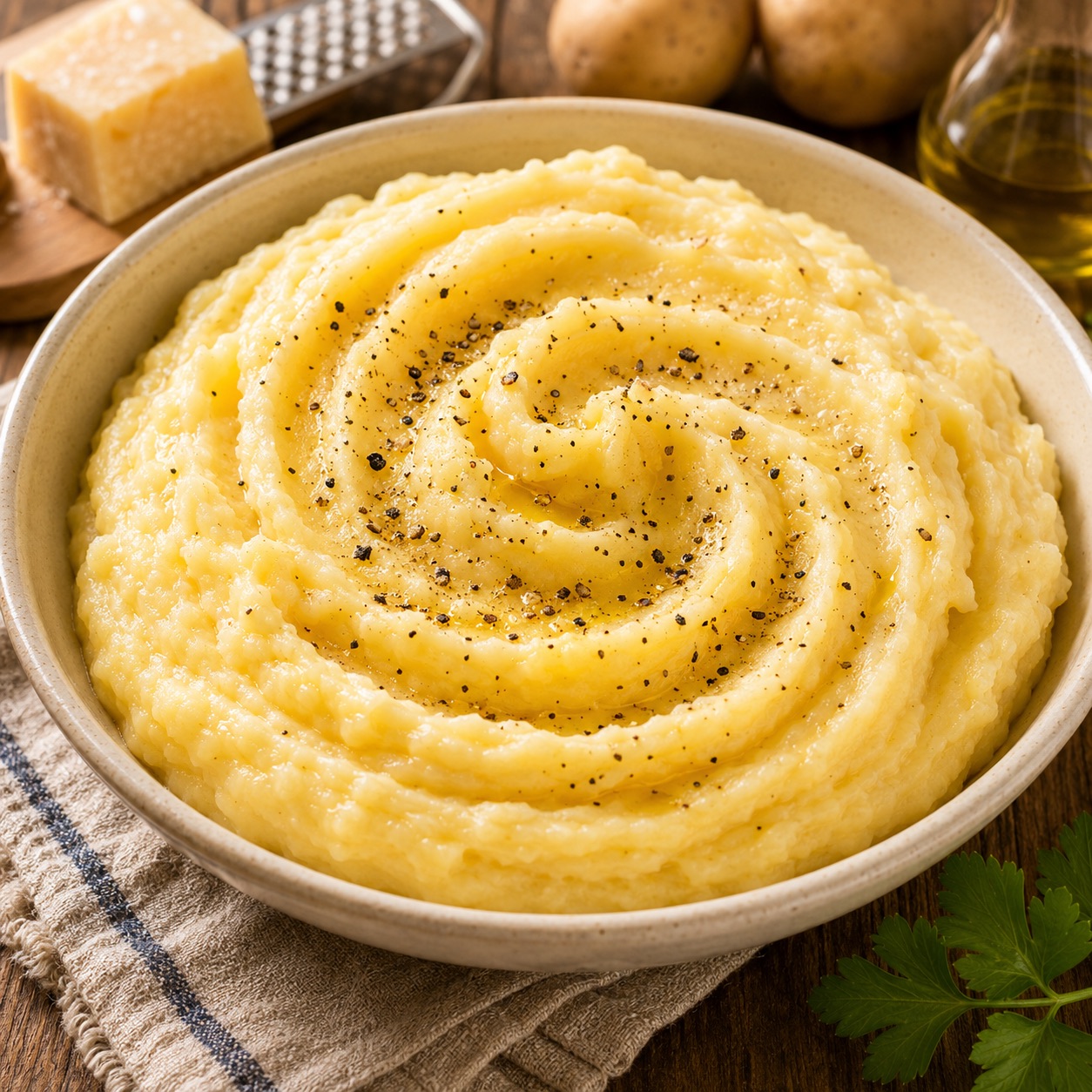
My mother made purè di patate to make me eat potatoes. This is the honest version of the origin story. I was a child who did not eat potatoes in their ordinary forms — not boiled, not roasted, not in soup — and so my mother found the form in which I would eat them, which turned out to be this one: smooth and golden, rich from the egg yolks and the Pecorino, with the specific silky texture that comes from a potato ricer and warm milk added gradually and cold butter cubed and whisked in at the end. I ate it. I ate a great deal of it. I ate it as a main course with a small salad alongside, which was not the canonical use of a side dish but was a perfectly complete meal for a child who needed the calories and the nutrition and had strong opinions about what he would and would not accept on a plate.
The Neapolitan 'O Purè is a different thing from what most people outside of Italy mean when they say mashed potatoes. It is richer, smoother, more intensely flavored. The egg yolks — added off the heat, so the residual warmth cooks them gently without scrambling — give it a golden color and a creaminess that butter alone does not produce. The Pecorino Romano adds a sharp, savory depth that is distinctly Campanian: the same cheese that goes into the ragù and the pasta al forno and the meatballs, the cheese that is the background note of most things that taste like home in this particular region. It is not a subtle preparation. It is a generous one.
The Italian tradition has always used the purè this way — not just as accompaniment but as a self-sufficient dish when made well enough. A bowl of it alongside braised meat is the canonical pairing, because the broth from a Neapolitan ragù or a beef brasato poured over the surface of the purè creates something that is better than either preparation alone. But the bowl on its own, with good bread, or with a bitter green like friarielli or cicoria sautéed in olive oil and garlic alongside it, is not a diminished version of the meal. It is the meal. The potato, the egg yolk, the cheese, the butter, the milk: these are not minor ingredients. The nutritional profile of this bowl is serious.
Potato starch, butter fat, and the digestibility of a well-made purè
The 'O Purè alla Napoletana is nutritionally denser than it appears. A serving built on 250 g of starchy potato provides approximately 20 g of complex carbohydrates — primarily starch in its most digestible form, since the heat of cooking gelatinizes the granules fully, making it one of the most bioavailable carbohydrate sources in the kitchen. Two egg yolks contribute approximately 10 g of high-quality fat (predominantly oleic acid and palmitic acid), 5–6 g of protein, and a concentrated dose of fat-soluble vitamins: vitamin A as retinol (not as beta-carotene, which requires conversion), vitamin D, vitamin E, and vitamin K2 — a form of vitamin K that is rare in plant foods and important for calcium metabolism and bone mineralization. The egg yolk is also one of the best dietary sources of choline, a nutrient essential for neurological development in children and for liver function in adults, and one that most Western diets are consistently deficient in. The Pecorino Romano contributes additional complete protein, calcium, and phosphorus. The whole milk adds calcium, fat-soluble vitamins A and D in the form most readily absorbed, and the small amount of lactose that, when combined with the heat of the preparation, contributes to the characteristic mild sweetness of a good purè. Cold butter added to warm milk creates a partial emulsion — the fat distributes evenly through the aqueous phase of the milk rather than pooling — which is why this technique produces a silkier texture than adding room-temperature butter to room-temperature milk. The potato ricer, not the food processor or immersion blender, is essential: a blender cuts the starch granules and releases amylose, producing a sticky, gluey paste. The ricer separates the cells without rupturing them, maintaining the light, fluffy texture that then absorbs the liquids in suspension rather than forming a paste. This is the chemistry behind what home cooks call "the texture."
The recipe — the Neapolitan way
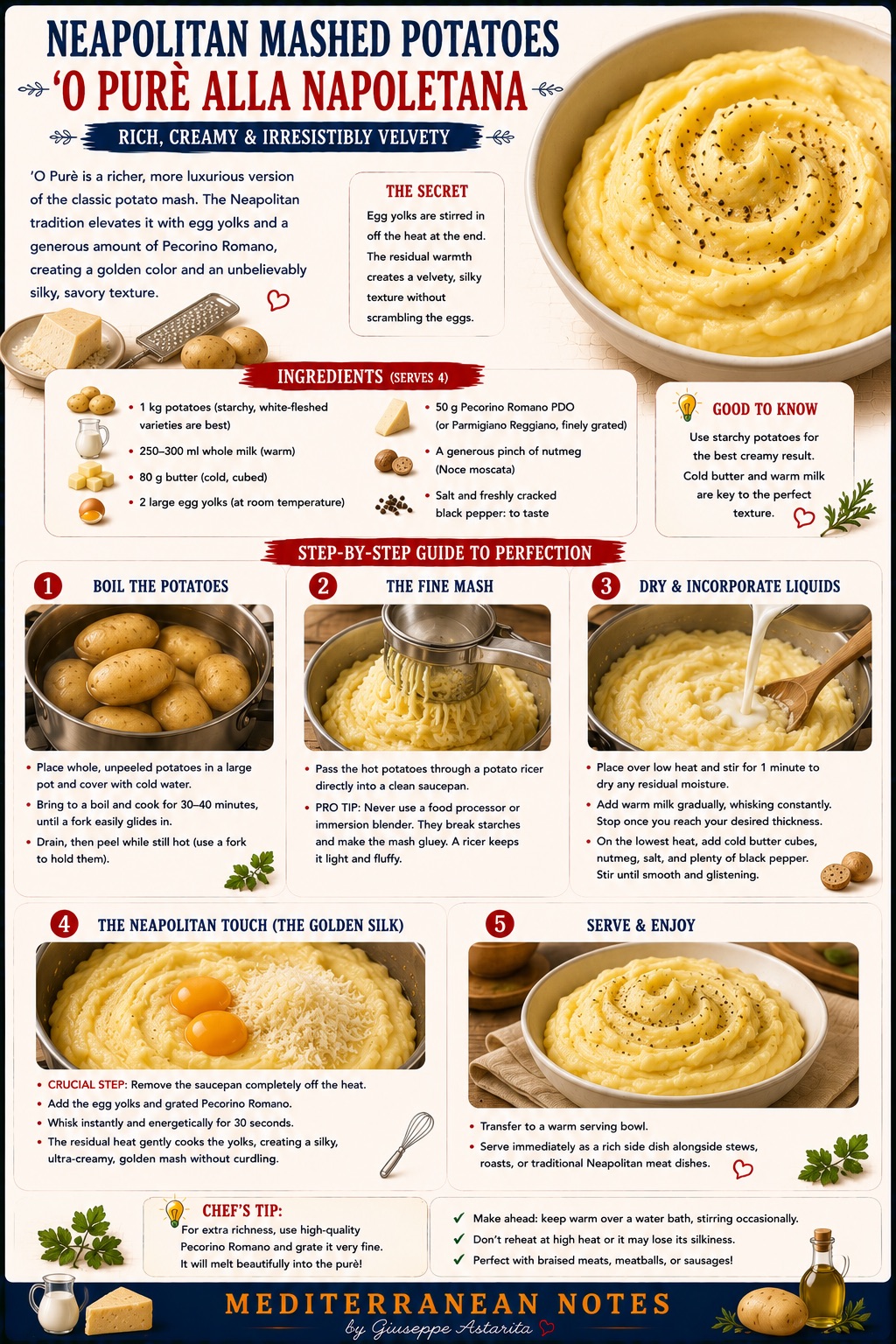
Ingredients · serves 4
Method
Boil the potatoes whole and unpeeled. Place the potatoes in a large pot, cover with cold water, bring to a boil, and cook for 30–40 minutes until a fork slides in without resistance. The time depends entirely on size — check after 30 minutes and continue if needed. Drain, then peel while still hot, holding each potato with a fork against the cutting board and pulling the skin away in strips. The peel comes off easily when hot; it becomes difficult when the potato cools.
Cooking whole and unpeeled prevents the potato from absorbing water, which would make the final purè watery and dense. This is not optional.
Pass through a potato ricer — immediately, while hot. Pass the hot peeled potatoes through a potato ricer directly into a clean saucepan. Work quickly: the ricing must be done while the potatoes are still hot, before the starch sets. Never use a food processor, a blender, or an immersion blender. These cut the starch cells and produce a gluey, unworkable paste. The ricer separates the cells without breaking them. The result is a light, fluffy, dry base ready to absorb the liquids.
Dry the mash and incorporate the milk and butter. Place the saucepan over very low heat and stir for about 1 minute to evaporate any remaining moisture. Add the warm milk gradually — a little at a time — whisking constantly and stopping when the consistency is smooth and slightly looser than you want the final result to be. Add the cold butter cubes a few at a time, whisking constantly until each addition is fully absorbed before adding the next. Add the nutmeg, salt, and a generous amount of freshly cracked black pepper. The mash should be smooth, glossy, and visibly rich.
Cold butter into warm mash is the technique. It creates an emulsion rather than simple fat absorption. The result is a different texture — lighter and more cohesive — than butter added at the same temperature as the mash.
The Neapolitan touch — the egg yolks and Pecorino. Remove the saucepan completely from the heat. Add the egg yolks and the finely grated Pecorino Romano. Whisk immediately and energetically for about 30 seconds. The residual warmth of the mash gently sets the yolks — cooking them just enough to be safe and to thicken the preparation further — without scrambling them. The mash becomes golden, silky, and noticeably richer. This is the step that makes it Neapolitan rather than simply Italian.
Off the heat is not a suggestion. On the heat the yolks will scramble and produce a grainy, yellow-flecked result. The pan must be fully off the burner before the yolks go in. Thirty seconds of energetic whisking distributes the heat evenly from the residual warmth of the mash itself.
Serve immediately in a warm bowl. Transfer to a warm serving bowl — a cold bowl pulls heat from the surface immediately and changes the texture. Serve as a side dish alongside braised meat, meatballs, or sausages with their cooking juices poured directly over the surface. Or serve as a main course with a bitter green alongside — friarielli sautéed with garlic and chili, or cicoria, or a simple salad dressed with olive oil and lemon. A bowl of this, a piece of good bread, and a green: that is a complete meal.
To keep warm for serving: place the bowl over a pot of barely simmering water, covered, and stir occasionally. Do not reheat over direct high heat — the egg yolks will grain and the silkiness will be gone.
A complete meal — not a side dish waiting for permission
There is a tendency in contemporary cooking culture to sort dishes into rigid hierarchies — the main course that justifies the meal, the side dishes that attend it. The Italian contorno and the primo and the secondo have their own structure too, but within that structure there has always been room for a bowl of something substantial to stand alone when the occasion called for it. A bowl of purè with a bitter green sautéed alongside it is not a diminished meal. It is a deliberate one — nutrient-dense, satisfying, built from inexpensive ingredients that become, through technique, something considerably better than their components suggest.
My mother understood this intuitively and without the language of nutrition. She understood that a child who would eat a full bowl of purè and a salad had eaten well, regardless of whether there was a piece of meat on the table. The potatoes provided the carbohydrates and the sustained energy. The egg yolks provided the fat-soluble vitamins and the choline. The Pecorino and the milk provided the calcium and the protein. The olive oil dressing on the salad provided the monounsaturated fats that made the fat-soluble vitamins in the yolks available for absorption. This is not hindsight — this is simply what a traditional Campanian home kitchen understood about food long before the science had a vocabulary for it.
If there was braised meat available — a piece of beef from a ragù, a few sausages, a polpetta — it went alongside or on top, with its cooking liquid poured over the surface of the purè. The hot braising liquid soaked in and enriched the mash from the top while the cold butter and egg yolks held the base together from below. This is one of the best combinations in the Campanian kitchen and one that requires very little explanation once you have eaten it. The rest of the time — the ordinary weekday lunch, the meal that needed to be made quickly and eaten and finished — a bowl of purè, a green, a piece of bread, and the meal was done.
Buon appetito — e grazie, mamma.