La Cultura dei Salumi
The cured meats of Campania — and the one that runs through half this blog
In Italy, salumi are not a category of food so much as a system of knowledge — what each one is, where it comes from, how thick to slice it, what bread it wants. Growing up in Caserta meant learning this without being taught it directly.
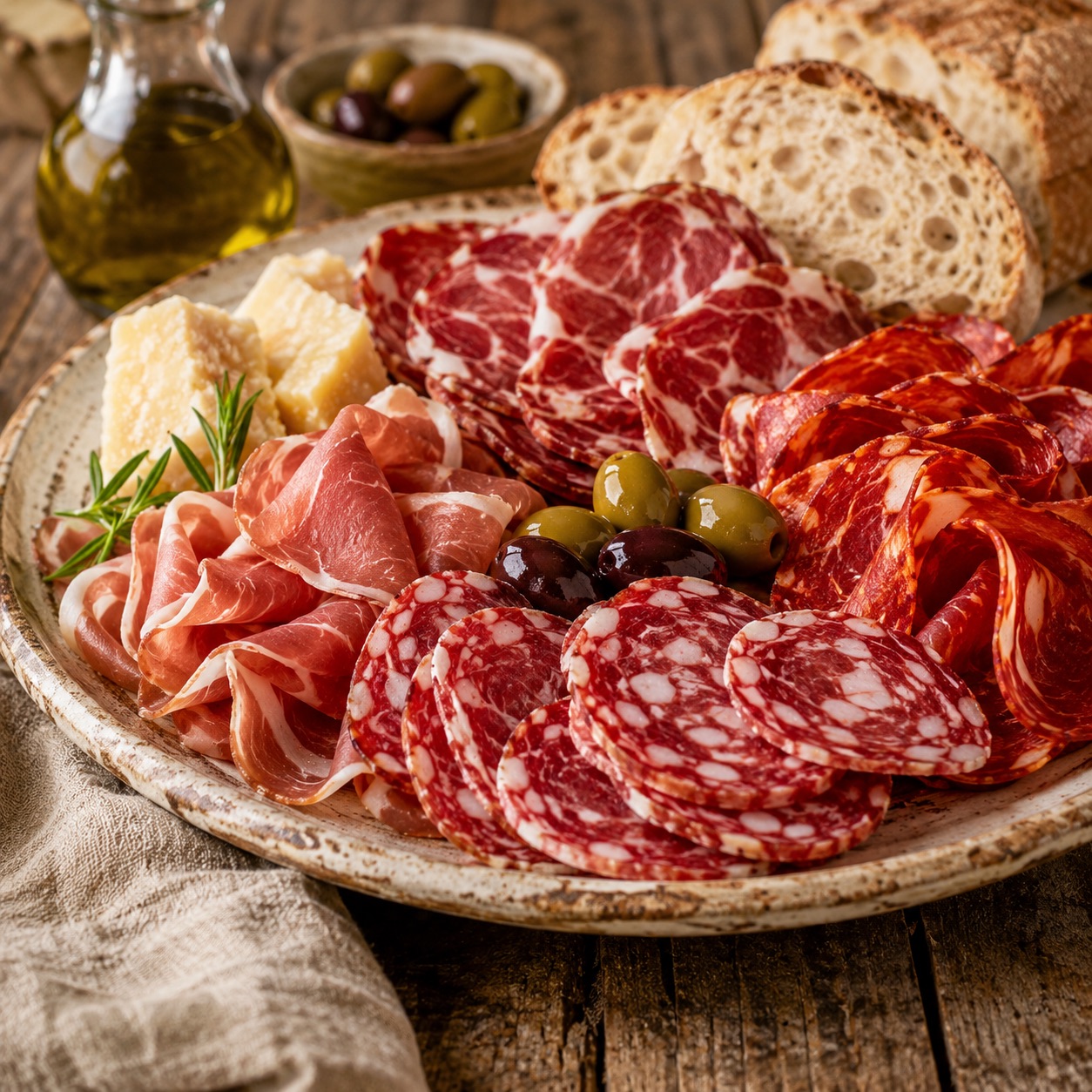
The salumeria was a specific kind of shop that has largely been absorbed by the supermarket, though not entirely. In Caserta when I was growing up, it was a narrow space with a glass counter, a large slicer bolted to one end, and a number of hanging salami from the ceiling that meant something specific about the season and the region. The man behind the counter — and it was always a man in my memory, though I am sure this was not universal — knew what everything was and would tell you if you asked, and the slicing happened in front of you to whatever thickness you specified. Thin for salame Napoli, slightly thicker for capocollo, very thin indeed for prosciutto. This information was transmitted practically and quickly and I absorbed it without noticing I was learning anything.
Campania's salumi tradition is rooted in the inland areas — the provinces of Caserta, Benevento, Avellino — where pig farming was woven into the agricultural economy for centuries and where the maiale nero casertano, the Black Casertano Pig, produced the raw material for a distinct regional charcuterie. The Black Casertano is a slow-growing heritage breed with high fat content and a specific fat composition that produces a more aromatic, complex flavor in aged products than the commercial white pig breeds that came to dominate Italian production in the second half of the twentieth century. A capocollo or a soppressata made from Black Casertano pork is a different product from one made with commercial pork, and the difference is not subtle. The breed has been recovering — there are active Presidio Slow Food programs dedicated to it — but for most of my childhood the distinction was simply there in the flavor of things, not yet articulated as a cultural loss.
The table at home had salumi in a specific way. They appeared as an antipasto at Sunday lunch when the family came, arranged on a plate without any particular ceremony: a few slices of salame Napoli, some capocollo, occasionally soppressata if someone had brought it from a specific source. The plate circulated and disappeared before the pasta arrived. During the week, salumi lived in the refrigerator and appeared in panini — prosciutto cotto more than anything else for everyday sandwiches, the cured salami reserved for something slightly more deliberate. My father ate salame without hesitation. It was one of the few protein categories that did not require negotiation with him, unlike most seafood and several vegetables.
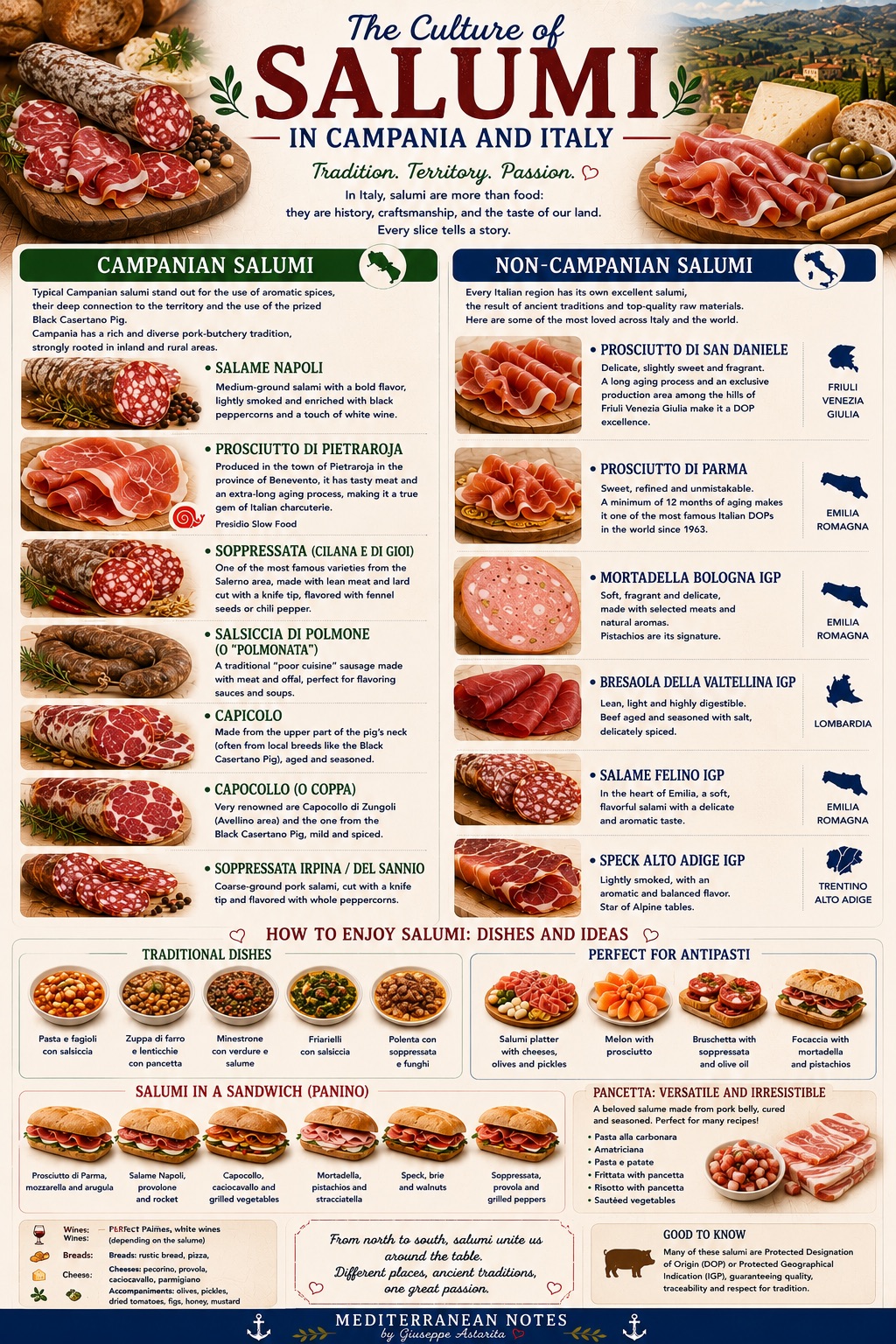
I salumi campani
La pancetta — the salume that runs through this blog
Pancetta is cured pork belly — the same cut as American bacon, treated with salt, spices, and sometimes black pepper, then rolled (pancetta tesa is flat, pancetta arrotolata is rolled) and aged for several weeks. It is not smoked, which is the primary distinction from bacon: the flavor is pure pork and spice without the smokiness that dominates American cured belly. In Campania it was not the most celebrated local product — the soppressata and capocollo had more regional identity — but it was present in almost every kitchen as a working ingredient rather than a centerpiece salume.
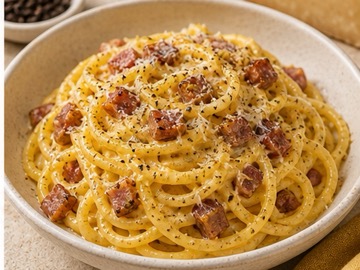
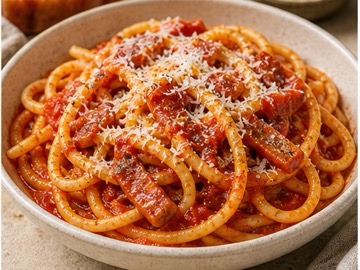
The reason pancetta appears throughout this blog rather than just on the antipasto plate is that it performs a specific cooking function: it provides fat, salt, and pork flavor to dishes that need a foundation. A soffritto started with diced pancetta rather than just olive oil has a different flavor base than one without. Pasta alla carbonara, pasta e fagioli con pancetta, lenticchie con pancetta — in each of these the pancetta is not a topping or a garnish but a structural ingredient whose rendered fat carries the aromatics and whose browned pieces provide textural contrast. Guanciale is the more traditional choice for carbonara and amatriciana — it has a higher fat content and a slightly different flavor from the cheek cut — but pancetta is the everyday alternative that every Italian home had in the refrigerator and that many recipes in this region use interchangeably.
The practical rule for pancetta in cooking is this: when you want smokiness, use bacon. When you want pure pork fat and salt without smoke, use pancetta. When you want the richest pork flavor from the jowl with a slightly higher fat ratio, use guanciale. All three work in many of the same recipes, and the substitutions are legitimate, but they are not identical. Pancetta tesa (flat, unrolled) slices into lardons easily and browns faster than the rolled variety. Pancetta arrotolata is better for the cold antipasto plate, sliced thin, eaten with bread. Both are correct products used in different contexts.
Curing is the controlled removal of water from meat through osmosis (salt draws water out of the cells) combined with the action of nitrates and nitrites that prevent the growth of Clostridium botulinum and other anaerobic bacteria in the low-oxygen interior of the curing meat. In dry-cured products like pancetta, salt and spices are rubbed directly onto the surface of the belly and the meat is held in a cool environment for one to three weeks, during which time water migrates out, salt migrates in, and the texture firms gradually. The aging that follows (weeks to months, depending on the product) allows proteolytic enzymes in the meat to break down some of the muscle proteins into free amino acids and short peptides — these are the compounds responsible for the complex, savory depth of a well-aged pancetta compared to a fresh sausage. American bacon differs from pancetta primarily in two ways: it is almost always smoked (adding a large library of volatile aromatic compounds from wood combustion — phenols, furans, aldehydes — that are absent from pancetta) and it is typically cured with added sugar in addition to salt, which gives American bacon its characteristic sweet note and contributes to faster Maillard browning in the pan. Italian pancetta is cured with salt and spices only — black pepper, sometimes juniper or clove depending on regional tradition — which means the fat renders clean and the flavor of the browned pieces is pure caramelized pork without smokiness or sweetness.
Beyond Campania — the Italian salumi every kitchen knows
Growing up in Caserta, the regional Campanian salumi were the default, but Italian food culture is also national, and certain products from other regions were completely familiar. Prosciutto di Parma appeared at every decent antipasto. Mortadella Bologna, with its pistachios and its specific smooth texture, was a staple in panini across the country. Bresaola della Valtellina — the lean, beef-based cured product from Lombardia — appeared occasionally as something lighter than pork products on a summer antipasto plate. These were not foreign foods but Italian foods that happened to come from somewhere else, which is how the national food culture works: deeply regional in identity, genuinely shared in practice.
Salumi nel panino — one at a time
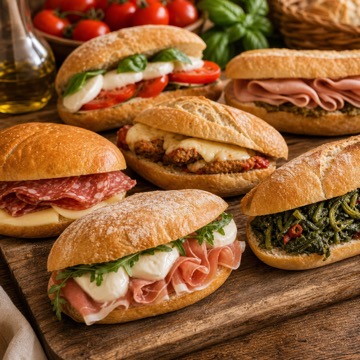
The rule about salumi in a panino is the same rule that applies to pizza toppings and to pasta sauces in this tradition: one ingredient at a time, chosen well, is better than several combined. A panino with prosciutto di Parma and good mozzarella on a fresh rosetta requires nothing else. A panino with capocollo and a few drops of olive oil on pane cafone is complete. Adding a second salume does not improve either — it creates competition where there should be clarity. This is not restraint for its own sake. It is the recognition that each of these products has a specific flavor that deserves space to be itself rather than background.
There are exceptions. Mortadella with stracciatella and pistachios on focaccia is a combination rather than a single ingredient, and it is correct. Soppressata with provola affumicata and grilled peppers on good bread is a combination that works because the elements are complementary rather than competing. But these are deliberate constructions, not defaults. The default is one good salume on good bread. Everything else is elaboration, which is permitted once you have understood the foundation.
I still keep salame Napoli in the refrigerator when I can find it — the Italian grocery in Boston carries a reasonable version. For cooking I use pancetta constantly; it is the salume that disappears fastest in my kitchen because it is in things rather than on the plate. A package of guanciale for carbonara when I find it. Prosciutto di Parma when we have guests. The categories are distinct and the uses are not interchangeable, which is the thing I learned at the salumeria counter in Caserta without realizing I was learning it.
Buon appetito — e una fetta alla volta.