Zuppa di lenticchie: Zia Ada's special, and a Sunday evening tradition
My aunt Zia Ada made it. My mother always added pasta and called it pasta e lenticchie. My kids eat it by dipping pieces of bread inside and asking for more. On a Sunday evening after a big lunch, when you want something warm and nourishing but not too heavy, there is nothing better.
There is a particular quality to the Sunday evening meal in a Campanian household — or at least there was, in the one I grew up in. Sunday lunch was the event: the long table, the pasta, the main course, the fruit, the dessert, the coffee, and the extended digestion that followed in the armchair or on the sofa. By evening, nobody wanted a meal in the same register. What was wanted was something warm, simple, that you ate in a bowl, that did not demand attention or ceremony. Soup.
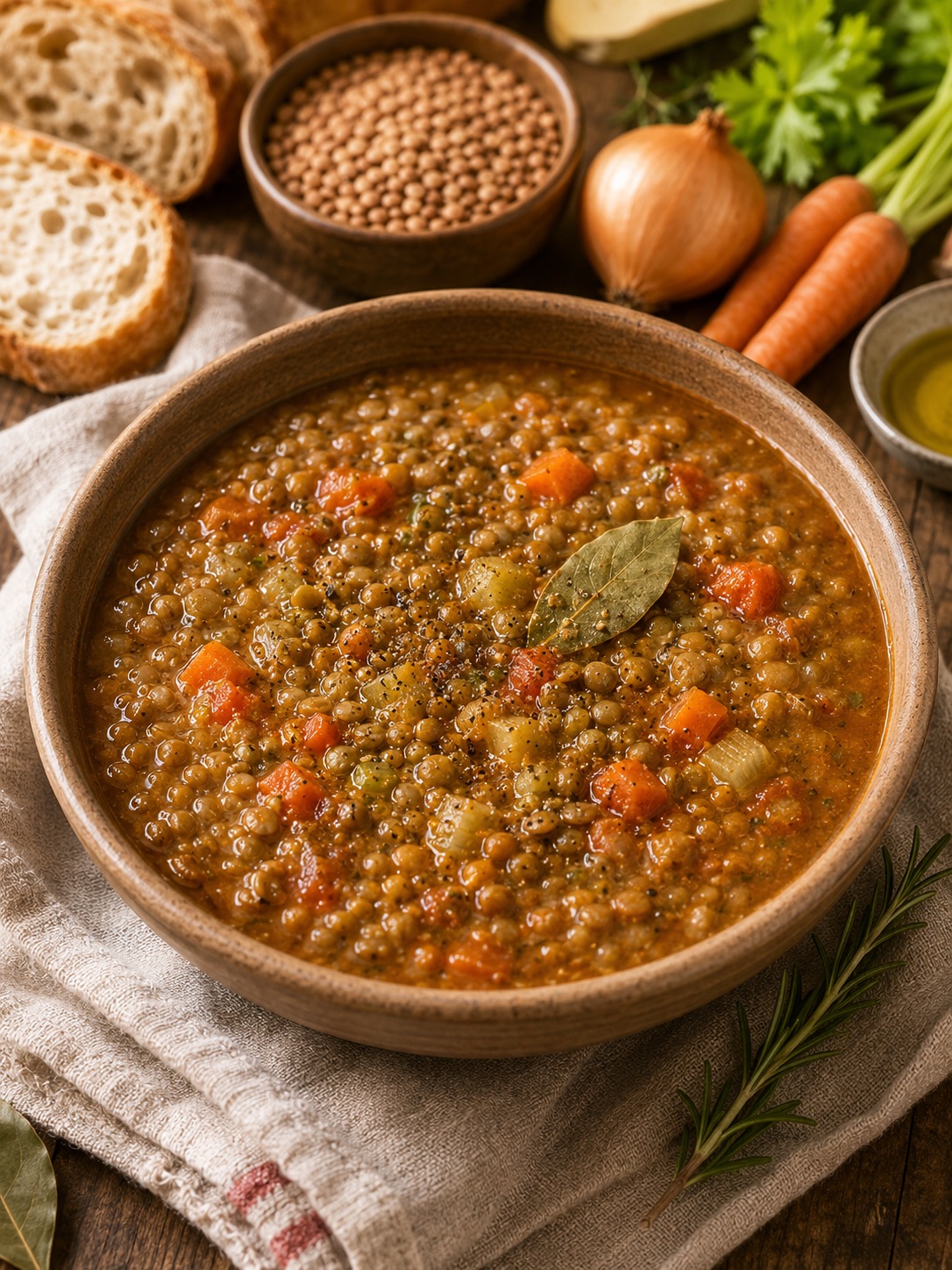
My aunt Zia Ada made lentil soup. This was her version — a pure, simple zuppa: lentils, soffritto, tomato, bay leaves, olive oil, and time. Nothing else. You ate it with bread, tearing pieces and dipping them into the bowl, and the soup absorbed into the bread and the bread absorbed into the soup in the way that only happens with something that has been cooked slowly and tastes of everything it was made with. My mother's version added pasta — small pasta, cooked directly in the soup until the starch of the pasta thickened the broth into something between a soup and a porridge. Pasta e lenticchie. A different dish with the same ingredients, heavier and more substantial, a meal rather than a restorative.
Both are correct. Both are from the same tradition — a tradition old enough that lentils appear in the oldest food records of the Mediterranean, eaten by the same peoples who gave southern Italy its agricultural foundations. Cucina povera at its most literal: dried legumes, vegetables from the garden, olive oil, water. The most nourishing combination of ingredients achievable with almost no money, refined over millennia into something that needs no improvement.
I still make it — the plain soup version for a quiet Sunday evening, the pasta version when the week calls for something more fortifying. My daughters eat it the same way I did: with bread, bent over the bowl, asking for the bread to be torn into smaller pieces so it can fit better. Some things transmit without effort. This is one of them.
Lentil protein density, resistant starch, and iron bioavailability in one bowl
Lentils are among the most nutritionally complete plant foods available. A 100 g dry serving provides approximately 26 g of protein — more than most animal proteins by weight — along with 18 g of dietary fiber, significant iron (around 7 mg, roughly half the adult daily requirement), folate (essential for DNA synthesis and cell division), magnesium, and zinc. The protein quality of lentils is high for a plant source but limited by methionine; when eaten with bread or pasta (wheat), the complementary amino acid profiles combine to provide a complete essential amino acid spectrum — which is precisely what this dish does, intuitively, in both its soup-and-bread and pasta versions. The soluble fiber in lentils — primarily galactomannans and pectin — forms a viscous gel in the intestinal lumen that slows glucose absorption, reduces postprandial glycemia, and feeds the butyrate-producing bacteria of the gut microbiome. The iron in lentils is non-heme iron (less bioavailable than the heme iron in meat), but the tomato in this recipe contributes vitamin C — ascorbic acid sharply enhances non-heme iron absorption, up to threefold at the same meal. The soffritto base — onion, carrot, celery cooked in olive oil — contributes quercetin and kaempferol (flavonoids from the onion), beta-carotene (from the carrot), and the phenolic compounds and oleocanthal of the extra-virgin olive oil. Bay leaves contribute small but consistent amounts of linalool, eugenol, and 1,8-cineole — aromatic terpenes that give the soup its characteristic depth and are not merely decorative. The drizzle of raw extra-virgin olive oil at the end — standard in the Italian version of this dish — adds phenolics that are partially degraded by heat when cooked in, preserving their antioxidant activity. This is a bowl of food that a nutritional biochemist would design from scratch if given a blank page and asked to optimize for satiety, gut health, iron bioavailability, and anti-inflammatory phytochemical density. It was designed by centuries of necessity instead, which arrived at the same place.
The recipe
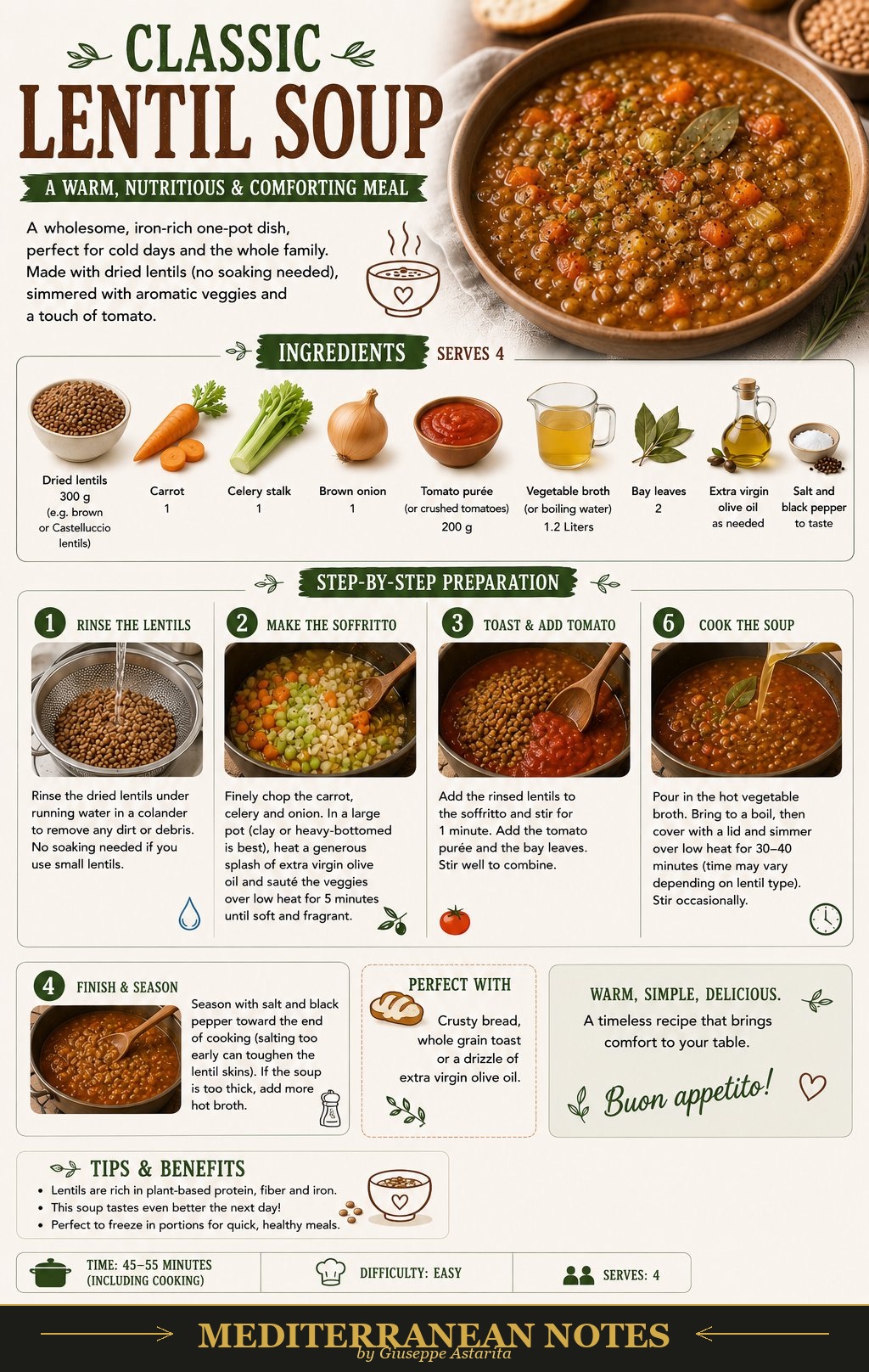
Ingredients · serves 4
Method
Rinse the lentils. Place the dried lentils in a colander and rinse under cold running water until the water runs clear. No soaking is needed — small lentils like brown or Castelluccio cook directly. Pick out any debris.
Make the soffritto. In a large, heavy-bottomed pot, heat a generous pour of olive oil over low heat. Add the finely diced carrot, celery, and onion. Cook gently, stirring occasionally, for about 5 minutes until softened and fragrant. The soffritto should be sweet and translucent — not browned.
A clay pot or heavy-bottomed pot distributes heat evenly and produces a gentler, slower cook. If you have one, use it here.
Toast the lentils and add tomato. Add the rinsed lentils to the soffritto and stir for 1 minute — toasting them briefly in the oil deepens their flavor. Add the tomato purée and the bay leaves. Stir well to combine.
Cook the soup. Pour in the hot broth or water. Bring to a boil, then reduce to a low simmer, cover with a lid, and cook for 30–40 minutes, stirring occasionally, until the lentils are completely tender and beginning to break down slightly at the edges. The soup should be thick and dense, not watery.
Do not add salt until the last 10 minutes of cooking. Salt added early toughens the lentil skins and extends the cooking time significantly.
Finish and season. Season with salt and black pepper. Remove the bay leaves. Taste — the soup should be deep, earthy, and slightly sweet from the vegetables. If it is too thick, add a splash of hot water or broth. Serve in bowls with a generous drizzle of raw extra-virgin olive oil on top. With good bread alongside — or with pasta, see below.
The raw olive oil drizzled at the end is not optional and not decorative. It adds flavor and preserves the heat-sensitive phenolics that are partially lost during cooking.
Two versions — same soul, different texture
Zia Ada's version
Zuppa — plain, with bread
The soup as described above. Dense, earthy, finished with raw olive oil. Eaten with crusty bread torn into pieces and dipped directly into the bowl. The bread soaks up the broth and becomes part of the dish. The correct Sunday evening version — warm and nourishing without being heavy. Also better the next day, reheated with a splash of water.
My mother's version
Pasta e lenticchie
When the lentils are cooked and the broth is sufficient, add a small pasta directly to the pot — ditalini, tubetti, or broken spaghetti. Cook until the pasta is al dente. The starch from the pasta thickens the soup into something between a soup and a porridge — the Italian word is brodoso, meaning brothy, and the line between brothy and thick is where this dish lives. More substantial than the plain soup; a full weeknight meal.
This soup freezes well — make a large batch, portion it into containers, and keep it for the evenings when there is nothing else planned and no energy to cook. Reheat gently with a splash of water, add a drizzle of olive oil at the end, and it is as good as the day it was made. If you have added pasta, freeze the plain soup and add fresh pasta when you reheat; pasta that has been frozen in the soup absorbs too much liquid and loses its texture.
Zia Ada would approve of the freezer strategy. She would not have used those words for it. But she would have approved.
Buon appetito — e buona domenica sera.