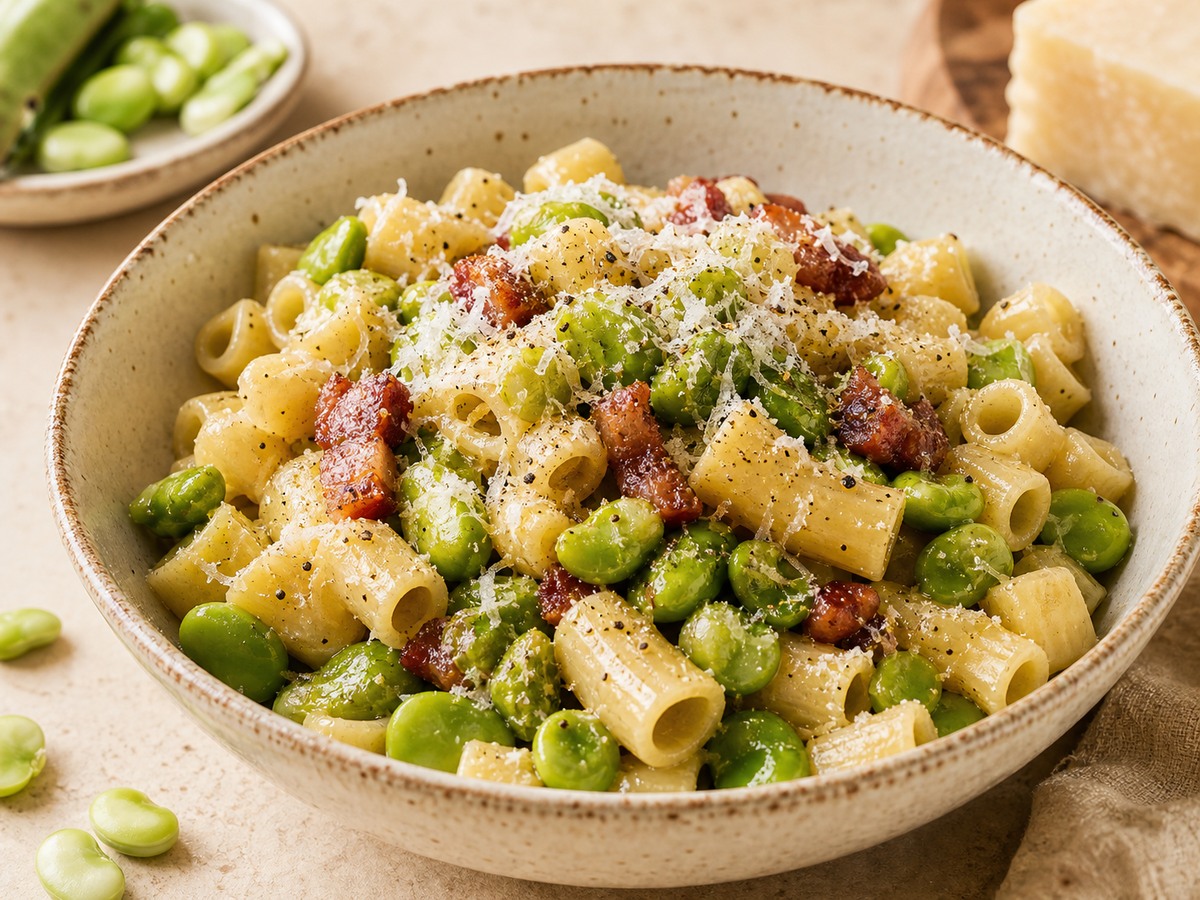
Bucatini all'amatriciana: the whistling pasta, the American roommates, and a history involving GIs
Guanciale rendered until crispy, deglazed with white wine, San Marzano tomatoes cooked into a rich sauce, Pecorino Romano at the end off the heat — and bucatini, which whistle when you eat them. A favorite of American roommates who encountered Italian cooking for the first time. And a dish whose modern form may be partly the invention of American soldiers who added bacon to everything.
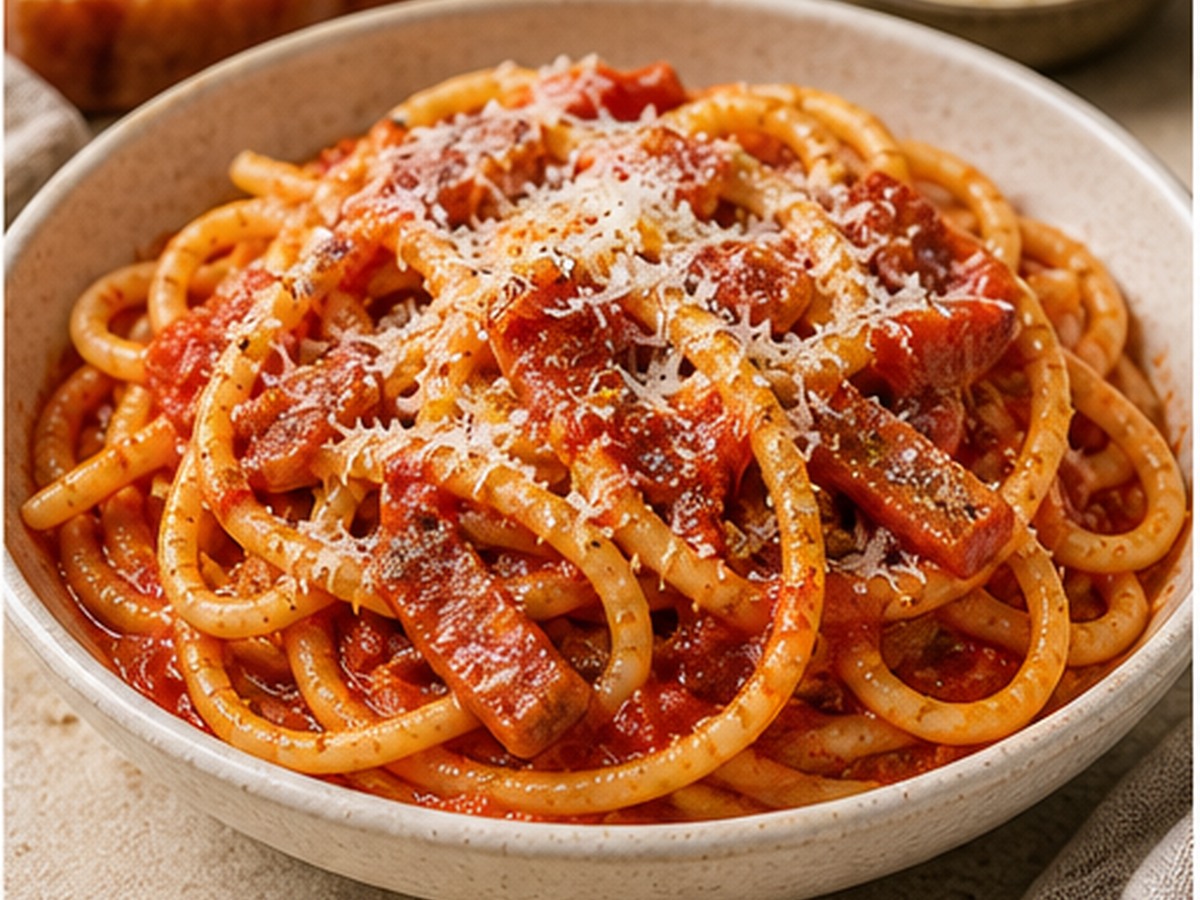
The amatriciana comes from Amatrice, a mountain town in the Lazio region that was largely destroyed by an earthquake in 2016. The dish predates the tomato version: the original, called gricia, is guanciale, Pecorino Romano, and black pepper — no tomato, white sauce, the older and perhaps purer form. When tomatoes arrived in Italy from the Americas and established themselves in southern Italian cooking, someone in Amatrice added them to the gricia and the amatriciana was born. The exact moment is not documented. The result is.
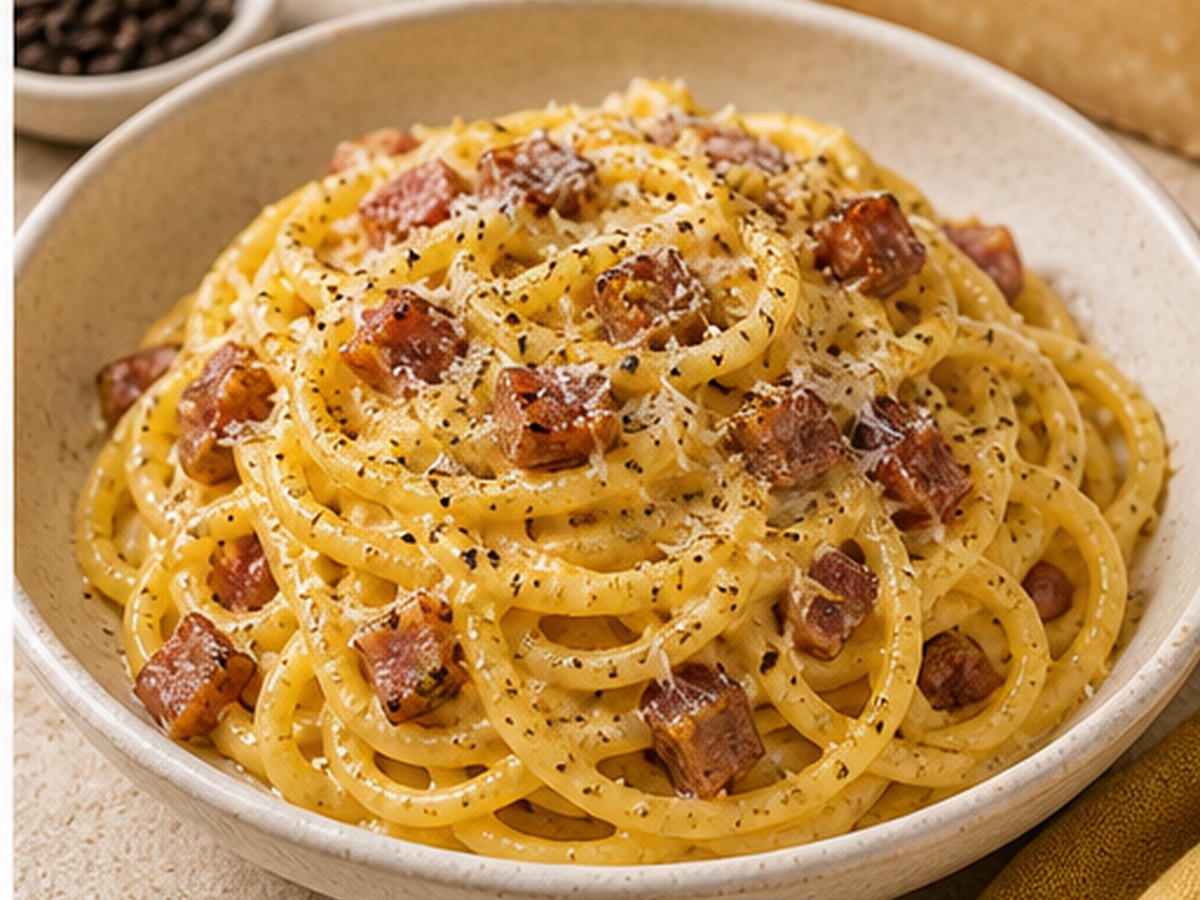
The dish belongs to the same Roman family as the carbonara and the cacio e pepe — three pasta preparations that share guanciale and Pecorino as structural elements and that are distinguished by what else is in them: egg in the carbonara, tomato in the amatriciana, nothing else in the cacio e pepe. Together they constitute the Roman pasta canon. They appear elsewhere in Italy in approximate versions, and the debate about what constitutes an approximation and what constitutes a legitimate variation is ongoing and is taken seriously by people who care about these things, which is to say most Italians.
The bucatini is the classic choice for this sauce because the hollow center traps the tomato and guanciale liquid inside the tube — when you eat it, the trapped sauce releases. The same physics produces the same sound as the pasta e cocozza with broken bucatini: a small, involuntary whistle as you pull the strand from the bowl. It is one of the more joyful incidental sounds of Italian eating.
The history of the tomato-version amatriciana intersects, in an intriguing and not fully resolved way, with the presence of American soldiers in central Italy during and after World War II. The GIs had access to canned goods including American bacon, and they were enthusiastic about adding it to Italian preparations they encountered — carbonara being the most famous example, where the American bacon is widely credited with influencing or possibly initiating the dish. The amatriciana's trajectory in the postwar period — its spread beyond Amatrice into Rome, its adoption as a Roman standard, the substitution of guanciale with pancetta in many versions — follows a similar timeline. Whether the American presence shaped the modern form of the dish, as it appears to have shaped the carbonara, is historically plausible and not fully proven. What is documented is that both dishes look like what happens when Italian cured pork meets American enthusiasm for bacon and the result gets absorbed into the Italian canon.
My American roommates, in any case, were immediately loyal to this dish the first time they ate it. It was possibly the first Italian pasta they took seriously — not as exotic food but as a specific thing they wanted again and would ask for by name. The bucatini helped. The sound of eating them is memorable and slightly ridiculous and entirely charming, and it makes the dish stick in the memory of everyone who eats it for the first time.
Guanciale vs. pancetta — fat ratios, flavor, and cured pork chemistry
The amatriciana is built on guanciale — cured pork cheek — rather than pancetta or bacon, and the distinction is more than culinary tradition. Guanciale has a significantly higher fat-to-meat ratio than pancetta: approximately 70–75% fat, compared to pancetta's 40–50%. This higher fat content means more rendered fat in the pan during the crisping step, which becomes the primary cooking medium and flavoring agent for the rest of the sauce. The fat of guanciale is predominantly oleic acid (monounsaturated) and palmitic acid (saturated), with a characteristic flavor profile that includes volatile compounds developed during the curing process — lactic acid esters, thiazoles, and pyrazines — that give guanciale its specific taste, distinct from both pancetta and American bacon. The white wine deglazing step after the guanciale is crisped serves two functions: the acetic acid and tartaric acid in the wine dissolve the browned fond from the pan bottom (Maillard reaction products, concentrated guanciale flavor), and the alcohol carries these dissolved compounds into the sauce as it evaporates, deepening flavor without adding sourness. San Marzano tomatoes are lower in acidity and higher in dry matter than round tomatoes — the lower water content means less liquid to evaporate, faster sauce concentration, and more intense tomato flavor per gram. The Pecorino Romano PDO — added after the heat is turned off — contributes glutamate (which amplifies the savory perception of the guanciale and tomato), calcium, conjugated linoleic acid from sheep's milk, and fat-soluble vitamins. The off-heat addition prevents the protein matrix of the cheese from seizing and clumping — the same principle as carbonara and cacio e pepe. The chili flakes contribute capsaicin and carotenoids (capsorubin, capsanthin) that are fat-soluble and are absorbed into the guanciale fat during the crisping step, distributing their heat and color throughout the sauce. This is a nutritionally rich pasta whose fat content comes almost entirely from the rendered guanciale and the olive oil, both of which are predominantly monounsaturated — an appropriate profile for the occasional rich pasta that belongs in a Mediterranean diet pattern.
The recipe
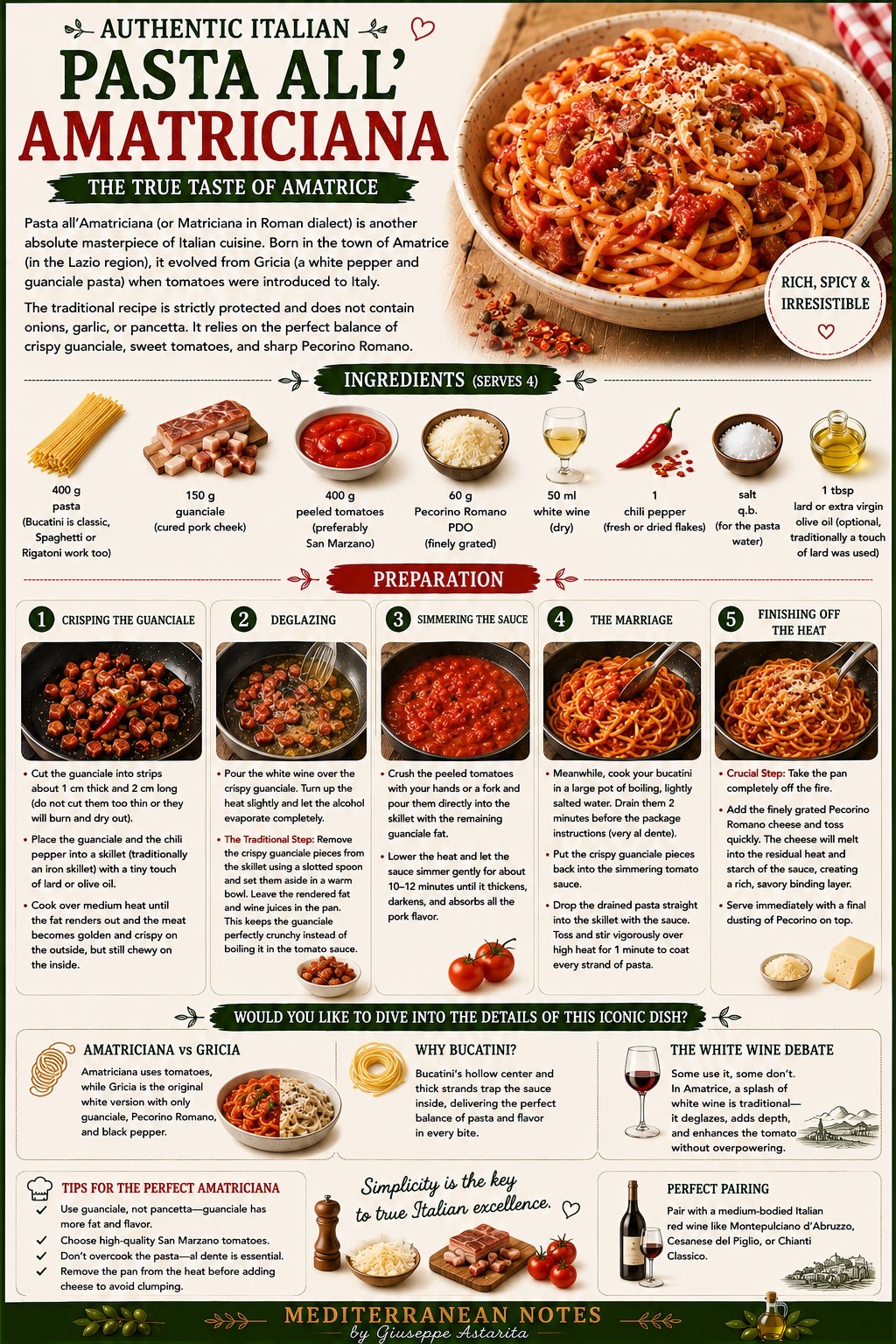
Ingredients · serves 4
Method
Crisp the guanciale. Place the guanciale strips in a skillet with a tiny touch of lard or olive oil and the chili over medium heat. Cook until the fat renders and the meat turns golden and crispy on the outside but remains slightly chewy inside — about 5–7 minutes. Do not cut the pieces too thin or they will dry out completely. Remove the crispy guanciale pieces with a slotted spoon and set aside in a warm bowl, leaving all the rendered fat and juices in the pan.
The guanciale goes back into the pasta at the end — not into the simmering tomato sauce. This keeps it crispy. Guanciale cooked in tomato for 10 minutes becomes soft and loses the textural contrast that defines the dish.
Deglaze. With the guanciale fat still hot in the pan, pour in the white wine. It will sputter. Let the alcohol evaporate completely — about 1 minute — then reduce the heat. This step dissolves the browned fond from the pan bottom into the sauce.
Simmer the sauce. Add the crushed San Marzano tomatoes directly to the pan. Season lightly with salt (taste first — the guanciale fat is already salty). Simmer over medium-low heat for 10–12 minutes, stirring occasionally, until the sauce thickens, darkens slightly, and absorbs the guanciale fat completely. It should look glossy and concentrated.
Cook the pasta and marry everything. Cook the bucatini in lightly salted boiling water until very al dente — 2 minutes before the package time. Reserve a cup of pasta water. Drain and add directly to the simmering sauce. Return the crispy guanciale pieces. Toss vigorously over high heat for 1 minute, adding a splash of pasta water if needed, until the sauce clings to every strand.
Add the Pecorino — off the heat. Take the pan completely off the fire. Add the finely grated Pecorino Romano and toss quickly — the residual heat melts the cheese into the sauce, creating a binding, savory layer without clumping. Serve immediately with a final dusting of Pecorino and, if you like, a last crack of chili.
Off the heat means completely off. Pecorino added to a hot pan seizes and clumps — the same principle as carbonara. The residual heat of the pasta and sauce is exactly sufficient.
The details that matter
Amatriciana vs Gricia
Gricia is the original: guanciale, Pecorino Romano, black pepper — no tomato, no chili. It predates the amatriciana by the time it took for tomatoes to arrive in central Italy and become part of the kitchen. The gricia is quieter, less assertive, the skeleton of the amatriciana. Both are worth making; the gricia shows more clearly what the guanciale and Pecorino alone can do.
Why bucatini
The hollow center fills with tomato-guanciale sauce as you eat. The sauce inside the tube is different from the sauce outside — more concentrated, less aerated — and releases as you bite. The whistle this produces is an incidental feature. It is also the whole point. Spaghetti and rigatoni work perfectly well; they produce a different eating experience that is quieter and less memorable.
The white wine debate
Some versions include it, some don't. In Amatrice, a splash of white wine after the guanciale crisps is traditional — it deglazes, adds depth, and lifts the acidity of the tomatoes slightly without making the sauce taste of wine. If you skip it, add a small splash of pasta water at the same stage and continue. Both produce a good result; the wine version has more complexity.
Guanciale, not pancetta, not bacon
Pancetta is the most common home substitution and produces a very good amatriciana. American bacon — smoked, sweet-cured — changes the flavor profile substantially and is not the same dish. The American soldiers who may have influenced the carbonara brought bacon precisely because it was what they had; the authentic guanciale version is what survived and was codified. Both have their history; this recipe uses guanciale.
Buon appetito.