Pastiera Napoletana
The Iconic Neapolitan Easter Cake
Made at Easter, every year. Better the second day, and the third. Eaten for breakfast and as dessert for every meal through the whole holiday. Given as a gift to the doctors who helped the family, to neighbors, to people you wanted to honor. A Neapolitan tradition carried from Caserta to Massachusetts.
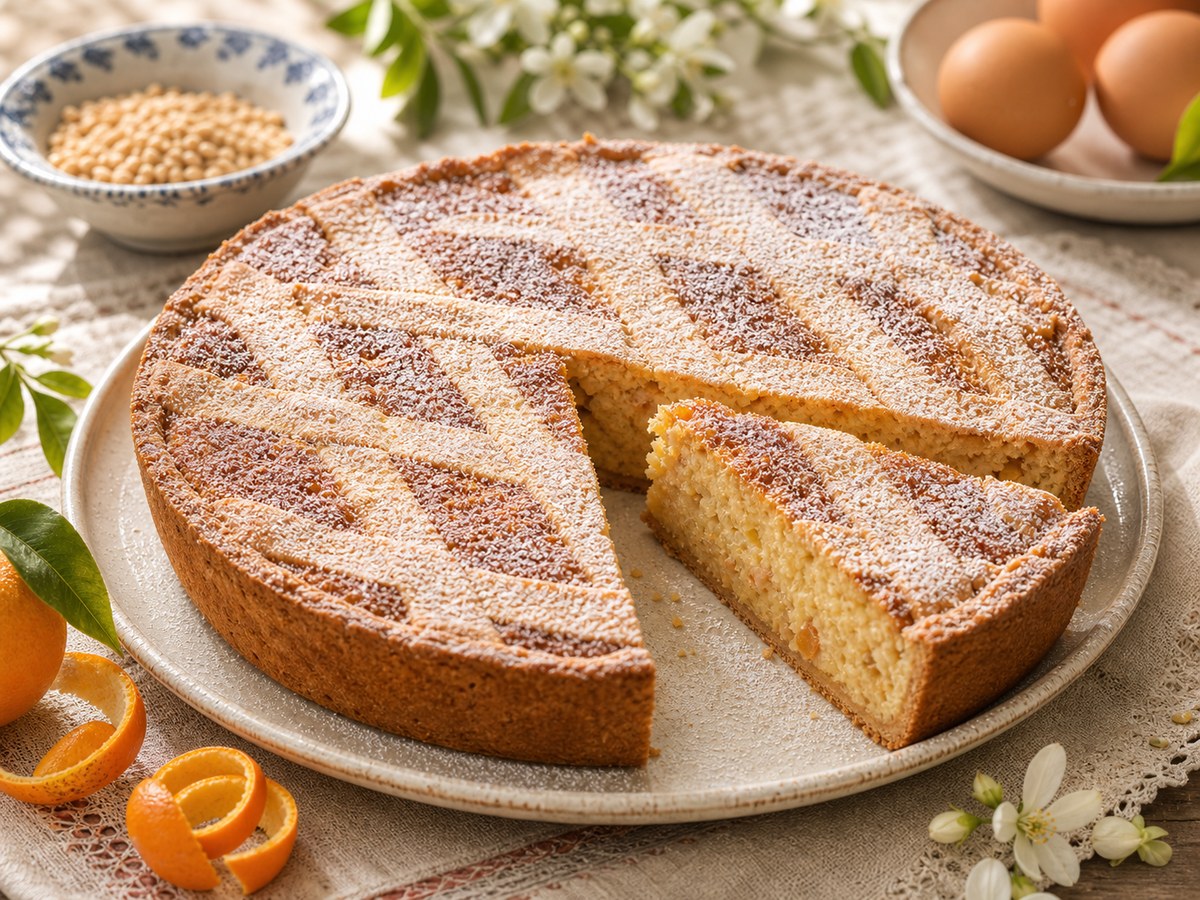
The pastiera napoletana is the undisputed monument of Campanian pastry. It appears at Easter with a certainty that is independent of any individual family's decision — it is simply part of what Easter is in Naples and the surrounding province. In Caserta we made it at Easter; in Naples some families also make it at Christmas, but that was not the tradition in our house. Easter was its time, and within the Easter period it was present at every meal: dessert at Sunday lunch, dessert at weekday lunch, breakfast on the Monday and Tuesday and Wednesday after Easter, still good and in some ways better than the day it came out of the oven.
This is the real secret the infographic correctly identifies — time. The pastiera must rest. Baked the day before at minimum, ideally two days before, it arrives at the table with the millefiori water and the orange blossom and the candied citrus fully integrated into the ricotta and wheat filling, the lattice crust softened slightly where it meets the filling, the flavors settled into something unified rather than the sum of their parts. Eaten the day it is made, it is already very good. Eaten two days later for breakfast with a coffee, it is extraordinary.
In Italy the grano cotto — pre-cooked wheat in a jar, ready to use — is available in every supermarket in the weeks before Easter. In the United States it is not, or requires a special trip to an Italian specialty shop, and even then it is not always in stock. I use pearl barley instead, soaked overnight and cooked until soft. The texture is slightly different — a touch firmer — but the result is closer to the real thing than a pastiera made without grain at all, and the flavor difference is smaller than you would expect. The other missing ingredient in the US is millefiori water — the floral essence made from a combination of flowers that gives the Neapolitan pastiera its characteristic perfume, the smell that is specific to this cake and nothing else. Orange blossom water, which is more widely available, is the partial substitute, though the millefiori has a complexity that orange blossom alone does not replicate. Italian specialty grocers and online importers stock it; it is worth searching for.
As with every recipe on this blog, every family makes the pastiera slightly differently. Some use lard in the pastry — which gives a shorter, more crumbly texture — others use butter. Some prefer sheep's milk ricotta, which is richer and slightly gamey, others use cow's milk. The amount of cinnamon varies from barely present to very present. The candied citrus is non-negotiable. The lattice on top, made with seven strips in the traditional diamond pattern, is not decoration — it is how you know it is a pastiera and not something else. At the core, across all versions, the cake is the same. The argument about which family's version is best is part of the Easter tradition as well.
The improvement of the pastiera over 24–48 hours of resting is not a placebo effect or a tradition justified retrospectively. Several real chemical processes happen during this time. The filling — ricotta, eggs, cooked grain, candied citrus, aromatic waters — contains both water-soluble and fat-soluble flavor compounds. As the tart cools and rests, these compounds migrate: the volatile aromatics from the millefiori and orange blossom water, which are highly concentrated when the cake first comes out of the oven, gradually diffuse into the fat-rich ricotta matrix and are partially absorbed by the cooked grain. This process rounds and softens what would otherwise be an overpowering floral note. Simultaneously, the egg proteins in the filling continue to contract slightly as they cool completely, giving the texture a denser, more cohesive consistency that slices cleanly rather than crumbling. The pastry lattice, still crisp immediately after baking, absorbs some moisture from the filling and develops a texture that is intermediate between crust and cake — softer, more integrated.
Millefiori water — literally "a thousand flowers" — is a distillate produced from a blend of flowers including orange blossom, jasmine, rose, and others depending on the producer. It contains a more complex mixture of aromatic esters and alcohols than any single-flower water, which is why a pastiera made with millefiori tastes dimensionally different from one made with orange blossom water alone. Orange blossom water contributes linalool and geraniol — clean, floral, slightly citrusy. Millefiori adds the additional esters and terpenoids of the other flowers, creating a layered floral aroma that is specifically Neapolitan. There is no complete substitute, but if millefiori is unavailable, a combination of orange blossom water and a small amount of rose water comes closer than either alone.
The recipe — ruoto 26–28 cm
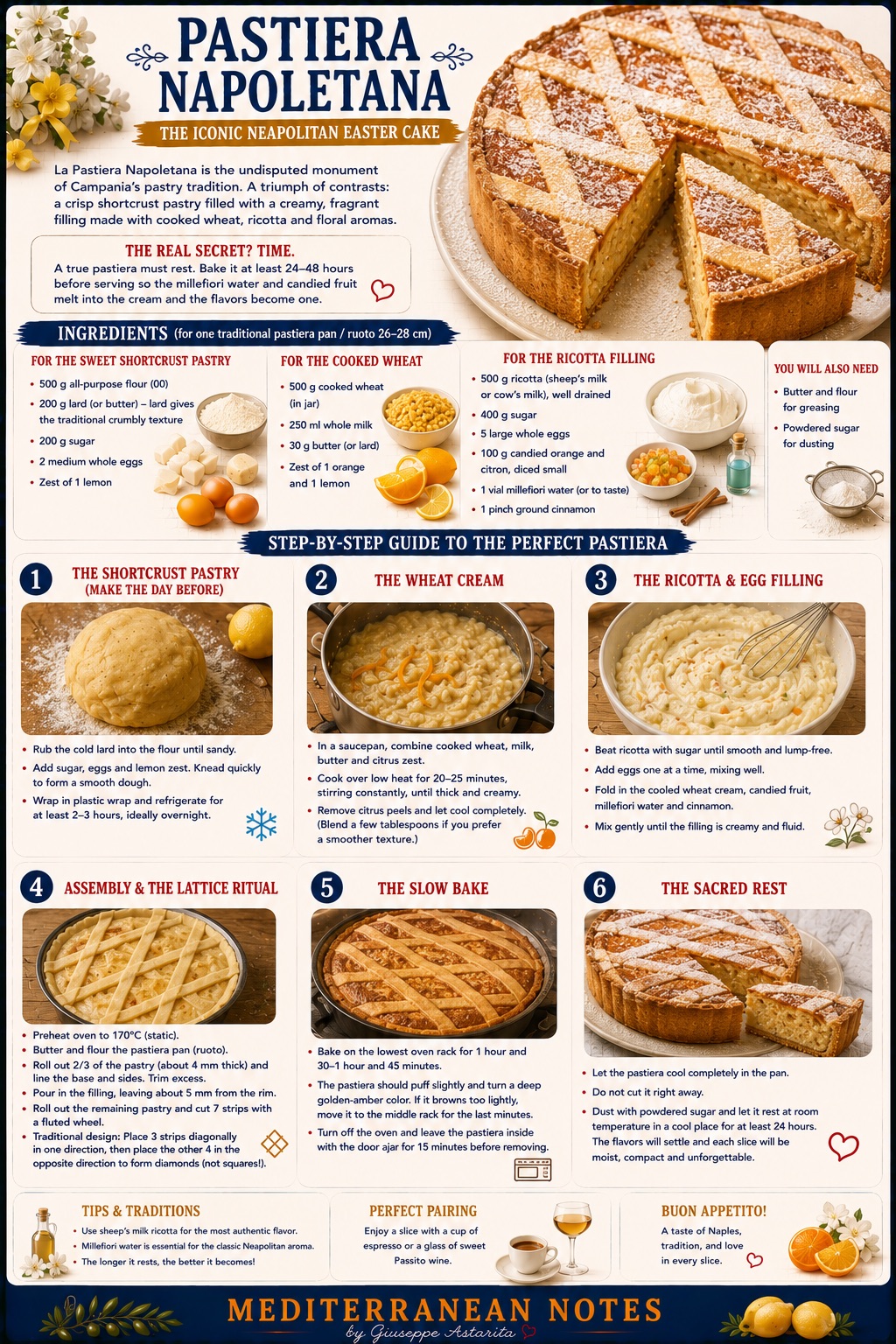
Families exchanged pastieras — yours to them, theirs to you — which meant you ended up with multiple versions over the Easter days, each subtly different, each carrying its maker's particular decisions. The comparison between them was warm and specific: more orange blossom in this one, more cinnamon in that one, sheep's milk ricotta here, cow's milk there. This is the same argument structure described in ogni famiglia ha la sua ricetta. The pastiera is where it arrives at its most generous form — not an argument about who is right, but an exchange between people who all care deeply about the same thing.
Variations and the US adaptation
The pastiera is not a difficult cake, but it requires planning — the pastry the day before, the resting period after baking, the time to source the right ingredients or their best substitutes. The result is worth every element of that planning. It is one of those preparations that has been made the same way, more or less, for centuries in the same city, by people who learned it from people who learned it from people before them, and the continuity is palpable in the eating. Every version is slightly different. They are all the same cake.
If pastiera's texture — the grano cotto, the chew of cooked wheat — isn't what you're after but you still want a Naples ricotta tart, there's a genuinely different one worth knowing: the crostata della babbaiola from Posillipo, ricotta folded into a silky lemon pastry cream instead of wheat and candied fruit. Not a substitute for pastiera — a different tart entirely, with its own name.
The Easter table — the full picture
The pastiera completes the Easter cluster. The other posts that belong at the same table:
Buona Pasqua — e lasciatela riposare.