Casatiello dolce: the sweet side of the Easter war
In Naples at Easter there are two casatiellos, and the household that makes both is the correct one. The casatiello dolce — sweet, fragrant, glazed white and scattered with colored diavulilli — for Easter breakfast or as a dessert. The casatiello salato, better known as pizza rustica, stuffed with cured meats and cheeses — for the merenda, for a light meal, and especially for the Monday after Easter picnic. Both were made at home. Both are irreplaceable and the question of which is better is unanswerable.
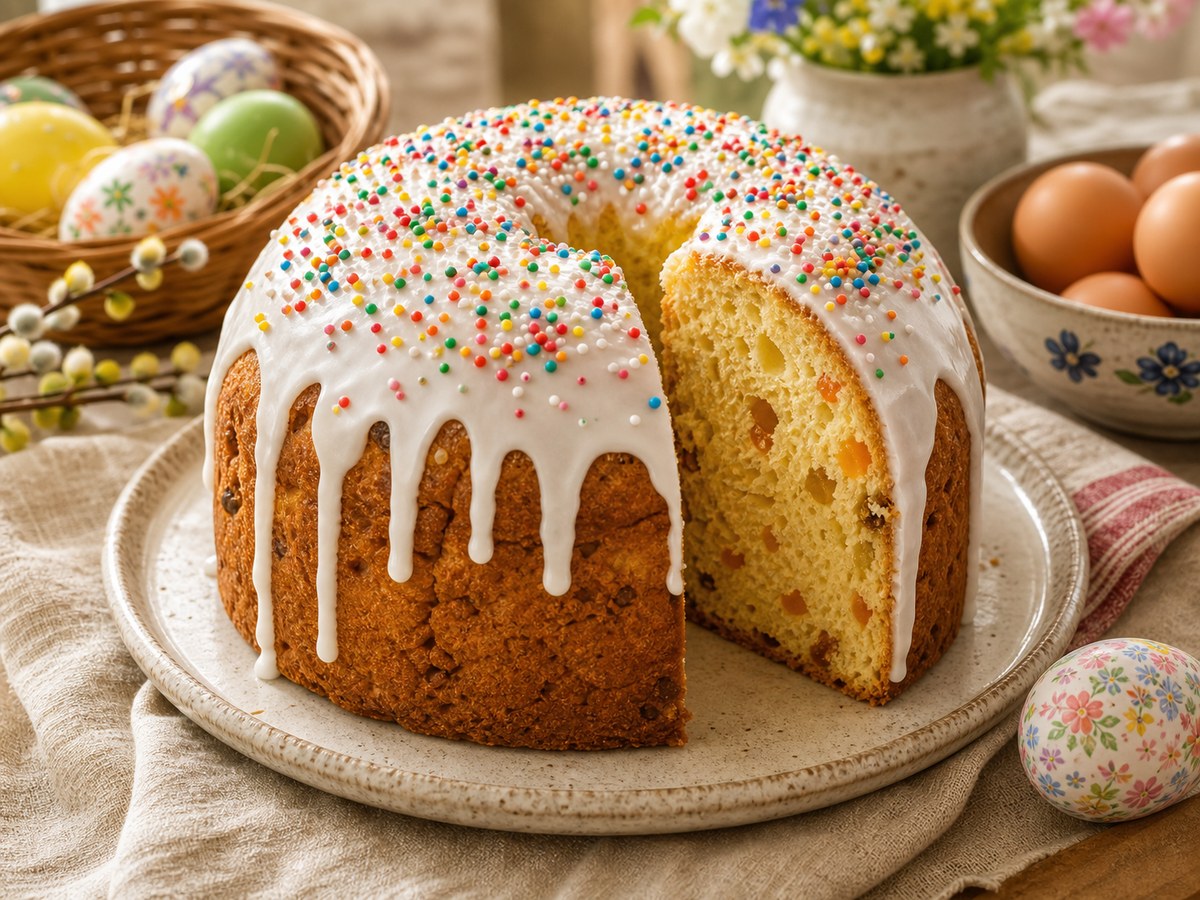
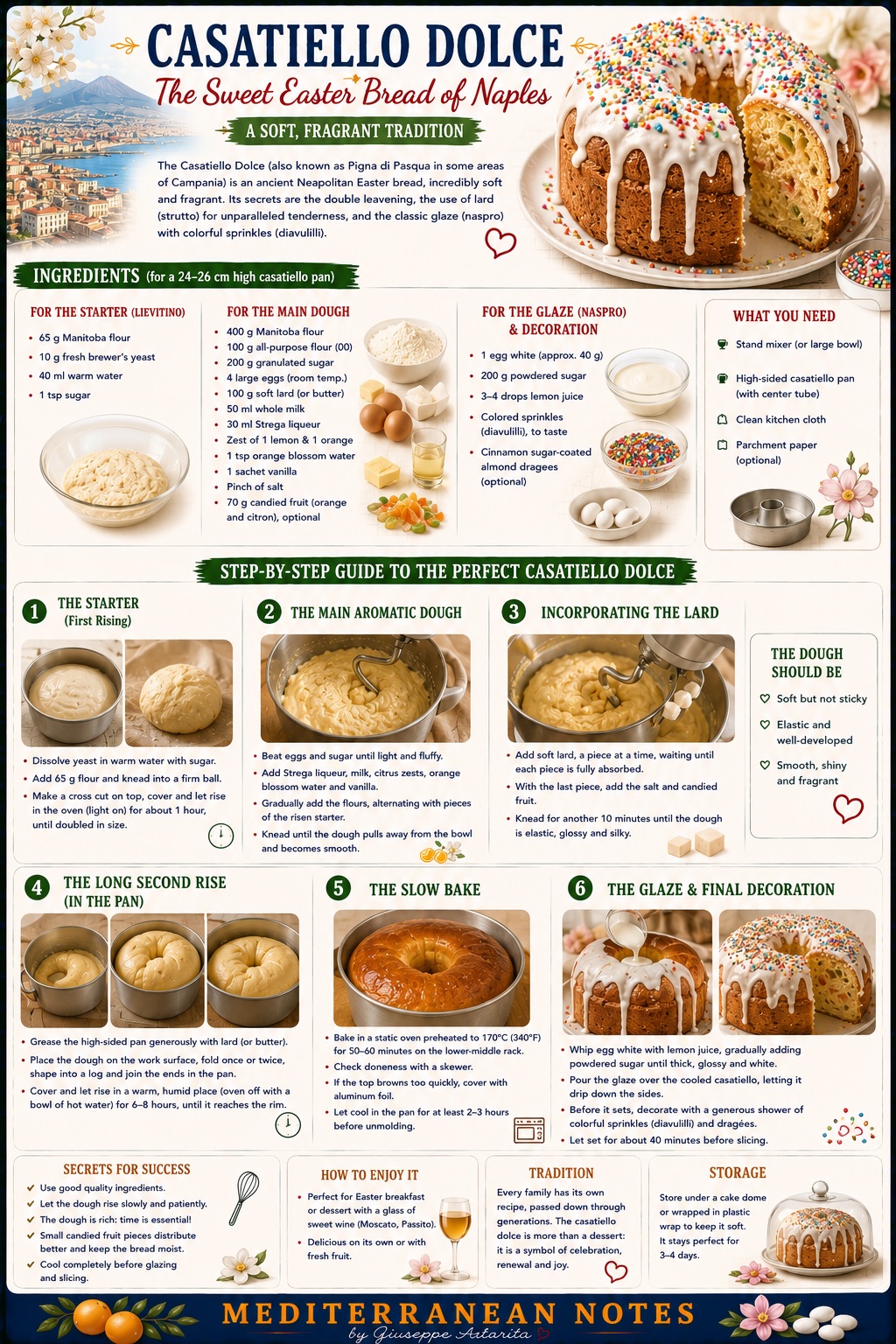
The casatiello dolce — also called pigna di Pasqua in some parts of Campania — is the sweet Easter bread of Naples, and it is not quite a cake and not quite a bread but something specifically itself: a leavened dough enriched with eggs and lard and sugar and scented with citrus zest and orange blossom water and Strega liqueur, shaped into a ring in the high-sided casatiello pan, risen for hours until it reaches the rim, baked slowly at low temperature, and finished with a white glaze — the naspro — that drips down the sides and sets around the colored sprinkles scattered over it. It is festive in a way that is specific to Easter — not Christmas, not any other celebration — and the preparation of it in the days before Easter was one of the kitchen events of the year.
The casatiello salato — the savory version, which in most Campanian households is called pizza rustica or pizza chiena — is an entirely different preparation that shares only the occasion and the general shape. Where the dolce is soft, sweet, and aromatic, the salata is dense, eggy, and packed with salami, soppressata, prosciutto, and cheeses. It belongs to a different eating moment: not the Easter breakfast with coffee or sweet wine, but the post-Easter meal structure. And most specifically, it belonged to the Monday after Easter — Pasquetta — which in Italy is a national holiday and is traditionally spent outdoors, in the park or in the countryside, with a picnic. The pizza rustica was the centerpiece of that picnic. It travels well, it can be eaten cold at room temperature, it requires no reheating, and it is substantial enough to be a proper meal on its own. It was always on the blanket on Pasquetta.
The casatiello dolce takes two days if done properly. The starter — a small pre-dough made with Manitoba flour, yeast, and warm water — rises for an hour before joining the main dough. The main dough is enriched with four eggs beaten with sugar until pale and fluffy, then lard added piece by piece so the fat emulsifies gradually into the gluten network rather than disrupting it, then the flours, the milk, the Strega, the citrus zests, the orange blossom water, the vanilla, a pinch of salt, and finally the candied fruit if you use it. The dough should be smooth, shiny, and fragrant — not sticky, not stiff. Then it goes into the greased pan and rises for 6–8 hours, covered, in a warm place. This patience is not optional. The slow second rise is what produces the characteristic texture: soft and airy inside, slightly dense at the base, with the specific crumb of an enriched bread that has had time.
Every family has its own version. Some add more candied fruit. Some use butter instead of lard, which produces a slightly different texture and a less distinctly Neapolitan result — lard is the traditional fat and the one that produces the correct tenderness. Some use different liqueurs. The Strega — the yellow herbal liqueur from Benevento, also used in the tiramisù in this collection — is the classic choice, adding an aromatic complexity that orange juice or rum would not produce in the same way. The white glaze is not optional. The colored sprinkles — diavulilli, literally "little devils" — are also not optional, and anyone who suggests omitting them for aesthetic reasons is missing the point of what the casatiello dolce is supposed to look like on an Easter table.
Enriched bread chemistry — how fat, eggs, and sugar determine texture
The casatiello dolce is a classic enriched yeast bread — in the same category as brioche, panettone, and colomba — and its specific texture is determined by the interaction between its three enriching agents: eggs, fat (lard), and sugar. Each plays a structural role that explains the recipe's specific sequence. Eggs contribute protein (ovalbumin, ovotransferrin) that strengthens the gluten network and emulsifiers (lecithin from the yolk) that help fat integrate into the aqueous dough without disrupting the gluten strands. Fat — lard in the traditional version — must be added gradually and in pieces precisely because large amounts of fat added at once coat the gluten strands and prevent them from developing further. Added piece by piece, the fat is absorbed into the gluten matrix incrementally, producing a dough that is both extensible and strong. Sugar competes with the yeast for water (osmotic stress) and with the gluten proteins for hydration, which is why enriched doughs rise more slowly than lean doughs and require longer fermentation times. The two-rise structure — starter rising 1 hour, main dough rising 6–8 hours — accommodates this slower fermentation and allows the yeast sufficient time to produce the carbon dioxide that gives the finished bread its open, airy crumb. The Strega liqueur contributes alcohol (approximately 40% by volume), which partially inhibits yeast activity during fermentation — another reason the second rise requires time. The Maillard browning during baking is limited by the low temperature (170°C / 340°F) required for the dense enriched dough, which would burn on the outside before setting on the inside at higher temperatures. The white glaze — whipped egg white with powdered sugar and lemon juice — sets by protein coagulation and sugar crystallization as it dries, producing the characteristic glossy, slightly brittle white coating. The colored sprinkles are purely festive and nutritionally inert. They are, however, correct.
The recipe
For a 24–26 cm high casatiello pan with center tube. Allow two days: prepare the starter and main dough on day one, second rise overnight or for 6–8 hours, bake on day two.
The starter — lievitino
The main dough
The glaze (naspro) and decoration
Method
Make the starter. Dissolve the yeast in the warm water with the sugar. Add the Manitoba flour and knead into a firm ball. Score a cross on top, place in a bowl, cover, and let rise in a warm place for about 1 hour until doubled in size.
Build the main dough. Beat the eggs and sugar with a stand mixer or by hand until light, pale, and fluffy — about 5 minutes. Add the Strega, milk, citrus zests, orange blossom water, and vanilla. Gradually add the flours, alternating with pieces of the risen starter. Knead until the dough pulls away from the bowl and becomes smooth and elastic.
Incorporate the lard — piece by piece. With the mixer running, add the soft lard one small piece at a time, waiting until each piece is fully absorbed before adding the next. With the last piece of fat, add the pinch of salt and the candied fruit if using. Knead for another 10 minutes until the dough is elastic, glossy, smooth, and fragrant. It should be soft but not sticky.
The piece-by-piece fat addition is not optional. Fat added all at once coats the gluten strands and prevents further development. Added gradually, it integrates without disrupting.
The long second rise. Grease the casatiello pan generously with lard. Place the dough on a floured surface, fold once or twice, shape into a log, and join the ends in the pan. Cover with a clean cloth and let rise in a warm place — oven off with a bowl of hot water inside — for 6–8 hours, until the dough reaches the rim of the pan. This cannot be rushed.
Bake slowly. Preheat oven to 170°C (340°F) static mode. Bake on the lower-middle rack for 50–60 minutes. Check with a skewer — it should come out clean. If the top browns too quickly, cover loosely with foil. Let cool in the pan for at least 2–3 hours before unmolding. The casatiello must be completely cold before glazing.
Glaze and decorate. Whip the egg white with lemon juice, gradually adding the powdered sugar until thick, glossy, and white. Pour over the completely cooled casatiello, letting it drip generously down the sides. While still wet, scatter the colored sprinkles — and dragées if using — generously over the top and sides. Let set for at least 40 minutes before slicing. The glaze should be firm and slightly brittle when tapped.
A note on the other casatiello — and the Monday picnic
The casatiello salato — what many families call pizza rustica or pizza chiena — is the savory counterpart, and it deserves a full post of its own. Briefly: it is a lard-enriched dough wrapped around a filling of beaten eggs mixed with salami napoletano, soppressata, prosciutto, and mixed cheeses — scamorza, provola, sometimes Parmigiano. The filling sets like a frittata inside the bread during baking, producing something dense and eggy and aggressively flavored that is nothing like the dolce and needs to be nothing like it.
The pizza rustica was the Pasquetta dish — the Monday after Easter, which in Italy is Lunedì dell'Angelo, a national holiday spent outdoors. Every family in Campania goes to the park or the countryside with blankets and baskets, and the pizza rustica is always on the blanket. It travels without refrigeration for several hours, it can be eaten cold, it does not require plates or cutlery, and it is filling enough to anchor a picnic meal. It was always made at home in the days before Easter, alongside the dolce, and the kitchen in the two days before Easter smelled of both simultaneously — the sweet citrus and Strega of the dolce rising in the pan, and the savory lard-and-cured-meat smell of the salata cooling on the rack. This coexistence is the correct Easter kitchen.
The war between them is unresolvable and the correct answer is: both, always, at Easter, each in its moment. The dolce is not better than the salata. The salata is not better than the dolce. They serve different functions at different times of the same celebration. The household that makes only one is missing half the Easter.
Buona Pasqua — e viva i diavulilli.