Campanian kitchen · Contorni · Salad · Five minutes · Year-round · Laura
Lattuga e cipollina
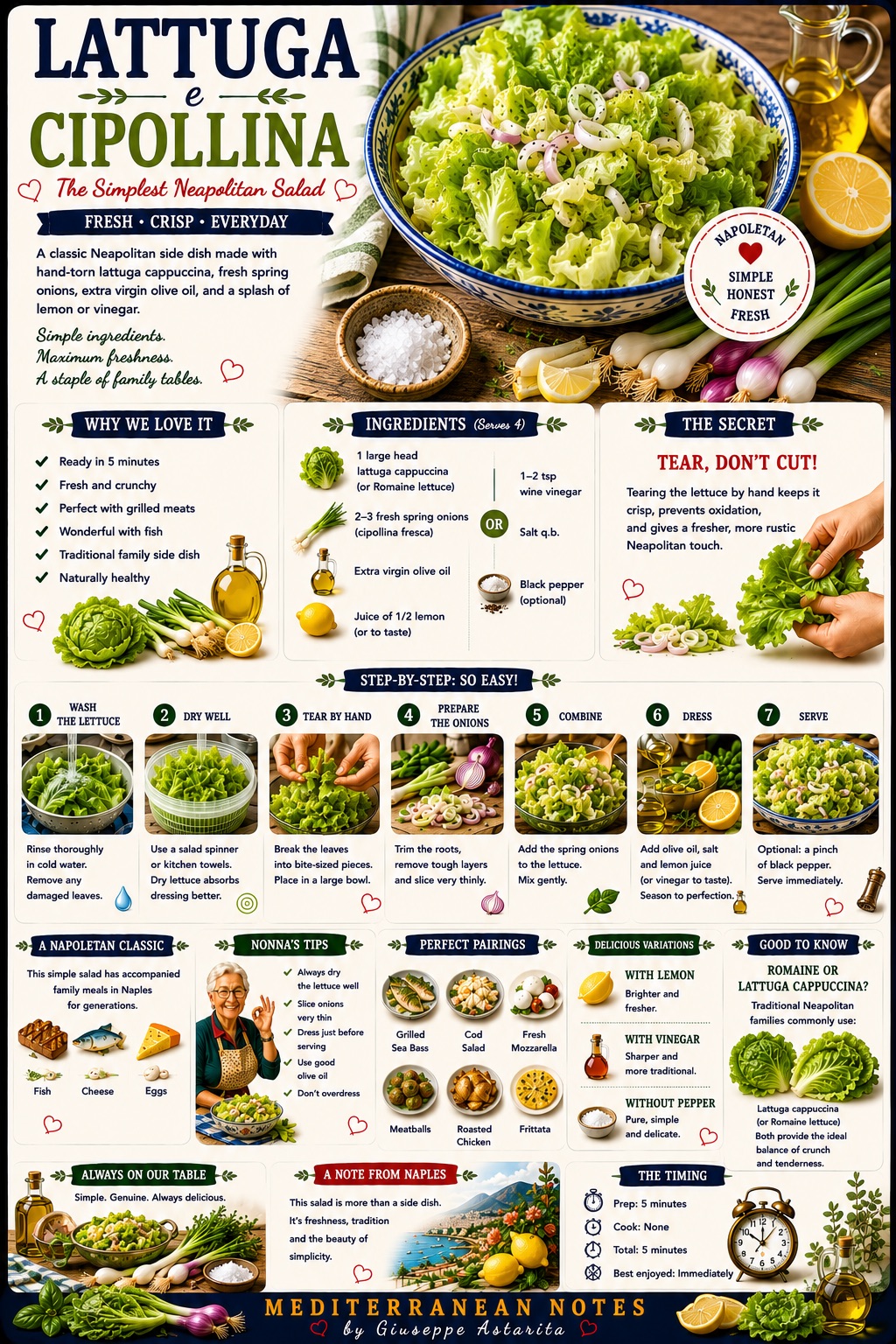
Lattuga cappuccina torn by hand, fresh cipollina — spring onions, novelle, thin white bulbs — sliced almost transparent. Salt, lemon or vinegar, olive oil. Eaten at the end of lunch, after the secondo, to close the meal. This is the salad that has been on the Neapolitan table for generations without changing because there is nothing to change.
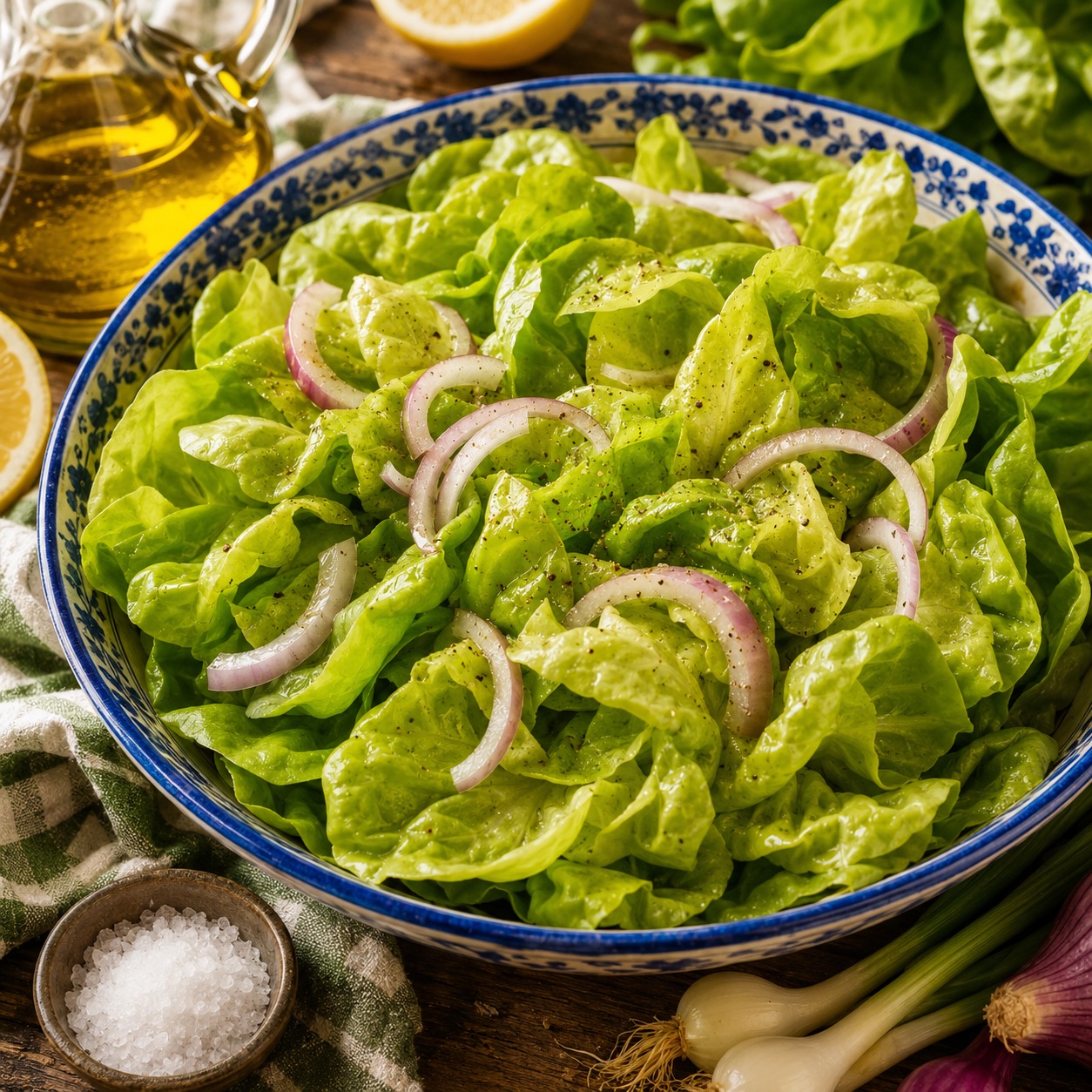
The salad came at the end of lunch, always. Not at the beginning — that would be the northern European and American habit, which inverts the logic of the Italian meal structure entirely. In the Neapolitan table, the salad closes the meal: after the primo, after the secondo, to clean the palate and support digestion before the fruit that finishes everything. It appeared without ceremony, a bowl at the center of the table, torn by hand, dressed simply. It was not the meal's main event. It was the meal's honest conclusion.
At a certain point in her growing years, my sister Laura started eating the lattuga cappuccina in serious quantities. Not a plate — a bowl. Directly from the serving bowl, sometimes, sitting next to me at the table, working through the lettuce with a concentration and appetite that impressed everyone and nobody commented on. This is the kind of memory that stays not because it was dramatic but because it was specific and recurrent — a particular behavior at a particular place at a particular table, observed from the adjacent chair. Laura and her bowl of lattuga. She set a good example without intending to.
My father dressed his salads with vinegar, always. Not lemon — vinegar. The wine vinegar my mother kept for salads and for certain preserved vegetables, sharp and clean. He applied it with the same systematic approach he brought to the other few culinary preferences he had strong opinions about. The rest of the table used lemon, mostly. This was not a conflict. It was a coexistence, which is how family food preferences work at a well-run table: the lemon and the vinegar both appeared, and everyone used what they preferred, and the salad was dressed individually or collectively depending on who reached the bottle first.
The dressing order debate — salt first, acid second, oil last: is your chemistry teacher right?
Your high school chemistry teacher's advice — salt first, then acid (lemon or vinegar) to dissolve the salt, then oil — has a defensible chemical rationale. Salt (sodium chloride) dissolves readily in aqueous solutions but poorly in oil. Adding salt directly to undressed lettuce draws water from the leaves by osmosis and leaves salt crystals on the surface rather than distributing evenly. Adding the acid first creates an aqueous medium in which the salt dissolves fully, producing a uniform seasoning that coats the leaves when the oil is added last. The acid-first method also allows you to assess the acidity before the oil mutes it. The opposing school — oil first — argues that coating the leaves in oil before adding acid prevents the acid from wilting the leaves by slowing the osmotic process, and that perfectly uniform salt distribution matters less than texture. Both arguments have merit. The oil-first method produces a crisper, slightly less wilted salad; the salt-and-acid-first method produces more evenly seasoned leaves. In practice, the Neapolitan table typically seasons simply: salt on the leaves, a squeeze of lemon or splash of vinegar, then a generous pour of olive oil, tossed and eaten immediately — the speed being as important as the order, since a dressed salad left for ten minutes wilts regardless of which school you follow.
The dressing — two schools
Salt → acid → oil (your chemistry teacher)
Salt on the leaves first. Then lemon juice or vinegar to dissolve the salt into an aqueous solution. Then olive oil last. More uniform seasoning. The acid is assessable before being muted by fat. Theoretically correct.
Oil → salt → acid (the crunch school)
Oil first coats the leaves and slows osmosis, keeping the lettuce crisper for longer. Salt and acid follow. Slightly less even seasoning but better texture, especially if the salad might sit for a few minutes before eating. My father's implicit preference.
Both are right. The more important rule: dress the salad and eat it immediately. A dressed salad improves nothing by waiting.
Recipe
Ingredients · serves 4
Method
Wash and dry thoroughly. Separate the leaves, wash in cold water, spin or pat dry with a clean cloth. Wet lettuce dilutes the dressing. A salad spinner is worth owning for this specific reason.
Tear by hand into the bowl. Never cut with a knife. Tearing keeps the cells intact at the tear edges rather than crushing them, which prevents rapid browning and keeps the leaves crisper. Break into bite-sized pieces — roughly.
This is the one rule with universal agreement: tear, never cut.
Add the cipollina. Trim the roots and the toughest outer layer. Slice as thin as possible — almost transparent. Add to the lettuce. The onion should be present but not dominant.
Dress and eat immediately. Salt first, then lemon juice or vinegar to dissolve the salt, then olive oil. Or oil first if you prefer the crunch method. Toss well. Taste. Add a pinch of oregano if you like. Eat immediately — do not let it sit.
The lattuga e cipollina is one of those dishes that appears in every post about what we ate without appearing in any post specifically — it was always there at the end of lunch, part of the daily structure rather than a main event. Writing it down as its own page feels almost too simple, but that is also what makes it worth writing down: the simplest things are the ones most easily lost when they are never recorded. My sister Laura in her bowl of lettuce. My father with his vinegar. The salad at the end of lunch every day. These are the smallest pieces of the picture, and they belong here as much as the ragù.
Insalata alla fine — sempre, ogni giorno, senza cerimonie.