Insalata di pomodori: the dish that is summer
It was on our table every other day in summer. Sliced tomatoes, olive oil, salt, oregano. Sometimes with red onion, sometimes with a stalk of celery. Always with bread for dipping in the liquid at the bottom. An acquired taste — one I now crave all winter long.
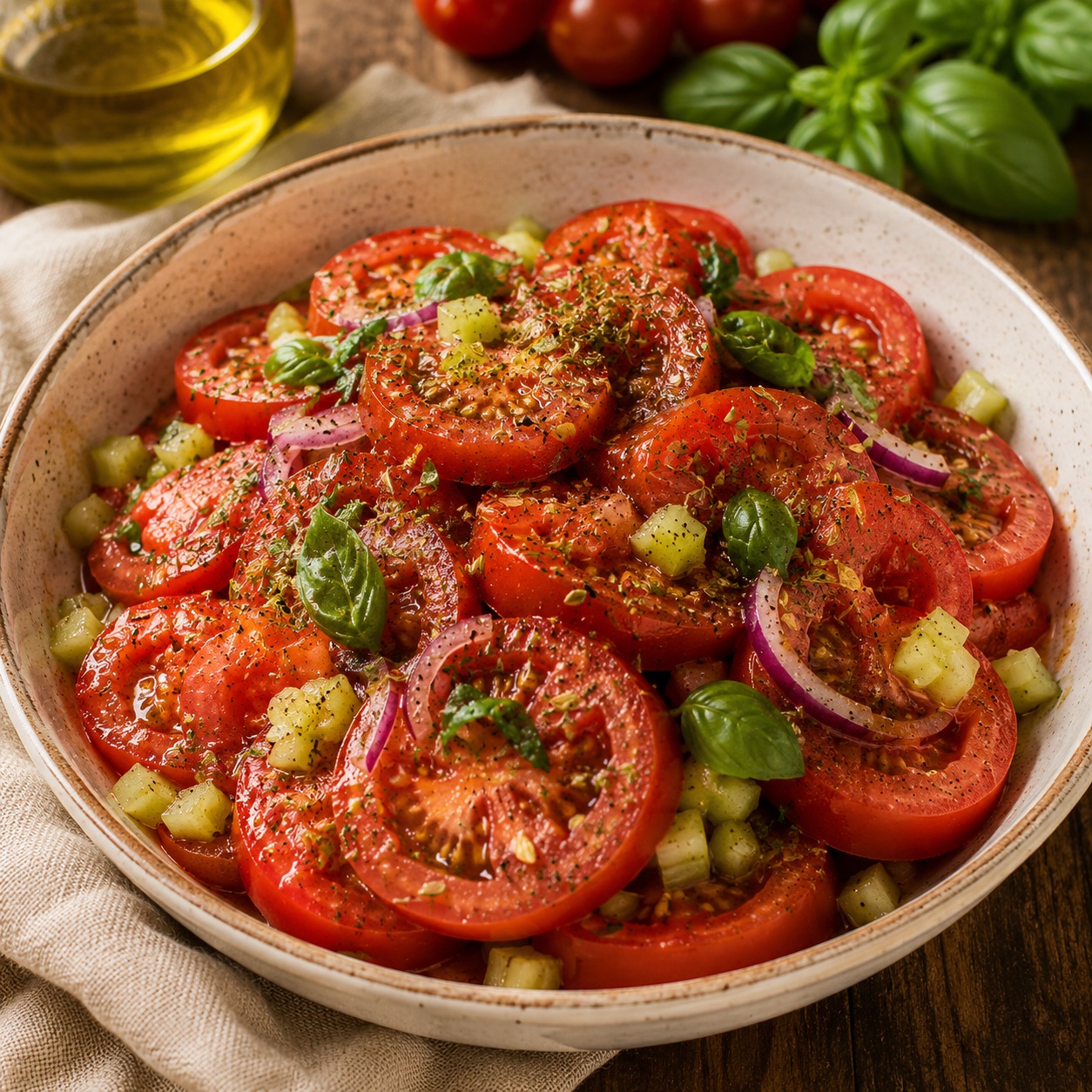
There are dishes that contain a season, and this is the one for summer. Not metaphorically — literally. The insalata di pomodori is made with tomatoes that are ripe in July and August and not much else worth eating for the rest of the year, dressed with olive oil and salt, left to rest until they release their juice into a liquid that pools at the bottom of the bowl and that has no name in any recipe but is the best part of the whole thing. You dip bread into it. You would drink it if that were acceptable. It is deeply, completely, irreplaceably summer.
It was on our table almost every other day in the hot months. Sometimes as a side alongside something grilled or alongside boiled eggs — the same boiled egg that appeared beside the potato and green bean salad, the versatile companion to every light summer plate. Sometimes the tomato salad was just there, at the center of the table, with bread and cheese, as the meal itself. No further justification was offered or required.
I did not fully like it as a child. Not all of it. The pomodori da insalata — the specific type of tomato sold expressly for salad, pale at the center, sometimes almost greenish, firm and slightly sharp rather than sweet and soft — were not my preference. I wanted the sweet ones, the red ones, the Cuore di bue that bleeds at the knife and tastes like it grew in warm soil. The salad tomato, which is what we often used because they were plentiful and cheap and sturdy, was an acquired taste. I acquired it. Now I crave both, and I understand that the sharpness of the slightly underripe salad tomato, dressed in olive oil and left to rest, produces a different and arguably more interesting flavor than the fully sweet one — more acidic, more complex, the kind of thing that makes you reach for another piece of bread.
The recipe has almost no technique. Slice the tomatoes. Salt them. Dress with olive oil. Add oregano or fresh basil, torn not cut. Let it rest. The only thing that can go wrong is using a tomato that was picked before it was ready and stored in a refrigerator, which produces something technically called a tomato but bearing little relationship to the one this recipe requires. Summer tomatoes, bought from someone who grew them nearby, never refrigerated. Everything else is easy.
The oregano question is worth addressing. Dried oregano is the traditional choice in Campania — not because fresh oregano is unavailable but because dried oregano has a more concentrated, resinous quality that complements the acidity of the tomato differently than fresh. It softens slightly as it sits in the olive oil and tomato juice and releases its aromatic compounds into the dressing. Fresh basil, torn by hand and added at the last moment, is the alternative — more delicate, more aromatic, more suitable for the sweetest ripe tomatoes. Both are correct. They are not interchangeable; they produce different salads. Choose based on what the tomato needs.
Lycopene, fat-soluble absorption, and why olive oil belongs on tomatoes
The tomato is one of the most studied foods in nutritional biochemistry, and for good reason. Lycopene — the carotenoid responsible for the red color of ripe tomatoes — is one of the most potent lipophilic antioxidants in the human diet, with documented associations with reduced risk of prostate cancer, cardiovascular disease, and oxidative stress across multiple large epidemiological studies. In raw tomatoes, lycopene is present in its trans-isomer form; heating (as in cooking or sauce-making) converts it to the cis-isomer, which is paradoxically more bioavailable — one of the few cases in nutrition where processing improves nutrient access. However, raw tomatoes dressed in olive oil, as in this salad, also show significant lycopene bioavailability because the fat from the olive oil emulsifies in the stomach and provides the lipophilic environment that lycopene requires for absorption into the intestinal mucosa. Vitamin C is present at high concentrations in raw tomatoes (around 14 mg per 100 g) and is heat-sensitive, making the raw salad the superior source of this nutrient compared with cooked tomato preparations. The acidity of the tomato (from citric and malic acids) and the acetic-acid-like quality of the tomato juice that forms in the bowl alongside the olive oil collectively reduce the glycemic load of any starchy food eaten with the salad — including, crucially, the bread dipped into the juices at the bottom. Dried oregano contributes thymol and carvacrol — two monoterpene phenols with antimicrobial and anti-inflammatory activity studied in multiple in vitro and in vivo models. Fresh basil provides linalool and eugenol. Both herb choices add phytochemical complexity to what is, on the surface, the simplest possible salad. The almost-green salad tomato, it is worth noting, has a higher chlorogenic acid content and a sharper malic acid profile than the fully ripe one — a different nutrient composition, not a nutritionally inferior one, and a taste that is genuinely distinct.
The tomato — the only real decision
Everything else in this recipe is simple. The tomato is the whole question. Different varieties produce genuinely different salads, and knowing which one to reach for depending on what is available is the only knowledge the dish requires.
Cuore di bue
The great summer tomato of southern Italy. Deeply red, few seeds, meaty flesh that bleeds at the knife. Sweet, rich, complex. The premium version of this salad — use it when the market has them and they are genuinely ripe.
San Marzano
Elongated, slightly less sweet, with a good acid balance. More commonly used for sauce, but excellent raw when truly ripe. Holds its shape well when sliced. The Campanian classic.
Pomodori da insalata
The salad tomato — sold specifically for this purpose, often slightly underripe and firm. Sometimes pale at the center, almost greenish, with a sharp acidity rather than sweetness. An acquired taste that produces a different, more complex salad. What we used most often at home.
Beefsteak
Large, juicy, sweet. Produces a lot of liquid in the bowl, which is the correct outcome. Widely available outside Italy and a good substitute for Cuore di bue when the latter is unavailable.
Cherry tomatoes
Halved, sweeter and more intense than any large variety. A different salad in texture and flavor — more uniform, less dramatic. Good when large tomatoes are not at their best.
Mixed varieties
No rule against combining — a Cuore di bue, some cherry tomatoes, a few slices of San Marzano. Different textures and flavors in the same bowl. What happens naturally when the garden or market offers several options at once.
The recipe
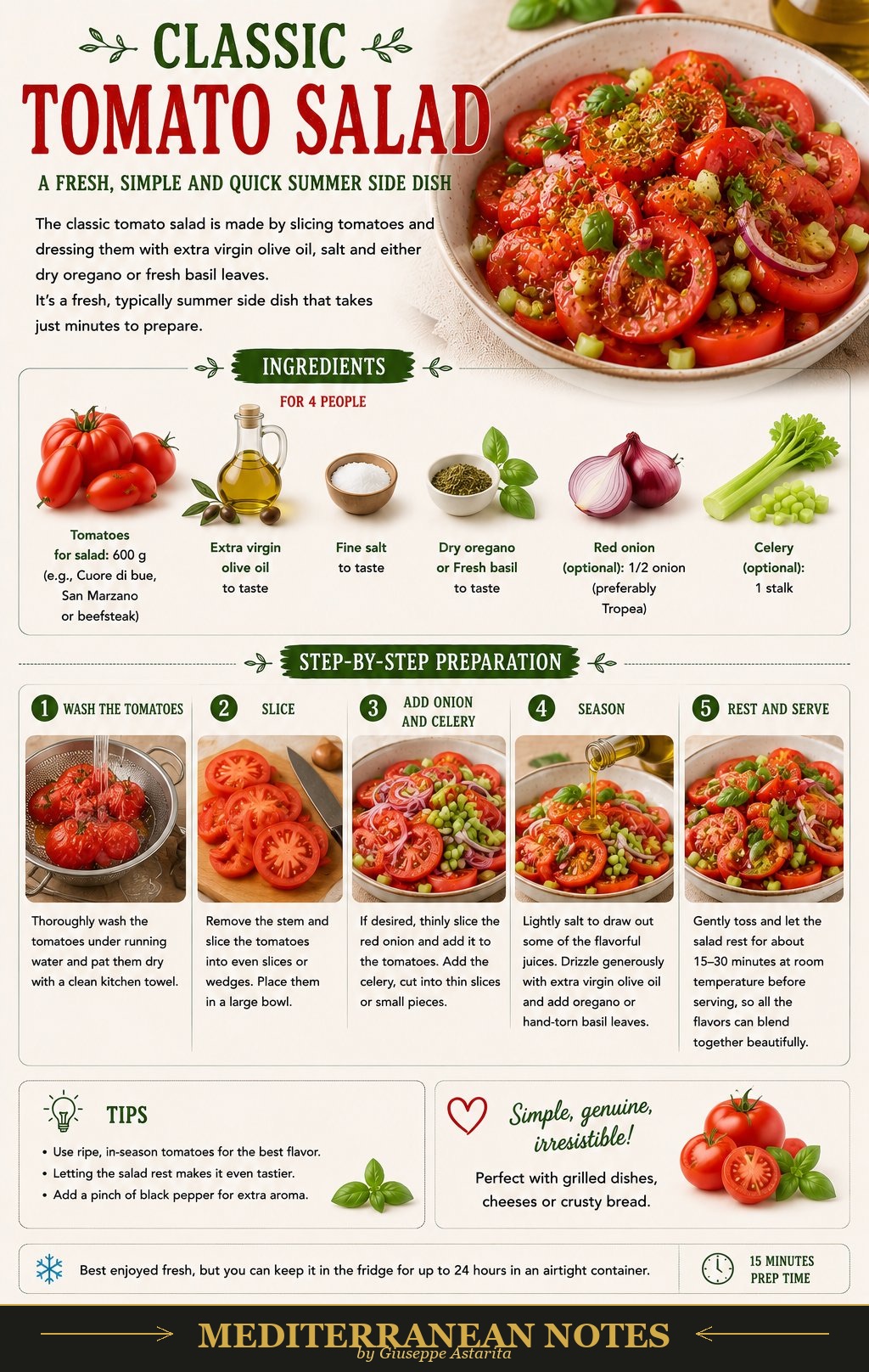
Ingredients · serves 4
Method — and this really is brief
Wash and slice. Wash the tomatoes and pat them dry. Remove the stem and slice into even rounds or wedges — thick enough to hold their shape, thin enough to dress easily. Place in a large bowl or directly on a serving plate.
A sharp knife matters here. A dull knife crushes the tomato and squeezes out the juice before it has a chance to pool in the bowl. Sharp, in one confident motion.
Add onion and celery if using. Thinly slice the red onion and add it to the tomatoes. Slice the celery stalk thinly and scatter over. Tropea onion — the sweet red onion of Calabria — is the best choice if available; it is less sharp than a standard red onion and requires no soaking in advance.
If using a standard red onion and the sharpness is unwelcome, soak the slices in cold water for 10 minutes before adding. It mellows significantly.
Salt first, then oil. Sprinkle salt lightly and evenly over the tomatoes — the salt draws out their juice and begins forming the liquid at the bottom of the bowl. Then pour the olive oil generously over everything. Add the oregano or tear the basil by hand and scatter it over. A grind of black pepper if you like it.
Salt before oil — not the other way around. Salt on an oiled surface slides off and does not penetrate. Salt directly on the tomato draws out juice and seasons from within.
Toss gently and rest. Toss once or twice to distribute the dressing. Then let the salad rest at room temperature for 15–30 minutes before serving. The tomatoes release their juice, the salt and oil and tomato liquid combine into the dressing, and the dried oregano (if using) softens and releases into the oil. The salad after resting is noticeably different from the one just assembled. This is not optional.
Serve with good bread alongside. Always. The bread is for eating with the tomatoes, and — critically — for soaking up the liquid at the bottom of the bowl when the tomatoes are gone. If you reach the bottom of the bowl without bread in hand, you have made a planning error.
This is the dish I now crave from October to June, when the summer tomatoes are over and the ones in the supermarket look right but taste of nothing in particular. It is the dish that makes summer worth waiting for in its specific culinary sense — not the strawberries or the zucchini or the peaches, but this: a plate of sliced tomatoes in olive oil, a piece of bread, a boiled egg on the side, in hot weather, without hurry.
It took me a while to understand that. Now I do not take summer tomatoes for granted. You cannot, once you have spent enough winters without them.
Buon appetito — e viva l'estate.