Come e Quando Mangiamo
Italian Food Is How and When We Live
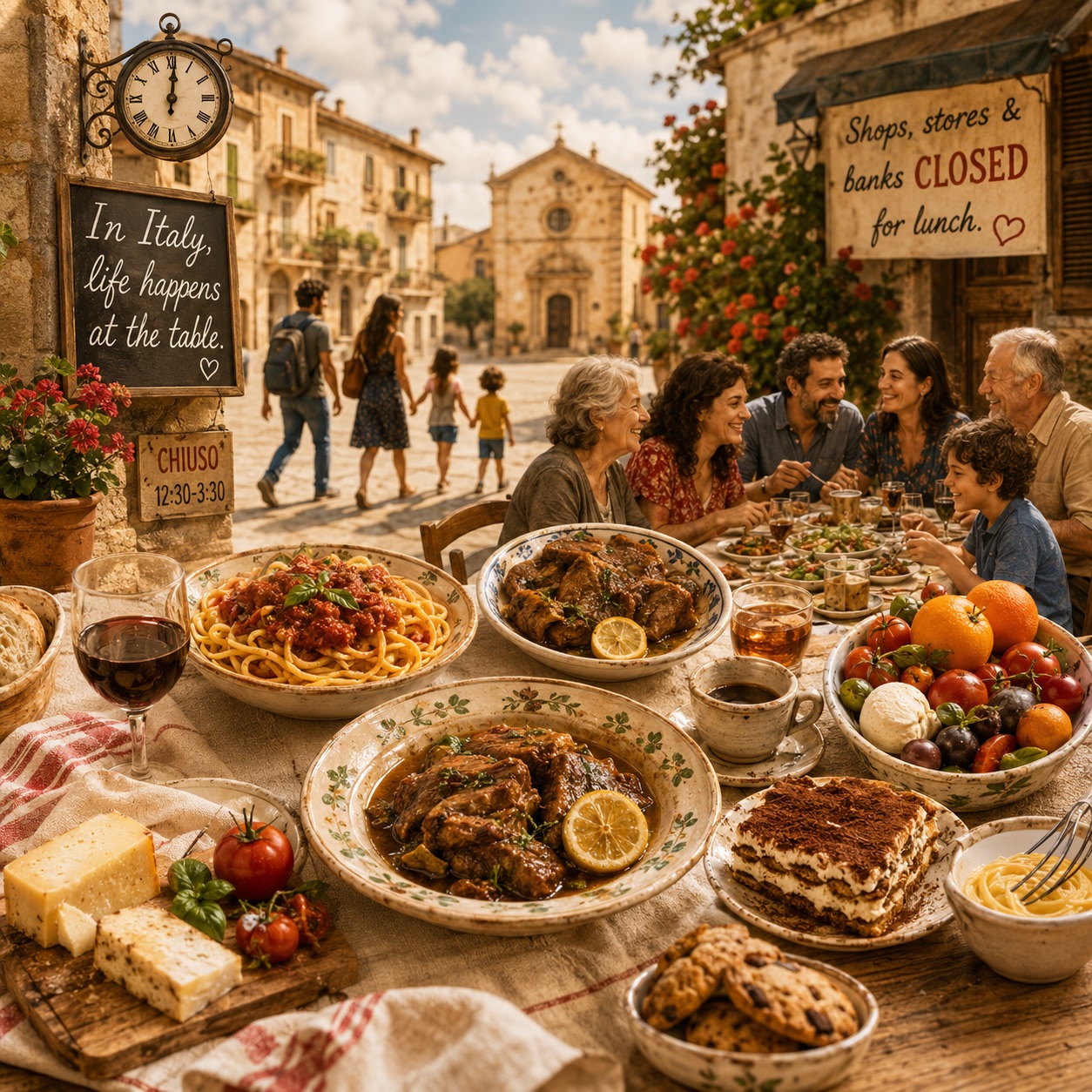
School finished at one o'clock and you went home for lunch. Shops were closed. Banks were closed. Parents came back from work. The whole family sat down. This happened every day, not just on Sundays, and it shaped everything about how food was understood.
The schedule had a sound. Lunch did not arrive by announcement at the table; it arrived by voice, projected over whatever distance separated my mother from her children. If we were down in the courtyard playing, the call came from the balcony — "È pronto, salite!", it's ready, come up — and it carried over the street noise and the game, which ended on the spot, because the call was not the first warning, it was the last. If we were only in another room, the short-range version sufficed: "È pronto, venite!", it's ready, come. Every mother on the street had her own version of the same broadcast, and every child could distinguish their own mother's call from the neighbors' the way birds distinguish their species' song. It was the dinner bell of the Italian South, and no technology has improved on it.
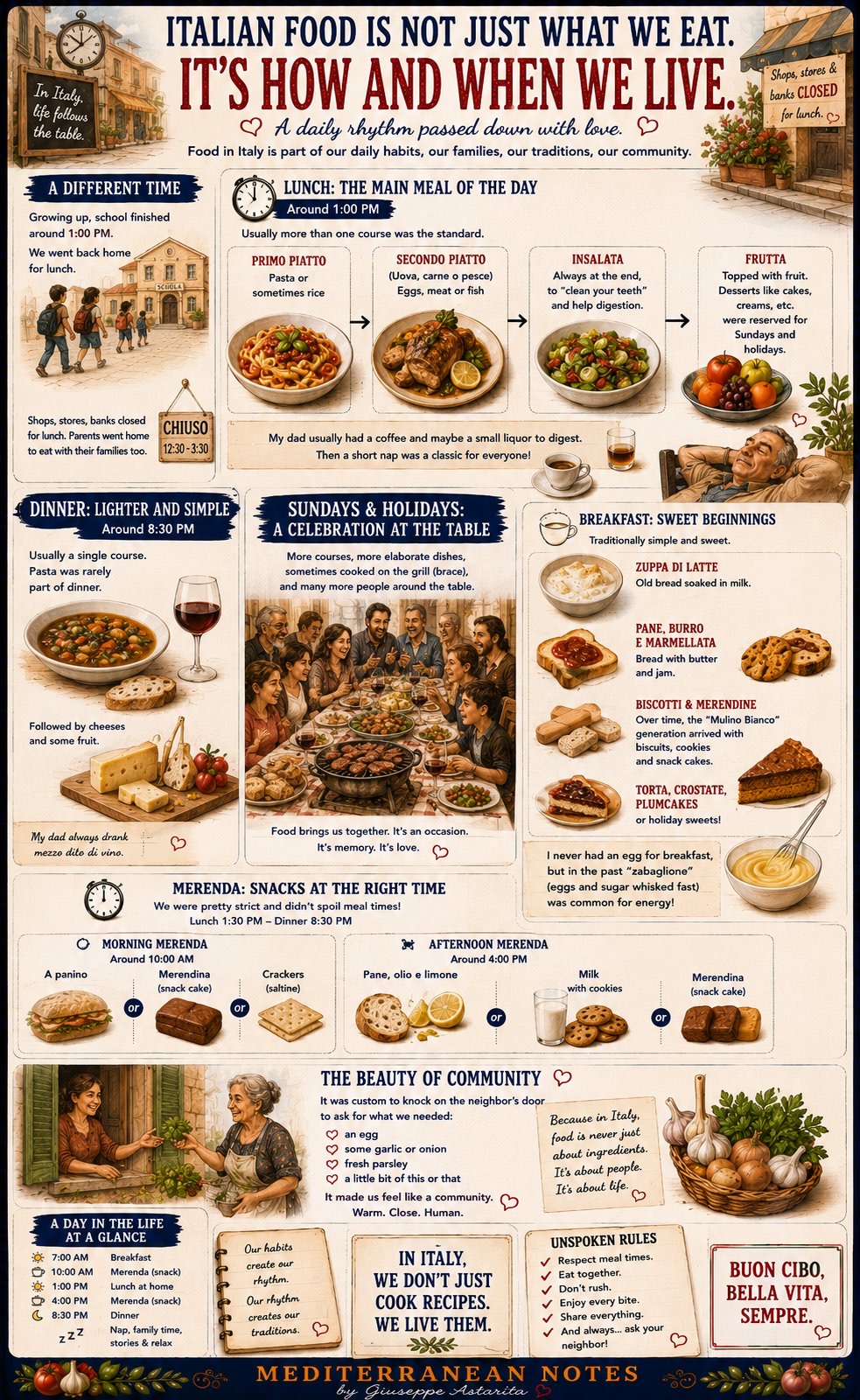
In Italy, food is not just what you eat. It is the structure around which the day is organized. This sounds like a pleasantry — the kind of thing said in tourist brochures — but it is a literal description of how time was divided when I was growing up in Caserta. The school day ended at one in the afternoon. Shops, banks, and offices closed for a midday pause that lasted until three-thirty. Parents came home. The family ate together. Then came the riposo — a short rest, sometimes a nap — before the afternoon resumed. Dinner was at eight-thirty. These were not approximate times. They were the architecture of the day, and the meals were built into them.
Understanding this rhythm is the second cultural key to reading the recipes on this blog — the first being the question of which family's version is correct. The recipes describe what was cooked. This post describes when it was eaten, how it fit into the day, and what that structure meant for how food was experienced. A ragù napoletano that simmers for four hours on a Sunday morning is not the same dish as a ragù that someone makes on a Tuesday evening after work. The dish is the same. The context is entirely different.
Lunch was the serious meal. Not because it was the longest or the most elaborate — Sunday lunch was both those things and existed in a different category entirely — but because it was the daily occasion when the family was all in the same place at the same time. The school returned children home. Work returned parents home. The table was the place where both halves of the day came together for an hour before separating again.
A standard weekday lunch in our house in Caserta had a structure that was followed without being planned — it was simply the order in which things were eaten, and it did not vary significantly from day to day. Primo piatto first: pasta almost always, occasionally rice. Then secondo: eggs, meat, or fish depending on the day of the week and what was in the kitchen. Then insalata — salad at the end, not the beginning, to clean the palate and help digestion, as my mother put it. Then fruit. Desserts of any kind were for Sundays and holidays. On a regular Tuesday the fruit was the dessert, and it was sufficient.
Weekday lunch was not a long affair. Thirty minutes, sometimes less — enough to eat properly without lingering, because the afternoon had other claims on it. My father was always the fastest eater at the table. He finished his pasta before anyone else, and my mother would bring him the secondo while the rest of us were still working through the primo. He never waited. She never made him wait. This had been the pattern long before I was old enough to notice it, and it continued without comment for as long as we all lived in the same house.
The television was on. Not as entertainment exactly — as the day's first news. The RAI telegiornale at lunchtime was how the household learned what had happened that morning, in a time before the internet, before phones that could tell you anything between school and home. It ran at a conversational volume: not loud enough to prevent talking, not low enough to ignore. The same anchors, the same format, the familiar cadence of the Italian public broadcaster. I understood only years later that this was also why weekday lunch felt different from dinner — at dinner there was no telegiornale, and the table had to provide its own structure. Lunch had the news. Dinner had us.
Dinner was lighter and structurally simpler than lunch. Usually a single course — a soup, a vegetable dish, leftovers from lunch, occasionally eggs cooked simply. Pasta rarely appeared at dinner in my family, which surprises people who assume pasta is at every Italian meal. It was not. Pasta belonged to lunch. Dinner belonged to other things. After the main course came cheese, then fruit — in that order, not combined, not interchangeable. A slice of provola, a piece of whatever cheese was in the house, something mild. Then fruit. My father always had mezzo dito di vino — half a finger of wine, no more, measured in the glass with his actual finger. That measure never changed. At lunch there was only fruit at the end; cheese was dinner's domain. No one had written this rule anywhere. Everyone followed it.
Sunday lunch was not an amplified version of the weekday lunch. It was a different occasion. More courses, more people around the table — grandparents, aunts, cousins, whoever was in the city that weekend. The sauce had been on the stove since morning. Sometimes there was meat cooked on the brace — the charcoal grill — for the secondo. Desserts appeared: a crostata, something bought from the pasticceria, a cake someone had made. The meal lasted longer than weekday lunch and its ending was not a signal to return to work but the beginning of the afternoon together — conversation, the coffee, the riposo, the children running between rooms.
The Sunday table is the context for the three sauces — the ragù napoletano, the sugo con salsiccia, the finto ragù — and for the bread-dipping ritual that preceded them. Those dishes did not exist in isolation. They existed inside a specific kind of Sunday morning, in a kitchen that had been working for hours, for a table that would hold more people than usual and last longer than any weekday meal.
She made almost everything. Moving through the recipes in this collection, dish after dish, I find myself recognizing each one as something she cooked at some point — the everyday preparations and the occasional ones, the cucina povera standards and the rarer dishes that required specific ingredients or a specific occasion. She tried every preparation the Campanian kitchen offered and she tried it for us, for the family at the table. The effort was continuous and largely invisible to me as a child because the food simply appeared. A full three-course lunch every day. A dinner that had been thought about. The meal structure was not the only thing she taught us at the table. Almost every dish came with a brief explanation of why it was good for us. Mangia le lenticchie — contengono molto ferro, ti danno tanta forza. Eat the lentils, they contain iron, they give you strength. Mangia gli spinaci per lo stesso motivo. Same with spinach. Mangia il pesce — contiene molto fosforo, fa bene al cervello. Fish has phosphorus, it is good for the brain. Bevi il latte — contiene calcio, fa bene alle ossa. Milk, calcium, bones. The claims arrived without being asked for and were stated with the same certainty as the recipes.
Not all of them were precisely accurate by current nutritional science. The iron in lentils is non-heme iron with lower bioavailability than the heme iron in meat — though lentils are genuinely a good source of it. The spinach-strength connection is a significant overstatement of the actual iron content and absorption, a legacy of a nineteenth-century error in nutritional data that somehow persisted for a century. The phosphorus-brain claim for fish was a simplification — fish is genuinely important for brain health, but the relevant compounds are the omega-3 fatty acids and phospholipids, not the phosphorus itself. The calcium in milk is real and well absorbed. The general direction of each claim was correct even where the specific mechanism was simplified.
More importantly, the practice behind the claims was sound regardless of the precision of the explanation. We ate a variety of foods. We ate legumes regularly. We ate vegetables every day. We ate fish once or twice a week. We ate seasonally because the market offered what the season had. We ate moderate amounts of meat. We ate bread at every meal and drank a small glass of wine at lunch, the adults. We ate together. This was the Mediterranean diet lived as a daily practice rather than a health prescription — and the scientific validation of that diet, accumulated over the decades since, confirms what my mother understood intuitively: eating a bit of everything, mostly seasonal, mostly cooked at home, mostly together, makes the difference.
I did not fully understand at the time how much effort went into feeding us the way she did. Every day there was a full lunch. Every evening a dinner that had been thought about. She moved through the kitchen with the efficiency of someone who had internalized the work so completely that it no longer registered as work. The three-course lunch, the seafood on Fridays, the seasonal variations, the specific dishes for specific occasions — she produced all of this continuously, mostly without anyone noticing the effort because the food simply appeared.
Now I am a parent, and I understand it differently. The effort was real and it was continuous and it was an expression of something that does not have a simple name — not just love, though it was that, but also a deliberate transmission: of how to eat, of what to value, of the specific relationship between food and occasion and family that constitutes a culture. She was not just feeding us. She was teaching us what a table is for, what a meal is for, what it means to cook with attention for people you care about. I did not appreciate this consciously as a child. My appreciation has grown every year since, and grows faster now that I am doing some version of the same thing in my own kitchen, for my own daughters, in a different country, with the ingredients I carry back in a suitcase.
Italian breakfast is not a serious meal in the way that lunch is, and it was never intended to be. Sweet, simple, and quick — coffee, something baked or sweet, done in ten minutes. The savory breakfast common in northern Europe and the United States — eggs, bacon, toast with things on it — was not part of the tradition I grew up in and is still not how breakfast works in most Italian households. I never had an egg for breakfast growing up. Neither did most people I knew.
My father had a different story. He grew up eating zuppa di latte — stale bread soaked in warm milk, which was the Campanian breakfast of an earlier generation when biscuits and packaged foods were not yet the default. It was practical: old bread that had hardened overnight, softened in milk, sometimes with a little sugar. By the time I was growing up, the Mulino Bianco generation had arrived — Mulino Bianco was the brand that defined Italian childhood breakfasts through the 1980s and 1990s, with its range of biscotti and merendine, and the grocery store aisle dedicated to packaged breakfast products became genuinely long. We had biscotti with milk, or pane burro e marmellata — bread with butter and jam — or the merendine that came in individual packs in every school bag.
My father also told me about zabaglione for breakfast — eggs beaten with sugar into a warm, foamy mixture that was drunk from a cup for energy before school or work. This was a pre-war tradition, from a time when eggs were cheap and plentiful and the idea of a protein-rich breakfast was understood instinctively rather than nutritionally. By my generation it had already become something grandparents remembered rather than something people made. But I find it interesting: an entirely different nutritional logic, arrived at through tradition rather than science, and in many ways more sensible than a breakfast of packaged biscuits.
We did not snack randomly. The merenda had a fixed time — twice a day, far enough from meals that it did not interfere with appetite — and anything eaten outside those windows was considered spoiling the meal. Lunch was at one-thirty, dinner at eight-thirty; the two merendas fell neatly in the spaces between, at ten in the morning and four in the afternoon. This was understood by everyone in the house without needing to be stated.
Pane olio e limone deserves a specific note. Bread — a good piece of pane cafone or whatever was left from lunch — drizzled with olive oil and squeezed with lemon and a pinch of salt. It is not a recipe and it is not a dish. It is the kind of thing made in thirty seconds when there is nothing particular in the kitchen but good bread and good oil, which there always was. I still make it sometimes in Massachusetts, standing at the counter, and it still tastes like four o'clock in the afternoon in Caserta in a way that nothing more elaborate manages to replicate.
It was normal to knock on a neighbor's door to ask for an ingredient you had run out of — an egg, a garlic clove, some fresh parsley, a little onion. This happened without embarrassment on either side. The neighbor gave what was asked for and sometimes added something extra. The exchange was brief and warm and required no accounting: you would return the favor on some other day, or had already done so on a previous one. The ledger was never explicit.
What this practice encoded was a assumption of community that I did not fully appreciate until I lived somewhere where it did not exist. In Massachusetts, knocking on a neighbor's door to ask for an egg would be, for most people, an unusual gesture — possibly awkward, requiring explanation, not quite the norm. In Caserta it was simply what you did when you needed something and the shops were closed for lunch. The apartment building was a small community with a shared kitchen logic, and the neighbor's pantry was, in a limited and neighborly sense, also yours.
The traditional Campanian meal rhythm — a substantial midday meal, a lighter evening meal, two small snacks at fixed times, a sweet and minimal breakfast — aligns closely with what circadian nutrition research now identifies as optimal for metabolic health. The largest caloric load in the early-to-mid afternoon coincides with peak insulin sensitivity and the highest capacity for glucose disposal in peripheral tissues. Eating the main meal at noon rather than in the evening means the digestive and metabolic processing happens while the body's systems are most active, and the lighter evening meal is consumed when circadian rhythms are already beginning to prepare the body for sleep.
The salad at the end of the meal — insalata per pulirsi i denti ed aiutare a digerire, as my mother put it — also has a functional basis that goes beyond the folk explanation. Raw vegetables consumed after a meal provide fiber that slows the final phase of gastric emptying and blunts the postprandial glucose peak from the preceding pasta and secondo. The bitter compounds in certain salad greens stimulate bile production and liver enzymes involved in fat metabolism. My mother's explanation was "to clean the teeth and help digestion." The mechanism is more specific than that, but the conclusion was correct. The tradition got the sequencing right before the research existed to explain why.
We live them.
The recipes on this blog were made inside this rhythm. The ragù was a Sunday sauce because Sunday was the day with enough time and enough people to justify it. The cotoletta was a weekday secondo because it was fast, satisfying, and ate well with the salad that followed. The finto ragù was what went on the stove when the morning was shorter and the family was smaller. The merenda was pane olio e limone at four in the afternoon because the shops were closed, the kitchen was stocked with bread and oil, and dinner was four and a half hours away. None of these dishes existed outside this structure. Understanding the structure is how you understand the food.
Buon cibo, bella vita, sempre.