Insalata di patate e fagiolini: the summer salad I didn't appreciate then
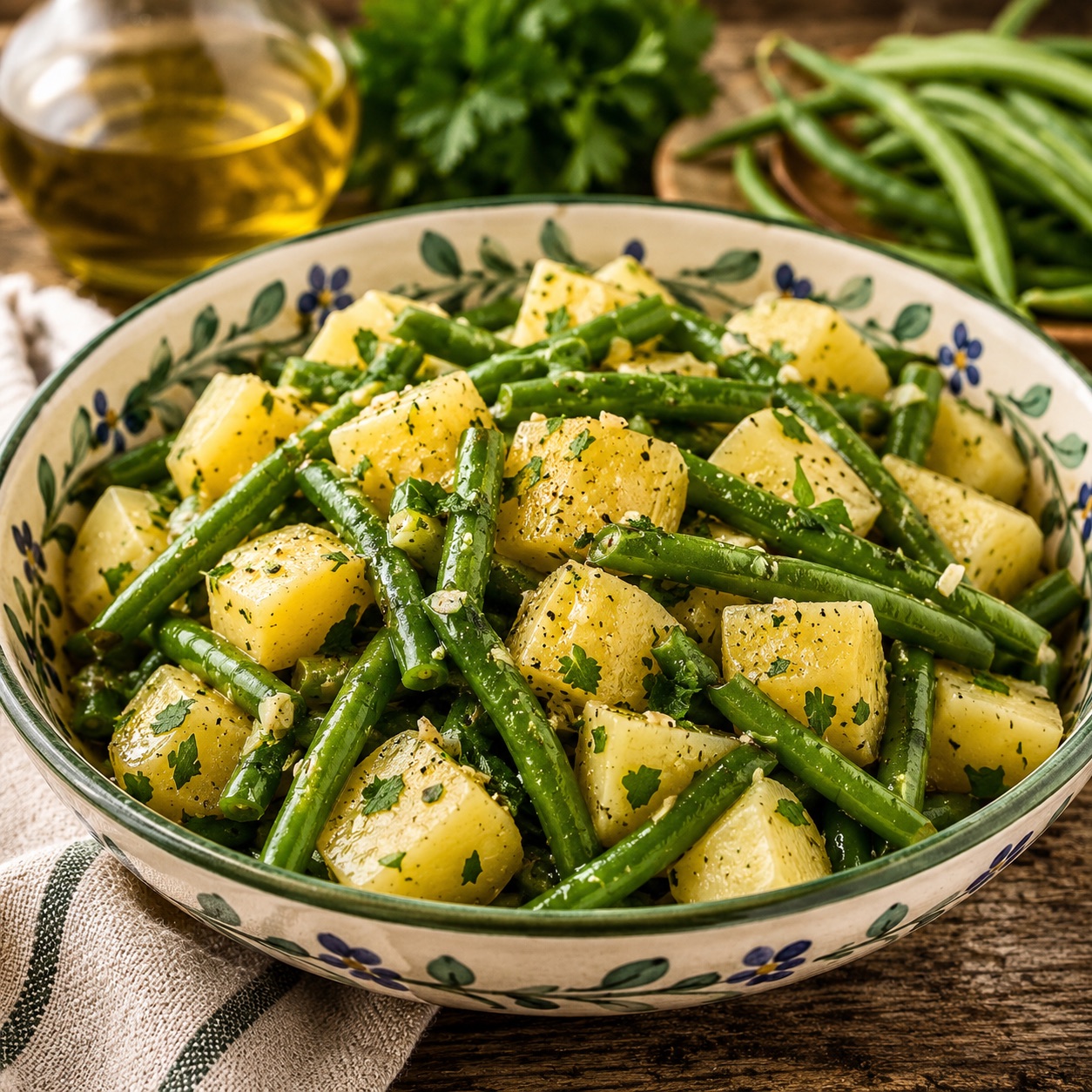
Potatoes and green beans, dressed in olive oil and a splash of white wine vinegar, served cold or just barely warm. Often with boiled eggs alongside. It was on our table almost every summer day. I didn't appreciate it much as a child. Now it takes me straight back.
Summer in Campania is hot. The kitchen is hot. The appetite is for things that are cool and light and do not require either a long cook or a heavy stomach afterward. The insalata di patate e fagiolini — potato and green bean salad — is one of the answers the Italian kitchen arrived at long before anyone was talking about light eating or summer nutrition. It is simply what makes sense when it is August and you need to put food on the table.
It was very often on ours. Lunch, sometimes dinner, frequently as a side alongside boiled eggs — which turns the salad from a vegetable side into a complete, light summer meal. The egg is not in the recipe, exactly; it is beside the recipe, sliced or halved and placed on the same plate, dressed with the same olive oil and a little salt. The combination is deeply satisfying without being heavy, which is the whole point in July.
I did not appreciate this salad as a child. It was too plain. It was too green. The potatoes were fine but the green beans felt like something that was on the plate because it was good for you, not because it was wanted. I was wrong, obviously. The taste for this kind of thing develops with time, with distance, with the accumulation of July lunches in other kitchens in other countries where the table did not automatically have a bowl of this on it. What you take for granted becomes visible only in its absence.
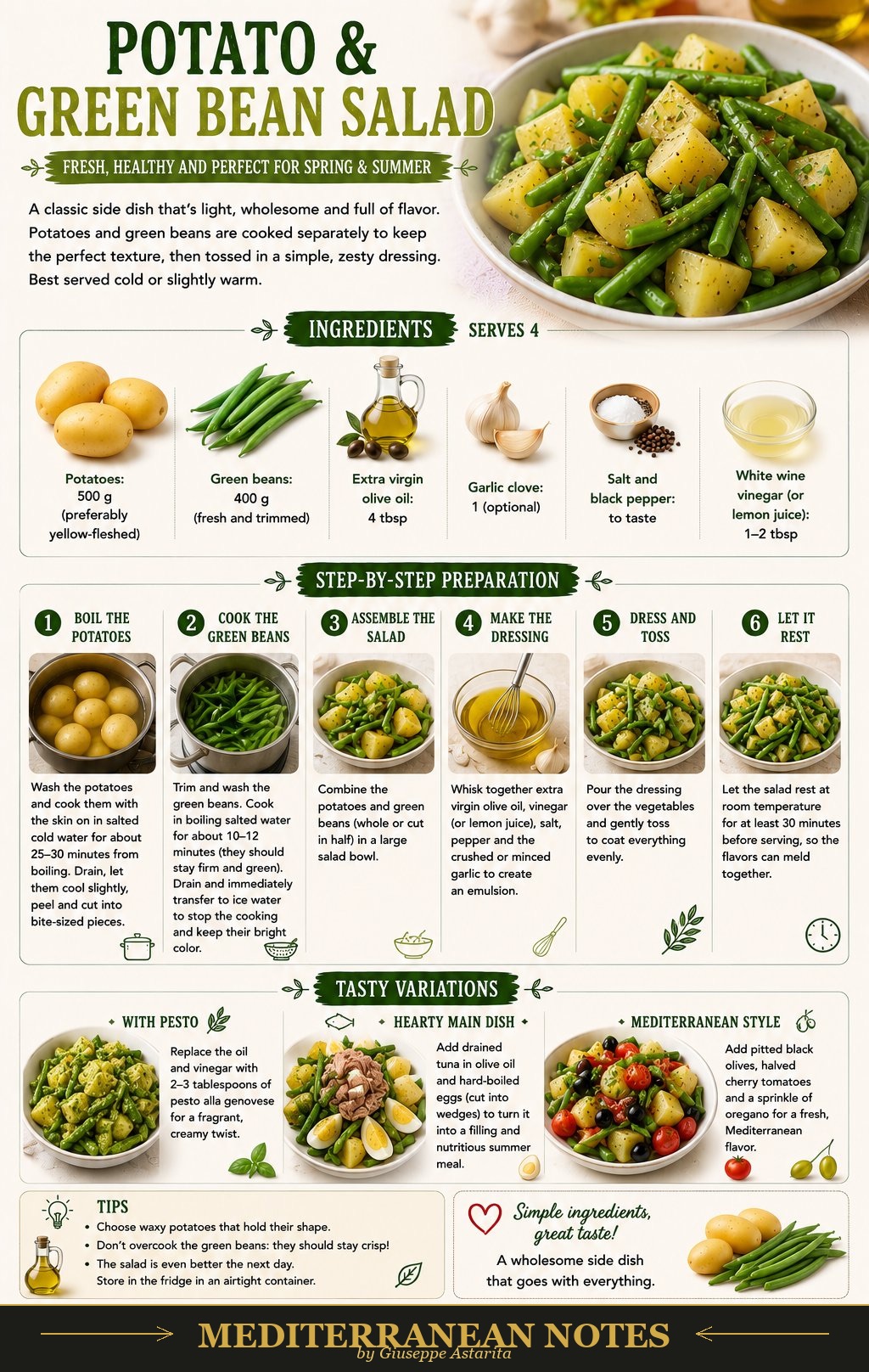
The recipe is genuinely simple, which is part of why I underestimated it. The potatoes are boiled skin-on, peeled while warm, and cut into pieces. The green beans are cooked separately — briefly, in salted boiling water, refreshed in cold water to stop the cooking and hold the green color — and left slightly firm, not soft. The dressing is olive oil, white wine vinegar or lemon, salt, pepper, and an optional garlic clove rubbed around the bowl before the vegetables go in. The salad rests for at least thirty minutes at room temperature before it is served, so the vegetables absorb the dressing and the flavors settle. That rest is not optional; the salad dressed and served immediately is technically correct but tastes unfinished. Patience of thirty minutes produces something noticeably different.
Cooled potatoes, resistant starch, and why this salad is better cold
This salad is an elegant nutritional composition disguised as a simple lunch. Waxy potatoes, cooked and cooled, have a significantly higher resistant starch content than freshly cooked potatoes — resistant starch increases as gelatinized starch partially retrogrades during cooling, producing a form of dietary fiber that resists digestion in the small intestine, slows glucose absorption, reduces postprandial glycemic response, and serves as a prebiotic substrate for gut microbiota. This is one of the few cases where the cooked-then-cooled version of a food is nutritionally superior to the freshly cooked one — and a salad served cold or at room temperature, as this one is, captures exactly that benefit. Green beans contribute vitamin C, vitamin K1 (essential for coagulation and bone metabolism), folate, and lutein — the carotenoid antioxidant associated with eye health. The extra-virgin olive oil dressing provides oleic acid and phenolic compounds (hydroxytyrosol, oleuropein) that improve the absorption of the fat-soluble carotenoids in the beans. White wine vinegar or lemon juice contributes acetic acid and vitamin C respectively — acetic acid has been shown in multiple studies to reduce postprandial blood glucose and insulin response when consumed with a starchy meal, which is precisely the combination here. When boiled eggs are added alongside — the classic accompaniment — the dish gains complete protein, choline, fat-soluble vitamins A, D, E, and K, and additional lutein and zeaxanthin concentrated in the yolk. The full plate of potato-bean salad with two eggs alongside is, from a nutritional standpoint, a remarkably complete and well-balanced summer meal — built from five ingredients, no technique beyond boiling, and no awareness of any of this at the time of composition.
The recipe
Ingredients · serves 4
Method
Cook the potatoes. Wash the potatoes and cook them whole, skin on, in well-salted boiling water for 25–30 minutes from boiling until completely tender. Drain and let cool just enough to handle — peel while still warm, which is much easier than peeling cold potatoes. Cut into bite-sized pieces and transfer to a large bowl.
Use waxy potatoes, not starchy ones. Waxy potatoes hold their shape after cooking and cutting; starchy ones crumble into mash when dressed. Yellow-fleshed varieties (Charlotte, Désirée, new potatoes) are ideal.
Cook the green beans. Trim the green beans at both ends. Cook in a separate pot of well-salted boiling water for 10–12 minutes — they should be tender but still have a slight bite and hold their vivid green color. Do not overcook; soft, olive-colored green beans are a different, lesser dish. Drain immediately and transfer to a bowl of ice water for 1–2 minutes to stop the cooking and fix the color. Drain again and pat dry.
The ice bath is the step that keeps the beans bright green. It takes 30 seconds and makes a visible difference. Skip it only if you are certain you like khaki green beans better.
Assemble. If using garlic, cut the clove in half and rub the cut side around the inside of the serving bowl. Discard the garlic. Add the potatoes and green beans to the bowl — the beans whole, or cut in half if they are long.
Make the dressing and toss. Whisk together the olive oil, vinegar or lemon juice, salt, and pepper until combined — it will not fully emulsify without mustard or garlic in it, but a brief whisk brings it together enough. Pour over the vegetables and toss gently to coat everything evenly. Taste and adjust — more acid if it needs brightness, more salt if it tastes flat.
Rest before serving. Leave the salad at room temperature for at least 30 minutes before serving. The potatoes absorb the dressing, the flavors round out, and the whole thing becomes noticeably more cohesive. Served immediately after dressing it is technically correct; served after resting it is better.
The salad is also very good the next day, straight from the refrigerator or brought back to room temperature. The potatoes will have absorbed even more dressing overnight — add a small drizzle of fresh olive oil before serving to refresh it.
Variations — and the one that matters most
With boiled eggs — the classic
Two boiled eggs per person, halved or quartered, placed beside the salad on the same plate. Dress the eggs with a little of the same olive oil and a pinch of salt. This is not a variation — it is the complete dish as eaten in the summer kitchen. The egg alongside turns a side salad into a meal.
With tuna in olive oil
Drain a tin of good tuna in olive oil and flake it over the dressed salad. Add hard-boiled eggs if you like. This is the version that becomes a substantial summer lunch on its own — closer to a salade niçoise in spirit but assembled with Italian instincts: no anchovies, no olives required, just tuna, potato, green bean, olive oil.
With pesto
Replace the oil-and-vinegar dressing with 2–3 tablespoons of pesto alla genovese. This is the Ligurian version of essentially the same dish — pesto traditionally goes with green beans and potato (it is the classic accompaniment for trofie al pesto). Creamy, fragrant, completely different in character from the plain version.
Mediterranean style
Add pitted black olives, halved cherry tomatoes, and a sprinkle of dried oregano to the dressed salad. A little more complex, a little more assertive. Good for a gathering where the salad is a course rather than a side. The tomatoes add acidity and color; the olives add depth.
This is the simplest dish in this collection — simpler even than the strawberries with lemon, because that at least has the drama of the syrup forming in the bowl. The potato and green bean salad has no drama. It is just vegetables, cooked and dressed, left to settle. It asks nothing of you and gives back something that took me until adulthood to understand: the particular pleasure of eating something clean and cool and well-made in hot weather, with a good egg alongside, without needing anything else.
It was on our table almost every summer day. I know that now in a way I didn't then.
Buon appetito — e buona estate.