Noi Mangiamo Così
A journey from America to Northern Italy to Southern Italy, arriving finally at Campania — discovering at each step that food culture is more specific, more intentional, and more distinct than any general label suggests. The closer you look, the more Campanian food culture becomes its own world.
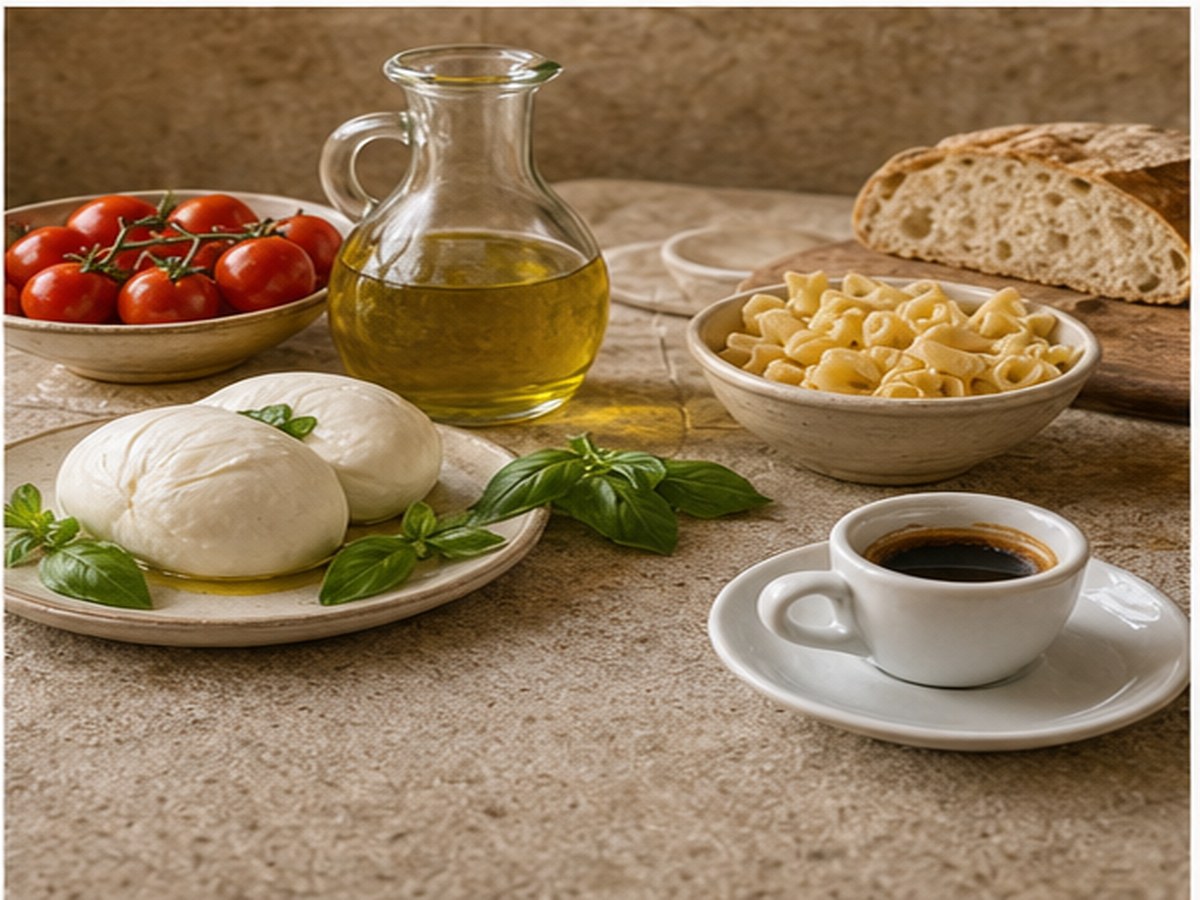
I have lived in the United States for twenty years — across the Midwest, the West Coast, and the East Coast — which means this comparison is not theoretical. The differences described below are not observations from a brief visit but from two decades of daily contact with American food culture in multiple regional forms. Chicago, California, Massachusetts: different regions, different food scenes, but sharing the same underlying architecture of how and when Americans eat. That architecture is what I compare to the Campanian one here, not any single regional American tradition. The observations are firsthand and specific.
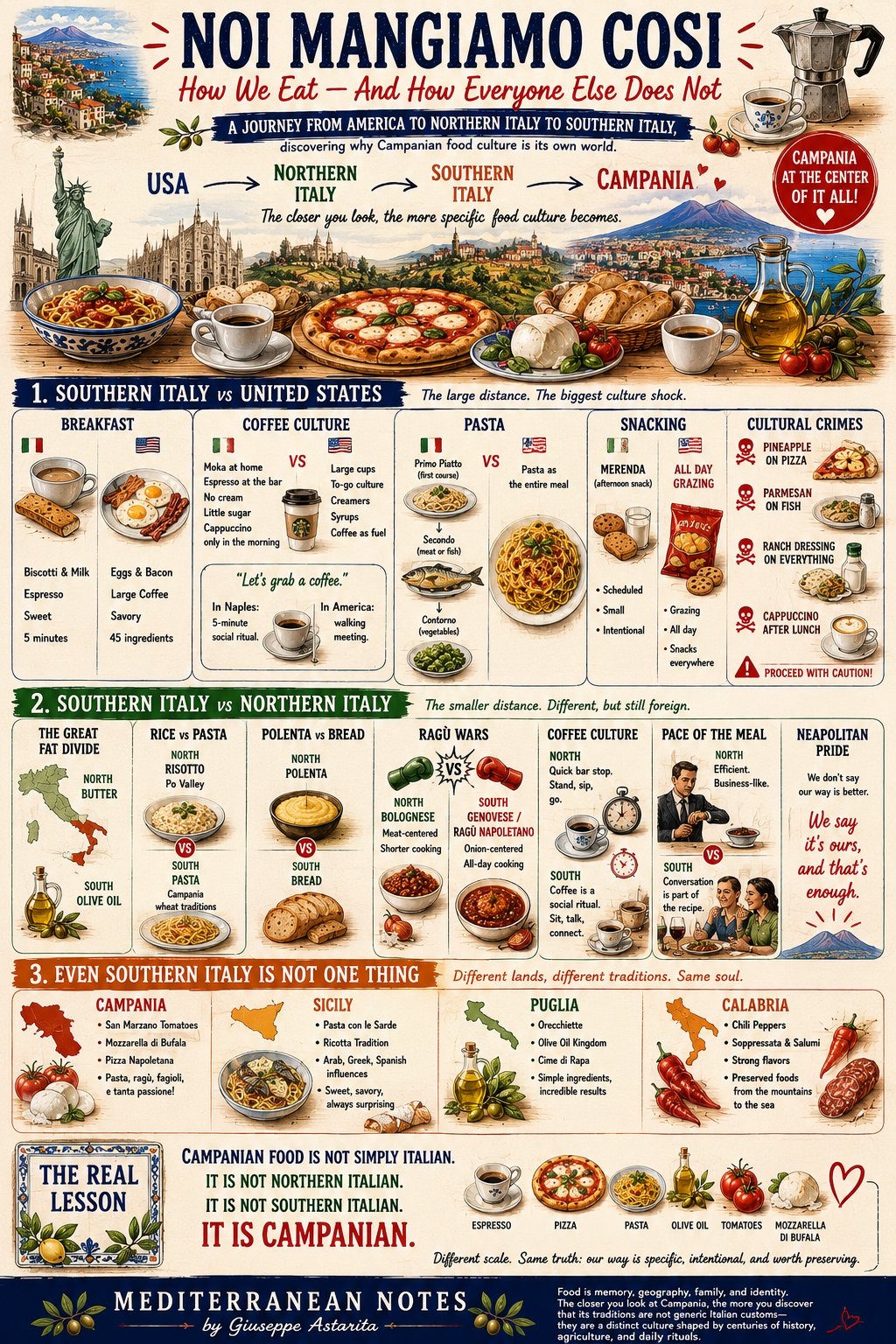
USA → Northern Italy → Southern Italy → Campania. The closer you look, the more specific. Click to enlarge.
Cultural Food Differences — Southern Italy, Northern Italy, and the United States
This collection has now documented more than a hundred preparations from the Campanian kitchen — recipes, traditions, rituals, memories. At a certain point it becomes useful to place all of it in context: to explain not just what we eat but how our eating differs from what the people around us — in America, in Northern Italy, even in other parts of the South — consider normal. Food culture is invisible when you are inside it. You only see it clearly when you step outside and look back. Having spent twenty years in the United States gives a certain clarity about where the Campanian kitchen ends and everything else begins.
What follows is a comparison across three scales: Southern Italy against the United States (the large distance, where everything is different), Southern Italy against Northern Italy (the smaller distance, where the differences are subtler but felt more sharply), and finally a brief acknowledgment that even within the South there is no single thing called southern Italian food. At the center of all three comparisons is Campania — which is not Italian in the generic sense, not southern Italian in the generic sense, but specifically Campanian in ways that this collection has tried to document and preserve.
Breakfast
🇮🇹 Southern Italy
Biscotti e latte — five minutes
Warm milk, biscotti dunked and eaten with a spoon. Espresso from the moka. Small, sweet, complete in five minutes. The bar offers a cornetto and a quick espresso at the counter. Breakfast is not a social occasion. It is the beginning of the day, handled efficiently. See:
biscotti e latte,
cioccolata calda for special days.
🇺🇸 United States
Eggs, bacon, toast — forty-five minutes, forty-five ingredients
A savory breakfast is standard: eggs in multiple preparations, bacon or sausage, toast, orange juice, large coffee. Brunch exists as a weekend institution. The meal is substantial, often protein-forward, frequently social. The American breakfast is a meal. The Italian breakfast is a ritual.
The savory breakfast is the first thing that disorients an Italian arriving in the United States. Eggs and bacon at 8am. A plate of food before the day has properly begun. In Campania, the morning is for coffee and something sweet and brief. The real food starts at lunch. The American logic — front-load the protein, eat big in the morning — is nutritionally defensible but culturally alien to anyone raised on the biscotto-in-milk tradition.
Coffee
🇮🇹 Southern Italy
Espresso — a five-minute social ritual
Small, dark, strong. At home from the moka; at the bar standing at the counter. No cream — ever. A little sugar for most people. Cappuccino only in the morning. "Andiamoci a prendere un caffè" is a work break format, not a meeting. The coffee is incidental to the pause; the pause is the point.
🇺🇸 United States
Large cups, to-go culture, coffee as fuel
Drip coffee in large quantities, or Starbucks in sizes that require their own taxonomy. Cream, syrups, oat milk, seventeen customizations. Consumed while walking, while driving, during meetings. Coffee as a productivity tool rather than a ritual. "Let's grab a coffee" is a forty-five-minute walking meeting.
Pasta — and the meal structure
🇮🇹 Southern Italy
Primo piatto — the first course
Pasta arrives first. A small plate — 80–100g dry — as the opening of a meal that continues with a secondo (meat or fish), a contorno (vegetables), a salad, and fruit. The pasta is the beginning, not the whole. Parmigiano goes on the pasta, not on fish dishes. The meal has structure.
🇺🇸 United States
Pasta as the entire meal
A very large bowl of pasta, often with a creamy or meaty sauce, served as the complete dinner. Garlic bread alongside. Perhaps a side salad first. The pasta is everything. Portions are calibrated for an entire meal's worth of calories in one dish. Parmigiano is shaken from a green container onto anything.
Snacking culture
🇮🇹 Southern Italy
La merenda — scheduled, small, intentional
One snack in the afternoon, around 4–5pm, between lunch and dinner. The merenda of childhood: biscotti, a piece of fruit, pane e olio e limone. Small, specific, timed. Snacking outside this window is not standard. Food has its moments and the moments have their food.
🇺🇸 United States
All-day grazing — snacks everywhere, always
Snacks at the office, snacks at the desk, snacks in the car, snacks at the cinema, snacks between snacks. The American food environment is designed for continuous eating — vending machines, snack bars, chip bags, energy bars. The concept of a scheduled snack window does not translate.
Cultural crimes — proceed with caution
🍍Pineapple on pizza. The pizza napoletana is described elsewhere in this collection. It does not have pineapple. The combination of sweet fruit with tomato and mozzarella is not a creative variation — it is a different category of object that happens to be served in a round shape. We understand that people enjoy it. We choose not to.
🧀Parmigiano on fish dishes. Parmesan on seafood pasta, on fish risotto, on anything from the sea. In Campania this does not happen. The rule is not arbitrary: the strong aged cheese flavor competes with and overwhelms the delicate iodine-sweet flavor of fresh seafood. They are from different flavor worlds. We keep them separate.
🥗Ranch dressing on everything. The Italian salad dressing is olive oil, lemon or vinegar, salt. Three ingredients. The American tendency to dress salads in thick, creamy, flavored sauces — ranch, blue cheese, thousand island — produces a result where the salad is a vehicle for the dressing rather than the dressing being a support for the salad. This is a philosophical difference.
☕Cappuccino after noon. This one is not negotiable in Naples. Cappuccino is a morning drink. The milk is too heavy for the digestion after a meal. After lunch, after dinner, with pizza: espresso. The cappuccino after noon is not incorrect — it is simply the mark of someone who is not from here.
The comparison with the United States is easy to make because the differences are large and obvious. The comparison with Northern Italy is more interesting and more personal, because it requires admitting that "Italian food" is not one thing — and that the food eaten in Milan or Bologna or Turin is, in several important ways, as foreign to a Neapolitan palate as the food eaten in Boston. This is not well understood by people who think of Italian cuisine as a single tradition.
🌿 Southern Italy
Olive oil — the universal fat
Every savory preparation begins with olive oil. Every salad is dressed in olive oil. Every finished dish receives a drizzle of raw olive oil. The Campanian kitchen cannot be separated from its oil. Butter appears in cakes and in some baked preparations — it does not appear in the savoury kitchen as a cooking fat.
❄️ Northern Italy
Butter — the fat of the Po Valley
Northern Italian cooking — Piedmontese, Lombard, Venetian — uses butter extensively. The risotto is finished with cold butter. The pasta is often egg-based and butter-sauced. The cooking fat of the north is animal fat from the dairy tradition of the Po Valley, as the cooking fat of the south is olive oil from the Mediterranean tree. Same country, different fat — different food.
🌿 Southern Italy
Pasta — the staple, every day
Pasta as described throughout this collection: daily, in rotation, as the first course of every substantial meal. Dried pasta made from durum wheat semolina. The shapes of the Campanian pantry — rigatoni, paccheri, spaghetti, fusilli, candele. A culture built on the wheat fields south of Rome.
❄️ Northern Italy
Rice — the Po Valley grain
The north eats risotto. Carnaroli and Arborio from the rice paddies of Lombardy and Piedmont, cooked slowly with ladle-by-ladle broth into a creamy unified dish. The south has risotto too — it appears in this collection — but as an adopted preparation, not a native one. For the north, the grain of daily cooking is rice, not wheat.
Onion-centered · All-day cooking
The Neapolitan ragù is built on onion, cooked for four to eight hours at the barest simmer, using whole cuts of meat that become both the sauce and the secondo. It is the sauce of patience and of Sunday. The tomato is San Marzano. The pippiare — the barely-visible simmer — is its defining technique.
❄️ The ragù bolognese
Meat-centered · Shorter cooking
The Bolognese is built on a soffritto base with ground meat — beef, pork, veal in various combinations — cooked for two to three hours in wine and milk. No tomato in the authentic version, or very little. Served on tagliatelle, not spaghetti. A completely different preparation that shares only the word ragù with its Neapolitan counterpart.
We don't say our way is better. We say it is ours, and that is enough. This is the Neapolitan position on the north-south food question, and it is a dignified one. The north has its butter and its risotto and its Bolognese. We have our olive oil and our pasta and our ragù napoletano. Neither needs to win. Both need to be understood as specific.
Here is how complete the separation was in practice: growing up in Caserta, I do not think we ever once had tortellini at home. Or piadina. Or the lasagna bolognese — our lasagna was the Neapolitan one, with the little meatballs, and the other one was something you knew existed the way you knew Sweden existed. These were not exotic foods. They were from Emilia-Romagna, a few hours up the autostrada. They simply did not belong to us, so they did not appear. The single boldest piece of culinary tourism in our kitchen — the farthest north my mother ever cooked — was polenta. We went as far as making polenta! It felt like an expedition.
And if the food of Bologna was foreign, imagine the food of other continents. Mexican, Chinese — these were not options we declined; they were options that did not exist. The flavors did not belong to us, the ingredients were impossible to find, and there was no restaurant to try them in anyway: growing up there was no Chinese restaurant around, no Mexican food, nothing. Eating out, when it happened at all, meant pizza — only local trattorie and pizzerie, places that cooked the same tradition we ate at home, slightly better dressed. The nearest McDonald's was in Rome, and I finally saw it at sixteen, on a high-school trip from Caserta — a school excursion to the capital that included, among the monuments, the hamburger.
The coffee comparison between north and south is perhaps the sharpest of the smaller-scale differences. Both drink espresso. But in Milan the espresso at the bar is a transaction — ordered, consumed in ninety seconds, paid for, left. Efficient, excellent, businesslike. In Naples the espresso at the bar is a social event — it has always been inexpensive enough that everyone can afford it, which makes it genuinely democratic, and the pause it creates is considered part of its value. The coffee is the excuse. The conversation is the point. Andiamoci a prendere un caffè is not an invitation to consume caffeine — it is an invitation to stop, to step outside, to exchange a few words with a person who is not a spreadsheet.
The final comparison is the most internal. Southern Italian food is itself not one thing — and a Neapolitan who claims to speak for the whole south is making the same kind of overgeneralisation that a northern Italian makes when claiming to represent all of Italy. Campania, Sicily, Puglia, and Calabria each have distinct traditions shaped by different geographies, different histories, and different agricultural conditions. What they share is a Mediterranean orientation, an olive oil foundation, and a relationship to food as identity rather than as fuel. What they do not share is a single unified cuisine.
Campania
San Marzano tomatoes.
Mozzarella di bufala. Pizza napoletana. Pasta, ragù, fagioli, e tanta passione. The Bourbon court's influence on the pasticceria tradition. The ancient olive trees and the volcanic soil of the hinterland. Coffee as a sacred daily ritual. The specific flavors of a city that was once the most populous in Europe and absorbed every culinary influence it encountered.
Sicily
Arab, Greek, Spanish, and Norman layers all visible in the food. Pasta con le sarde — sardines with wild fennel, pine nuts, and raisins — is a dish with no direct equivalent in Campania. The ricotta tradition dominates the pastry kitchen where Campania uses mozzarella and ricotta di bufala. Sweet, savory, and always surprising: the Sicilian kitchen is the most multicultural in Italy.
Puglia
The olive oil kingdom — the largest olive oil producing region in Italy, with a tradition that makes even Campanian oil culture look modest. Orecchiette with cime di rapa (friarielli's Pugliese cousin) is the iconic preparation. Simple ingredients, incredible results from the flatlands and the ancient trulli country. A spare, honest cooking that does not rely on rich sauces.
Calabria
The region of chili pepper — 'nduja, the spreadable spiced pork paste; soppressata and local salumi; preserved foods from the mountains to the sea. Strong flavors, bold seasoning, the influence of Greek colonization still visible in certain preparations. Calabrian food has a directness and an intensity that distinguishes it from the sweeter, more tomato-rich tradition of Campania.
The real lesson
Campanian food is not simply Italian.
It is not Northern Italian.
It is not generically Southern Italian.
It is Campanian.
Food is memory, geography, family, and identity. The closer you look at Campania, the more you discover that its traditions are not generic Italian customs — they are a distinct culture shaped by centuries of history, agriculture, and daily rituals. The San Marzano tomato in the volcanic plain south of Naples is not a tomato: it is a specific place in a specific season expressed through a fruit. The mozzarella di bufala is not cheese: it is the water buffalo tradition of the Campanian coast, the specific fat of that milk, the hands that stretch it. The ragù napoletano is not a meat sauce: it is Sunday, it is the slow Sunday morning smell, it is the moment when the whole household knows what day it is.
This collection exists because these specific things are worth knowing about. More than a hundred preparations — recipes, traditions, rituals, ingredients, cultural posts — and all of them together make the same argument: that the food of Campania is not generic Italian, not Mediterranean Diet in the abstract, but the particular food of a particular region eaten by particular people who understood it as the natural order of things. Twenty years in the United States, moving between the Midwest and the West Coast and the East Coast, has provided the distance necessary to see it clearly. What looked like simply how food worked turns out to be a specific and beautiful tradition worth documenting, preserving, and teaching to the next generation — to daughters growing up in Massachusetts who shell fresh peas at the kitchen table and eat biscotti in warm milk and know what la scarpetta means.
Different scale. Same truth: our way is specific, intentional, and worth preserving.
Noi mangiamo così —
e siamo fieri di farlo.