Lasagna napoletana: the feast before the fast
Carnival, New Year's Day, a Sunday with the whole family invited. The Neapolitan lasagna is not a dish — it is an occasion. Rich, layered, made over two days, eaten slowly at a long table. And the leftovers on the evening after are better than the original.
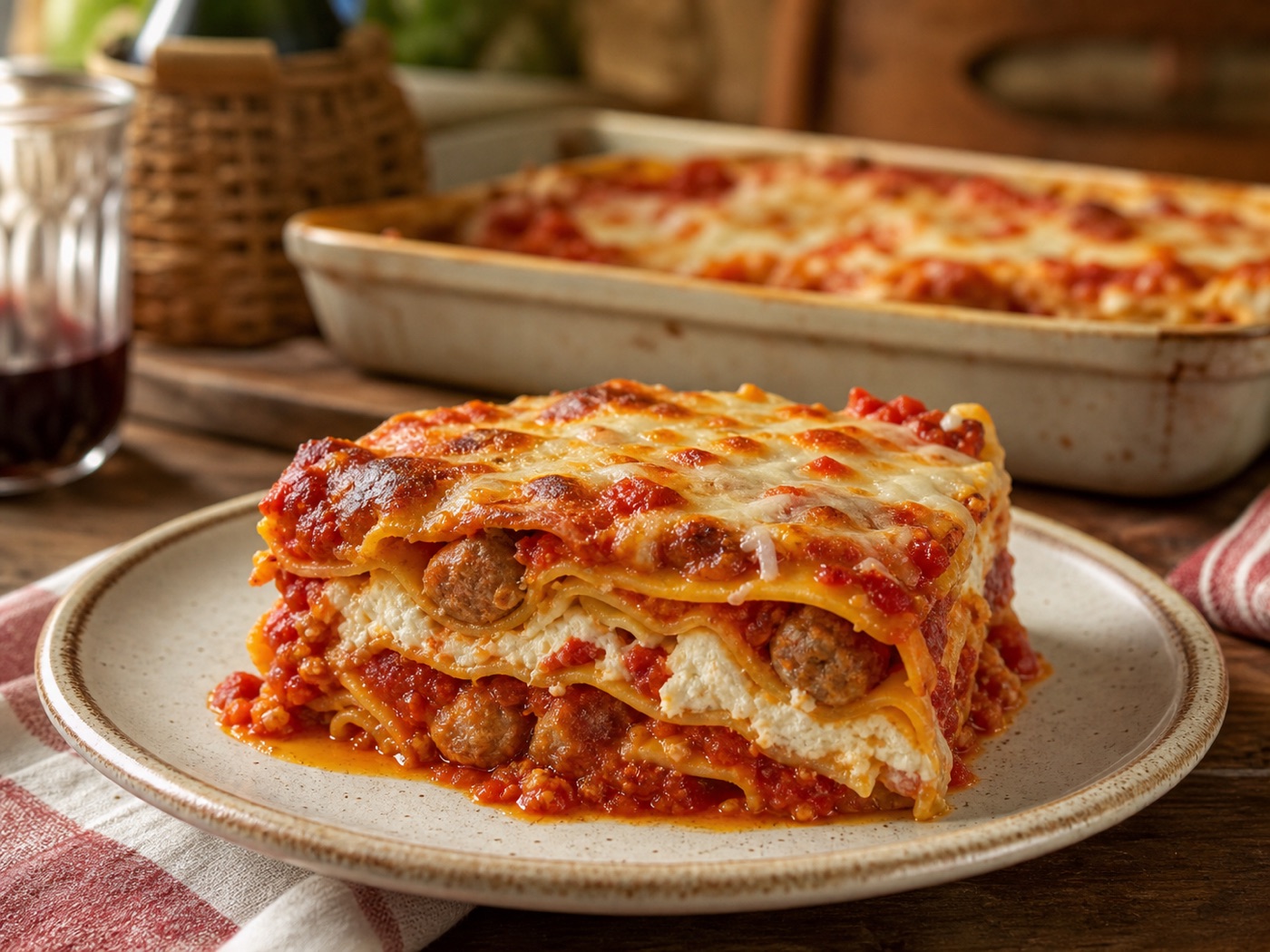
In Naples, the lasagna belongs to Carnival. Not exclusively — it appears at New Year's Day lunch, at Easter Monday, at any Sunday gathering large enough to justify the effort — but Carnival is its spiritual home. The days before Lent are the days of abundance and excess in the Catholic calendar, the deliberate celebration of richness before the forty days of fasting that follow, and the Neapolitan lasagna is the culinary expression of that logic. It is everything at once: long ragù, tiny fried meatballs, creamy ricotta, melting fiordilatte, hard-boiled eggs, abundant Parmigiano. It is not modest. It is not supposed to be.
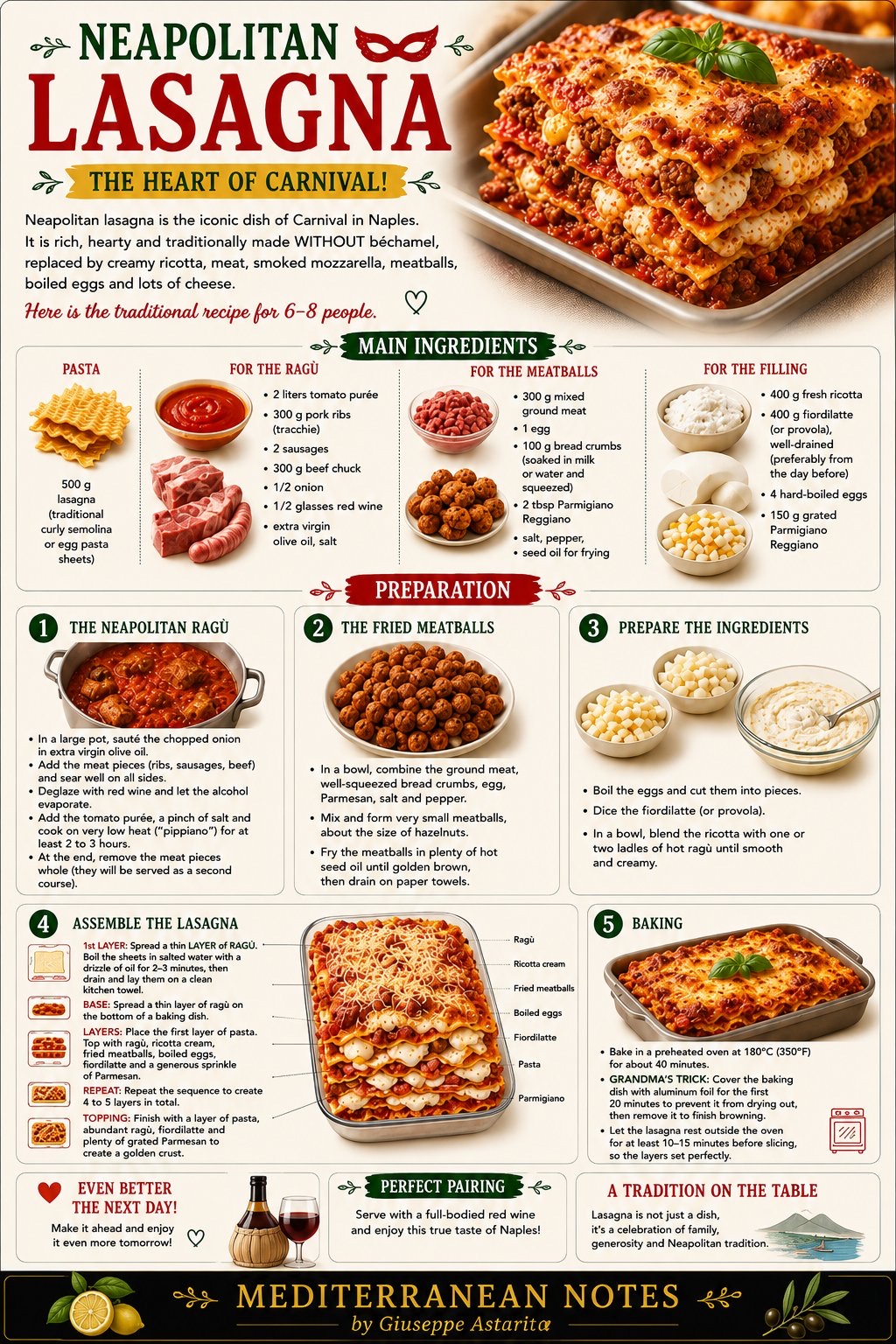
The Neapolitan lasagna has nothing to do with the Bolognese version — no béchamel, no single meat sauce, no clean architecture of two components. The Neapolitan version is layered with everything the kitchen has to offer: the ragù that has been cooking since the night before or since early morning, the ricotta thinned with a little of that ragù until it is smooth and just pourable, the polpettine — tiny meatballs the size of a hazelnut, fried separately and added to the layers — the fiordilatte cut into pieces and well-drained so it does not make the lasagna wet, the hard-boiled eggs sliced and distributed through the layers, and at every interval a generous dusting of Parmigiano. Five layers, sometimes more. Every layer different. Every slice, when cut, reveals a cross-section of the whole day's work.
We invited family for this. You have to. The lasagna for six to eight people is a project that produces more food than one household reasonably needs for a single meal — which is precisely the point. The table was full. The meal was long. And what remained — and there was always something remaining — was stored and eaten the next evening, cold or reheated, and it was consistently better: the layers had settled and compressed, the ragù had deepened, everything had had time to become one thing rather than many things stacked.
This is a two-day dish. The ragù should be made the day before — it needs at least two hours, ideally three, and it tastes significantly better after an overnight rest. The polpettine can be made and fried on the same day as the assembly, but the components being cold and firm make the layering easier. If you make the whole thing on day one and bake it on day two, the result will be better than if everything happens in one continuous session. The lasagna rewards planning.
The polpettine deserve a specific mention. They are the same mixture as the polpette alla napoletana — the Sunday meatball — but made tiny, hazelnut-sized, and added to the lasagna layers raw after a brief initial fry. Their purpose is to appear unexpectedly in each slice, small concentrated points of savory flavor distributed through the layers like a discovery. This is the detail that most distinguishes the Neapolitan lasagna from any imitation of it. If you make this recipe without the polpettine, you have something good. With them, you have something specific and unrepeatable.
The most nutritionally complete dish in the collection — and why it takes a day to make
The Neapolitan lasagna is nutritionally one of the most complete single dishes in this collection — and also the most calorie-dense, which is appropriate given its role as a celebration meal. The long ragù provides heme iron, zinc, B12, creatine, and complete protein from multiple meat sources simultaneously; the slow braise also produces collagen-derived gelatin from the pork ribs (tracchie) and connective tissue of the beef chuck, which gives the ragù its characteristic body and coating quality. Ricotta, made from the whey remaining after cheese production, is one of the richest dietary sources of whey protein — the fastest-absorbing protein fraction, with a high leucine content that makes it particularly effective at stimulating muscle protein synthesis. The combination of casein from the fiordilatte and whey from the ricotta in the same dish provides both fast- and slow-absorbing protein fractions, sustaining amino acid availability across a longer postprandial window than either alone. Hard-boiled eggs contribute choline, fat-soluble vitamins, and lutein — the carotenoid antioxidant found in egg yolks that accumulates in the retinal macular pigment. Parmigiano Reggiano provides calcium at very high density (approximately 1100 mg per 100 g — roughly equal to the adult daily requirement in a modest portion), glutamate (the umami compound that deepens flavor across all the other components), and conjugated linoleic acid. The pasta sheets provide carbohydrate and, if made with semolina, a moderate glycemic load relative to the large quantity of fat and protein in the rest of the dish — which slows gastric emptying and distributes the postprandial glucose response over several hours. This is a meal designed, by historical accident, for a long table and a long afternoon of sitting and talking. The physiology of eating it supports exactly that.
The recipe — over two days
For the ragù · ideally made the day before
For the polpettine · tiny meatballs
For the filling and pasta
Method — Day One: the ragù and polpettine
Make the ragù. In a large, heavy pot, heat olive oil over medium heat. Sauté the onion until soft. Add all the meat pieces and sear well on all sides — do not rush this, the browning develops flavor. Deglaze with the red wine and let the alcohol evaporate completely. Add the tomato purée, a pinch of salt, and stir. Reduce to the lowest possible heat — the sauce should barely move, what Neapolitans call pipiando, just the gentlest trembling. Cook for at least 2 hours, ideally 3, stirring occasionally. The ragù is ready when it is deep, rich, and the fat has separated slightly to the surface. Remove the meat pieces — they will be served separately or as dinner another day.
The ragù is dramatically better the next day. Cover and refrigerate overnight. The fat solidifies on the surface, the flavors consolidate, and what you use for the lasagna assembly is a completely different sauce than the one you tasted at the end of cooking.
Make and fry the polpettine. Use the same mixture as the polpette alla napoletana — ground meat, soaked and squeezed bread, egg, Parmigiano, salt, pepper — but form them tiny: hazelnut-sized, about 10–12 g each. Fry in olive oil until golden all over. Drain on paper towels. They do not need to cook through entirely at this stage; they will finish in the oven inside the lasagna. Refrigerate overnight alongside the ragù.
Method — Day Two: assembly and baking
Prepare the components. Bring the ragù back to a gentle simmer. In a bowl, mix the ricotta with 1–2 ladles of hot ragù until smooth and pourable — it should be loose enough to spread easily but not liquid. Slice the fiordilatte (well-drained overnight in a colander) into small pieces. Slice or quarter the hard-boiled eggs. Have the polpettine and the grated Parmigiano ready.
Draining the fiordilatte overnight is essential — fresh mozzarella contains a large amount of water that will make the lasagna wet and prevent proper layering. The day before is not optional here either.
Cook the pasta. Bring a large pot of salted water to a boil. Cook the lasagna sheets for 2–3 minutes only — they should be pliable but still firm; they will finish in the oven. Drain, lay on clean kitchen towels to dry, and proceed immediately to assembly.
Assemble the lasagna. See the layer diagram below. Work in 4–5 repetitions of the same sequence. The goal is even distribution of every component so that each slice contains every element.
Use a deep baking dish — the lasagna needs room to expand upward. Press each layer lightly with the back of a spoon to compact slightly before adding the next.
Bake. Cover the dish tightly with aluminium foil. Bake in a preheated oven at 180°C (350°F) for 20 minutes covered, then remove the foil and bake for another 20 minutes until the surface is deeply golden and the edges are bubbling. The total time is approximately 40 minutes.
The covered phase prevents drying; the uncovered phase creates the crust. Both are necessary. A pale, unsurfaced lasagna is not finished.
Rest before cutting. Remove from the oven and let the lasagna rest for at least 10–15 minutes before slicing. The layers need time to set — cut too early and everything slides. Rest, then cut with a sharp knife in clean downward motions. Serve in the dish at the table.
The quick version — for when the occasion is slightly smaller
The full Neapolitan lasagna is a two-day, multi-component project, and it is worth every minute of it. But there is a simpler version that produces something genuinely good with a fraction of the effort — and that is the version to reach for on a weeknight, when someone asks for lasagna and the Sunday ragù is not already in the refrigerator.
The quick lasagna uses a simple tomato sauce in place of the long ragù — olive oil, onion or garlic, tomato purée, basil, thirty minutes of cooking. Ground beef can be added to the sauce: brown it first in the same pan, add the tomato, cook together until the sauce has some body. Then layer exactly as above — pasta, sauce, ricotta thinned with a little of the sauce, fiordilatte, Parmigiano — without the polpettine, without the hard-boiled eggs, without the complexity of the full version. Four layers instead of five. Forty minutes in the oven.
It is not the same dish. Nothing about a thirty-minute tomato sauce is the same as a three-hour ragù. But it is a very good lasagna — lighter, faster, appropriate for a Tuesday, and a better weeknight dinner than most things you could put in its place. The ricotta and fiordilatte layers carry it. The simplification is in the sauce; everything else stays.
Quick version — the practical notes
For the quick red sauce: sauté half an onion or a clove of garlic in olive oil, add 700 g of tomato purée, a few basil leaves, and salt. Simmer 25–30 minutes. Optional: brown 300 g of ground beef before adding the tomato. The ricotta cream: 400 g ricotta loosened with 2–3 tbsp of hot sauce until pourable. The fiordilatte: 300–400 g, diced small and well-drained on paper towels for at least 30 minutes. Parmigiano: as generous as for the full version — this is one step that does not get reduced. Layers: base of sauce, pasta, sauce, ricotta cream, fiordilatte, Parmigiano. Repeat 3–4 times. Bake covered at 180°C for 20 minutes, uncovered for 20 more. Rest 10 minutes before cutting. Even the quick version is better the next day.
The lasagna is even better the next day. Refrigerate what remains, covered, and reheat individual portions in a pan with a splash of water and a lid, or in the oven at 160°C until warmed through. The layers compress overnight and the flavors become one coherent thing rather than many separate ingredients. Eating a cold slice of Neapolitan lasagna directly from the refrigerator the morning after is not a lesser experience. In some ways it is the better one.
This dish requires most of a day and produces something worth most of a day. It is not a weeknight recipe. It is a Carnival recipe, a New Year recipe, a recipe for when the table needs to be full of people and the kitchen smell needs to reach the front door and there is enough food for everyone to eat twice. It is, in the fullest sense of the word, a celebration.
Buon appetito — e buon Carnevale.