La fresella: wait for the tomatoes
My daughter is asking for them. I told her to wait for summer, when the tomatoes will be in season. Growing up, when nobody wanted to turn on the stove in the heat of August, my parents would say: facimmo na fresella. Let's make a fresella. The simplest possible meal, and one of the best.
The fresella is a Neapolitan institution that does not travel well — not because it is fragile, but because outside of Campania almost nobody knows what it is. In Italy, every grocery store has an entire shelf of them: different sizes, different flours, different degrees of hardness. In the United States, they are nearly impossible to find, and when you explain what they are to someone who has never encountered one, you are working against a very limited frame of reference. "Dry bread?" Not exactly. "A biscuit?" No. "Like a dried bagel?" This comparison has been made by people I know and it is not entirely fair and not entirely wrong and I find it mildly offensive on behalf of Campania.
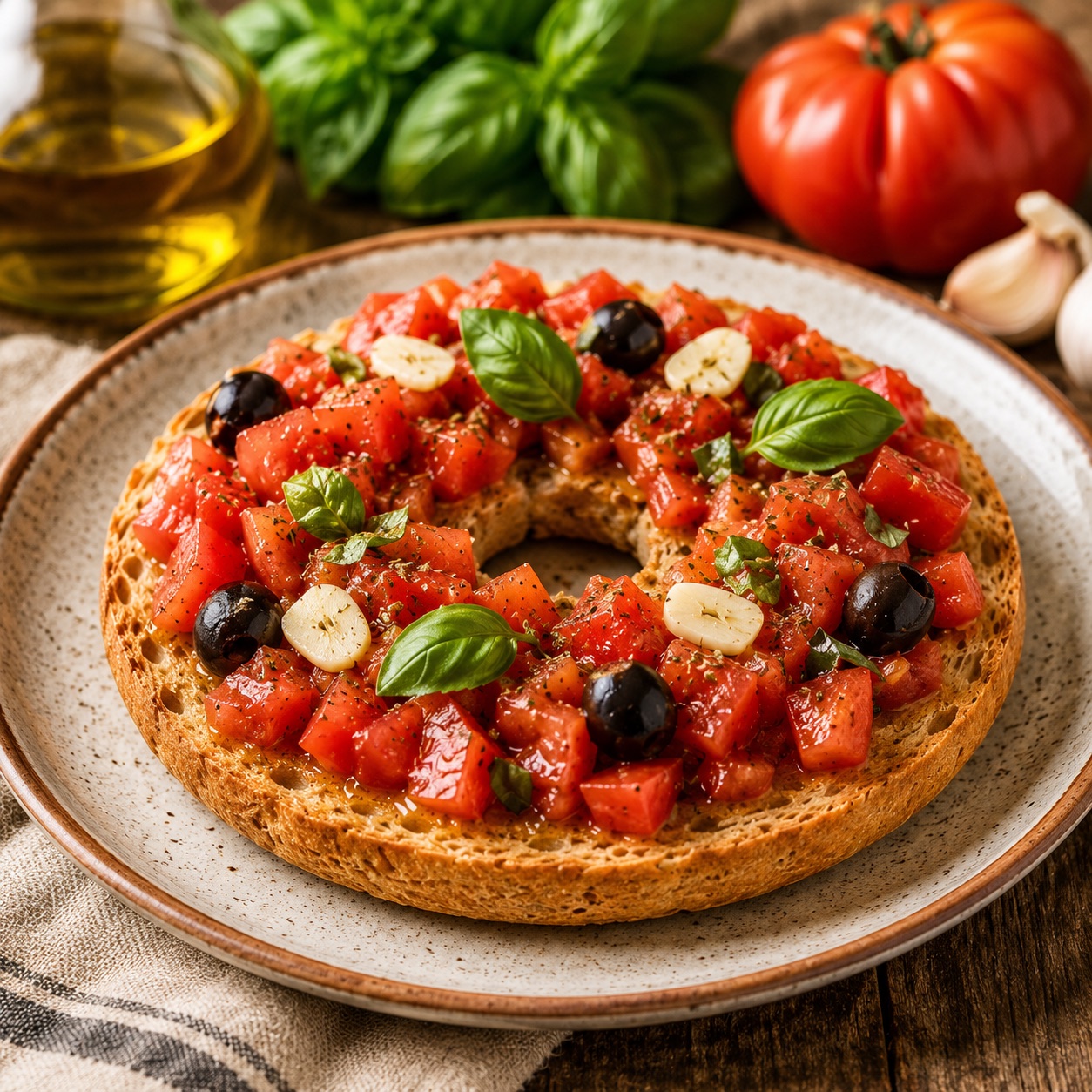
The fresella is a ring of twice-baked bread — made from durum wheat or barley flour, baked once, split horizontally, and baked again until completely dry and hard. The result is a crisp, shelf-stable disk that can be stored for months without deteriorating. This is not a byproduct of the baking process; it is the point. The fresella was designed for durability — for fishermen, for farmers, for anyone who needed bread that would survive heat and time without spoiling. The twice-baking removes all moisture and creates something that keeps indefinitely in a dry place. Ancient functional design, good-looking modern food.
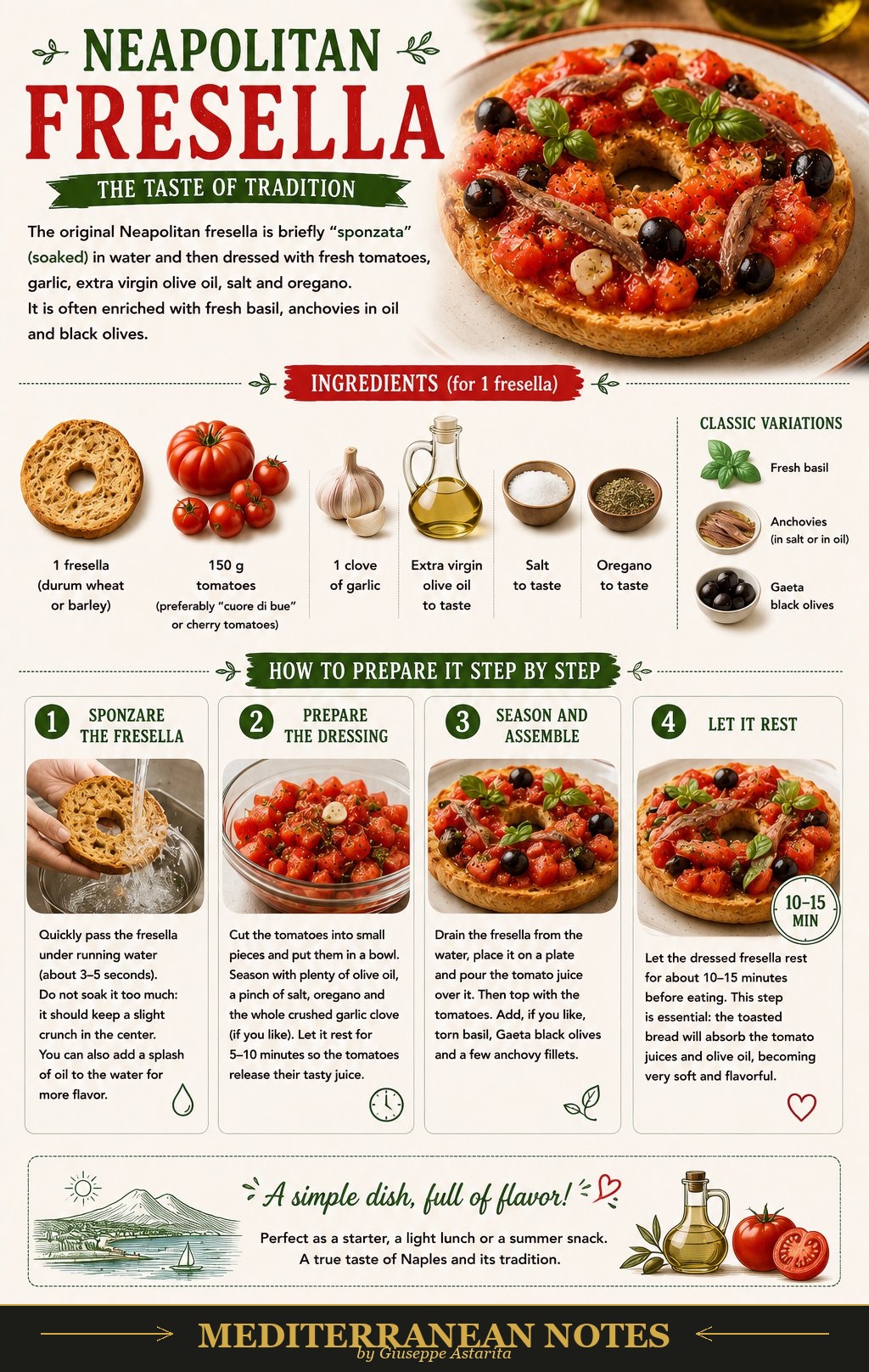
The preparation is technically not cooking at all. You hold the fresella briefly under running water — three to five seconds, no more — to soften the outer surface slightly while leaving the center with a crunch. This is called sponzare, which means to soak, and the amount of soaking is a matter of strong personal preference. Some people like it barely damp and still very crunchy throughout. Others prefer it softer, more yielding, closer to the texture of fresh bread. My parents were on the crunchier side. I have become more flexible about this over time. My daughter, when summer comes and the tomatoes are ready, will have to work out her own position.
The dressing is the same as the tomato salad: good tomatoes, good olive oil, salt, oregano. The tomatoes are chopped small, seasoned with oil and salt and left for five minutes to release their juice. Then the fresella is placed on the plate, the tomato juice is poured over it, and the tomatoes are heaped on top. A little garlic rubbed over the surface first, if you like it. A few torn basil leaves. Some Gaeta black olives, the small wrinkled ones, if you have them. A couple of anchovy fillets across the top — the combination of salty anchovy, sweet tomato, and the slightly bitter oregano-soaked bread is one of those flavor combinations that explains itself immediately on the first bite.
The ten-to-fifteen-minute rest after assembling is not optional. The bread absorbs the tomato juice and the olive oil, the flavors settle, and the fresella transforms from assembled ingredients into an actual dish. Eating it immediately after dressing is a mistake. The impatience is understandable; the wait is rewarded.
I did not fully appreciate the fresella growing up — it felt too simple, too ordinary, something that appeared on the table on the days when my parents were too hot to cook anything. Now I understand that simplicity and ordinariness as the point rather than a limitation. It is a perfect summer meal. It asks almost nothing: no stove, no cleanup, five minutes of assembly. What it requires is a good fresella and a good tomato, and the understanding that these two things in summer, in olive oil, are sufficient.
Twice-baked bread, resistant starch, and the logic of ancient preservation
The fresella's twice-baking produces a food with a distinctive nutritional profile compared to regular bread. The complete removal of moisture concentrates nutrients per gram — particularly in barley-flour freselle, which retain their beta-glucan content (a soluble fiber shown in multiple meta-analyses to reduce LDL cholesterol and postprandial blood glucose), as well as B vitamins and minerals. Durum wheat freselle have a lower glycemic index than regular white bread, partly because of their dense, compact starch structure and partly because the twice-baking produces a higher proportion of resistant starch — a form of dietary fiber with prebiotic properties discussed throughout this blog. The brief soaking in water (sponzatura) rehydrates the surface without substantially altering the starch structure of the interior, preserving much of this lower-GI benefit. The tomato dressing provides lycopene — whose absorption is significantly enhanced by the extra-virgin olive oil drizzled over — and vitamin C. The resting period after assembly (10–15 minutes) is not merely a sensory improvement; it allows the polyphenols and aromatic compounds of the tomato juice and olive oil to penetrate the surface of the bread and begin integrating, a process similar to what happens in panzanella. If anchovies are added, they contribute omega-3 fatty acids (EPA and DHA), iodine, and selenium at meaningful concentrations for a single food topping. Gaeta olives add oleic acid and additional phenolic antioxidants. The fresella with tomato and olive oil is, per unit of cooking effort (approximately zero), one of the most nutritionally efficient meals in this collection.
The recipe
Ingredients · per person — scale freely
Method
Prepare the tomatoes. Cut the tomatoes into small pieces and place in a bowl. Season with olive oil, a pinch of salt, and oregano. Toss and let rest for 5–10 minutes. The tomatoes will release their juice — this liquid is what you pour over the fresella first, and it is precious.
If using cherry tomatoes, halve or quarter them. If using Cuore di bue, the juice yield is excellent and very flavorful. The slightly underripe salad tomato, discussed in the insalata di pomodori post, works here too and produces a sharper, more complex result.
Sponzare the fresella. Hold the fresella briefly under cold running water — about 3–5 seconds, tilting and rotating it so the water reaches the whole surface. It should soften slightly on the outside but retain a firm center. This is the sponzatura: not a soaking, not a dipping, a rapid pass under the water. Place on a plate. Rub the surface with a cut garlic clove if you like, discarding the garlic.
How much to sponzare is personal — some prefer it barely damp and crunchy throughout, others want it softer. Start with 3 seconds, let it sit a minute, and judge. You can add more water; you cannot take it back. You can also add a small splash of olive oil to the soaking water for extra flavor — an old Neapolitan trick.
Dress and assemble. Pour the tomato juice that has accumulated in the bowl over the soaked fresella first — this is the first layer of flavor absorption. Then heap the tomatoes over the surface. Add any toppings you are using — torn basil leaves, Gaeta olives, anchovy fillets. A final drizzle of extra-virgin olive oil over everything.
Rest for 10–15 minutes. This is essential. The bread absorbs the tomato juice and oil, the oregano softens and releases, the whole thing settles into itself. Eating it immediately is a mistake. Set it on the table and go do something else for a quarter of an hour. Come back to a different, better dish.
The fresella in Italy — and why it's hard to find in the US
In any Italian grocery store or bakery in Campania, the fresella shelf is a serious section. Different sizes, different flours, different hardnesses, sometimes seasoned. It is not a niche product; it is a staple. In the United States, it is nearly impossible to find outside of Italian specialty importers and some online retailers. If you have an Italian grocery nearby, ask specifically — they may carry them. If not, online importers do stock them, often from Puglia and Campania, and they ship well because they are, by definition, designed to last.
Grano duro (durum wheat)
The most common and the most neutral in flavor. Firm, golden, and versatile. Works with any topping. The version most widely found outside Italy.
Orzo (barley)
Slightly darker, nuttier, more complex in flavor. Higher in beta-glucan fiber. My preference for the classic tomato and olive oil dressing — the barley flavor is a good match.
Integrale (whole grain)
More fiber, more mineral density, more pronounced taste. Pairs well with stronger toppings — anchovies, olives. Less delicate with the plain tomato; more substance.
Toppings — the classic and the variations
The base is always the same: tomato and olive oil. Everything else is a choice. The rule, if there is one, is that whatever you add should complement the tomato and the bread without overwhelming either. The fresella is not a vehicle for a large quantity of toppings. It is a very good piece of bread with very good tomato on it, and additions should serve that rather than replace it.
The classic — tomato, oil, oregano
The only version that requires nothing you don't already have at home in summer. Good tomatoes, good olive oil, dried oregano, salt. The whole point of the fresella stated plainly. My parents' version, the one I ate growing up, the one that is still the best.
With anchovies and Gaeta olives
The upgraded classic. Two or three anchovy fillets draped over the tomatoes, a handful of small wrinkled Gaeta olives, perhaps a few capers. The saltiness of the anchovy and the bitterness of the olive against the sweet tomato and the oregano-soaked bread: one of the best flavor combinations in the Neapolitan pantry.
With canned tuna in olive oil
Drain a good tin of tuna in olive oil and break it over the tomatoes. A classic summer variation — more substantial than the plain version, still no cooking required. The tuna oil adds another layer to the dressing. Good tuna makes a significant difference here; oil-packed, not water-packed.
With melanzane sott'olio
A few slices of preserved eggplant in oil — the same jar discussed in the gattò di patate and melanzane a funghetto posts. The acidity and richness of the preserved eggplant against the tomato and bread is an excellent combination, and it adds substance without adding any cooking. Keep a jar in the pantry for exactly this use.
With fresh ricotta
A spoonful of fresh ricotta on the soaked fresella before the tomatoes go on. Creamy and mild, it softens the sharpness of the tomato and makes the whole thing more substantial. A quieter variation than the anchovy version, good for those who prefer something more delicate.
Whatever is good in the kitchen
This is not a joke. The fresella is the most honest expression of the Italian instinct to use what is available. Good olive oil and a ripe tomato are the foundation. Everything else — olives, capers, preserved vegetables, tuna, leftover roasted peppers — is a legitimate addition if it is good and if you want it.
My daughter is asking for them now, in May, when the tomatoes in the supermarket look right and taste of very little. I am holding the line. The fresella with a mediocre tomato is a shadow of the fresella with a proper August tomato, and the proper August tomato is worth waiting for. This is one of those cases where patience is not a virtue so much as an understanding of what the dish actually is.
Summer is coming. The tomatoes will be ready. And when they are, we will make a fresella — or several — and eat them at the table or in the garden or wherever seems right on a hot afternoon when nobody wants to cook. Facimmo na fresella. Let's make a fresella. It still sounds like the right answer.
Buon appetito — e aspettiamo l'estate.