Arancini di riso: the treat that couldn't wait until dinner
They were fried, so they were a treat. I couldn't wait until dinner and started eating them mid-afternoon. A very early dinner followed. A side of salad with lemon. I had to contain myself not to have too many — and I never quite managed it.
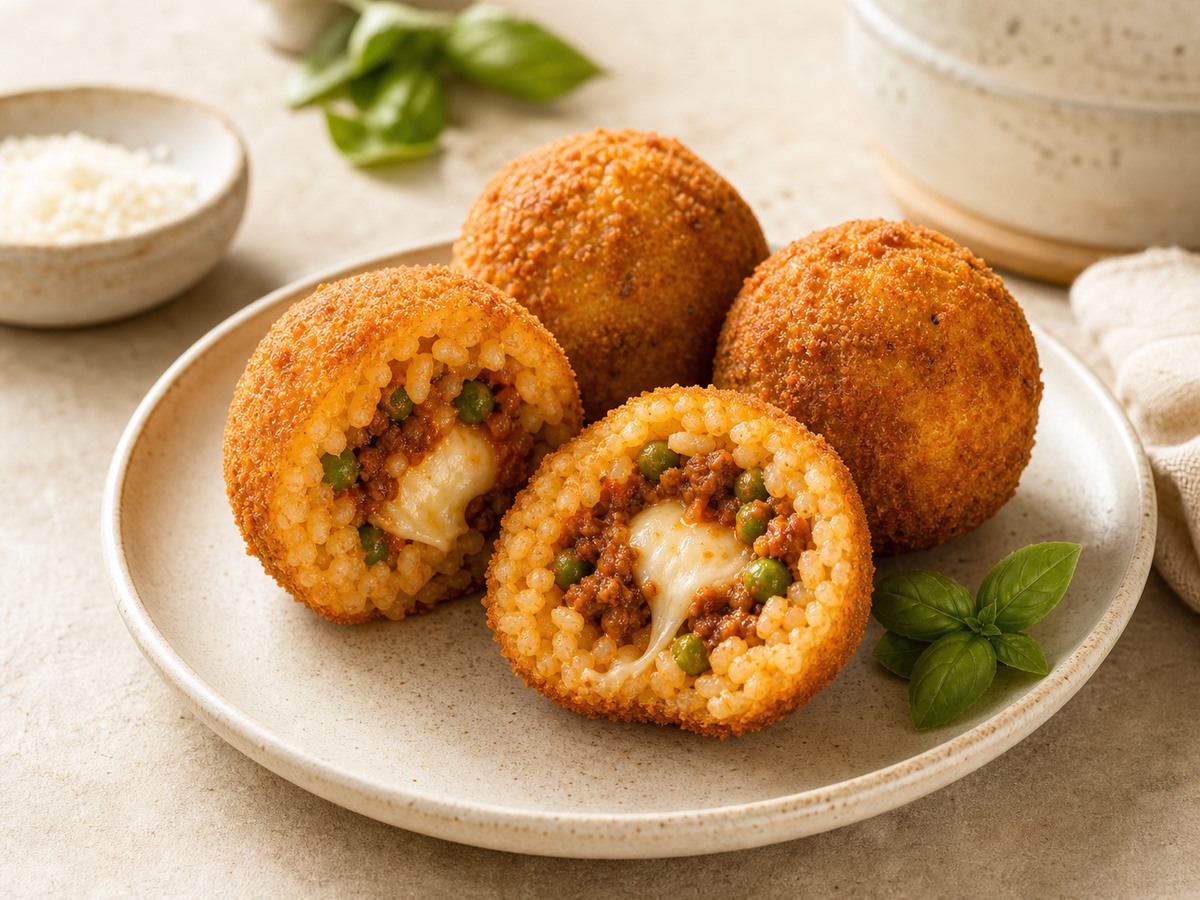
There is a pattern in this family's kitchen that keeps appearing: something fried, something that smells too good to ignore, and a child who cannot wait for the meal to be officially ready. The crocchè di patate were the same. The arancini were the same. Mid-afternoon, the smell of hot oil and tomato-cooked rice reaching through the apartment, and the negotiation with myself about whether a small one before dinner was really so wrong. It was not. I am confident of this now.
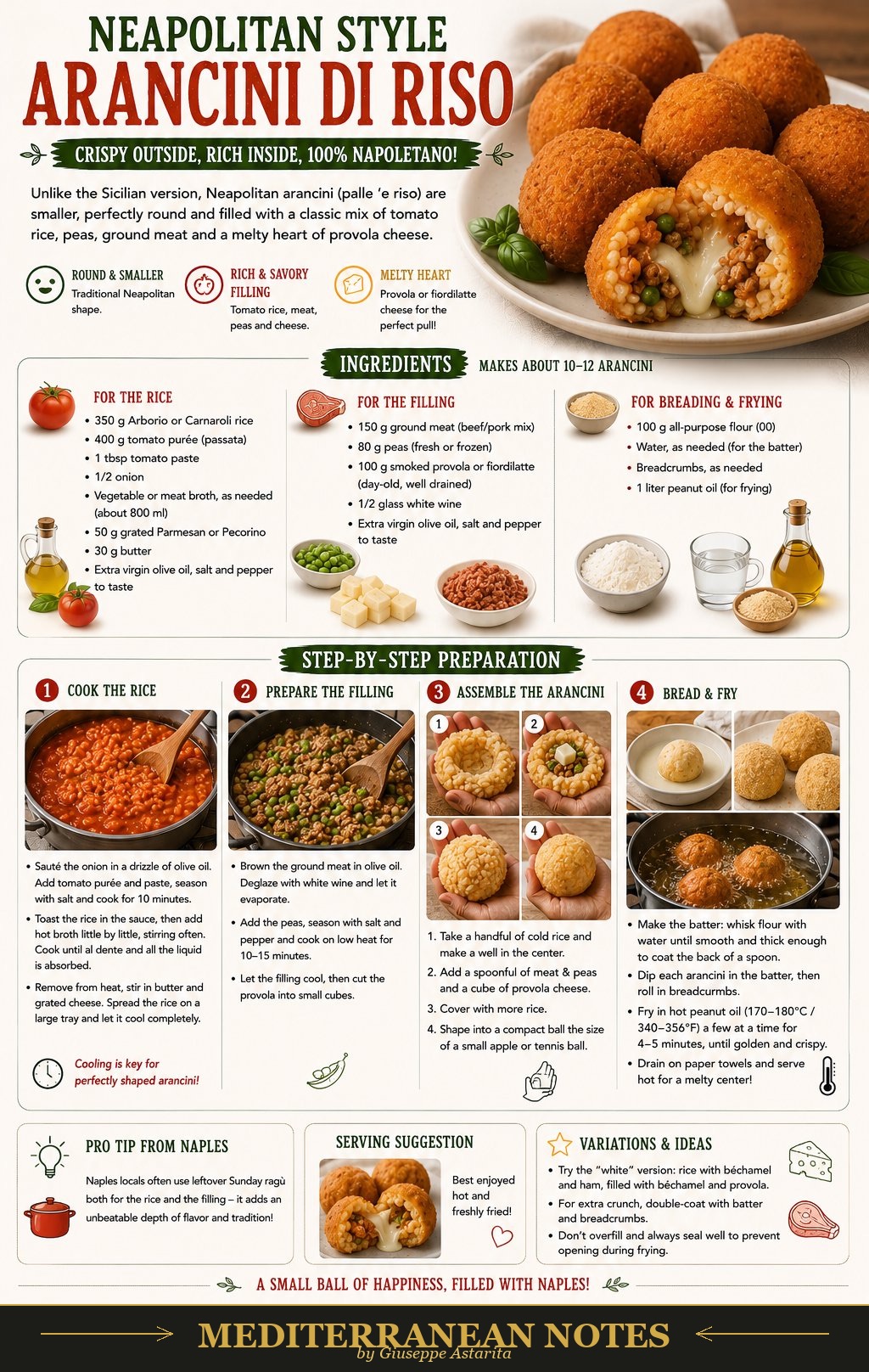
The Neapolitan arancino is different from the Sicilian one — smaller, rounder, and called by some palle 'e riso, literally rice balls, which is exactly what they are. Where the Sicilian version tends toward the monumental — conical, the size of a fist, filled with elaborate ragù — the Neapolitan one is more restrained in size and simpler in filling. The rice is cooked with tomato sauce and finished with butter and Parmesan, giving it a deep, savory flavor before anything goes inside. The filling at home was often very simple: a little prosciutto cotto, a cube of provola that would melt in the center. That was enough. More than enough.
The filling, once you have the basic technique, is where you can take the recipe in any direction. Ground meat with peas is the classic shown in the infographic. But the real answer is: use what you have that is good, keep it simple, make sure there is always a piece of provola in the center because the cheese pull when you break one open is the whole point.
After eating them, the salad — the same lattuga with olive oil and lemon that appears alongside the crocchè and the gattò. The pattern is not accidental. Fried things need something cold and sharp alongside, and olive oil with lemon is the simplest and most reliable version of that contrast. It is not a recipe; it is a reflex.
And if you do not want to fry — or the occasion does not call for standing over a pot of hot oil — the oven and the air fryer both work. The crust is different: less shattery, more evenly golden, without the characteristic deep-fry char. But the rice inside is the same, the provola melts the same way, and the result is still very good. My mother's practical instinct — cook the healthier version when you can, save the fried version for when it matters — applies here exactly as it did with the crocchè.
Arborio rice, amylopectin, and the starch that holds arancini together
Arborio and Carnaroli rice are short-grain varieties with a high amylopectin content — the branched form of starch that creates the creamy, sticky texture characteristic of risotto and that makes these rices ideal for arancini, since the starch acts as a natural binder during shaping. Tomato sauce cooked into the rice increases lycopene bioavailability through heat and fat (from the butter and olive oil in the base), making the cooked rice itself a meaningful source of this carotenoid antioxidant. Peas contribute plant-based protein, fiber, and vitamin K. The provola or fiordilatte filling provides calcium, casein protein, and fat-soluble vitamins. The breading — a batter of flour and water followed by breadcrumbs — creates the crust through Maillard browning during frying or baking, producing a complex aromatic layer of pyrazines and furans responsible for the characteristic golden-fried smell that, as described, is impossible to resist from another room. The lemon-dressed salad alongside contributes vitamin C (which improves iron absorption from the meat filling) and polyphenols from the olive oil. The combination of starchy rice, protein-rich filling, and sharp acidic salad is, nutritionally, a reasonably complete and well-balanced plate — which is not the framing one usually applies to fried rice balls, but it holds up.
The recipe
For the rice
For the filling — choose your version
For breading and cooking
Method
Cook the rice. Sauté the onion in a drizzle of olive oil until soft. Add the tomato purée and paste, season with salt and pepper, and cook for 10 minutes. Add the rice to the sauce and toast it briefly, then add hot broth a ladleful at a time, stirring often, until the rice is cooked al dente and all the liquid is absorbed — about 18 minutes. Remove from heat, stir in the butter and grated cheese. Spread the rice onto a large tray in an even layer and let it cool completely. This is not a step you can skip or rush.
A Neapolitan pro tip: use leftover Sunday ragù for both the rice and the filling. The depth of flavor it brings is unmatched — it is the version that tastes like it came from someone's grandmother's kitchen.
Prepare the filling. If using ground meat: brown it in olive oil, deglaze with a splash of white wine and let it evaporate. Add the peas, season, and cook on low heat for 10–15 minutes. Let cool completely. Cut or break the provola into small cubes. If using prosciutto cotto or another simple filling, dice it small and combine with the provola. Simple fillings work just as well as elaborate ones.
Shape the arancini. With damp hands, take a handful of cold rice — about 80–90 g — and flatten it into a disc in your palm. Place a spoonful of filling and a cube of provola in the center. Close the rice around the filling, pressing firmly and sealing all edges, then roll into a compact ball about the size of a small apple. The seal must be complete — any gap means the cheese escapes during cooking. Repeat until all the rice is used.
Cold rice is essential. Warm rice is too sticky and fragile to shape properly. If the balls feel soft, refrigerate them for 30 minutes before breading.
Bread them. Whisk the flour with enough water to make a smooth batter — thick enough to coat the back of a spoon. Dip each arancino in the batter, covering it completely, then roll in breadcrumbs and press so they adhere well all around. For extra crunch: double bread — dip again in batter and again in breadcrumbs. Refrigerate the breaded arancini for at least 20 minutes before cooking.
Cook. See the three options below. Whatever method you choose: serve hot, immediately. The cheese pull inside lasts only a few minutes before it sets. Eat them as soon as they are ready — mid-afternoon if necessary.
Three ways to cook them
The treat
Fried — the classic
Heat olive oil to 170–180°C in a deep pan. Fry a few arancini at a time for 4–5 minutes, turning gently, until deeply golden all over. Drain on paper towels and eat immediately. The crust shatters; the inside is molten. This is the version worth not waiting for dinner over.
The everyday
Oven-baked
Brush or spray the breaded arancini with olive oil. Bake at 200°C (400°F) for 25–30 minutes, turning once halfway through, until golden all over. The crust is more uniform and less shatter-y but still genuinely good. Lighter, easier, no hot oil.
The quick version
Air fryer
Spray with olive oil and air fry at 190°C (375°F) for 15–18 minutes, turning once. Produces a dry, very even crust — less golden than fried but excellent texture. The fastest and cleanest method. Works particularly well if you have already made them ahead and refrigerated overnight.
What to put inside — a few ideas
The provola stays. Everything else is a variable. Choose one filling per batch — mixing too many things inside makes the arancino chaotic rather than harmonious.
Prosciutto cotto + provola
The simplest and the one I grew up with most often. Diced cooked ham and a cube of provola. No cooking required for the filling. Clean, direct, completely satisfying.
Ground meat + peas + provola
The classic Neapolitan version from the infographic. Cooked ragù-style with tomato and wine. More work, more depth. The version for a Sunday.
Mortadella + provola
Diced mortadella, slightly sweet, pairs beautifully with the smoked provola. No cooking. One of the most underrated arancini fillings.
Béchamel + ham + provola
The "white" arancino — the rice is made without tomato (plain risotto bianco) and the filling is a thick béchamel with diced ham. Richer, more delicate, less common. Worth making once.
Just provola
A cube of good provola, nothing else. The cheese melts and fills the cavity entirely. Minimal, honest, and better than it sounds. The version for when you want to taste the rice.
Sunday ragù
If you have leftover Sunday ragù — meat sauce that has cooked for hours — use it. A spoonful inside each arancino, with provola. The flavor is in another category entirely.
Buon appetito — e non aspettate la cena.