Risotto ai Funghi
The King of Risotto
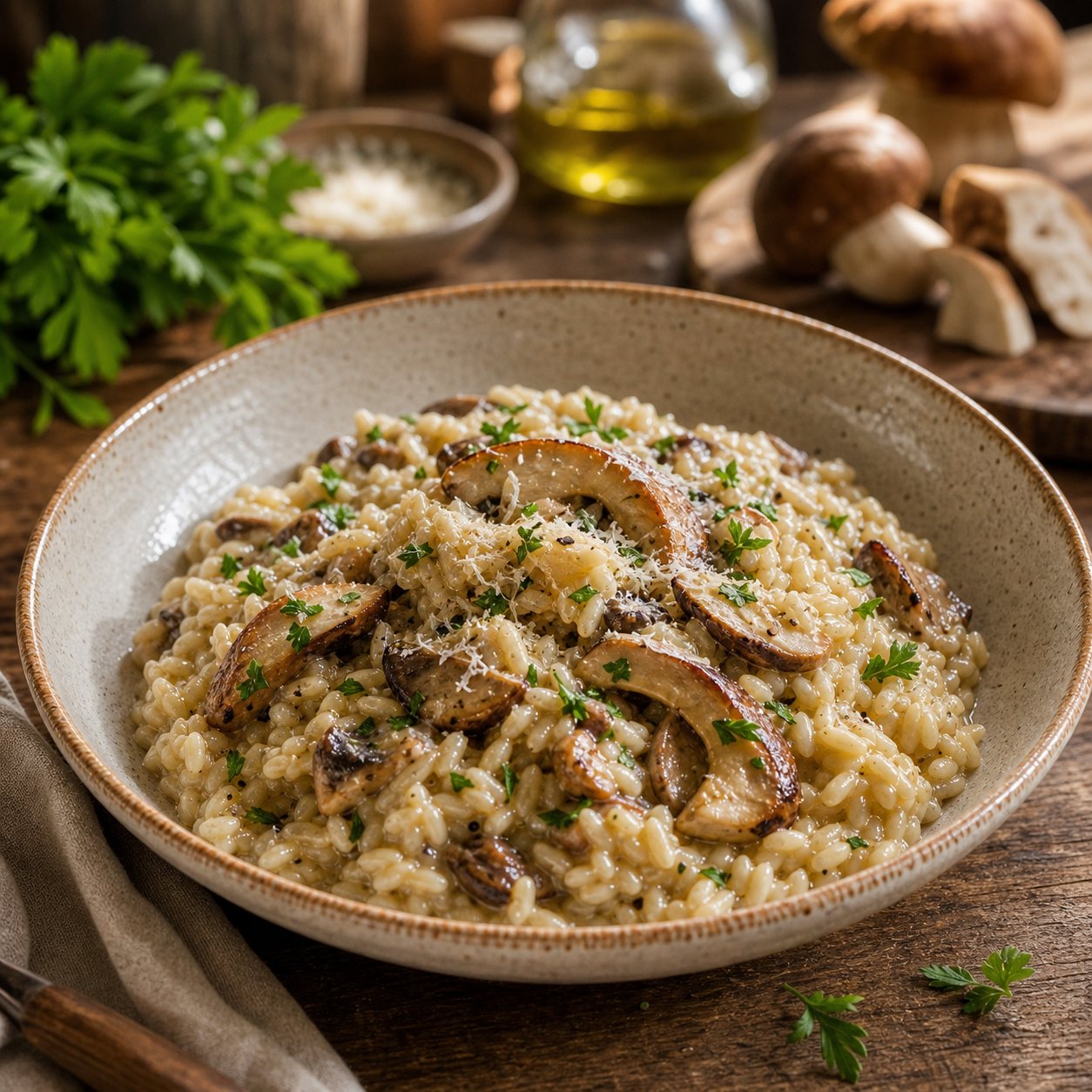
Not typically Campanian — risotto is fundamentally a northern Italian preparation — but such a classic that it appeared in the kitchen regardless, and it is the best of its kind. My father for a period did not appreciate mushrooms as much, so we did not consume many. But any risotto was delicious. I still make this dish often, enjoying a variety of mushrooms and all their different flavors. And do not forget the Parmigiano rind.
The secret that nobody writes down — La scorza di Parmigiano
We used to add la scorza di Parmigiano — the rind of the Parmigiano cheese, the hard outer crust that remains when the cheese is finished — to soups and risotti while they cooked. The rind releases its flavor into the surrounding liquid without dissolving, deepening the broth with a savory, slightly nutty richness that no amount of grated cheese added at the end can replicate. And then, when you were eating the risotto, you might find the softened rind at the bottom of the bowl. You ate it. It was so good — yielding and intensely flavored, the condensed essence of everything the rind had contributed to the pot. Never waste the rind of a Parmigiano. Store them in the freezer and add one to any risotto or soup that will benefit from it. This one will.
Risotto is not a Campanian preparation. Its heartland is the Po Valley — Piedmont, Lombardy, Veneto — where the short-grain rice varieties that produce the characteristic creamy texture (Carnaroli, Arborio, Vialone Nano) have been cultivated for centuries. Campanian cooking is built around pasta, not rice, and the risotto technique — the patient ladle-by-ladle addition of hot broth, the constant stirring, the mantecatura of cold butter at the end — is more associated with Milanese and Venetian kitchens than Neapolitan ones. And yet risotto appeared in Italian home kitchens throughout the country from the 1970s onward as food culture spread and culinary magazines and television brought northern techniques southward. In our kitchen it was made sometimes, and it was always received well.
The mushroom version is the one I come back to most often, then and now. The mushroom has an affinity with rice that it does not quite have with pasta — the creaminess of the risotto absorbs and amplifies the earthy, slightly mineral flavor of the mushroom in a way that a pasta sauce does not. With good porcini, the result is one of the most satisfying things Italian cooking produces. With a mixture of mushrooms — champignon for body, dried porcini for depth, shiitake for umami — you build a complexity that a single variety alone cannot achieve.
Good ingredients, patience, and love. That is the secret of a truly unforgettable mushroom risotto — and of most things worth making. The patience specifically: the risotto cannot be rushed. The broth must go in one ladle at a time. The next ladle goes in only when the previous one has been absorbed. This takes eighteen minutes. There is no shortcut that produces the same result.
Why Carnaroli produces a creamier risotto — and what the mantecatura actually does
The creaminess of risotto is not added cream — it is starch released from the rice grains during cooking. Carnaroli and Arborio are short-grain varieties with a high amylopectin content (the branched form of starch) relative to amylose (the linear form). As these grains cook in the hot broth, their outer starch layer gelatinizes and some of the amylopectin dissolves into the surrounding liquid, creating a thick, viscous, creamy cooking medium. Arborio releases starch more rapidly and can become gluey if overcooked; Carnaroli has a firmer core that remains al dente while the exterior starch dissolves, giving it a longer window between correctly cooked and overdone — which is why professional risotto cooks generally prefer it.
The mantecatura — the vigorous incorporation of cold butter and Parmigiano off the heat at the end — is the step that completes the emulsion. The cold butter (temperature matters: cold butter emulsifies more effectively than room-temperature butter) releases its fat into the hot starchy cooking liquid and is agitated into a stable emulsion by the vigorous stirring. The result is a sauce that is simultaneously rich from the butter fat, thick from the dissolved starch, and glossy from the emulsification. The Parmigiano adds both flavor and additional protein that helps stabilize the emulsion. The risotto must then rest for one minute before serving — the resting allows the emulsion to settle into a uniform consistency. Served immediately after mantecatura it is slightly too loose; after one minute it reaches the correct all'onda texture — flowing gently like a wave when the plate is tilted.
The Parmigiano rind dropped into the broth contributes glutamates (from the aged cheese proteins that have broken down into free amino acids) and fat-soluble flavor compounds that gradually migrate into the surrounding liquid during the 30–40 minutes it sits in the hot broth. This is why the broth used to cook a risotto that has had a rind simmering in it tastes deeper and more savory than broth without one — the rind is functioning as a flavor amplifier, contributing the same compounds that make aged Parmigiano one of the richest savory flavors in the kitchen.
The recipe — serves 4
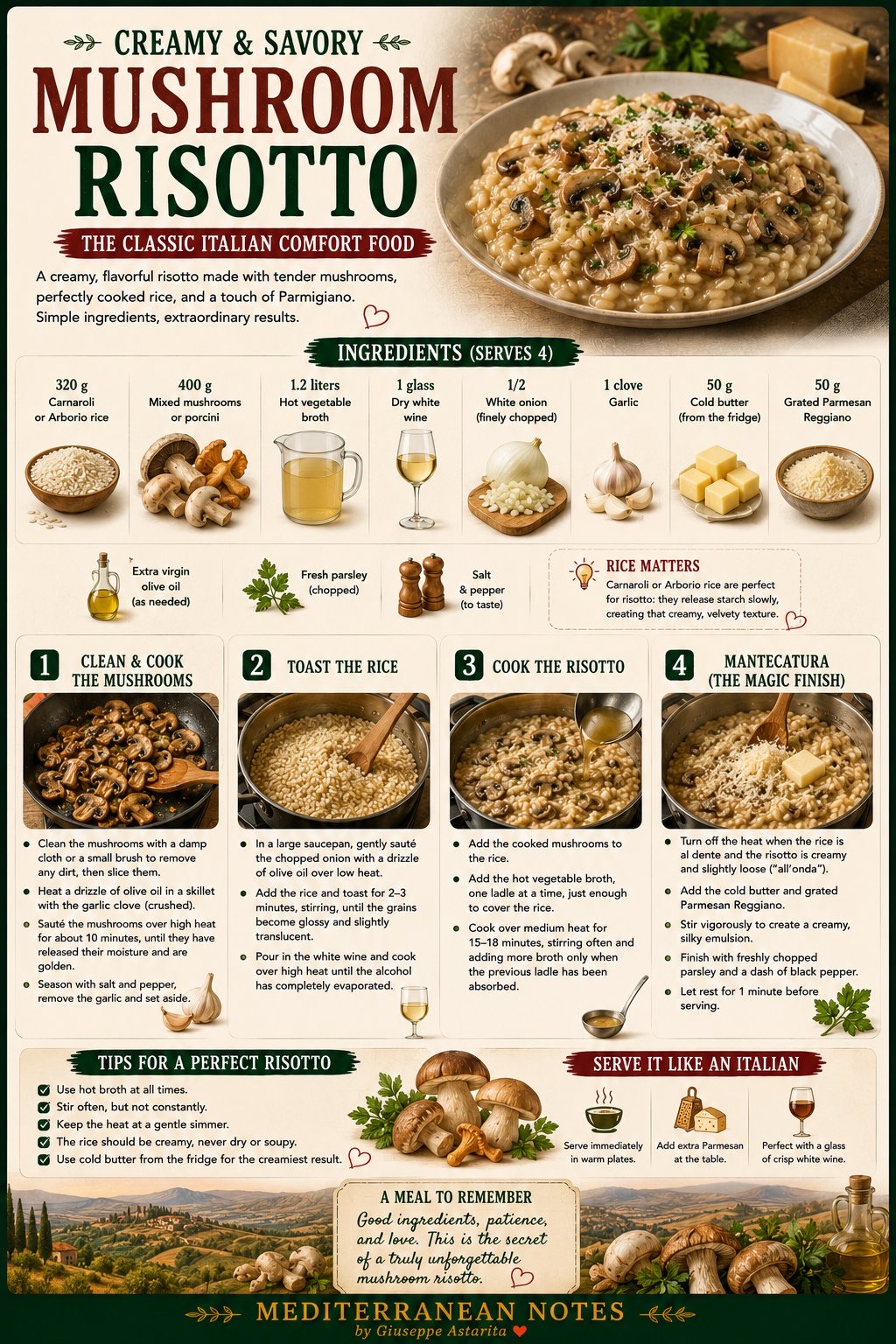
Risotto ai funghi — buoni ingredienti, pazienza, e amore. Click to enlarge.
320 gCarnaroli rice (preferred) or Arborio
400 gMixed mushrooms or porcini — or a combination
1.2 litres, kept hotVegetable broth — with a Parmigiano rind simmering in it
1 glassDry white wine
½, finely choppedWhite onion
1 clove, crushedGarlic
50 g, cold from the fridgeButter — cold is essential for mantecatura
50 g, gratedParmigiano Reggiano
1 piece — the secret ingredientParmigiano rind, added to the hot broth
to finishFresh parsley, chopped · extra-virgin olive oil
Step 1 — Prepare the mushrooms
1
Clean mushrooms with a damp cloth or brush — never wash under running water, which saturates them. Slice. Heat olive oil in a wide skillet over high heat with the crushed garlic. Sauté the mushrooms for 8–10 minutes until they have released their liquid and the liquid has evaporated, leaving them golden and concentrated. Season with salt and pepper. Remove the garlic. Set aside.
High heat is essential for mushrooms — low heat produces steamed, waterlogged mushrooms rather than golden, concentrated ones. Work in batches if needed rather than crowding the pan.
Step 2 — Toast the rice and build the risotto
2
In a large, heavy saucepan, soften the chopped onion in olive oil over low heat for 5 minutes without browning. Add the rice and raise the heat to medium. Toast the rice for 2–3 minutes, stirring, until the grains become slightly translucent at the edges. Pour in the white wine and stir until completely absorbed and the alcohol has evaporated.
3
Add the sautéed mushrooms to the rice. Begin adding the hot broth one ladle at a time — the broth should be hot, not cold, or the cooking will stop with each addition. Add the next ladle only when the previous one has been fully absorbed. Stir often (not constantly) and keep the heat at a gentle simmer. Cook for 15–18 minutes total.
The risotto is done when the rice is al dente — firm at the very center but cooked through — and the mixture flows slowly when you tilt the pan. This is the all'onda consistency.
Step 3 — La mantecatura (the magic finish)
4
Turn off the heat. Add the cold butter in small pieces and the grated Parmigiano. Stir vigorously for 1–2 minutes to create a creamy, silky emulsion. Add a splash of hot broth if needed to achieve the correct flowing consistency. Add chopped parsley and a grind of black pepper. Let rest 1 minute, then serve immediately in warm plates with extra Parmigiano at the table.
The butter must be cold. Room-temperature or melted butter does not emulsify the same way — it produces a greasy rather than a creamy finish. Keep the butter in the refrigerator until the moment it goes in.
Which mushrooms — and why variety matters
Porcini (fresh or dried)
The king of mushrooms for risotto — intense, earthy, slightly nutty. Dried porcini rehydrated in warm water add concentrated flavor; use the soaking liquid strained into the broth. Fresh porcini in season (autumn) are extraordinary.
Champignon
The most available and the most versatile. Mild flavor, good texture. The workhorse of the mushroom risotto — best combined with stronger varieties rather than used alone, where they produce a pleasant but uninteresting result.
Shiitake
Not Italian, but their high glutamate content adds significant umami depth to a mixed mushroom risotto. Added to champignon and dried porcini, they produce a complexity that none of the three achieves alone. An excellent modern addition.
Oyster mushrooms
Delicate, slightly sweet, with a texture that holds up well in the risotto. Good combined with champignon. Less intensely flavored than porcini but contribute a different aromatic register.
Dried porcini — always
Even if using fresh mushrooms, 10–15 g of dried porcini rehydrated and their strained soaking water added to the broth dramatically deepens the flavor of any mushroom risotto. This is the single most effective improvement available.
Mixed — the best approach
The combination of champignon (body and texture), dried porcini (depth), and one other variety — shiitake, oyster, or whatever is at the market — produces a more interesting result than any single mushroom. I still make this often with whatever variety combination I can find.
On the Parmigiano rind — never waste it
The rind of a Parmigiano Reggiano wheel is the compressed, dried outer layer that forms during the long aging process — typically 12 to 36 months. It is edible but too hard and dense to grate or eat as cheese. It is not a leftover to discard: it is a flavor concentrate. Stored in the freezer (where it keeps indefinitely), it can be added to any broth, soup, or risotto that will cook for long enough to extract its flavor — at least 20–30 minutes in simmering liquid is sufficient.
The rind releases free glutamates (the amino acids that produce umami flavor) and fat-soluble aromatic compounds into the surrounding liquid. It does not dissolve — you remove it at the end, or you find it softened in the bowl and eat it, which is the best outcome. The softened rind after 30 minutes in hot broth is yielding and intensely savory, with a texture that is simultaneously firm and slightly chewy — genuinely one of the most satisfying incidental discoveries in Italian cooking. Add it to your broth before beginning the risotto. Remove it — or eat it — at the end.
I still make this dish often. It is one of those preparations that rewards attention without demanding creativity — the technique is fixed, the ingredients are simple, the result depends entirely on patience and the quality of what goes into the pot. The mushrooms, the cold butter, the Parmigiano rind in the broth. These are the things that make it what it is. Good ingredients, patience, and love. The infographic's closing line is the correct one.
Buon appetito — e non buttare mai la scorza del Parmigiano.