Timballo di melanzane con ziti: the Sunday dish my mother packed for picnics
Made the day before. Packed in a bag the morning of. Carried up the mountain or down to the beach, where it was eaten cold or at room temperature, in slices that held together perfectly because the night in the refrigerator had done what no amount of resting at room temperature can do. The crunchy edges from the oven — where the pasta had touched the sides of the dish and taken on color and texture — were the part everyone wanted. They still are.
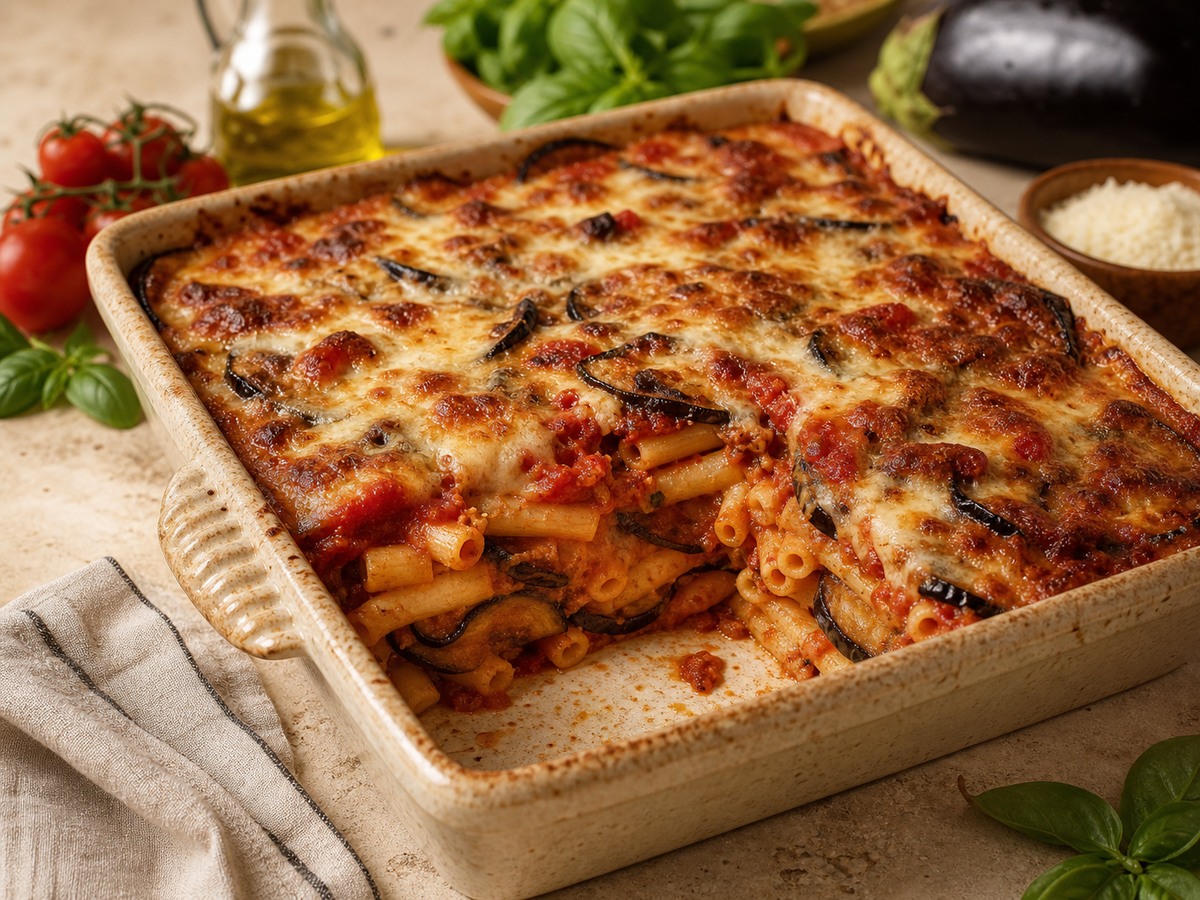
There is a category of Neapolitan cooking that is designed not for the table but for the road. Dishes that travel well, that improve with time, that are meant to be made the evening before and eaten the day after from a wrapped tray on a blanket on the grass or at the edge of the sea. The timballo di melanzane con ziti belongs to this category completely and without qualification. My mother made it for Sunday mountain picnics and for days at the beach in the same way — prepared the afternoon or evening before, left overnight in the refrigerator, carried the next morning in whatever container held it best. It arrived at the destination already perfect, having spent the night settling into itself, the eggplant and the sauce and the cheese and the pasta having become a single coherent thing rather than a collection of components that happened to be in the same baking dish.
A timballo is a baked pasta — pasta al forno in its most architectural form. The eggplant slices, fried golden and left to drain and dry, line the dish and form the shell: the exterior layer that holds everything together when the timballo is unmolded or cut into slices. Inside, the ziti — broken into pieces of three or four centimeters so they fit into the dish without protruding through the eggplant layer — are tossed with a simple tomato sauce, provola or mozzarella cut into cubes and drained well, grated Parmigiano Reggiano, and torn fresh basil. Assembled in layers, pressed down firmly at each stage, then sealed with the remaining eggplant and baked at 180°C until bubbly and deeply colored at the edges and on the surface.
The dish is vegetarian in its base form and entirely complete without meat. The eggplant, the cheese, the egg — if you add it, as some versions do — and the pasta together provide a meal that needs nothing alongside except possibly a simple salad. The version with ground beef or mixed meat, browned first and added to the sauce, exists and is excellent, but it is not the version I remember from the picnics, which was the senza carne version, lighter and more fragrant with the basil and the tomato and the specific flavor of provola that melts differently from mozzarella — firmer, more savory, with a slight smokiness that holds its character through the long bake rather than disappearing into the sauce.
Why the timballo improves overnight — starch retrogradation and gelatin setting
The improvement of the timballo overnight — which every Neapolitan cook knows and relies on — is not imaginary. It is a function of several physical and chemical processes that continue after the oven has been turned off. First, retrogradation: as the baked pasta cools, the gelatinized starch molecules partially recrystallize, forming a firmer, more cohesive structure that holds its shape under pressure and produces a cleaner slice. This is the same process responsible for the superior texture of day-old bread and cold rice. Second, moisture equilibration: the water released from the tomato sauce and the cheese during baking redistributes evenly through the timballo overnight, so that layers that were slightly dry or slightly wet immediately post-bake reach a uniform moisture content by the next morning. Third, flavor development: the volatile aromatic compounds released from the tomato and basil during cooking continue to interact with the fats in the cheese and the oil overnight through passive diffusion, deepening and integrating the flavor in a way that hot, freshly assembled layers do not achieve. The eggplant layer is the structural element that makes all of this possible: fried eggplant, drained and dried well, has a water content low enough and a fat content from the frying oil high enough that it acts as a semi-permeable barrier, absorbing flavor from the interior while maintaining its structural integrity. Eggplant that is not salted and drained adequately before frying retains too much water, which migrates during baking and destroys the cohesion of the timballo. This is why the salting and draining step — 30 minutes minimum — is not optional. The crunchy caramelized edges where pasta contacts the hot baking dish surface are the result of the Maillard reaction between the amino acids in the pasta protein and the reducing sugars in the tomato sauce, identical in mechanism to the browning on bread crust and roasted meat: high surface temperature, low moisture, reducing sugars, available protein. These edges are genuinely different in flavor from the interior — more complex, slightly bitter, with the caramelized depth that only comes from sustained high-temperature contact with a dry surface.
One dish, many starting points
The timballo also solves a problem that Campanian cooks have always understood: what to do with the eggplant that was made yesterday and is sitting in the refrigerator. A melanzane a funghetti — eggplant cubed and fried with tomato and basil, the quick Neapolitan preparation — or a parmigiana di melanzane already made can become the filling or the shell of a timballo the next day without any additional preparation. You have already done the hard work. The eggplant is already cooked and flavored. Cook the pasta, make or use leftover tomato sauce, add the cheese, assemble, and bake. This is the correct way to think about the relationship between preparations in a Campanian kitchen — not as separate dishes that begin from zero each time, but as moments in a longer sequence where the work of one day feeds the cooking of the next.
From melanzane a funghetti
Use the cubed fried eggplant directly as the filling layer rather than the shell. Line the dish with long-sliced fried eggplant from a fresh batch, fill with the ziti tossed with the funghetti and cheese, seal, and bake. One preparation becomes two dishes across two days — the second is often better than the first.
From parmigiana di melanzane
Use slices of leftover parmigiana to line the dish — the tomato and cheese already embedded in the eggplant enrich the timballo from the outside in. Reduce or omit the additional sauce inside accordingly. The flavor is richer and more complex than the fresh-made version; the layered tomato-eggplant shell gives the pasta a depth the standard preparation does not have.
The recipe — the classic Neapolitan version
Ingredients · serves 6–8
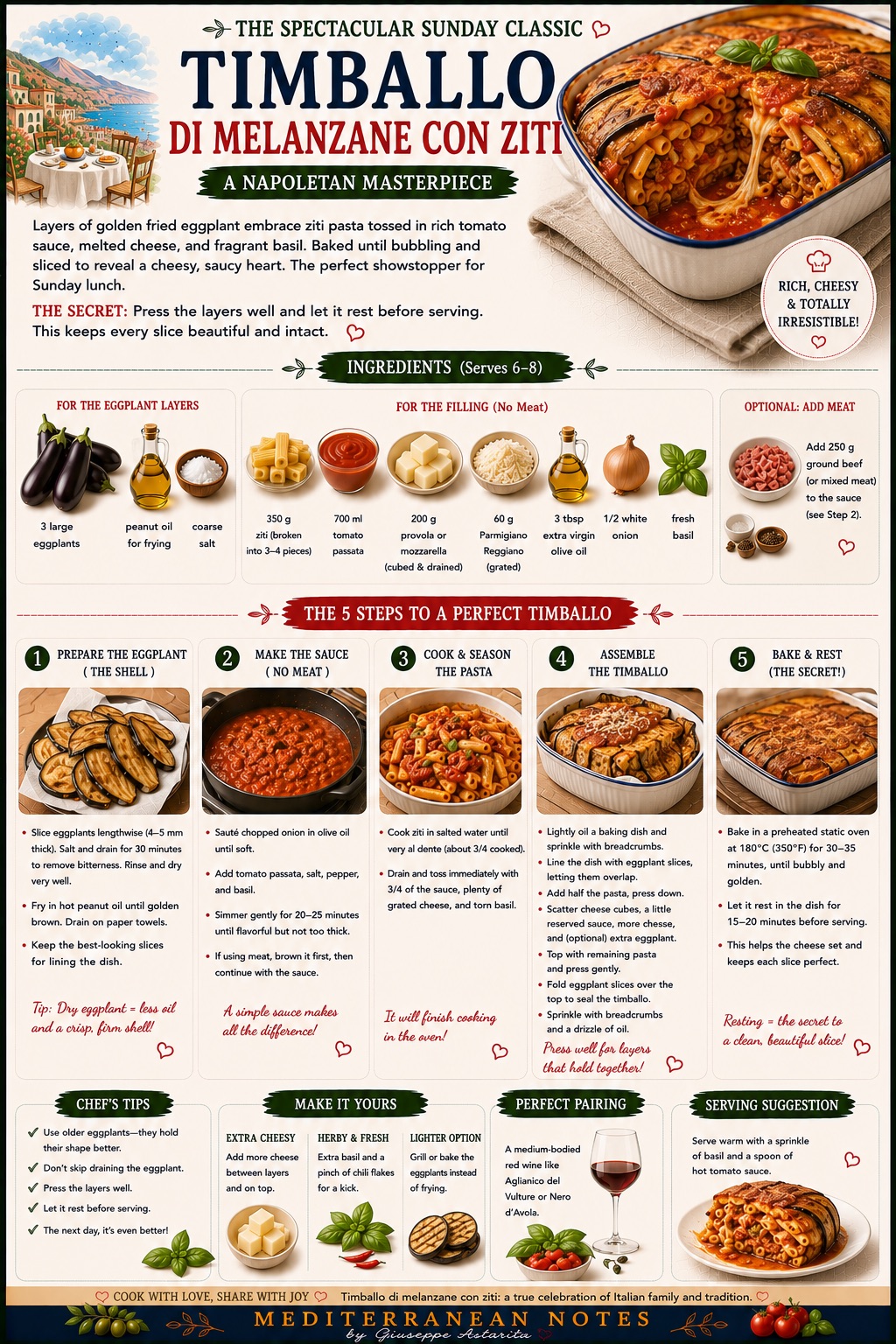
Method
Prepare the eggplant — the shell. Slice the eggplants lengthwise into 4–5 mm slices. Lay them in a colander, salt generously between layers, and leave for at least 30 minutes. They will release a significant amount of dark, bitter liquid. Rinse thoroughly under cold running water, then press dry between clean kitchen towels — they must be as dry as possible before frying. Fry in hot olive oil in batches until deeply golden on both sides. Drain on paper towels. Set aside the best, most intact slices for lining the dish; the rest go inside as a layer in the filling.
Older eggplants have less water and fewer seeds and hold their shape better through frying and baking. Do not skip the salting step — undrained eggplant releases its water into the timballo and collapses the structure. Dry eggplant absorbs less oil and produces a firmer shell.
Make the tomato sauce. In a wide pan, sauté the chopped onion in olive oil over medium heat until soft and translucent. If using meat, add it now and brown it well before continuing. Add the tomato passata, a pinch of salt, pepper, and a few torn basil leaves. Simmer gently for 20–25 minutes until the sauce has reduced and concentrated but is not thick. It should be fluid enough to coat the pasta and continue cooking in the oven without drying out. Taste and adjust. A simple sauce — not elaborate, not overseasoned — is correct here. The eggplant and the cheese carry the flavor; the sauce is the medium.
Cook the pasta — very al dente. Cook the broken ziti in generously salted water until about three-quarters of the way through their cooking time — firm, with a pronounced white core at the center. They will finish cooking in the oven inside the timballo. Drain and toss immediately with three-quarters of the tomato sauce, plenty of grated Parmigiano, and torn basil. The pasta should be sauced and fragrant but not swimming in sauce.
Undercooking is not negotiable. Fully cooked pasta will continue to absorb liquid in the oven and become soft and heavy. The residual heat of baking is the final cooking stage, not a warming step.
Assemble the timballo. Preheat the oven to 180°C (350°F). Oil a baking dish generously and coat with breadcrumbs, tapping out the excess. Line the bottom and sides with the best eggplant slices, overlapping them slightly and letting them hang over the edges — they will fold over the top to seal the timballo. Add half the pasta filling and press down firmly. Scatter the provola cubes, a spoonful of reserved sauce, a handful more of Parmigiano, a few torn basil leaves, and any remaining eggplant pieces not used for the lining. Add the remaining pasta and press down firmly again. Fold the overhanging eggplant slices over the top to seal. Sprinkle with breadcrumbs and a drizzle of olive oil.
Press each layer firmly. This is what keeps the slices clean and intact when the timballo is cut. A loosely assembled timballo falls apart; a well-pressed one slices like a terrine.
Bake — and then rest. Bake in the preheated oven for 30–35 minutes until bubbly, deeply colored at the edges, and with a firm, dark crust on the surface where the breadcrumbs have toasted. The edges and corners, where the pasta meets the hot baking dish directly through the eggplant, will be darkest and crunchiest — this is correct and desirable. Remove from the oven and leave to rest in the dish for at least 15–20 minutes before cutting. If making for the next day, cover and refrigerate once it has cooled to room temperature. Cut cold, directly from the refrigerator, for the cleanest slices.
The resting — or the overnight — is the secret. Hot from the oven the timballo is delicious but loose. Cold from the refrigerator it is a different preparation: firm, cohesive, sliceable, with a concentrated flavor that the fresh-baked version does not yet have. Both are good. The next-day version is better.
The picnic — and why this dish belongs outside
There is something specific about eating a slice of cold timballo outdoors that is better than eating it warm at a table. Partly it is the context — the mountain air, the sound of water somewhere, the particular hunger that comes from a morning of walking. Partly it is the dish itself, which at room temperature or slightly cool reveals flavors that the heat suppresses: the provola becomes more distinct, the eggplant sweeter, the caramelized edges more pronounced against the background of the tomato-soaked interior. A dish designed for heat behaves differently at rest. This one behaves better.
My mother packed it in a deep container with a tight lid, already sliced or whole depending on how many were coming, with a knife wrapped in a cloth alongside it. At the destination, the container was opened and the knife used and the slices distributed and everyone ate with their hands or with a fork carried from home, standing or sitting on a blanket or on a wall above the sea, and the meal was complete and required nothing alongside it except water or a glass of cold wine if someone had thought to bring it. No reheating, no serving plates, no arrangement. Just the timballo, which had been thought through entirely the day before and required nothing further of whoever was carrying it.
This is the practical genius of the Campanian pasta al forno tradition — the understanding that a dish made for a specific occasion is better if it can be made ahead and transported and served without infrastructure. The timballo asks for effort on the day it is made and nothing on the day it is eaten. This is the correct distribution of work for a picnic, for a family lunch in another house, for any occasion where the cooking cannot happen on site. You do the work when you have the kitchen. You bring the result.
Buon appetito — e buona gita.