Orecchiette con cime di rapa: from Puglia, adopted by our family, still on the table
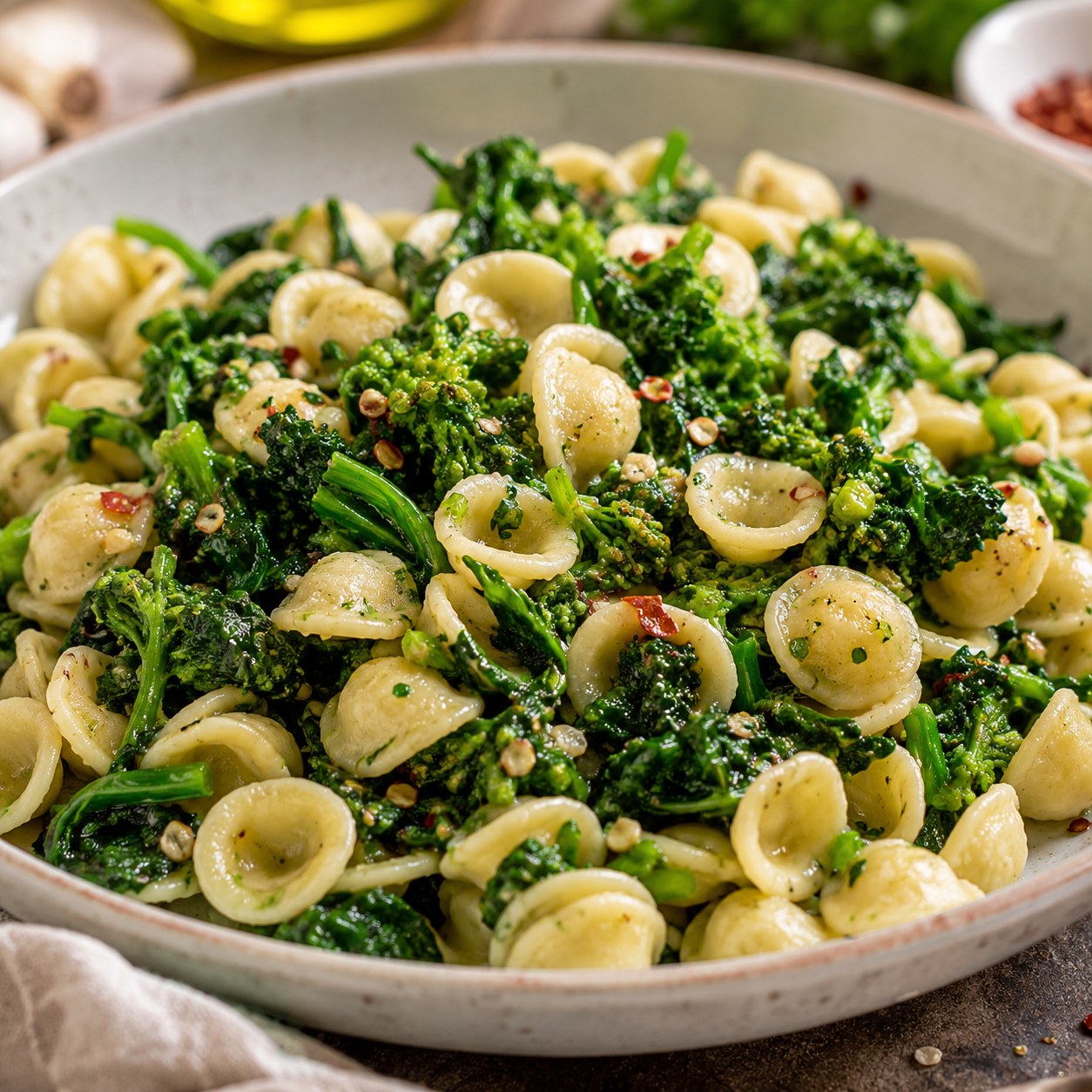
Originally from Puglia — the soul of the Bari table. My father loved it. We still make it often, and it always feels genuinely healthy rather than virtuous: the bitterness of the cime di rapa, the kick of the chili, the fruity olive oil, everything tasting clean and alive. More cheese for creaminess, more pepper for warmth. One pot, one toss, one of the great simple pastas of southern Italy.
This is not a Campanian dish — it belongs to Puglia, to the heel of the Italian boot, to the wheat fields and olive groves and trulli of the region just east of Campania. But the border between regional kitchens is not a wall, and a dish as good as orecchiette con cime di rapa does not stay inside its region of origin. It traveled, as all the best dishes do, through family connections and shared markets and the simple fact that cime di rapa grows well throughout southern Italy and that the combination of bitter greens, pasta, garlic, and good olive oil is one of the most reliable flavor structures in the whole southern Italian table.
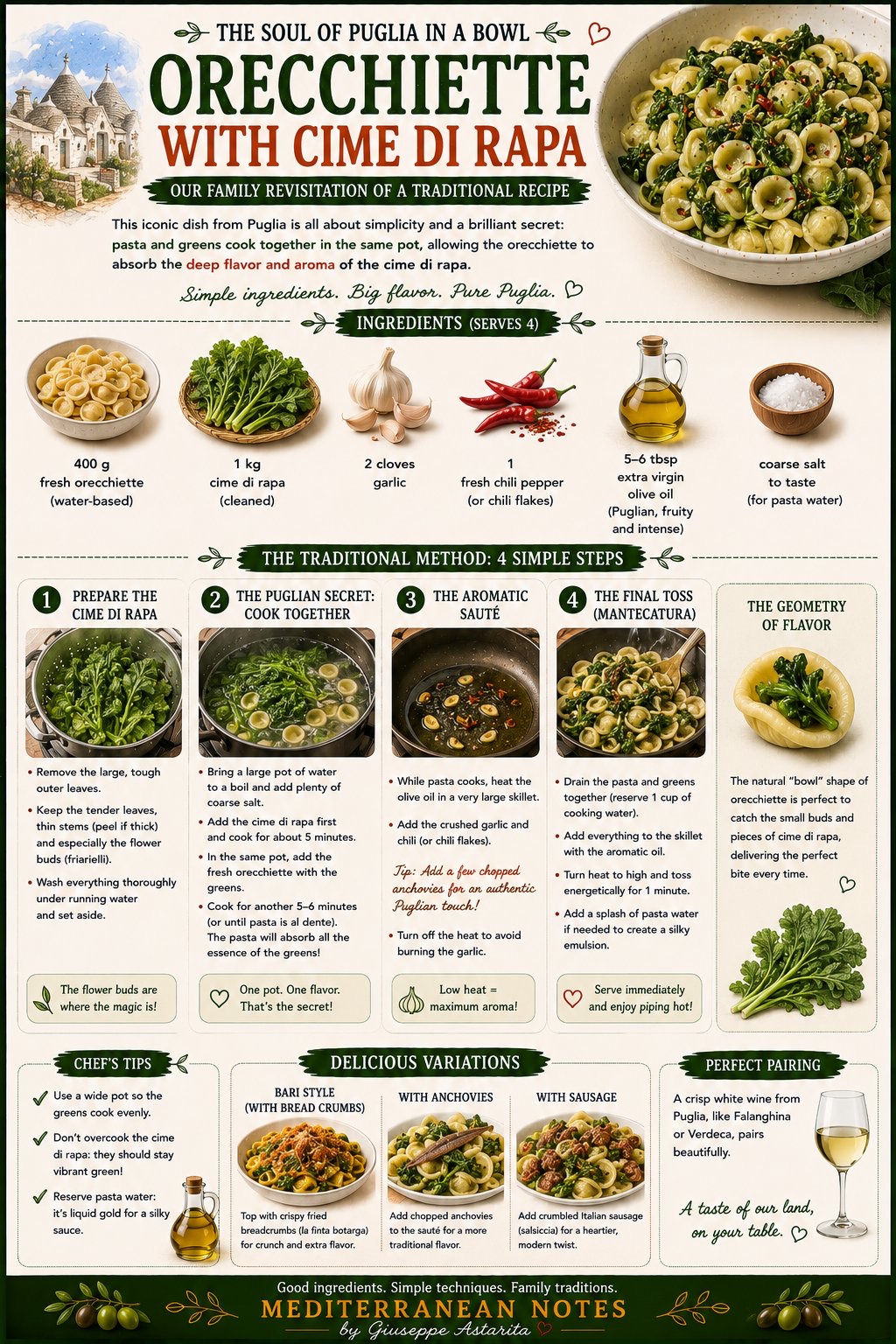
The cime di rapa — broccoli rabe in English, sometimes called rapini — is a slightly bitter, slightly peppery vegetable that is not the same as broccoli despite the family resemblance. It belongs to the turnip family rather than the cabbage family, and its bitterness is different in character from the bitterness of radicchio or chicory — more vegetal, more mineral, with a warmth at the back of the throat that is intensified by the chili and the raw garlic that go into the olive oil. The flower buds — the small, closed florets at the top of the stems — are the sweetest and most prized part. The infographic is correct that they are where the magic is.
The technique — the Puglian secret — is cooking the pasta and the greens together in the same pot. The cime di rapa goes in first, cooks for five minutes in generously salted water, then the fresh orecchiette goes in with it. The pasta absorbs the vegetable cooking water, infused with the mineral bitterness of the greens, and this is what gives the dish its depth — the pasta tastes of the vegetables it cooked with, rather than of neutral pasta water. This is the same nutritional logic as the risottata method used in the pasta e zucchini e uova post and the pasta e cavolfiore: cooking in the vegetable liquid rather than plain water. It is also why the cime di rapa must be genuinely good — what the pasta absorbs is the flavor of the water, and the flavor of the water depends entirely on the quality of the greens.
The orecchiette shape is not incidental. The little ear shape — slightly cupped, slightly rough on the inside, smooth on the outside — is specifically designed to carry small pieces of vegetable or sauce in its cup. A floret of cime di rapa fits inside an orecchietta almost perfectly, and the rough inner surface holds it there. Each bite contains pasta and vegetable in the correct ratio. This is the geometry of flavor the infographic names — and it is genuinely why this shape belongs to this dish.
Glucosinolates, sulforaphane, and the bitter Brassica chemistry of cime di rapa
Cime di rapa (Brassica rapa subsp. sylvestris) is one of the most micronutrient-dense vegetables in the southern Italian kitchen. It belongs to the Brassicaceae family — the same family as broccoli, kale, cabbage, and arugula — and shares their characteristic glucosinolate content. The characteristic bitterness of cime di rapa comes from glucosinolates and their hydrolysis products (isothiocyanates and nitriles), which are released when the cell walls are damaged during cooking. These compounds have documented anti-cancer activity in epidemiological and cell culture studies, primarily through induction of phase II detoxification enzymes in liver cells. The cooking water that the pasta absorbs when cooked together with the greens contains water-soluble glucosinolate hydrolysis products, which is part of why the dish tastes the way it does — distinctly bitter and minerally — and also part of its nutritional value. Cime di rapa also provides vitamin K1 (approximately 300% of the adult daily requirement per 100 g), vitamin C, folate, iron, calcium, potassium, and lutein. The iron in cime di rapa is non-heme iron (plant form), whose absorption is significantly enhanced by the vitamin C present in the same vegetable — an example of nutritional self-pairing within a single ingredient. The chili added to the olive oil during the sauté contributes capsaicin, which has mild anti-inflammatory and circulation-stimulating activity, and carotenoids (capsanthin, capsorubin) that dissolve into the olive oil and distribute with it through the dish. Garlic sautéed briefly in olive oil contributes allicin-derived organosulfur compounds with cardiovascular and antimicrobial activity. The fruity Puglian olive oil provides the highest-quality oleic acid and phenolic antioxidants at the concentrations for which southern Italian extra-virgin olive oil is specifically valued — and quantity matters here, because this dish uses olive oil generously, both for cooking and as the primary sauce. This is one of the most anti-inflammatory pasta dishes in this entire collection — and it happens also to be one of the simplest.
The recipe
Ingredients · serves 4
Method
Prepare the cime di rapa. Remove and discard the large, tough outer leaves. Keep the tender inner leaves, the thin stems (peel the thicker ones), and especially the small closed flower buds — these are the most flavorful part. Wash everything thoroughly. The preparation takes more time than the cooking.
Cook together — the Puglian secret. Bring a large pot of generously salted water to a boil. Add the cime di rapa and cook for about 5 minutes. Then add the fresh orecchiette directly to the same pot with the greens. Cook together for another 5–6 minutes until the pasta is al dente. The pasta absorbs the bitter, mineral flavor of the vegetable cooking water throughout — this is the foundation of the dish's flavor.
Reserve at least 1 cup of the green cooking water before draining. It is the liquid gold for the final toss.
Make the aromatic oil. While the pasta cooks, heat the olive oil in a large skillet over low heat. Add the crushed garlic and chili. Sauté very gently — the garlic should turn golden and fragrant but must not brown. Turn off the heat to stop the cooking. If using anchovies, add them now and let them dissolve in the warm oil off the heat.
The garlic must be treated with care — golden and fragrant at low heat, not browned and bitter. The difference is the difference between a good dish and a great one.
Toss and serve — the mantecatura. Drain the pasta and greens together and add everything to the skillet with the aromatic oil. Turn the heat to high and toss energetically for 1 minute, adding splashes of the reserved green cooking water to create a silky emulsion between the starch-enriched water and the olive oil. If adding cheese, scatter it off the heat and toss again quickly. Serve immediately — piping hot, with a drizzle of raw olive oil on top.
Variations — adjusting to taste
Con il formaggio — creamier
Add grated Pecorino Romano or Parmigiano off the heat, with a splash of pasta cooking water, and toss until the cheese melts into a light creamy coating. Not traditional Puglian orthodoxy — in Bari, this dish is served without cheese. But it is very good and significantly more satisfying as a one-bowl meal. More cheese = more creaminess = more comfort.
Con le acciughe — Puglian authentic
Add 2–3 anchovy fillets to the warm garlic oil off the heat and let them dissolve completely. The anchovies become invisible in the finished dish but add a deep, savory umami note that amplifies the bitterness of the cime di rapa rather than competing with it. The version closest to what is made in Bari. My father's version without anchovies was the family adaptation.
Con la finta bottarga — Bari style
Top with crispy fried breadcrumbs (la mollica or finta bottarga) — stale bread blitzed and fried in olive oil until golden and crunchy, scattered over the finished pasta instead of cheese. The breadcrumbs provide the contrasting texture that cheese provides elsewhere, and are the traditional topping in the poorest versions of the dish — cucina povera at its most resourceful.
Con la salsiccia — heartier
Add crumbled Italian sausage (salsiccia) sautéed in the garlic oil before the pasta arrives. The fat from the sausage enriches the olive oil base and the sausage pieces become the protein element that makes the dish a complete meal without any addition. A winter version — heavier, more filling, appropriate for cold evenings.
This dish is one of the reasons to appreciate the exchange that happens between neighboring regions in southern Italian cooking. It was born in Puglia, became a family staple in Campania, and is now made regularly in Massachusetts. The orecchiette shape is worth finding at a good Italian grocery or making fresh — it is not interchangeable with anything else for this specific combination. The cime di rapa, when in season in late winter and early spring, is worth using instead of substitutes. The olive oil should be the best available.
My father liked it simple — no anchovies, no cheese, just the greens and the garlic and the chili and the olive oil and the pasta. The version we make now sometimes has cheese added at the end. Both are correct. The dish is generous enough to accommodate the adjustment.
Buon appetito — semplice è il meglio.