Scarola Affogata
Escarole drowned in its own steam with garlic, anchovies, olives, capers, raisins, and pine nuts. A side dish, a pasta filling, and the soul of the pizza di scarola — all from one pan.
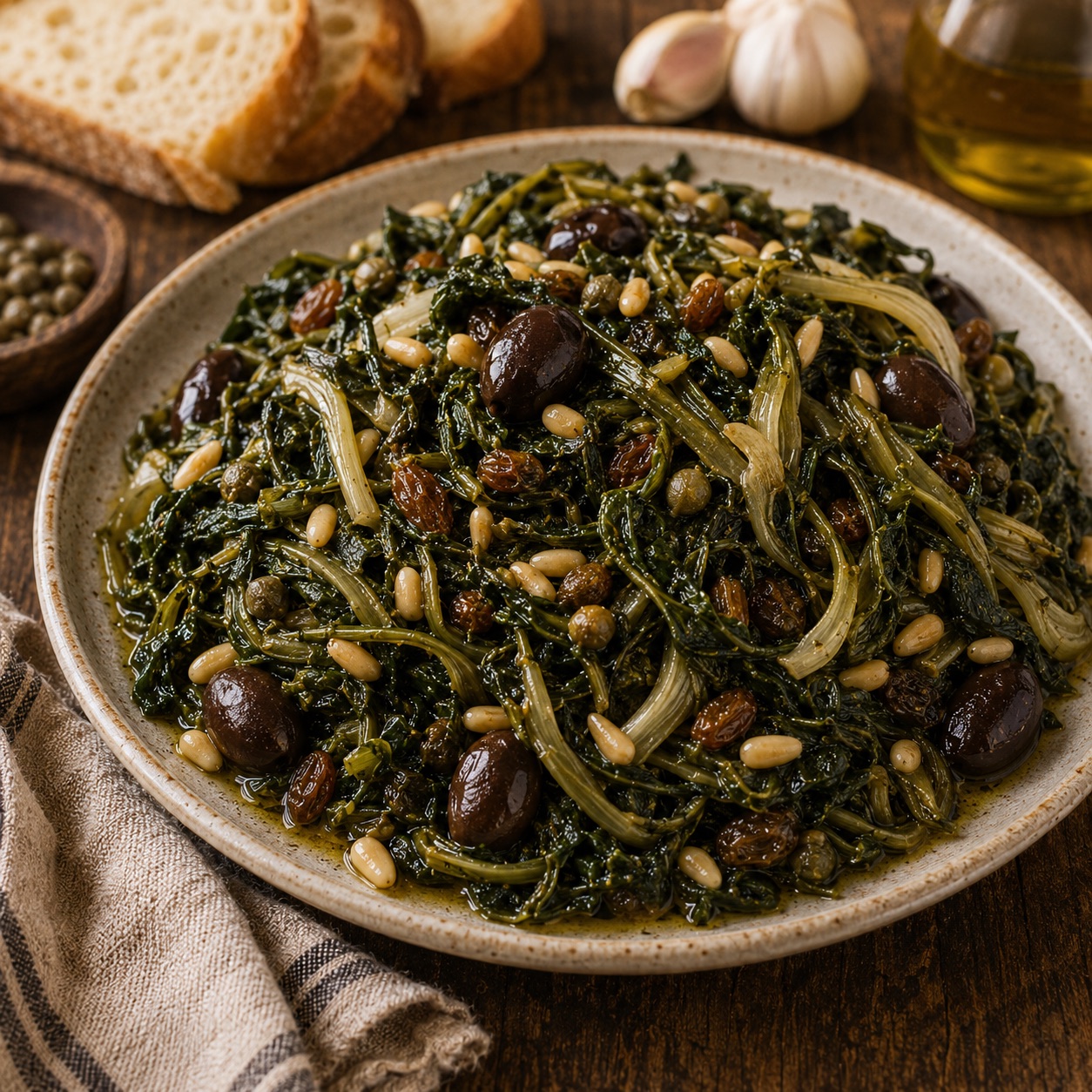
"Ho fatto la scarola affogata per cena." This was an announcement that registered differently depending on who you were. For my mother, it was a quiet declaration of a good winter evening — something that smelled right from the moment the anchovies hit the oil, something she could leave covered on the stove while she did other things. For my father, who ate around the anchovies and the olives, it meant dinner would require some navigation. For me, it meant bread. You cannot have scarola affogata without bread to soak the dark, savory, faintly sweet liquid at the bottom of the pan.
The word affogata means drowned. The escarole — scarola in Italian, a variety of curly endive with broad, slightly bitter leaves — goes into the pan raw, still wet from washing, and the lid goes on immediately. It wilts in its own moisture, releasing liquid that mingles with the olive oil, garlic, and dissolved anchovies already in the pan. No water added, no pre-boiling. The vegetable drowns in itself, which is the technique and the name simultaneously.
What distinguishes scarola affogata from a simple braised green is the combination of flavors added once the leaves have wilted: black olives, salt-packed capers rinsed well, raisins soaked and drained, pine nuts. This is the Neapolitan agrodolce tradition applied to a bitter green — the sweet of the raisins against the salt of the anchovies and capers, the olives adding their distinct earthiness, the pine nuts giving texture. The result is something that operates on multiple levels at once and doesn't resolve into any single flavor.
Scarola affogata is a winter dish in Campania, made when escarole is at its best — broad-leafed, slightly firm, with a bitterness that cooks down to something mellow rather than sharp. In summer you make other things. In the cold months, when the market had heads of scarola piled next to the carciofi and the friarielli, my mother bought them reliably and made this dish with a frequency that made it feel like a given rather than a choice.
Scarola affogata vs. Scarola all'agro
These are two different dishes from the same ingredient, and confusing them produces neither one correctly. Some families call the affogata version scarola stufata — stewed escarole — which describes the same technique from a different angle. The name changes; the dish does not.
Scarola affogata
Cooked covered in its own moisture. Anchovies, garlic, olives, capers, raisins, pine nuts. Long, slow, savory-sweet result. Served warm as a contorno, with bread. Also the filling for pizza di scarola. The dish is cooked, deeply flavored, complex.
Scarola all'agro
Boiled in salted water until tender, then drained, squeezed, and briefly sautéed or simply dressed while still warm with olive oil, lemon juice or wine vinegar, salt, garlic, and sometimes chili. All'agro literally means sour/tart — the acid finishes the dish. No anchovies, no olives, no sweetness. A clean, slightly bitter result eaten at room temperature. The bitterness is present and intentional.
The two share the vegetable and nothing else. Scarola all'agro is lighter, faster, served cooler — more dressed salad than side dish. Scarola affogata is a slow cooked preparation that produces depth and complexity. You do not arrive at one by modifying the other. They are different decisions about what escarole should become.
Affogare as a cooking method — and why it works on bitter greens
Cooking escarole covered in its own moisture is a form of steam-braising. As the leaves heat, their cells release water — escarole is about 92% water by weight — which pools at the bottom of the pan and creates a humid environment that cooks the upper layers via steam rather than direct contact with the hot surface. This is gentler than boiling and preserves more of the fat-soluble flavor compounds from the olive oil and dissolved anchovies, which would be diluted in a large volume of boiling water.
The bitterness of escarole comes primarily from sesquiterpene lactones — lactucopicrin and related compounds — concentrated in the ribs and outer leaves. These compounds are partially soluble in water and in fat. Slow cooking in olive oil with gentle steam reduces their intensity progressively, which is why affogata escarole tastes milder than blanched escarole dressed cold: the longer heat exposure breaks down more of the bitter compounds and allows the fat to absorb and carry them away from the surface of the leaves.
The raisins serve a specific function beyond flavor: their sugars partially caramelize in the oil and provide a counterbalance to the residual bitterness and the salinity of the anchovies and capers. This is the classic Neapolitan agrodolce logic — not sweetening the dish to mask the bitter, but calibrating the sweetness precisely so the bitter and salty remain present but balanced.
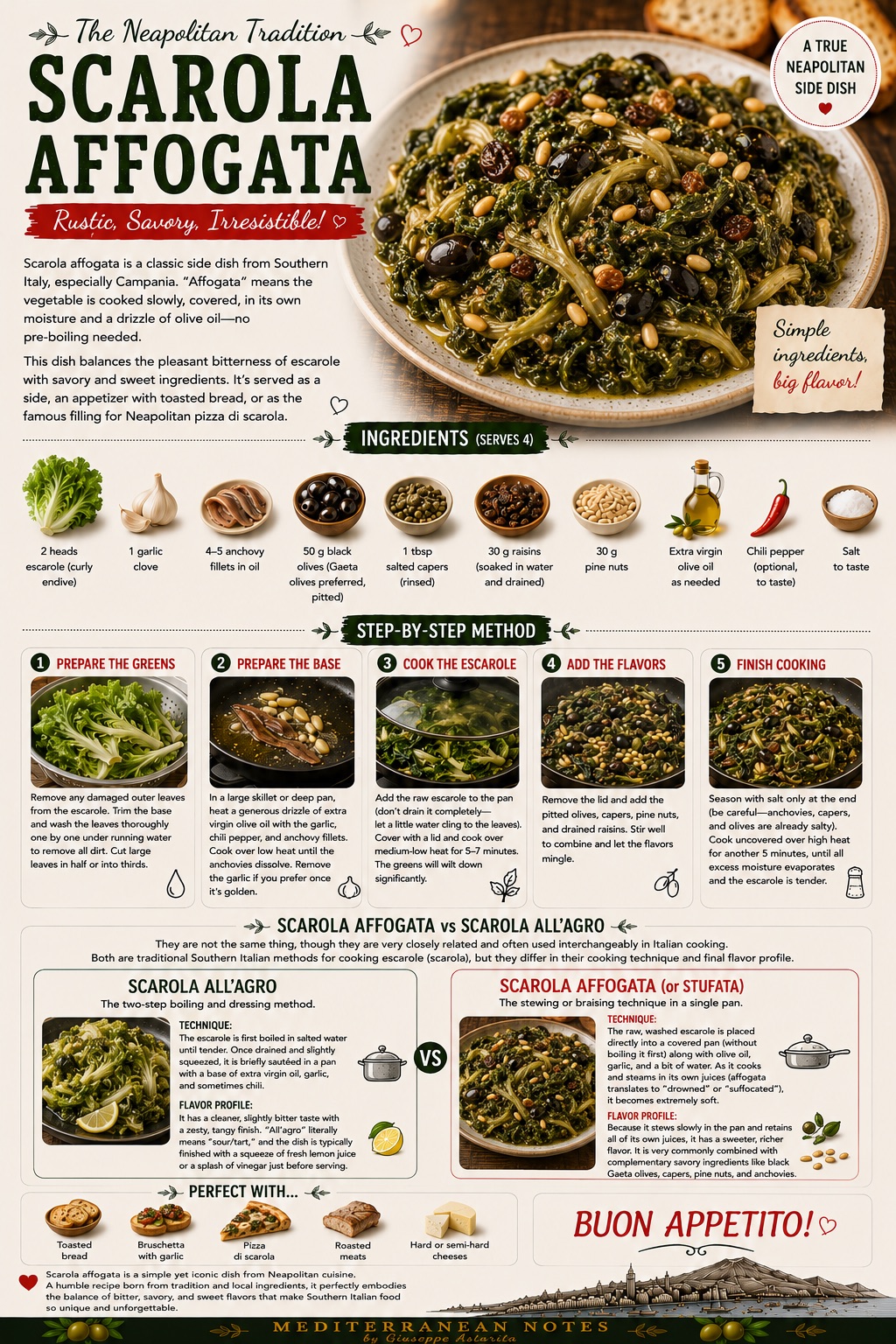
Tap to enlarge — Scarola affogata vs. scarola all'agro: technique, flavor, when to use which
Recipe — Scarola Affogata
Serves 4 as a contorno · Active time 15 min, total about 25 min
- 2 heads escarole curly endive — washed leaf by leaf, not fully dried
- 4–5 anchovy fillets in oil — optional
- 1 garlic clove whole or lightly crushed — removed after cooking
- 50 g black olives Gaeta preferred, pitted
- 1 tbsp salted capers rinsed well, then rinsed again
- 30 g raisins soaked in warm water 10 min, then drained
- 30 g pine nuts
- Extra virgin olive oil generous — 4–5 tbsp
- Chili pepper optional — a small dried piece
- Salt at the end only, if needed at all
I make this regularly in winter, and it is one of the dishes I have replicated most successfully from memory — which is to say it tastes close to what I remember, not exactly the same. The liquid at the bottom of my mother's pan seemed darker and more concentrated than mine. I have not worked out whether this is a difference in the escarole, the olives, or simply memory doing what it does to food from the past. I keep making it. It is a good dish regardless of whether the comparison is accurate.