CoursesBasicsFirst CoursesSecond CoursesSides & VegetablesSoupsSaucesEggs & FrittatePizza & BreadBreakfastSnacksStreet FoodDesserts
DietVegetarianVegan
SeasonSpringSummerAutumnWinter
MainSeafoodMeatEggs
MoreCulture & TraditionsGlossaryAbout

Il Roast Beef della Domenica
Three Traditions, Three Versions — One Sunday Cut

Sometimes on Sundays my mother made roast beef — one of three versions, rotated across the season. We alternated our ways of cooking the Sunday secondo: the ragù, the cacciatora, the scaloppine, and when it was a roast beef Sunday, she sliced it at the table with the electric knife. For a period in the 1980s she had one of those. It produced perfect thin slices and it made the whole preparation feel slightly theatrical, which was appropriate for a Sunday lunch.
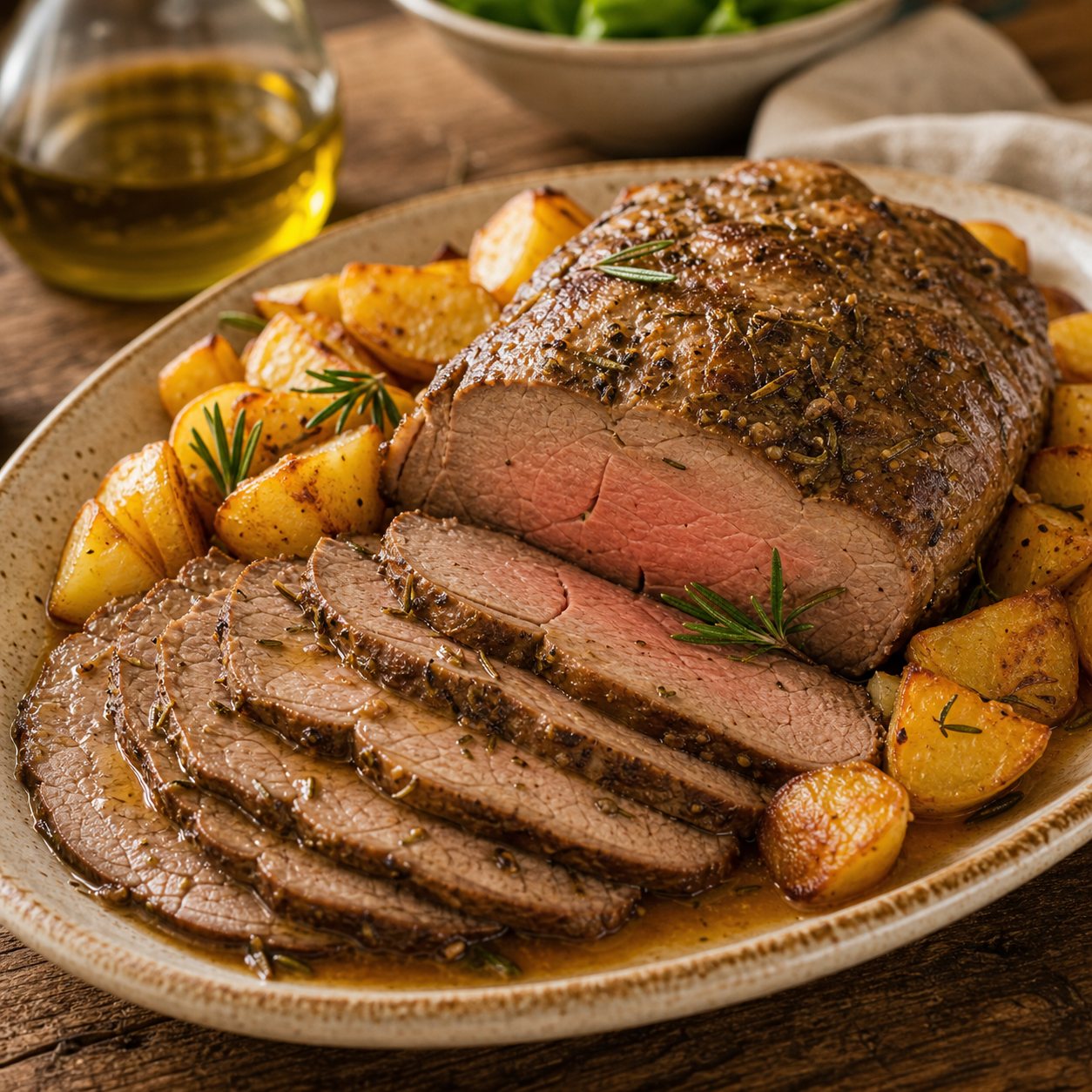
Roast Beef Domenica

The roast beef occupies a specific position in the Neapolitan Sunday table — it is the secondo that alternates with the braised and stewed preparations, providing variety across the weeks and a different kind of satisfaction. Where the ragù and the cacciatora are slow and sauce-forward, the roast beef is about the meat itself — sliced, presented, eaten with whatever sides the season offered. The fact that Italian home cooks adopted the English term roast beef rather than the Italian equivalent (arrosto di manzo) reflects the particular prestige attached to the English preparation in the postwar Italian imagination — a certain association between the English Sunday roast and a kind of prosperous domesticity that Italian middle-class kitchens of the 1960s and 1970s found aspirational.

Three versions appear in this collection because three versions were made. The English-style one — seared on the stove, finished in a hot oven, rested, sliced thin — is the most straightforward and the one that depends most on the quality of the meat. The Neapolitan one — stuffed with garlic, Pecorino, and parsley, braised slowly in a rich tomato sauce for hours — is in fact closer to the logic of the ragù than to an English roast: the sauce becomes the pasta dressing and the meat is the secondo. The alla Genovese version — already described in depth in the Genovese post — uses the same onion-and-beef logic with the roast as its protein.
My mother had an electric knife for a period. The kind with two serrated blades that oscillate against each other. For roast beef it was ideal — it produced thin, even slices without compressing the meat the way a manual knife would if not kept extremely sharp. The slices were uniform and they fanned out on the plate in a way that looked deliberate. The electric knife was a 1980s appliance, slightly loud, slightly theatrical. It suited Sunday lunch.
English Roast Beef
Juicy, rosy & tender
Seared on the stove, finished in a very hot oven, rested 15 minutes. Served with pan juices reduced to a light gravy. Thin slices. The electric knife's moment.
Neapolitan Roast Beef
Slow in tomato sauce
Stuffed with garlic, Pecorino, parsley. Braised for hours in San Marzano tomato sauce. The sauce goes on ziti first. The meat comes second. Two courses from one pot.
Roast Beef alla Genovese
Sweet, creamy & irresistible
The onion-and-beef logic of the Genovese applied to a whole roast. Hours of slow cooking. Sauce on pasta first. Meat sliced and served with the creamy onion alongside.

Version 1 · The electric knife version
English-Style Roast Beef
Seared, oven-finished, rested — thin slices, pink at the center
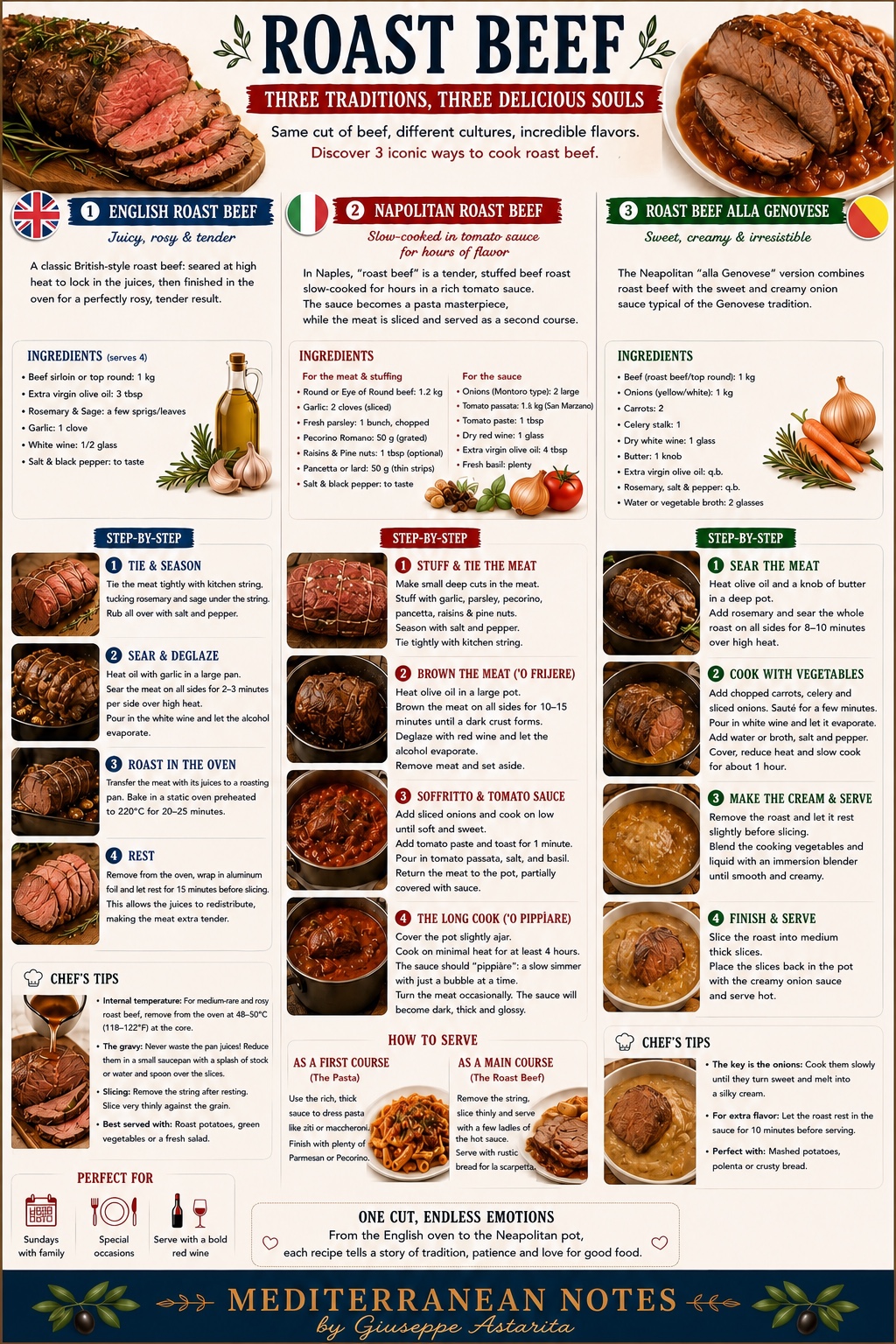
Roast Beef — Three Traditions, Three Versions infographic
One cut, three traditions — English, Napoletana, alla Genovese. Click to enlarge.
1 kgBeef sirloin or top round, tied tightly
3 tbspExtra-virgin olive oil
few sprigsRosemary and sage, tucked under the string
1 cloveGarlic
½ glassDry white wine
to tasteSalt and black pepper — rubbed all over
1
Tie the meat tightly with kitchen string, tucking the rosemary and sage under the string. Rub generously all over with salt and black pepper. Bring to room temperature before cooking — at least 30 minutes out of the refrigerator.
2
Heat the oil in a wide oven-proof pan with the garlic over high heat. Sear the meat on all sides for 2–3 minutes per side until a dark crust forms. Pour in the white wine and let the alcohol evaporate. Transfer the pan to a preheated oven at 220°C static.
For medium-rare and rosy: remove from the oven when the internal temperature reaches 48–50°C. Rest for 15 minutes in foil — the temperature will rise to approximately 55–58°C during resting. This is the correct temperature for a rosy, tender result.
3
Roast in the oven for 20–25 minutes. Remove, wrap loosely in aluminum foil, and rest for 15 minutes before slicing. Meanwhile reduce the pan juices on the stove with a splash of stock or water into a light gravy. Slice very thin against the grain — the electric knife, if you have one, was ideal for this.

Version 2 · The Neapolitan pot roast
Neapolitan Roast Beef in Tomato Sauce
Stuffed, braised for hours, sauce on pasta first — then the meat

This version works exactly like the ragù in its dual-course logic: the rich tomato sauce produced by the long braising dresses ziti or maccheroni as the primo, and the meat itself — stuffed, slow-cooked, falling-tender — is the secondo. One pot, two courses, one Sunday.

For the meat and stuffing
1.2 kgRound or eye of round beef
2 cloves, slicedGarlic
1 bunch, choppedFresh parsley
50 g, gratedPecorino romano
50 g, thin stripsPancetta or lard
1 tbsp each — optionalRaisins and pine nuts
to tasteSalt and black pepper
For the tomato sauce
2 large (Montoro type)Onions, sliced
1.5 kg San MarzanoTomato passata
1 glassDry red wine
4 tbspExtra-virgin olive oil
1 tbspTomato paste
plentyFresh basil
1
Make deep cuts in the meat and stuff with sliced garlic, parsley, grated Pecorino, pancetta strips, and raisins and pine nuts if using. Season all over with salt and pepper. Tie tightly with kitchen string.
2
Brown the meat in olive oil in a large pot on all sides for 10–15 minutes until a dark crust forms. Deglaze with the red wine, let the alcohol evaporate. Remove the meat and set aside.
3
In the same pot, soften the sliced onions over low heat. Add the tomato paste and cook 1 minute. Pour in the passata and basil. Return the meat to the pot, partially covered with sauce. Cover with the lid slightly ajar and cook on the lowest possible heat for at least 4 hours — the sauce should pippiare, the Neapolitan word for the barely visible simmer with just a bubble at a time.
The longer it cooks, the better. Turn the meat occasionally. The sauce will become dark, thick, and glossy. Use it on pasta as the primo. Slice the meat for the secondo.

Version 3 · The sweetest and most patient
Roast Beef alla Genovese
Whole roast slow-cooked in the onion sauce — sauce on pasta first, then the meat

The Genovese version is described in full in the La Genovese Napoletana post, including the technique, the onion quantities, the six preparations the sauce supports, and the rule about pasta first and meat separately. In brief for this context: sear a whole girello or top round in olive oil and butter with aromatics, add the onions (equal weight to the meat, or more), deglaze with white wine, cover and cook for 2½ to 3 hours on the lowest possible heat. The onions dissolve into a sweet, amber-colored, silky sauce. Use the sauce on ziti or paccheri as the primo. Slice the beef and serve with a spoonful of remaining sauce as the secondo. The most patient of the three versions and the most distinctly Neapolitan.

Why resting the roast matters — and what happens during those 15 minutes

When a piece of beef is subjected to high oven heat, the outer muscle fibers contract rapidly and the juices are pushed toward the center of the meat. If you cut immediately after removing from the oven, those juices — under pressure from the contracted outer fibers — run out onto the cutting board and the meat is dry. Resting allows the temperature to equalize from the hot exterior toward the slightly cooler center; as this happens, the muscle fibers relax and the juices redistribute evenly throughout the meat rather than pooling at the center under pressure. The result is a slice that retains its juice when cut rather than releasing it onto the plate.

This is also why the internal temperature target during cooking (48–50°C for the English version) is lower than the final serving temperature (55–58°C): the resting period adds temperature from carryover cooking — the residual heat in the outer layers continues to penetrate inward for 10–15 minutes after removal from the oven. A roast removed at 48°C and rested properly will finish at a uniformly pink 55–58°C throughout. Removed at 60°C it will finish at 68°C or higher, which is well-done and dry. The thermometer, if you have one, makes this predictable; experience makes it instinctive. My mother's instinct, after years of Sunday roast, was entirely reliable without either.

On the electric knife — and slicing in general
The electric knife my mother had was a specific 1980s domestic appliance — the kind with two narrow serrated blades that oscillated against each other, marketed as ideal for roasts, turkeys, and bread. For roast beef it was genuinely better than a manual knife because it produced consistent thin slices without the sawing motion that compresses the meat and squeezes out juice. A sharp carving knife works equally well if properly maintained, but most home knives are not sharp enough for thin-sliced roast beef without compression. The electric knife solved this problem for a generation of Italian home cooks who discovered roast beef as a Sunday second course in the 1970s and 1980s.

The correct slice direction is against the grain — perpendicular to the muscle fiber bundles, which are visible as parallel striations in the raw meat. Sliced with the grain, the muscle fibers are long and the meat is chewy; sliced against the grain, the fibers are short and the meat is tender. This applies to all three versions, though only the English one actually gets sliced thin. The Neapolitan braised version pulls apart rather than slicing cleanly, and is better served in thick chunks with the sauce. The Genovese version is sliced moderately thin after resting in the onion sauce for 10 minutes.

The Sunday secondo alternated. Some Sundays it was the ragù with the meat served after. Some Sundays it was the cacciatora, or the scaloppine, or the cotoletta, or the lesso rifatto on Saturday. And some Sundays it was the roast beef, with one of these three preparations chosen according to the season, the occasion, and probably the mood of whoever was cooking. The electric knife came out, the slices fanned across the plate, the table was already set from before, the pasta had been eaten and cleared. That was Sunday.

Buona domenica — e il coltello elettrico sul tavolo.
More from Secondi
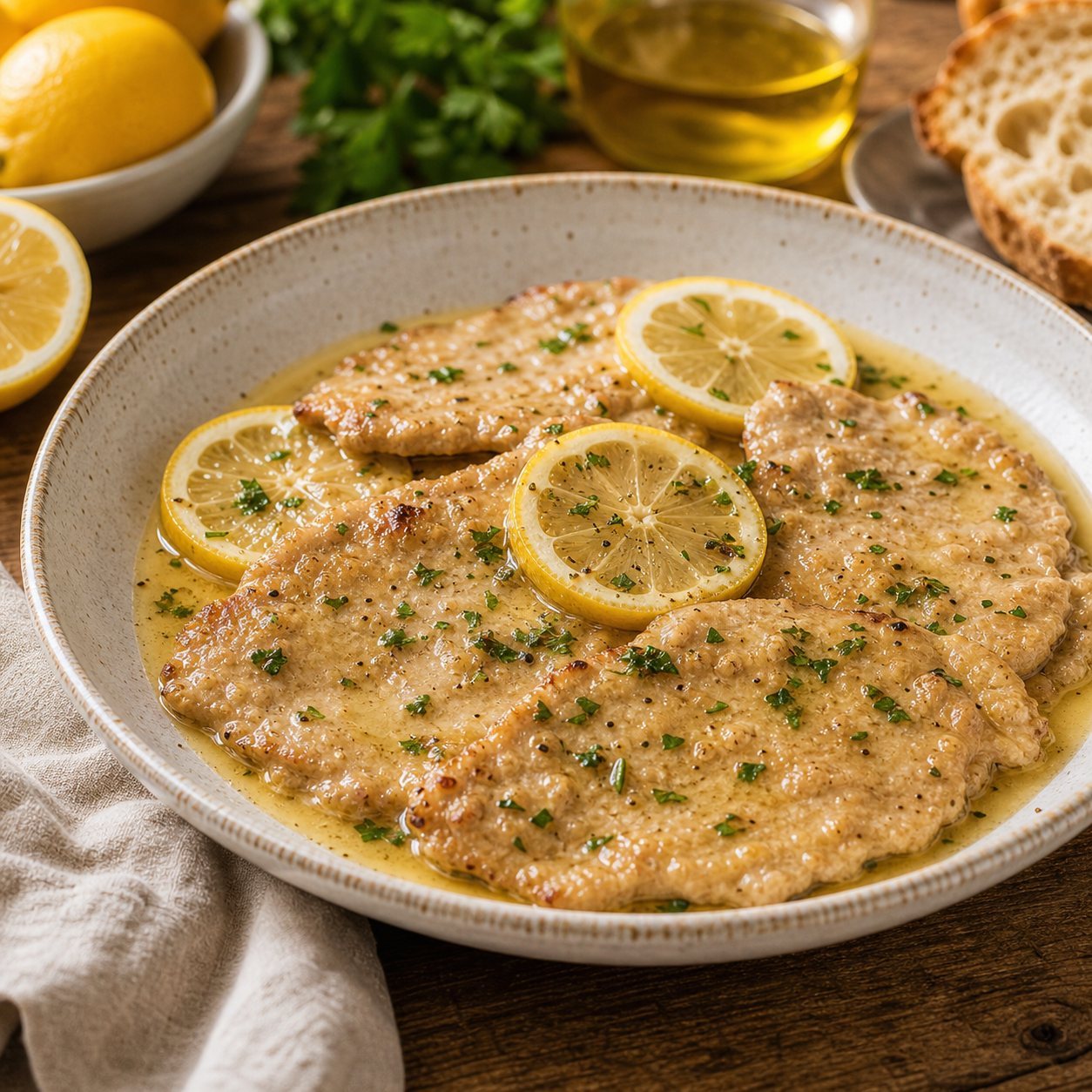
Scaloppine al limone
Thin veal in a bright lemon pan sauce.
Spezzatino di vitello
Veal stew with potatoes.
Polpette di melanzane
The vegetarian meatball that needs no apology.