Puparuoli 'mbuttunati con carne
Stuffed Peppers alla Napoletana — the meat version
Known in dialect as puparuoli 'mbuttunati. The Neapolitan special-occasion version: ground beef browned with garlic, combined with soaked stale bread, egg, Parmigiano, diced ham, cubed smoked provola, olives, and capers — packed inside red or yellow bell peppers and baked until the skin wrinkles and blisters. Rich, dense, firmly a secondo.
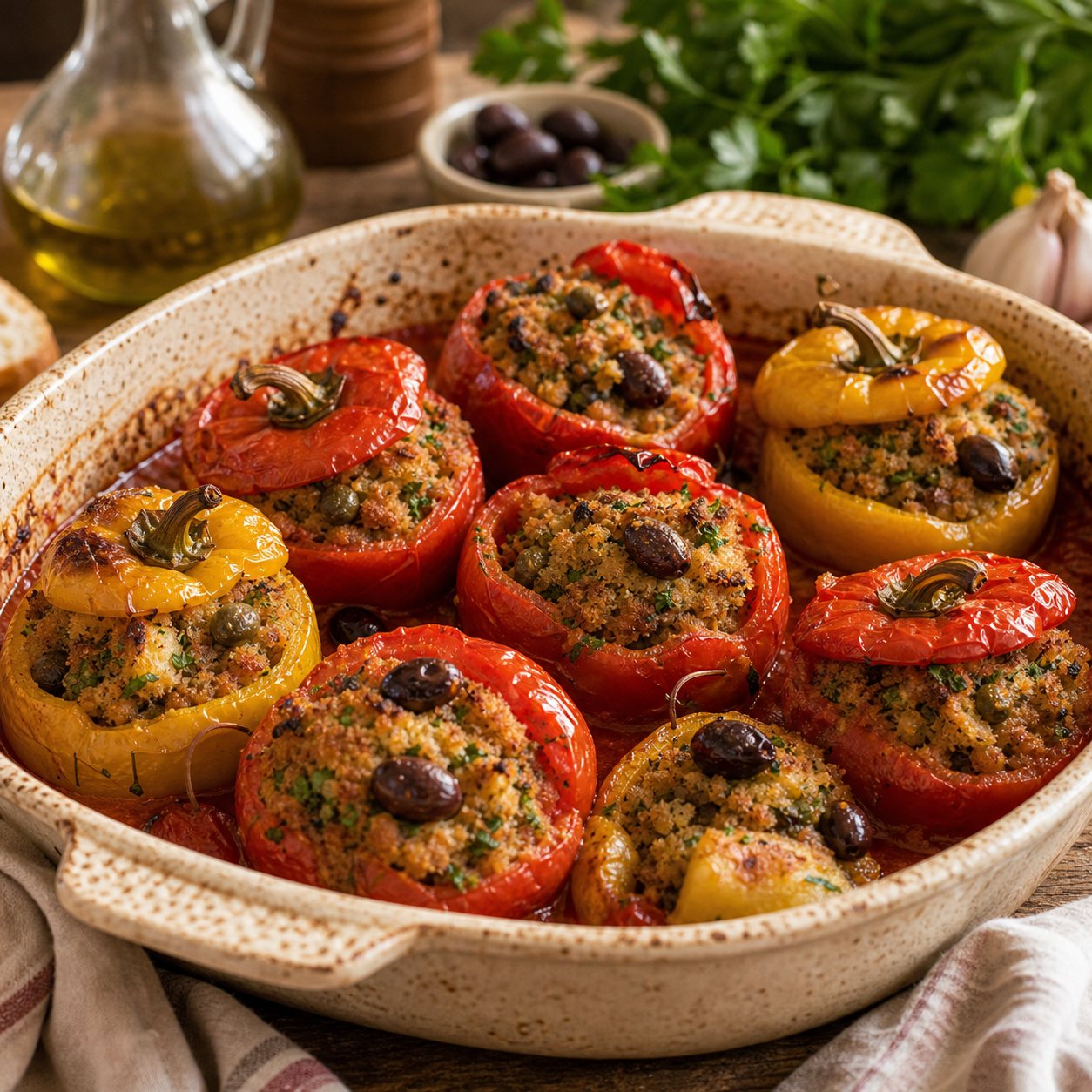
The dialect name is the same for both versions — puparuoli 'mbuttunati, stuffed peppers in Neapolitan — which is fitting, because the dish is one in tradition even when it divides into two along the meat/meatless line. The bread-and-olive filling is the cucina povera version, the everyday version, the one that many Campanian families made because it was cheaper and because it turned out to be genuinely good on its own terms. The meat version is the elaborated version — the one that appears at Sunday lunch in larger families, at the kinds of occasions when the table has more people and the cooking has more components. It is not better than the vegetarian version. It is different in the way that a rich secondo differs from a light contorno: more substantial, more filling, more deliberate in what it asks of the cook and what it delivers.
The filling logic comes from a different place than the bread stuffing. The ground meat is browned first with garlic in olive oil, deglazing with a splash of white wine, then cooled slightly before being combined with soaked and squeezed stale bread — which acts as a binder and absorber — plus egg, grated Parmigiano, diced cooked ham, and the cubed smoked provola. The olives and capers go in last. The provola is the key: it melts inside the filling during baking, creating pockets of stretched cheese that pull when you cut into the pepper. The smoked version (scamorza affumicata works equally well) adds a layer of flavor that the plain version cannot match.
The pepper contains all of this, the top replaced as a lid, and goes into the oven at 180°C for forty to fifty minutes. What comes out is a pepper that has given up its juice entirely into the filling — the meat has braised from the inside in pepper steam, the provola has melted and re-firmed slightly, the bread has absorbed everything that the pepper and the meat produced during cooking. The filling is no longer a collection of separate ingredients. It is a single thing, dense and complex, that happens to be held inside a wrinkled pepper.
The smoked provola melts inside the filling and then firms slightly as the pepper cools. When you cut into it warm, it pulls. When you eat it the next day at room temperature, it has firmed into something different — denser, more integrated, arguably better. The meat stuffed pepper improves overnight in the same way the bread version does, and for the same reason: the filling continues absorbing the pepper juice as it cools.
The two versions — how they differ
This recipe · Neapolitan secondo
With ground meat, ham, and provola
Ground beef or mixed meat browned with garlic and deglazed with wine, combined with soaked bread, egg, Parmigiano, diced ham, cubed smoked provola, olives, and capers. Rich, dense, firmly a secondo. The filling forms a single complex mass during baking with pockets of melted cheese. The special-occasion and restaurant version.
The meatless version · Carne fjuta
The bread, olive, and caper filling
Stale bread soaked and squeezed, black olives, rinsed capers, garlic, parsley, olive oil. No meat. The stuffing absorbs the pepper juice during baking and becomes unified and deeply flavored. The cucina povera version and the everyday one — lighter, more dependent on the pepper itself, honest about its ingredients.
Full recipe →
What the meat adds — and why the bread is still essential
The stale bread in the meat version is not filler. It serves two functions simultaneously: it absorbs the pepper juices during baking (the same capillary mechanism as in the vegetarian version), and it binds the ground meat filling by providing a porous matrix that holds the fat released by the browning meat. Without the bread, the meat filling compacts into a dense, dry mass during baking. With it, the filling remains tender — the bread holds moisture and distributes it through the filling as the pepper cooks.
The smoked provola cubes melt at around 55–60°C, well before the filling reaches full temperature. During baking they liquefy into the surrounding meat and bread mixture, then partially re-solidify as the filling cools, creating the characteristic stretchy pockets. Smoked provola has a slightly lower moisture content than fresh mozzarella, which means it melts more slowly and holds its form longer during cooling — producing cleaner pockets of cheese rather than a uniform melt that disappears into the filling. This is the same property that makes scamorza suitable for grilling where mozzarella would simply run.
The recipe — meat version, serves 4
For the meatless cucina povera version, see Peperoni Imbottiti — the bread and olive filling.
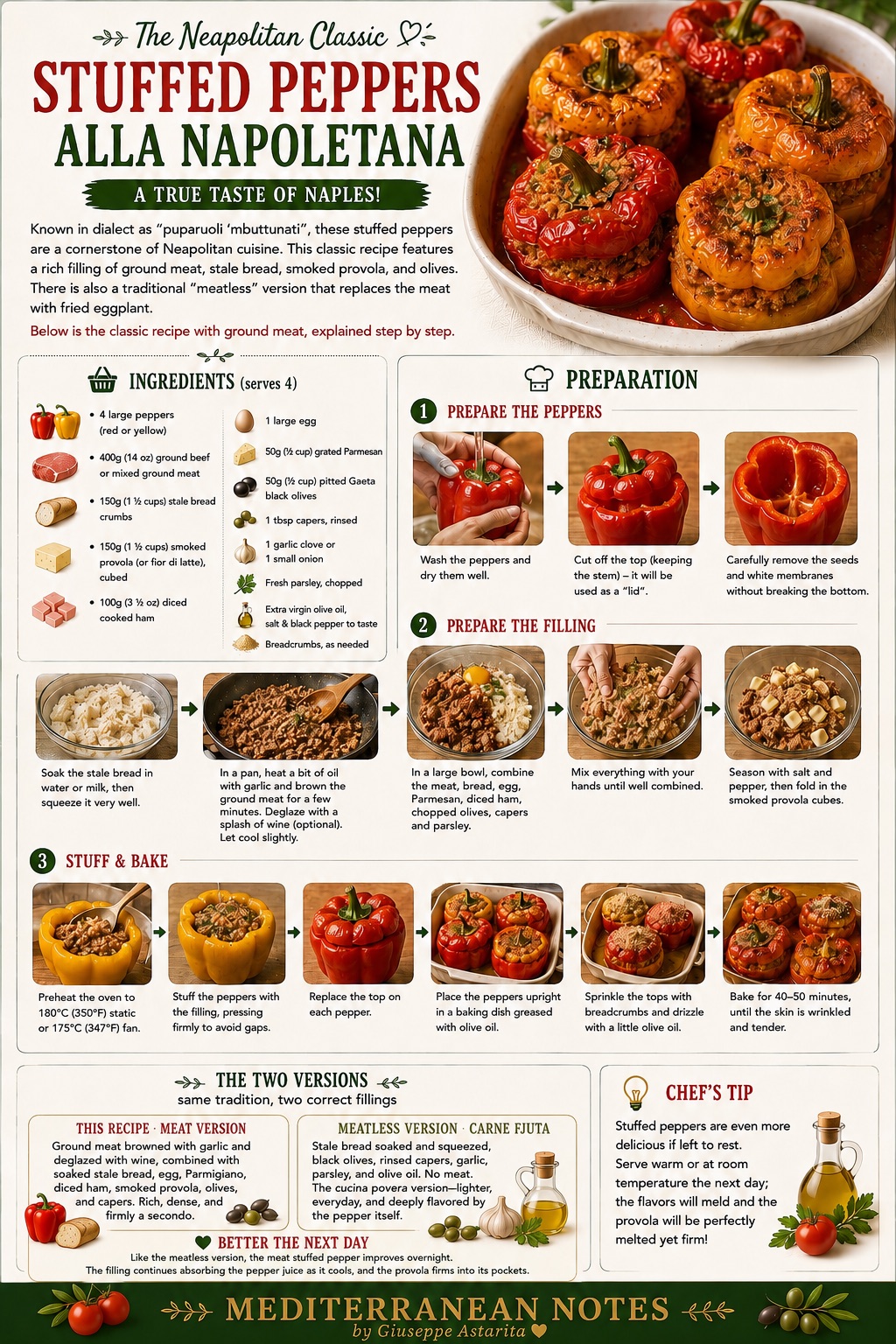
Puparuoli 'mbuttunati con carne — the Neapolitan meat version. Click to enlarge.
4 large — red or yellow
Bell peppers
400 g — ground beef or mixed beef/pork
Ground meat
150 g, soaked in water and squeezed bone dry
Stale bread — 2–3 days old
150 g, cut into 1 cm cubes
Smoked provola or scamorza affumicata
100 g, diced small
Cooked ham (prosciutto cotto)
50 g, pitted
Gaeta black olives
1 tbsp, rinsed well
Salted capers
1 large
Egg
50 g, grated
Parmigiano Reggiano
1 clove, finely chopped
Garlic
large handful, chopped
Fresh flat-leaf parsley
splash — optional
Dry white wine, for deglazing
generously for browning and drizzling
Extra-virgin olive oil · Salt and black pepper to taste · Breadcrumbs for topping
1
Soak the stale bread in cold water for 10 minutes. Squeeze it very firmly in your hands — in handfuls, then again — until almost completely dry. It should feel like damp clay. Break into a large bowl and set aside.
The bread must be nearly dry. Any excess moisture makes the filling loose and prevents it from absorbing the pepper juices properly during baking.
2
In a wide skillet, heat 2 tablespoons of olive oil over medium heat. Add the garlic and cook briefly until fragrant. Add the ground meat and cook, breaking it up, until browned and any liquid has evaporated — about 7–8 minutes. Deglaze with a splash of white wine if using and let it evaporate. Season lightly with salt and pepper. Remove from heat and cool slightly.
Do not season heavily — the capers, olives, and ham all carry salt. Taste the filling before adding more salt at the mixing stage.
3
In a large bowl, combine the cooled meat with the squeezed bread, egg, Parmigiano, chopped garlic, parsley, olives, and rinsed capers. Mix well with your hands until evenly combined. Fold in the diced ham and smoked provola cubes last — gently, so the cheese pieces remain intact.
4
Wash and dry the peppers. For bell peppers: cut off the tops cleanly, keeping the stem as a lid; remove seeds and white membranes without breaking the base. For cornetti: cut off the top, reserve as a cap, remove seeds through the opening and stuff whole. Preheat the oven to 180°C static (175°C fan).
5
Stuff each pepper firmly with the filling, pressing to avoid air pockets. Leave a small gap at the top. Replace the cap on each pepper. Place upright in a baking dish greased with olive oil. Sprinkle the tops with a little breadcrumb and drizzle generously with olive oil.
Firm packing matters. Loose stuffing falls away from the walls during baking. Press the filling in and compact it — it will shrink slightly during cooking.
6
Bake 40–50 minutes until the pepper skin is wrinkled and blistered, the flesh fully tender when pierced, and the top is golden. Allow to rest at least 15 minutes before serving. Excellent warm or at room temperature. Even better the following day.
Notes on variations and eating
The provola question
Smoked provola (or scamorza affumicata) is the traditional choice. It melts cleanly into pockets inside the filling without disappearing completely, and the smoke adds a layer of flavor the plain version lacks. Fior di latte works but melts more aggressively into the filling and does not hold its form as well. Fresh mozzarella releases too much water.
Better the next day
Like the
vegetarian version, the meat stuffed pepper improves significantly overnight. The filling continues absorbing the pepper juice as it cools, the flavors integrate, and the provola firms into its pockets. Cold from the refrigerator, brought back to room temperature, with good bread alongside — one of the better summer lunches.
On the pepper color
Red and yellow peppers are sweeter and more suitable than green ones, which remain slightly bitter after long baking. The natural sweetness of red or yellow flesh works with the rich, savory filling rather than competing with it. Use the largest peppers you can find — small ones do not hold enough filling to be worth the effort.
The fried eggplant variation
Some Neapolitan versions mix cubes of fried eggplant into the meat filling in place of some of the bread. The eggplant adds moisture and a slightly smoky flavor, and it holds together the filling differently than bread. It is a good variation for summer when eggplants are at their peak and the bread version has already been made several times.
The two versions of this dish — the bread-and-olive filling and the meat filling — represent the same tradition from different economic and social positions. The cucina povera produced the meatless version first, because bread and olives and capers were always available and affordable. The elaborated meat version came from families and occasions where the additional expense was appropriate. Neither is more authentic than the other. They are both puparuoli 'mbuttunati, and they are both correct.
The distinction between these two traditions reflects a broader pattern in Campanian food culture: the coastal and urban areas closer to Naples tend toward richer, meat-based preparations, while the inland territories — Caserta, Benevento, the hill towns of the province — developed a more austere cucina povera tradition where bread and preserved ingredients (olives, capers, salted anchovies) do the work that meat does elsewhere. This is not poverty as deprivation but poverty as ingenuity — the kind of cooking that produces extraordinary flavor from limited ingredients because every element is used correctly and nothing is wasted. The stale bread absorbs the olive oil, the pepper juices, and the anchovy fat during baking, and the result has a density and savory depth that fresh bread would not produce.
Buon appetito — e mangiateli anche il giorno dopo.