Strawberries with lemon: my father's favorite dessert, and also the easiest one
Fresh strawberries, lemon juice, and a tiny bit of sugar or honey. Let it sit and it creates its own syrup. That is the whole recipe — and it is one of the best things you can put on a table in summer.
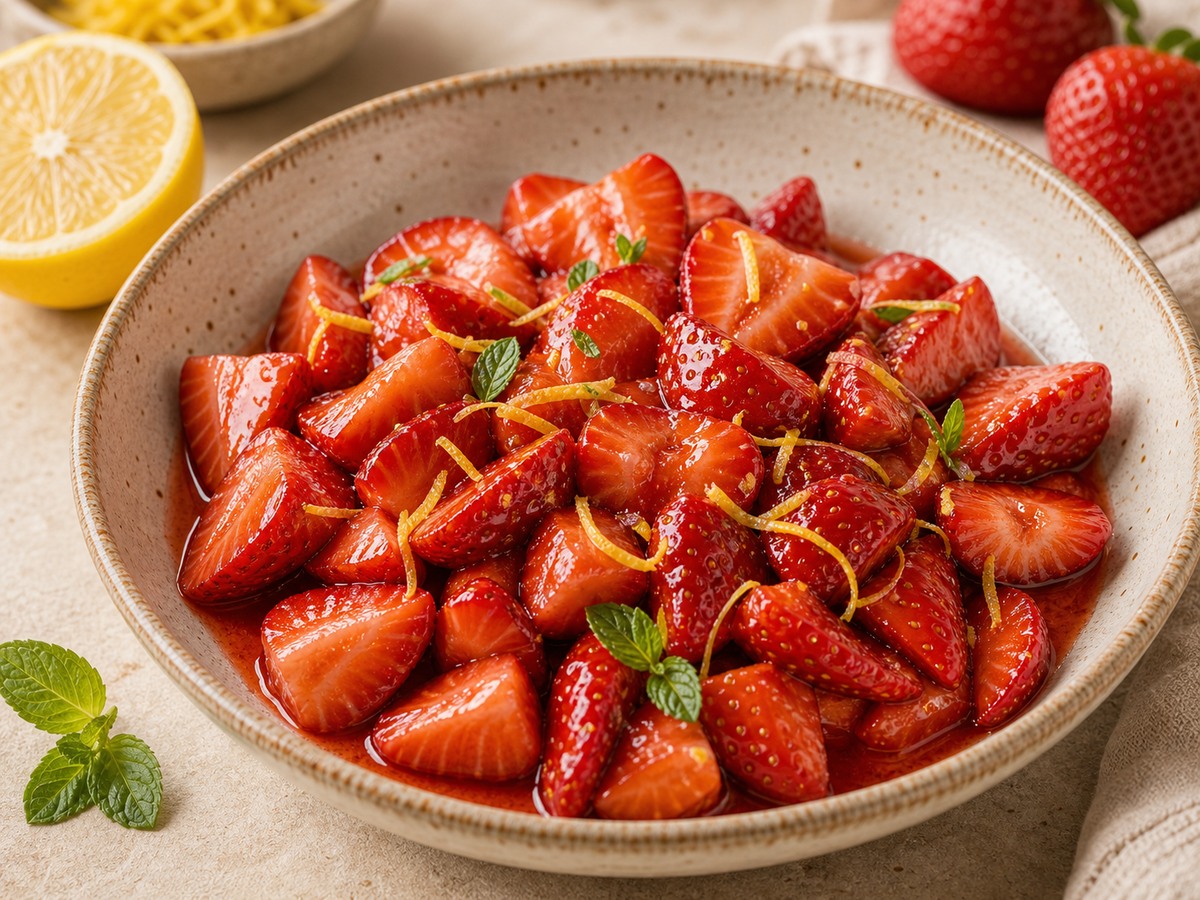
My father loves this. When we want something sweet after dinner and there is nothing prepared — which, I should admit, happens regularly because I do not make desserts very often — this is what I make. My wife finds this funny. She is not wrong. But the thing is, my father is happy every time, and the bowl is always empty, so I am not sure the objection holds.
The recipe is this: slice strawberries, add lemon juice, add a small amount of sugar or a drizzle of honey, toss gently, and wait fifteen to thirty minutes at room temperature. In that time, the sugar draws water out of the strawberries through osmosis, the lemon juice brightens and sharpens the flavor, and the whole thing creates a loose, fragrant syrup that collects at the bottom of the bowl. That syrup is the best part. You need bread, or a spoon held at a slight angle, or a willingness to drink from the bowl when no one is watching.
This is not a recipe in any demanding sense. It is a technique applied to a fruit — the same technique Italian grandmothers have used for generations to turn good summer strawberries into something that tastes better than they had any right to. The only actual requirement is ripe strawberries. Everything else follows from that.
You can add whipped cream if you want. A spoonful, a cloud of it, a little lemon zest curled on top. My daughters prefer it this way. My father prefers the strawberries alone, with the syrup, at room temperature, with no embellishment. Both positions are defensible. The strawberries do not need the cream; they are complete without it. But the cream does not hurt.
Sugar, osmosis, and what lemon juice does to strawberry flavor and color
What happens when you add sugar to sliced strawberries is straightforward osmosis: sugar creates a concentration gradient across the cell membranes of the fruit, drawing intracellular water outward and producing the syrup that pools in the bowl. The lemon juice — citric acid — simultaneously lowers the pH of the mixture, which has two effects: it intensifies the perceived sweetness of the strawberries (the brain registers sweetness differently at lower pH) and it stabilizes the anthocyanins responsible for the deep red color, keeping them bright rather than allowing them to degrade toward purple-brown. Strawberries are among the richest dietary sources of vitamin C (about 60 mg per 100 g — roughly the full adult daily requirement in a single serving), ellagic acid (a polyphenol with anti-inflammatory and chemopreventive properties studied in multiple cancer models), and fisetin, a flavonoid that has attracted recent attention for its senolytic activity — its ability to selectively clear senescent cells. The lemon juice contributes additional vitamin C and hesperidin, a flavanone glycoside concentrated in lemon peel and juice with documented effects on blood vessel tone and inflammation markers. Together, this bowl of strawberries with lemon is doing considerably more nutritional work than its simplicity suggests.
Ingredients · serves 4
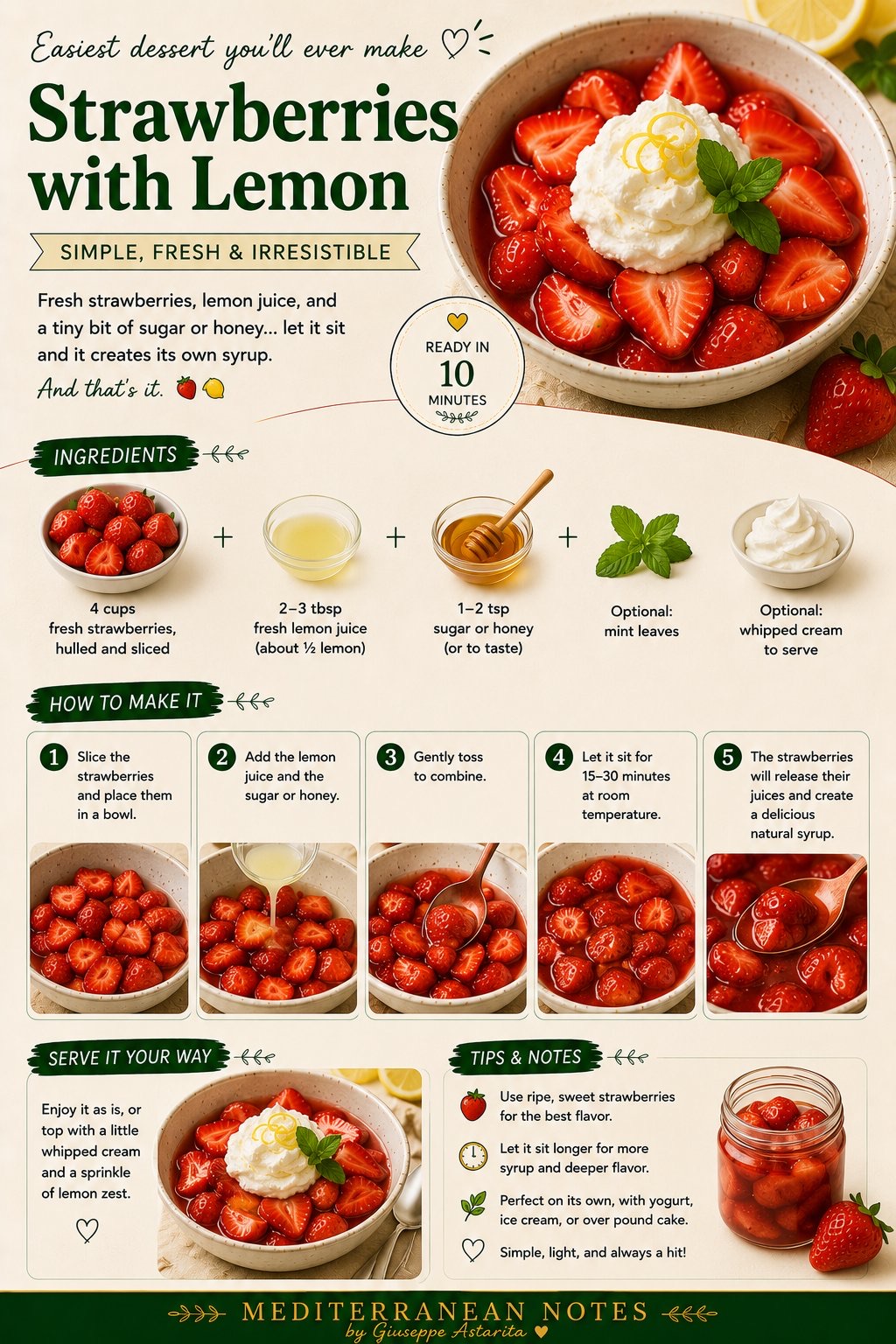
Method — and it really is this simple
Hull the strawberries and slice them — halves or quarters depending on the size, roughly uniform so they macerate at the same rate. Place them in a bowl large enough to toss without spilling.
Use the ripest strawberries you can find. This recipe does not improve on mediocre fruit the way cooking does. It simply presents the strawberry as it is, sharpened by lemon. Start with good strawberries.
Add the lemon juice and the sugar or honey. Start with less than you think — one teaspoon of sugar, two tablespoons of lemon. You can always add more; you cannot subtract.
Toss gently to combine. Once. Maybe twice. Do not crush the strawberries or turn them into compote. The goal is to coat them and let them do the rest themselves.
Leave the bowl at room temperature for 15–30 minutes. Do not refrigerate during this time — cold slows osmosis and the syrup takes much longer to form. The patience is the recipe.
An hour produces more syrup and deeper flavor. If you are making this ahead, cover and refrigerate after the first 30 minutes, then bring back to room temperature before serving.
Serve in bowls, spooning the syrup over the top. Add whipped cream and a curl of lemon zest if you like. Serve immediately — the strawberries are best within an hour or two of macerating, before they soften completely.
The syrup left in the bowl after the strawberries are gone is worth something. A spoon, a piece of bread, a small glass. Do not waste it.
This works over vanilla ice cream, spooned onto pound cake, alongside yogurt in the morning, or completely alone in a bowl on a warm evening. It is not a recipe that needs a context. It is just strawberries and lemon, and it is almost always the right answer when someone wants something sweet and there is nothing prepared.
My father would agree. He has agreed, repeatedly, for many years. I am happy to keep making it.
Buon appetito.