Calzone Napoletano
Come da Vecchiariello — vicino alla stazione di Caserta
Near the train station in Caserta there was an old man — ru vecchiariello, in dialect — who made a margherita and a calzone that I have not forgotten. The dough was chewy and slightly charred at the edges, the way it gets when the oven runs very hot and the baker does not rush things. We ordered to go and took it somewhere — a patch of grass nearby, or home — and ate it out of the paper. It was phenomenal. Now I make it at home. My girls still won't eat it.
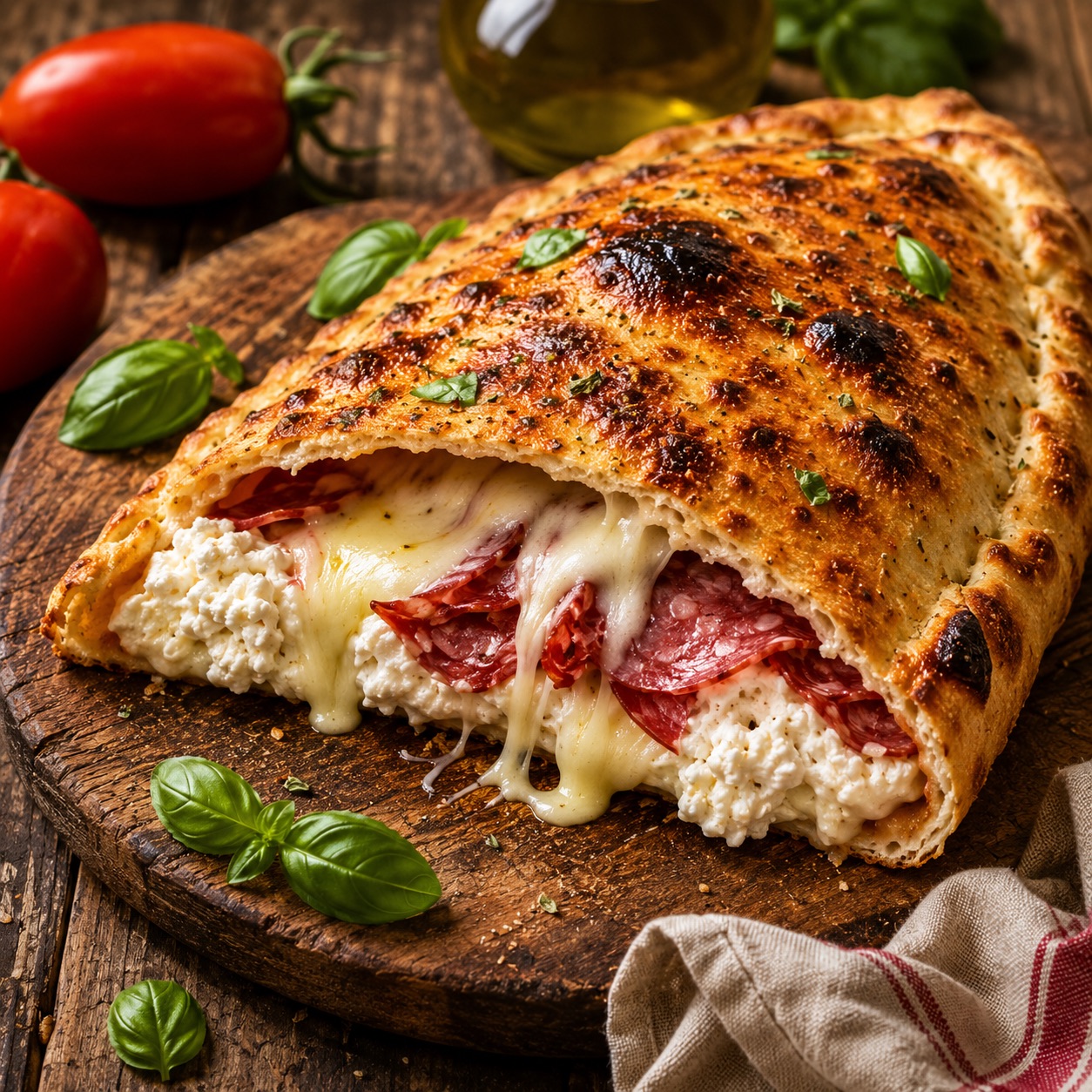
There was nothing remarkable about the place, which is part of why I remember it so clearly. It was near the station, the kind of small pizzeria that exists in every Campanian town — a few tables, a wood-fired oven taking up most of the back wall, an old man working it who had been working it for decades and had no particular interest in making things look appealing or modern. The margherita was excellent. The calzone was phenomenal. I use that word deliberately: there are things you eat as a child that exceed the category of good food and enter the category of memory, and his calzone was one of those. Slightly burned at the sealed edge — not charred through, just darkened and slightly bitter in the way that very good pizza gets when the oven is truly hot — and the dough was chewy, with that elasticity that means the gluten has developed properly and the dough has had time to rest. Inside: ricotta, mozzarella, something salty. The whole thing wrapped in paper and handed over the counter.
We used to order to go — not because the place was unpleasant but because the calzone traveled and a picnic was better. There was grass somewhere near the station, or we just walked back toward home. The paper kept everything hot for longer than you would expect. By the time we sat down the cheese was still pulling strings and the crust had gone from actively hot to the right temperature — warm enough to eat immediately, settled enough that the filling held together when you bit into it. A calzone eaten sitting on a patch of grass near a train station with no utensils is a better experience than the same calzone on a plate in a restaurant. I believe this is true and I cannot fully explain it.
That kind of place has become harder to find. The neighborhood pizzeria with an old man at the oven and no Instagram presence is disappearing steadily, replaced by either the tourist-facing super-fancy version or the mediocre chain. This is a loss that I register every time I go back to Campania and look for the kind of pizza I remember from childhood — the cheap, honest, slightly imperfect version that was simply very good. So I make it at home. The oven is not a wood-fired oven and the result is not identical. But the dough, given enough time and a properly hot oven, produces something that is recognizably in the same family. The girls — Anna and her younger sister — inspect it, decline it, and ask for something else. This is fine. They are children and children are wrong about many things. Eventually they will understand the calzone. I am patient.
The characteristic dark spots and slightly burned edges of a calzone baked in a genuinely hot wood-fired oven are the result of the Maillard reaction and pyrolysis proceeding beyond the golden-brown stage into the early phases of carbonization. At the surface temperatures reached in a wood-fired oven — 350–450°C at the stone surface — the outer layer of dough goes through browning and into slight charring in a matter of seconds. The char compounds that form at this stage include polycyclic aromatic compounds that are genuinely bitter, but also furans and other aromatic molecules that contribute smoky, complex notes not produced at lower temperatures. This is why pizza from a wood-fired oven at 450°C tastes different from the same dough baked at a domestic oven's maximum of 250°C — not just faster-cooked but qualitatively different in flavor, with a depth at the charred edges that the lower-temperature crust cannot develop.
The chewiness of a well-made calzone dough is a function of gluten development and hydration. A dough that has been kneaded properly and rested for a full two hours develops an extensible, elastic gluten network that bounces back when stretched rather than tearing — this is the chewiness. Higher hydration (water percentage relative to flour) produces a more open crumb and a slightly wetter, more tender interior. A dough at 65% hydration produces the chewy, slightly dense texture of a traditional Neapolitan-style calzone; a 70% hydration dough produces a more airy, lighter result. The long rest matters: during the two hours, enzymes in the flour continue to break down starch and protein, producing fermentation products that contribute flavor and further relax the gluten, making the dough easier to stretch without tearing.
The recipe
Makes 4 calzoni. The two-hour rise is not negotiable — it is what produces the chewy, developed dough that the memory requires. Use a pizza stone or a heavy baking sheet preheated in the oven: it is the closest a domestic oven comes to the stone floor of a wood-fired one. Preheat the oven to its maximum temperature — typically 250°C — for at least 45 minutes before baking.
Dough — for 4 calzoni
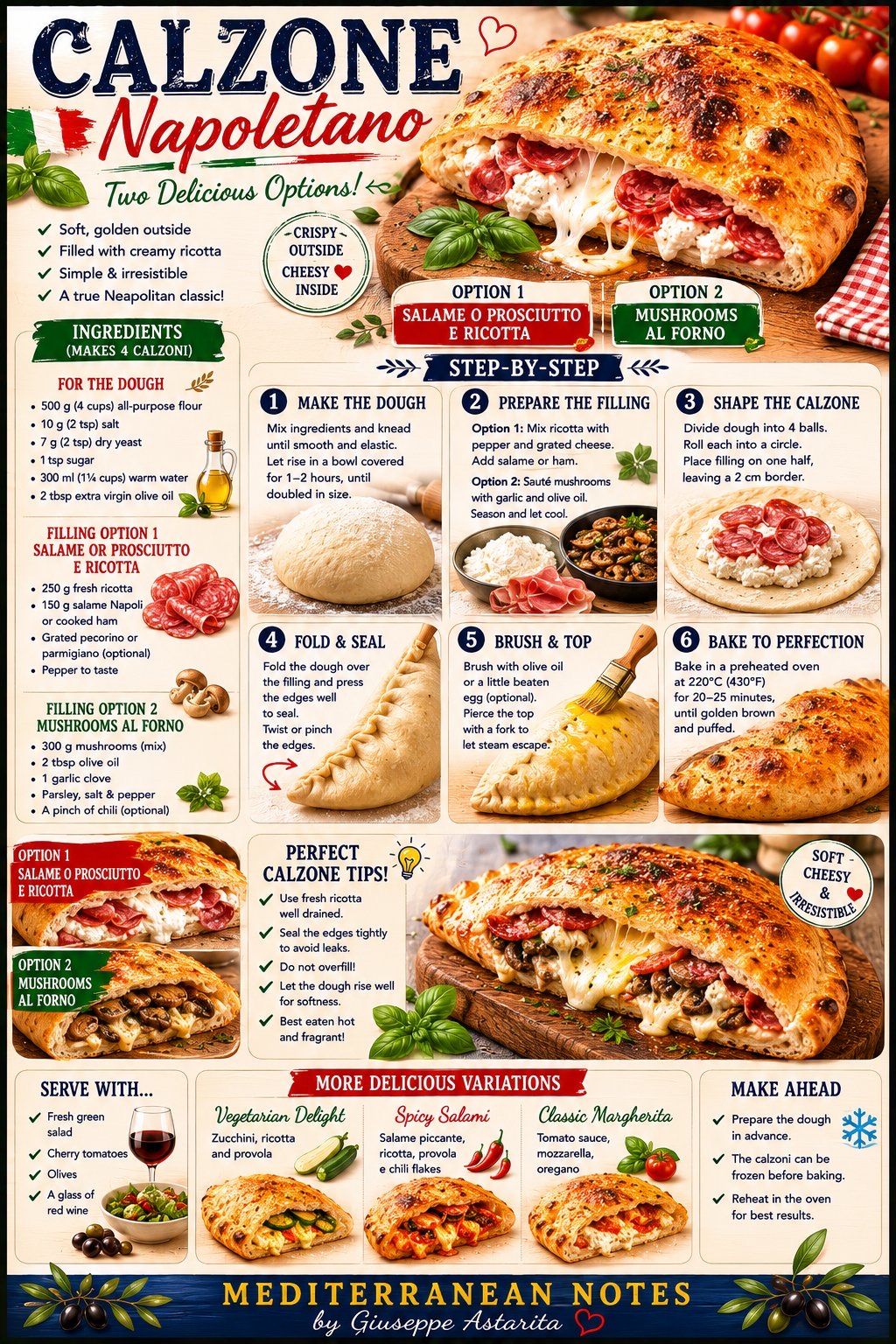
Filling — per calzone
The mushroom variation
The infographic shows a second filling option that is worth knowing: calzone ai funghi al forno, the mushroom version. It replaces the salame and ricotta with 300 g of mixed mushrooms — cremini, porcini if you can find them, or whatever is at the market — sautéed with garlic, olive oil, a little parsley, salt, and pepper until fully cooked and any liquid has evaporated. Let them cool before filling. A little provola or mozzarella added to the mushrooms melts inside the calzone and gives the filling body. This version has no salame, no ricotta — it is lighter in character, more autumnal in flavor, and very good. Vecchiariello, as far as I remember, only made the classic. But the mushroom version is a legitimate variation and one I make at home when good mushrooms are available. The girls are no more interested in the mushroom calzone than in the classic one. I remain patient.
The girls will come around eventually. Or they will not, and they will miss something. Either way the calzone is worth making, and the making of it — the two-hour wait, the hot oven, the slightly darkened fold — is its own argument for why certain simple things done correctly are worth more than many elaborate things done approximately.
Buon appetito —
e grazie, vecchiariello, ovunque tu sia.