Tagliolini in brodo: Saturday, full belly, basketball practice, and my daughter requesting it now
Saturday lunch, every week: tagliolini in meat broth as the first course, then the boiled meat served with potatoes sautéed with onion as the second. I ate so many rounds that my belly was close to exploding and I had basketball practice immediately after and I could barely move. My daughter now requests this dish. Only tagliolini. Made fresh from scratch.
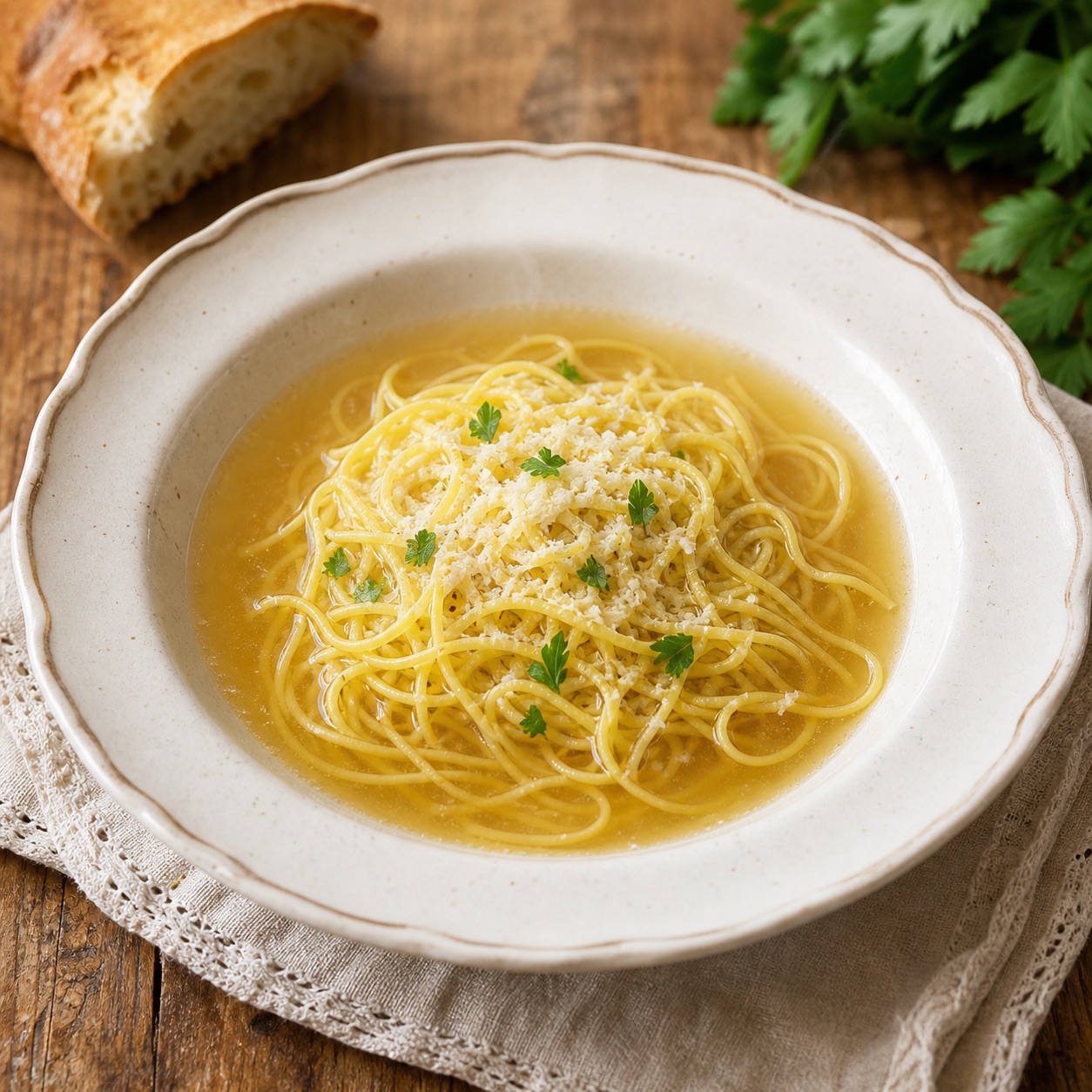
The brodo di carne — meat broth — is one of the foundational preparations of Italian cooking, and it is specifically a Saturday ritual in many Italian households. Not Sunday, which belongs to the ragù and the polpette and the long table. Saturday is the broth day: the pot goes on the stove in the morning, the meat and vegetables and aromatics simmer for three hours while the rest of the day happens around them, and by lunchtime the kitchen smells of it and the broth is dark amber and clear and deeply flavored. The tagliolini cook directly in the broth for one to two minutes — they are so thin that this is all they need — and come out soft and yielding and completely saturated with the liquid they cooked in. Nothing else is added. A generous dusting of Parmigiano on top.
This was the first course. The second course was the bollito — the boiled meat that had given its flavor to the broth — served with boiled potatoes, or with the potatoes and the broth vegetables sautéed together in a pan with onion and olive oil until golden. This was not a concession or a use of leftovers; it was the planned second act of the same pot. The meat that makes the best broth is not the most tender or the most expensive cut — it is the cut with connective tissue and bone that releases collagen and gelatin slowly over the long simmer and produces the body that distinguishes a proper broth from flavored water. This same meat, after three hours in the pot, is soft and yielding and good with the potatoes.
In Italy, the tagliolini for this dish came from the fresh pasta shop — la pasta fresca — a category of small business that exists in every Italian town and that has no real equivalent in the United States. You went with a container and they filled it with fresh egg pasta in whatever shape you requested. The tagliolini were very thin — thinner than spaghetti, thicker than angel hair — and they were made that day and had a texture that dried pasta does not replicate: soft, yielding, slightly rough on the surface in a way that holds the broth. Now we make them from scratch, which is simpler than it sounds and which my daughter insists on specifically. No other pasta in this dish.
The charred onion is the detail that changes the color of the broth. Half an unpeeled onion, placed cut-side down in a dry pan over high heat until deeply charred — almost blackened — and then added to the broth pot. The caramelized and slightly bitter compounds from the charring turn the broth from pale yellow to a beautiful dark amber without making it taste burnt. This is a technique that appears in Italian household cooking without much explanation — it is simply done, and the result is the rich golden color that makes the bowl of brodo with floating tagliolini look as good as it tastes.
Bone broth, collagen, glycine, and what slow simmering extracts from connective tissue
Meat broth made from bone-in cuts and slow-simmered for three hours is one of the most nutritionally complex preparations in the Italian kitchen. The long simmer extracts collagen from the connective tissue of beef chuck, brisket, and marrow bones, hydrolyzing it into gelatin — a mixture of peptides including hydroxyproline-containing sequences that have been studied for their effects on joint health, skin collagen synthesis, and gut barrier integrity. A properly made broth sets to a soft gel when refrigerated, which is the visual indicator of adequate gelatin content. The marrow bone contributes bone marrow — one of the most lipid-dense tissues in the body, providing oleic acid, palmitic acid, conjugated linoleic acid, and fat-soluble vitamins A, D, E, and K2 at concentrations meaningful even in the small quantity that leaches into the broth. The chicken quarters provide a different amino acid profile from the beef, with a higher proportion of glycine and proline — the amino acids that dominate collagen structure and that are used preferentially in gut lining synthesis. The long cooking extracts potassium, phosphorus, and zinc from the meat and bones into the liquid. The cherry tomatoes added to the broth provide lycopene, potassium, and vitamin C; some vitamin C is degraded by the heat but residual amounts remain in the cooled broth. The charred onion contributes Maillard reaction products and caramelized sugars that give the broth its amber color and a subtle complexity. The fresh egg tagliolini cooked directly in the broth — rather than in salted water and then transferred — absorb the broth's collagen, minerals, and amino acids as they hydrate, meaning the pasta in this dish is literally nutritionally enriched compared to the same pasta cooked in plain water. The Parmigiano dusted on top contributes calcium, glutamate (which amplifies the savory perception of the broth), and fat-soluble vitamins. A bowl of tagliolini in brodo is, per gram of pleasure delivered, one of the most nourishing things in this collection.
The recipe — the whole Saturday meal
For the meat broth — start in the morning
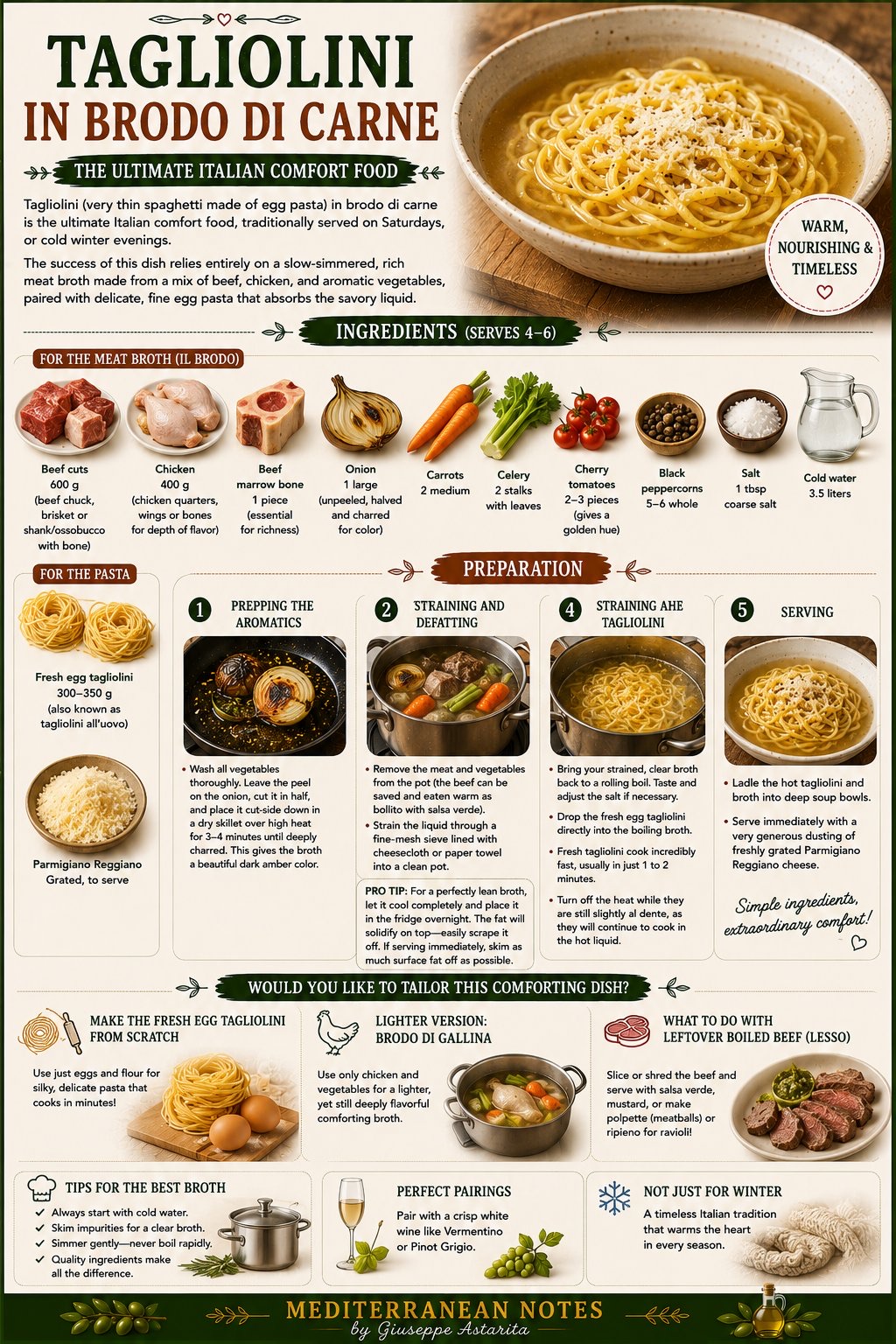
For the tagliolini — fresh, made from scratch
Method — the broth
Char the onion. Halve the onion without peeling. Place cut-side down in a dry skillet over high heat for 3–4 minutes until deeply charred — the cut surface should be almost black. Set aside. This step produces the dark amber color of the finished broth.
Build the broth — cold start. Place all the meat and bones in a large pot. Cover with 3.5 litres of cold water. Bring slowly to a boil — this takes about 20–25 minutes. As the water heats, impurities will rise to the surface as grey foam. Skim these off patiently with a ladle as they appear. A clear broth begins here.
Always start with cold water and a slow heat. Starting in boiling water seals the meat surface and produces a less clear broth. The slow rise extracts impurities gradually so they can be skimmed.
Add aromatics and simmer. Once the broth is boiling and skimmed clear, add the charred onion, carrots, celery, cherry tomatoes, peppercorns, and salt. Reduce to the gentlest possible simmer — the surface should barely tremble, never boil rapidly. Cover partially and cook for at least 3 hours. The longer it simmers, the deeper the flavor.
A rapid boil makes a cloudy broth. The collagen extracts best at a gentle simmer that never disturbs the liquid violently. Patience is the skill this step requires.
Strain and defat. Remove the meat and vegetables — the meat goes to the second course, the vegetables are discarded or eaten separately. Strain the broth through a fine-mesh sieve lined with cheesecloth or a clean kitchen towel. For the clearest result: let cool completely and refrigerate overnight. The fat solidifies on the surface as a solid layer — lift it off cleanly. What remains is a crystal-clear, deeply amber broth that sets to a soft gel when cold.
Make the tagliolini. On a clean surface, mound the flour and make a well in the centre. Break the eggs into the well. Beat the eggs with a fork, gradually incorporating the flour from the inside edge of the well. When the dough comes together, knead for 8–10 minutes until smooth and elastic. Rest wrapped in film for 30 minutes. Roll very thin — the thinnest setting on a pasta machine, or as thin as possible by hand — and cut into very fine strips, 1–2 mm wide. Dust with semolina to prevent sticking.
Fresh tagliolini can also be bought from any Italian fresh pasta shop or good Italian deli. Dried tagliolini works as a substitute but requires longer in the broth. No other pasta shape is right for this dish — the thinness is the point, and my daughter enforces this.
Cook and serve. Bring the strained broth to a rolling boil. Drop the fresh tagliolini directly into the boiling broth. Cook for 1–2 minutes — they are very thin and cook almost instantly. Turn off the heat while they are still very slightly al dente; they will continue cooking in the hot liquid. Ladle into deep bowls — pasta and broth together. Dust generously with Parmigiano. Serve immediately.
What to do with the bollito — the Saturday second course
Carne e patate in padella — the Saturday classic
Slice or shred the boiled beef. Dice the boiled potatoes. Sauté together in a pan with olive oil and sliced onion over medium-high heat until golden and slightly crispy at the edges. Season with salt and pepper. This is the Saturday second course — simple, complete, using what the broth pot already produced. The meat from three hours in the broth is soft and yielding; the pan gives it back some texture and color.
Con la salsa verde
Serve the boiled beef sliced warm or at room temperature with salsa verde — parsley, capers, anchovy, garlic, olive oil, a little vinegar, blended into a sharp green sauce. The classic accompaniment for bollito throughout northern Italy. The acidity cuts through the richness of the slow-cooked meat precisely. Make it while the broth simmers.
Ripieno per ravioli
Finely chop the boiled beef with Parmigiano, nutmeg, egg, and a little of the broth to bind. Use as filling for ravioli or tortellini — traditionally these too are served in the broth. A two-day project: broth and bollito on Saturday, filled pasta in brodo on Sunday.
Polpette di bollito
Mince the leftover boiled meat finely. Mix with an egg, Parmigiano, parsley, salt, and breadcrumbs soaked in a little broth. Form into small patties or meatballs and pan-fry in olive oil until golden on both sides. A use of the bollito that produces something with completely different texture and character from the original. Serve with a simple salad.
The Saturday broth is one of those dishes that requires more time than skill, more patience than technique. The pot goes on in the morning and the house smells of it for hours. By lunchtime the broth is ready and the tagliolini take two minutes. The second course is already in the pot, already cooked, already waiting. It is a meal that manages itself once you start it — which is perhaps why it was the Saturday meal rather than any other day, when a morning at home could contain three hours of gentle simmering without anyone needing to do much beyond skimming occasionally and waiting.
My daughter requests it with specificity: the tagliolini made fresh, the broth deep and amber, the Parmigiano generous. The same meal, the same sequence, the same satisfaction that ended with a full belly and basketball practice — which in retrospect was probably a reasonable use of the energy.
Buon appetito — e buon sabato.