Torta Caprese: the cake that was always there
My mother used to make this for breakfast — my father's favorite. I would wake up and find it on the table, fragrant and dark and dusted with powdered sugar. I did not appreciate it enough then. Now I do, and I want to keep the tradition going.
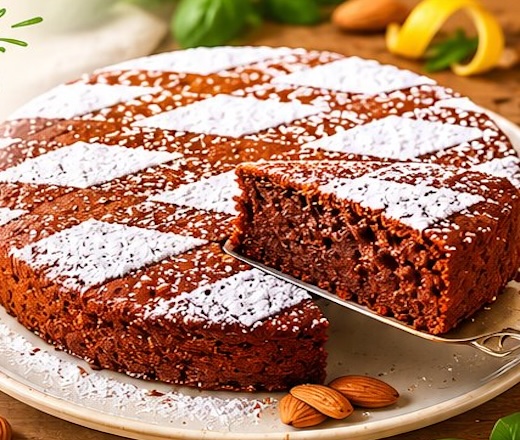
Sometimes I would wake up in the morning and there it was — a torta caprese on the table, still faintly warm, the powdered sugar forming a white pattern across the dark surface. My father loved it. My mother made it for him, and by extension for all of us, the way Italian mothers make things — without announcement, without ceremony, simply because it was good and it was there and it was part of what mornings were.
I did not fully appreciate any of it at the time. This is the universal experience of growing up inside something that only becomes visible once you have left it. The good smell of a cake baking in the morning, the routine of finding something sweet on the table with the coffee and the milk — these were not special to me then, because they were always there. They become special later, in the accumulating distance, when the kitchen is in another country and the mornings are arranged differently.
The torta caprese is also — and this is part of why it appears at breakfast in Campania, not only as a dessert in the evening — a cake that is designed to sit and improve. Italians have always known that something rich and dense, eaten with a strong coffee or a warm caffellatte in the morning, is a very good way to begin the day. The North of Europe invented the austere breakfast. The South of Italy politely disagreed.
The cake itself comes from the island of Capri, off the coast of Naples, which makes it Campanian in spirit if not strictly in origin. It contains no flour — almonds provide the structure, moisture, and the dense, slightly fudgy crumb that is the signature of the cake. Dark chocolate — at least 60%, properly 70% — gives it its character. The eggs are separated: yolks into the batter, whites whipped to stiff peaks and folded in gently, which is what gives the cake its slight lift despite having no leavening and no gluten. The result is crispy at the edges, moist and dense at the center, and incomparably fragrant — chocolate and almond together in a way that smells, when it is baking, exactly like it tastes.
It is naturally gluten-free. This is not a selling point in the recipe's original context; it is simply a structural fact — there was never flour in it. The almonds were always the ingredient, and the almonds are enough.
Almonds, dark chocolate, and the nutrient density behind a flourless cake
The torta caprese is, from a nutritional standpoint, a cake built on genuinely good ingredients. Almonds are rich in monounsaturated fatty acids (primarily oleic acid, the same fat that defines olive oil), vitamin E (a fat-soluble antioxidant that protects cell membranes from oxidative damage), magnesium, and dietary fiber. Almond meal — ground almonds — retains all of these compounds, including the skin polyphenols when the almonds are not blanched. Dark chocolate at 60–70% cocoa contributes flavanols: epicatechin and catechin, monomeric flavonoids that improve endothelial function, reduce LDL oxidation, and lower blood pressure in multiple randomized controlled trials. Cocoa flavanols also increase cerebral blood flow. Eggs contribute choline (essential for phospholipid synthesis and neurotransmitter production), complete protein, and fat-soluble vitamins. The whipped egg whites, folded in rather than mixed, create a protein foam that traps air and gives the cake its characteristic slightly open crumb without any flour-derived gluten network — a remarkable structure achieved entirely through protein denaturation and fat emulsification. This is not a health food, but it is built from ingredients that carry real nutritional weight, and a slice with a coffee in the morning represents a more defensible breakfast than its dessert reputation would suggest.
The recipe
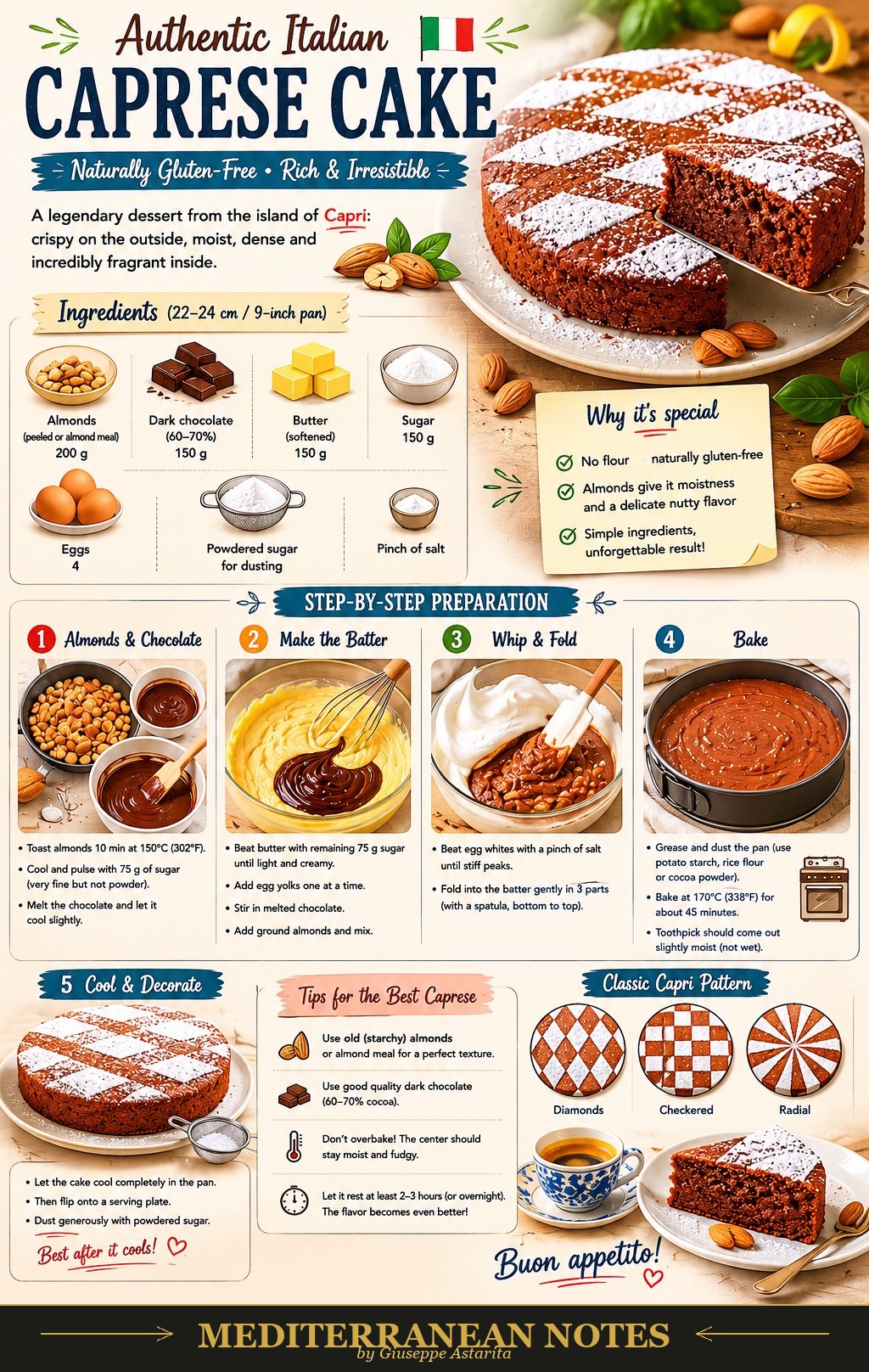
Ingredients · 22–24 cm pan · 8–10 slices
Method
Almonds and chocolate. If using whole almonds, toast them for 10 minutes in the oven at 150°C (300°F). Let them cool completely, then pulse in a food processor with 75 g of sugar until finely ground — very fine, but not a paste. Meanwhile, melt the chocolate gently in a bain-marie or microwave in short bursts. Let it cool slightly.
Old, slightly starchy almonds grind better and produce a finer texture than fresh, oily ones. Almond meal works perfectly well and skips this step entirely.
Make the batter. Beat the softened butter with the remaining 75 g of sugar until pale and creamy — about 3 minutes with an electric mixer. Add the egg yolks one at a time, beating well after each. Stir in the melted chocolate, then fold in the ground almonds. The batter will be dense and fragrant.
Whip and fold. In a clean, completely dry bowl, beat the egg whites with a pinch of salt until stiff peaks form — they should hold their shape when the whisk is lifted. Fold the whites into the chocolate-almond batter in three additions, working from the bottom up with a spatula. Do not stir; fold. Each addition should mostly disappear before you add the next. Stop when the batter is uniform — a few streaks of white are fine.
This is the step that determines whether the cake is light or heavy. Take your time with the folding. Overmixing deflates the whites; undermixing leaves pockets of uncooked foam.
Bake. Grease your pan and dust it with cocoa powder, rice flour, or potato starch — not regular flour. Pour in the batter and smooth the top. Bake at 170°C (340°F) for approximately 45 minutes. The edges should be set and pulling slightly from the sides; the center should feel firm but give just slightly when pressed. A toothpick should come out slightly moist — not wet, not clean. That slight moisture is correct.
Do not overbake. The torta caprese is meant to be dense and fudgy at the center. A completely clean toothpick means you have gone too far.
Cool and decorate. Let the cake cool completely in the pan — do not rush this. Then invert onto a serving plate. Dust generously with powdered sugar using a fine-mesh sieve. For the classic Capri pattern, lay a paper stencil (diamonds, a checkerboard, or radial lines) on the surface before dusting, then lift it away cleanly.
The flavor improves significantly after 2–3 hours of rest, and is even better the next morning. This is a cake that rewards patience, which is part of why it made such a good breakfast — it was always made the evening before.
The torta caprese keeps well — covered at room temperature, it is good for three days, and better on days two and three than on the day it is made. This was always one of its practical virtues for the Italian breakfast table: bake it one evening, eat it over several mornings, with coffee, without any further effort. It is a cake that fits around the life of a family rather than demanding special occasion.
My daughters know it as a dessert, because that is mostly when it appears in our house here in Massachusetts. But I want them to know it the way I knew it — as a morning thing, a smell before they are fully awake, something my mother made because it was my father's favorite and the tradition mattered. That is the part worth keeping.
Buon appetito — e buona colazione.