Crostata di fragole: bread, butter, jam — and the Italian tart that belongs everywhere
It sits behind the glass counter of every Italian bar alongside the cornetti. It appears at Sunday lunch, at birthday parties, in the school lunchbox as a crostatina. The crostata is not a complicated recipe — it is a constant, a thread that runs from the simplest breakfast to the most patient afternoon of baking.
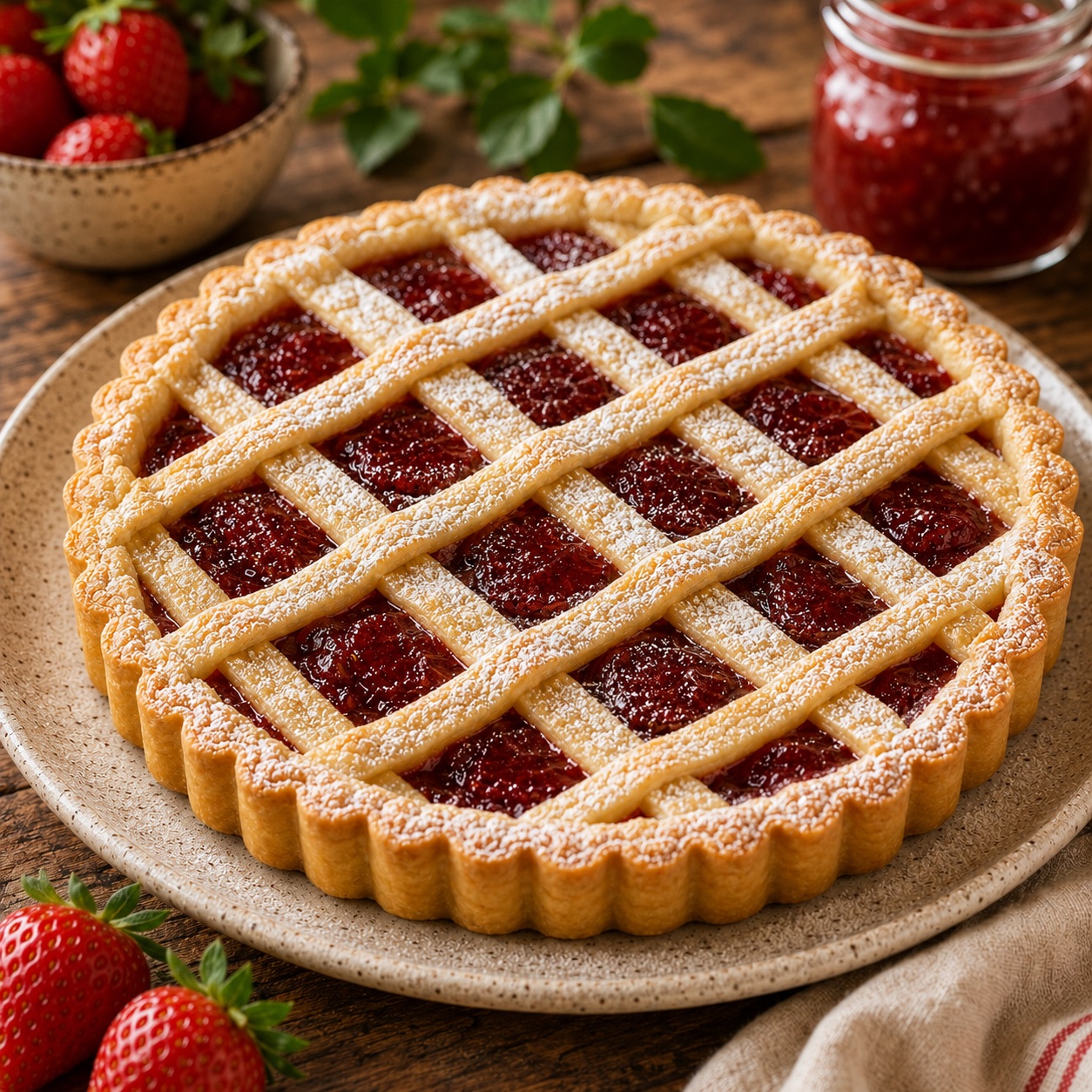
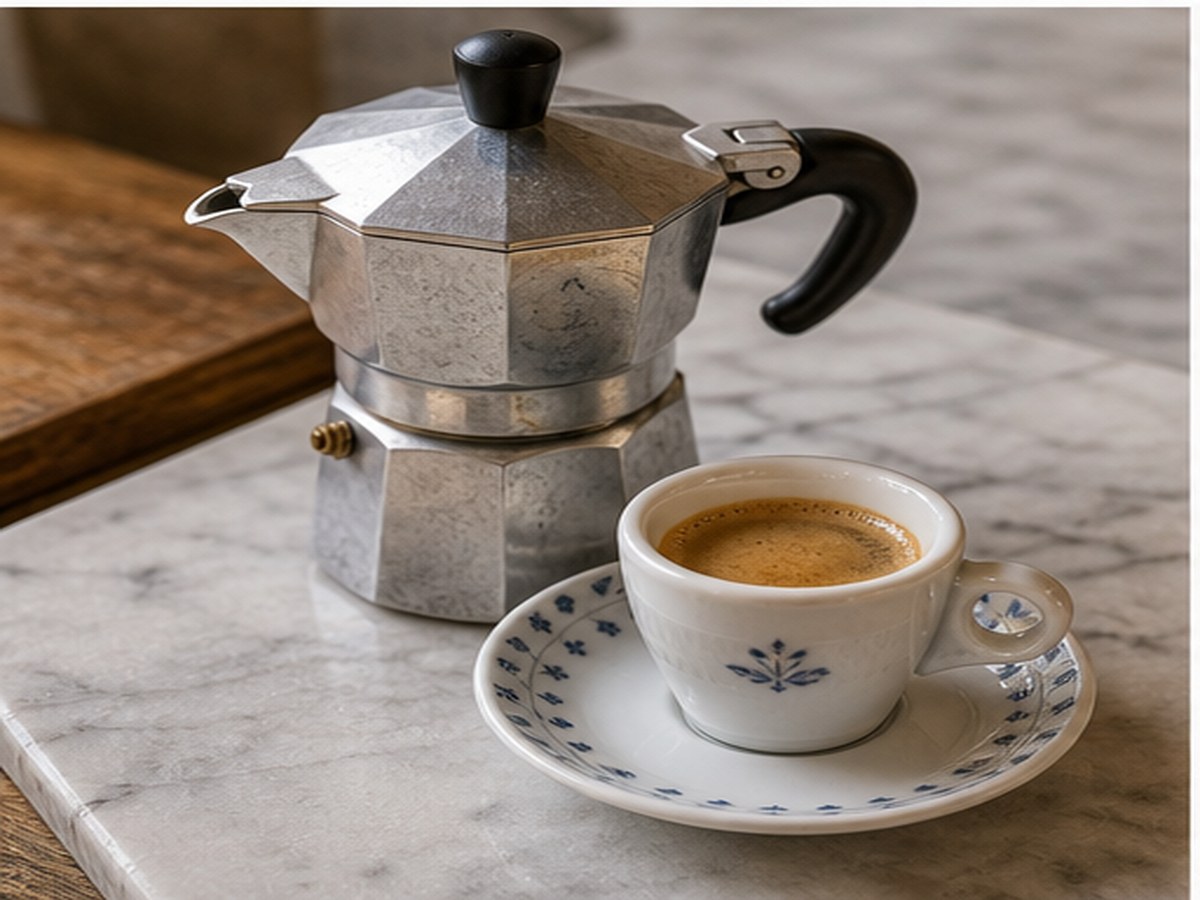
There is a particular quality to the Italian bar in the morning — the espresso machine running, the pastries behind the glass, the crostata sitting whole on a plate or already cut into wedges. It is sweet enough for breakfast and not so sweet that it demands to be called dessert. It occupies the space between the two that Italian food culture handles better than any other.
In Italy, the relationship with jam is uncomplicated and ancient. Fruit preserved in sugar has been part of the Italian pantry for centuries — in southern Italy particularly, where the summer abundance of fruit demanded preservation techniques that made the flavors of July available in December. The jam you spread on bread in the morning, the jam that fills the crostata at the bar, the jam in the crostatine that schoolchildren carry in their bags — these are all the same continuum, the same relationship between fruit, sugar, and dough that extends from the most elemental breakfast to the most careful pastry.
The crostata is the Italian grandmother's tart — it appears at Sunday lunch, at birthday parties, at the end of a weekday dinner when someone remembered there were strawberries. It does not require specialized equipment or pastry school technique. What it requires is cold butter, a willingness to get your hands into the flour, and patience enough to let the dough rest before you roll it. Or not even that — you can roll it immediately and it will still work.
The crust is a pasta frolla made by the sabbiatura method: rubbing cold butter into flour with your fingertips until the mixture resembles coarse sand. It is satisfying in a way that machine baking rarely is — you feel the butter break down, the texture change. My daughters are at an age where they can help with this step. Rubbing butter into flour is exactly the kind of task that feels like play. They do not overthink it, which is probably why their dough comes out well. The lesson, applied broadly: mix until it just holds together and then stop.
You can also make it small — crostatine, individual tartlets the size of a palm, filled with whatever jam is open in the pantry, perfect for a child's lunchbox or a gathering where people want something sweet without having to cut anything. The same dough, the same technique, a smaller pan. No jar survives a batch of crostatine.
Pasta frolla's sandy texture — fat coating flour before gluten can form
The sandy texture of pasta frolla — what Italians call friabilità — is the result of fat coating the flour particles before any water is added, physically preventing gluten strands from forming long networks. Cold butter is essential; warm fat melts into the flour rather than coating it, collapsing the structure. The crostata eaten as part of an Italian breakfast with coffee represents a food combination calibrated by habit that holds up well to scrutiny: the pasta frolla crust provides carbohydrate, fat (fat-soluble vitamins, satiety), and protein from the egg (choline). Strawberry jam contributes simple sugars — rapid energy appropriate for a morning meal after overnight glycogen depletion — along with residual anthocyanins and ellagic acid that survive the jam-making process. The coffee alongside provides caffeine (adenosine receptor antagonism, improved alertness and cognitive performance) and chlorogenic acids, one of the richest dietary sources of these phenolic antioxidants. Fresh strawberries arranged on top after baking contribute additional vitamin C, anthocyanins, and ellagic acid at concentrations meaningfully higher than those retained in the cooked jam beneath them — making the crostata di fragole a nutritionally more complete dessert than it appears on the surface.
The recipe — large tart and crostatine
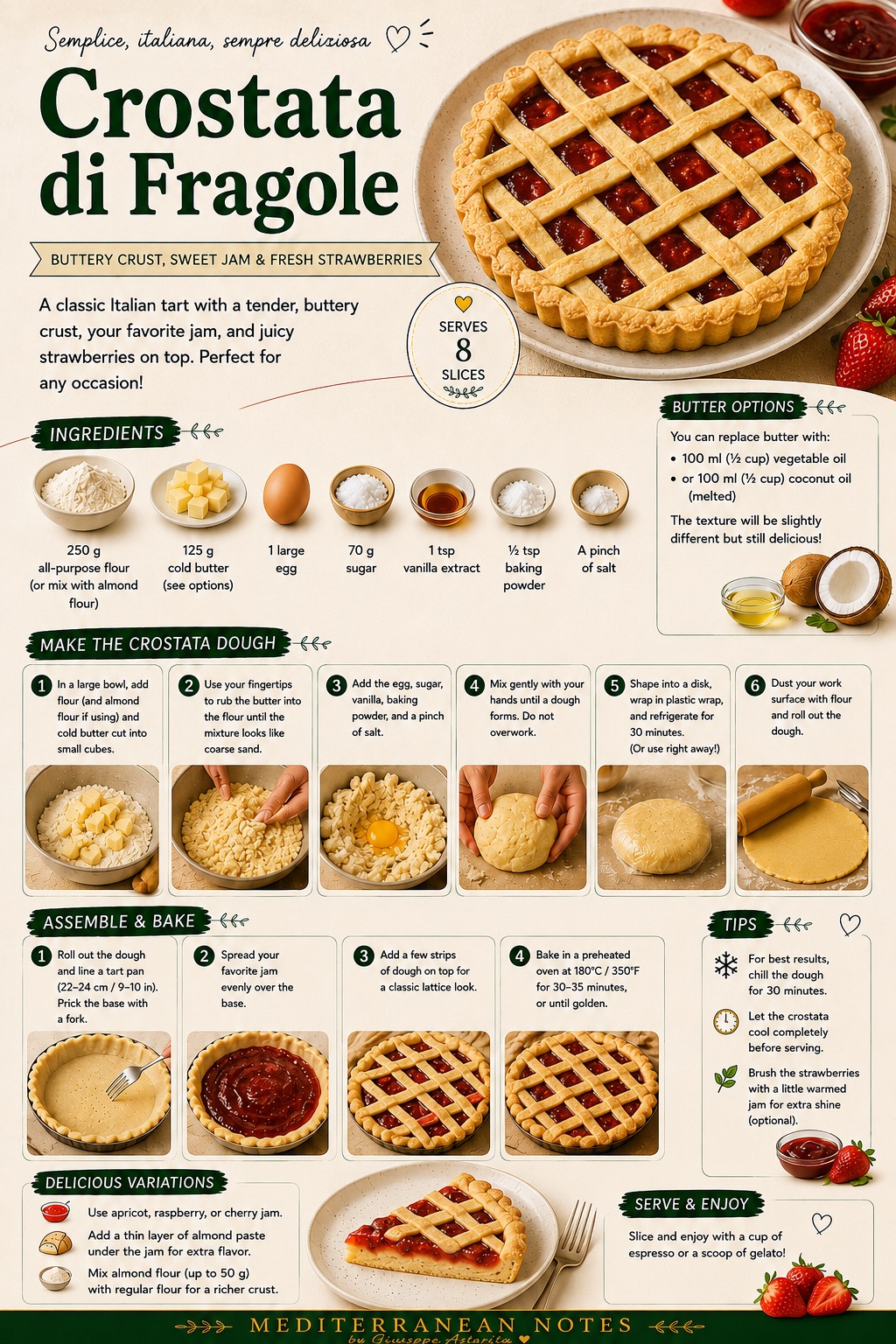
Ingredients · makes one 22–24 cm tart · serves 8 · or about 12 crostatine
Method — the pasta frolla
Sabbiatura. Combine the flour and cold butter cubes in a bowl. Work quickly with your fingertips — pinch, press, release — until no large pieces remain and the mixture looks like coarse, damp sand. About 2–3 minutes. Keep everything cold and work without hesitation.
Warm hands are the enemy of good shortcrust. If the kitchen is hot, chill the flour and butter in the freezer for 10 minutes first.
Add the wet ingredients. Add the egg, sugar, vanilla, baking powder, and salt. Mix gently with your hands until the dough just comes together. Press it a few times until cohesive. Do not overwork; stop the moment it holds together. It should feel soft and slightly tacky, not sticky.
Rest or proceed. Shape into a flat disc, wrap in plastic, and refrigerate for 30 minutes. Or proceed immediately with a generously floured surface. The rested dough is more forgiving and easier to roll; the immediate version works perfectly well with patience.
Roll and line. Dust the work surface and rolling pin. Roll to about 3–4 mm thick. Lift by rolling loosely around the pin, then unroll over the tart pan. Press gently into the sides, trim the edge, prick the base all over with a fork.
Fill. Spread the jam evenly over the base — generous, not too thick, leaving a small border. Optional: add a thin layer of almond paste beneath the jam for a richer result. For a lattice: roll the trimmings into strips and lay over the jam in a grid, pressing the ends into the rim.
Bake and cool. Preheat oven to 180°C (350°F). Bake 30–35 minutes until the crust is deep golden and the jam bubbles at the edges. Let cool completely in the pan before unmolding — a warm crostata crumbles. Arrange fresh strawberries on the cooled tart, brush with a little warmed jam for shine, and serve at room temperature.
For crostatine. Press or roll the dough into individual tartlet tins 8–10 cm wide. Fill with a spoonful of jam each. Bake at 180°C for 18–22 minutes. Cool completely before removing — the small tins are fragile when warm. Different jams in each one is both practical (uses up open jars) and the correct approach for a gathering.
Variations and substitutions
The jams — choose one, or one per crostatina
The crostata accepts any jam that is good enough to eat on bread. The quality of the jam is the quality of the tart.
Fragola — strawberry
The classic. Bright, sweet-sharp. Strawberry jam with fresh strawberries on top is the version most associated with the crostata as a pastry-shop dessert. Also the one my children always choose.
Albicocca — apricot
The great pairing for the plain crostata without fresh fruit. Apricot's balance of sweetness and acidity complements the butter crust perfectly. The traditional bar choice for the classic lattice version.
Ciliegia — cherry
Deep, slightly tart, complex. Less sweet than strawberry, more assertive than apricot. Works especially well with the almond flour crust, which amplifies the natural nuttiness.
Fico — fig
Sweet and rich, grainy with seeds. A southern Italian choice — fig trees grow everywhere in Campania and the jam is a classic homemade preserve. Unusual in a bar crostata but excellent at home.
Lampone — raspberry
The sharpest and most aromatic. More tart than sweet — it cuts through the richness of the butter crust with particular elegance. Good for those who find apricot a little too gentle.
Whatever is open
The honest answer. The crostatina was always partly a way to use the last of a jar. One spoonful of fig, one of apricot, one of strawberry — each tartlet filled with whatever the pantry offered.
The crostata is a patient recipe — patient to make, patient in its character. It connects the child eating bread with butter and jam in the morning to the adult who makes a tart on a weekend afternoon and takes it to a friend's house or cuts a slice for breakfast with a coffee. The thread is the same: flour, butter, fruit, sugar. Very old, very simple, very Italian.
I still find peanut butter mildly startling at breakfast, twenty-two years later. I have made peace with it. But it is not what I reach for.
Buon appetito — e buona colazione.