Campanian kitchen · Fish · Oven · Special occasion · No added fat
Spigola in crosta di sale
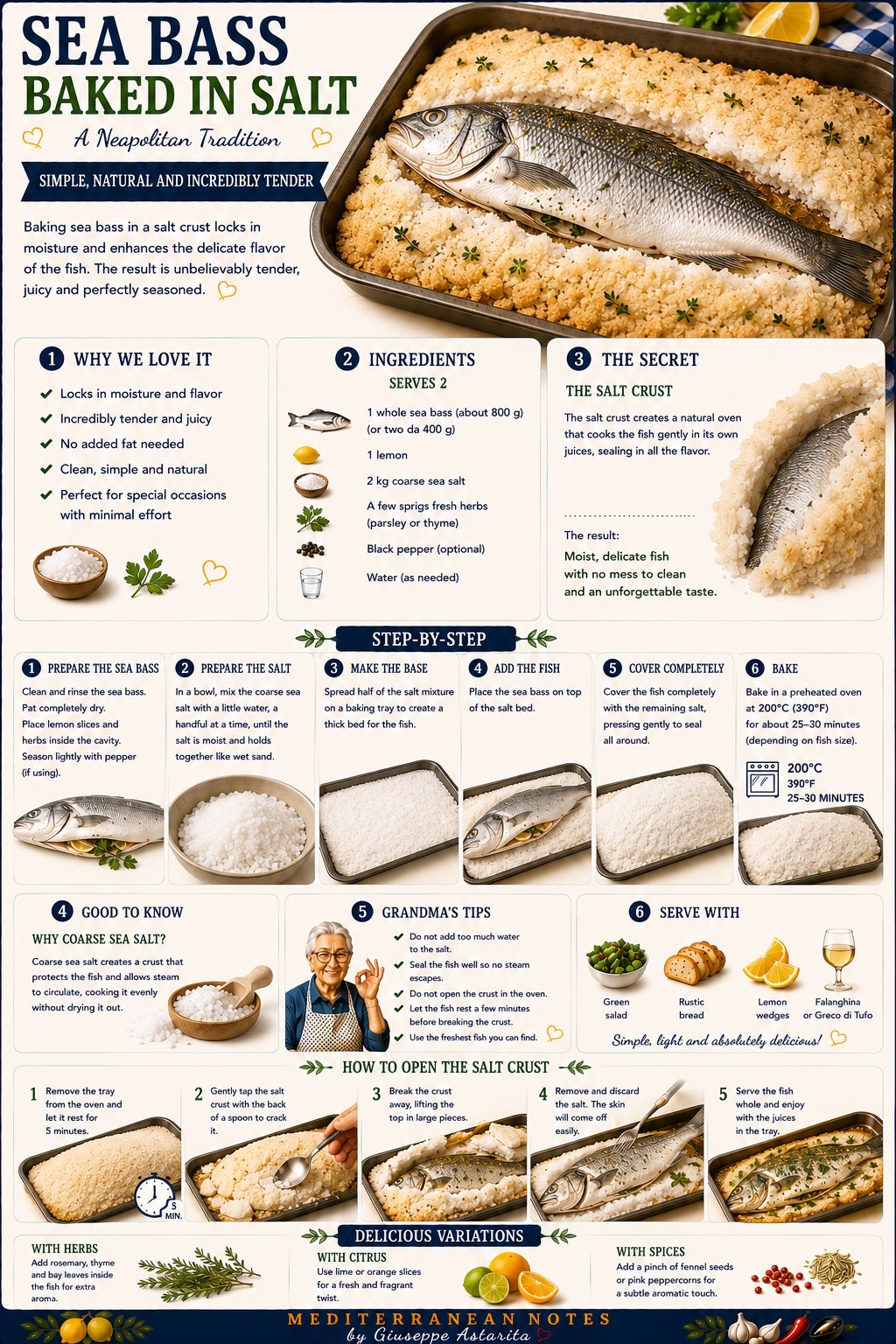
The fish buried in coarse sea salt and baked. The salt sets into a hard crust that seals every drop of moisture inside. No oil needed during cooking — the fish steams in its own juices. When the crust breaks at the table, what comes out is the most tender, moist spigola the oven can produce.
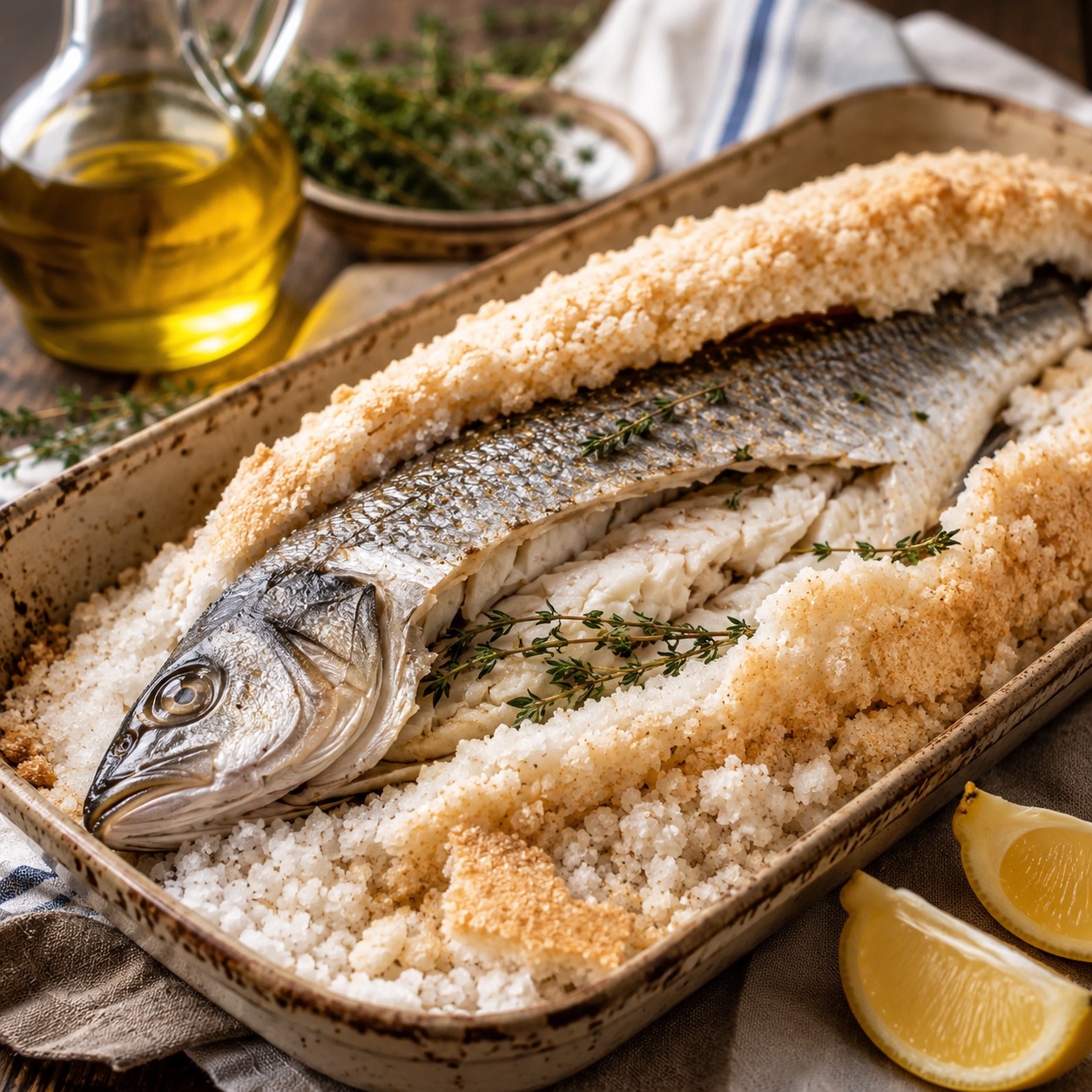
This preparation looks more complicated than it is. The ingredient list is almost nothing — fish, salt, water, a few herbs for the cavity. The technique is just packing. The result is the most purely flavored of all the spigola preparations: no olive oil in the pan releasing its character, no tomatoes contributing acidity, no wine. Just the fish in a sealed salt environment, cooking in its own moisture at oven temperature, the flesh emerging white and impossibly tender, tasting only of itself.
The salt does not make the fish salty. This surprises people every time. The coarse salt crust works as insulation and a vapor trap — it does not penetrate the skin in the way that dissolving salt in water would. The skin acts as a barrier; the salt sets hard around it; the steam from the fish's own moisture circulates inside the crust rather than escaping into the oven. The result is something closer to steaming than baking, but producing a different texture from both — firmer than a steamed fish, more delicate than a roasted one.
The critical variable is the salt mixture. Pure dry coarse salt will not adhere around the fish properly — it needs a small amount of water added until it holds together like slightly damp sand. Too much water and the mixture becomes a paste that shrinks as it dries; too little and it crumbles rather than sealing. The test: take a handful and squeeze it — it should hold its shape when you release your hand.
Why the salt crust does not make the fish salty — osmosis, vapor pressure, and the skin barrier
Coarse sea salt encasing a whole fish with its skin intact creates a different chemical situation from dissolving salt in water for a brine. For salt to enter fish tissue and raise its sodium content, it must first dissolve in water and then diffuse across a membrane — a process driven by the concentration gradient between the salt solution and the intracellular fluid. In the salt crust preparation, the salt is packed dry around intact skin; the skin's lipid bilayer and protein matrix act as an effective barrier to ion diffusion during the short baking time (25–30 minutes). Some surface seasoning occurs at the skin itself, but this does not penetrate to the flesh in any meaningful way. What the salt crust does is create a vapor-tight enclosure: as oven heat raises the temperature of the fish, the water in its muscle tissue evaporates to steam and builds pressure inside the sealed crust. The steam circulates, cooking the fish evenly from all sides simultaneously — explaining why salt-crusted fish cooks more evenly than open-roasted fish. The relatively low internal temperature (the fish never exceeds 65–70°C at its center) preserves the delicate texture of the proteins and produces the characteristic softness of this preparation.
Recipe — serves 2
Ingredients
Method
Prepare the fish. Rinse and pat dry. Check the skin is intact all the way around — any tears will let steam escape and salt enter. Place lemon slices, herbs, and a pinch of pepper inside the cavity. Do not score the skin.
Do not score the skin here — unlike the roasted and grilled preparations, intact skin is essential. It is the barrier between the salt and the flesh.
Make the salt mixture. Pour the coarse salt into a large bowl. Add cold water a tablespoon at a time, mixing with your hands after each addition. Stop when the salt holds together when squeezed — like damp sand or a sandcastle mixture. Do not over-wet it.
Build the salt bed. On a parchment-lined baking tray, spread a layer of the salt mixture approximately 1 cm thick, shaped roughly to the outline of the fish. Place the fish on top.
Encase completely. Pack the remaining salt mixture over and around the fish, pressing firmly to seal all surfaces. The layer should be at least 1 cm thick all around — thicker at the sides. No part of the fish should be visible. Press down firmly on all sides to close any gaps.
Check the tail and the underside carefully — these are the areas most likely to have thin coverage. Press extra salt mixture there.
Bake at 200°C for 25–30 minutes. The crust will turn golden and firm as it bakes. Do not open the oven. Remove and rest for 5 minutes.
Break the crust at the table. Bring the tray to the table. Tap the crust firmly with the back of a spoon to crack it, then lift away the top section in large pieces. Remove any salt from the skin surface. The skin will lift away cleanly — pull it back to reveal the flesh. Serve with lemon wedges and a drizzle of good raw olive oil. No pan juices — the olive oil is the only finish this preparation needs.
The salt lifts away with the skin. The flesh beneath will be pure white and extremely moist. Eat it immediately — it cools quickly once the crust is open.
The crosta di sale is the preparation that looks the most dramatic and requires the least skill. The assembly is just packing salt. The oven does everything. The theatre is breaking the crust at the table, which takes confidence — a firm tap with a spoon, then lifting away the top section — and produces a moment of visible steam and a smell that justifies itself completely. My mother made it for guests partly because it impressed them and partly because she could assemble it twenty minutes before they arrived and forget it until it was time to break it open.
Sotto il sale, il pesce aspetta — e vale l'attesa.