Campanian kitchen · Fish · Grill · Summer · Fast
Spigola alla griglia
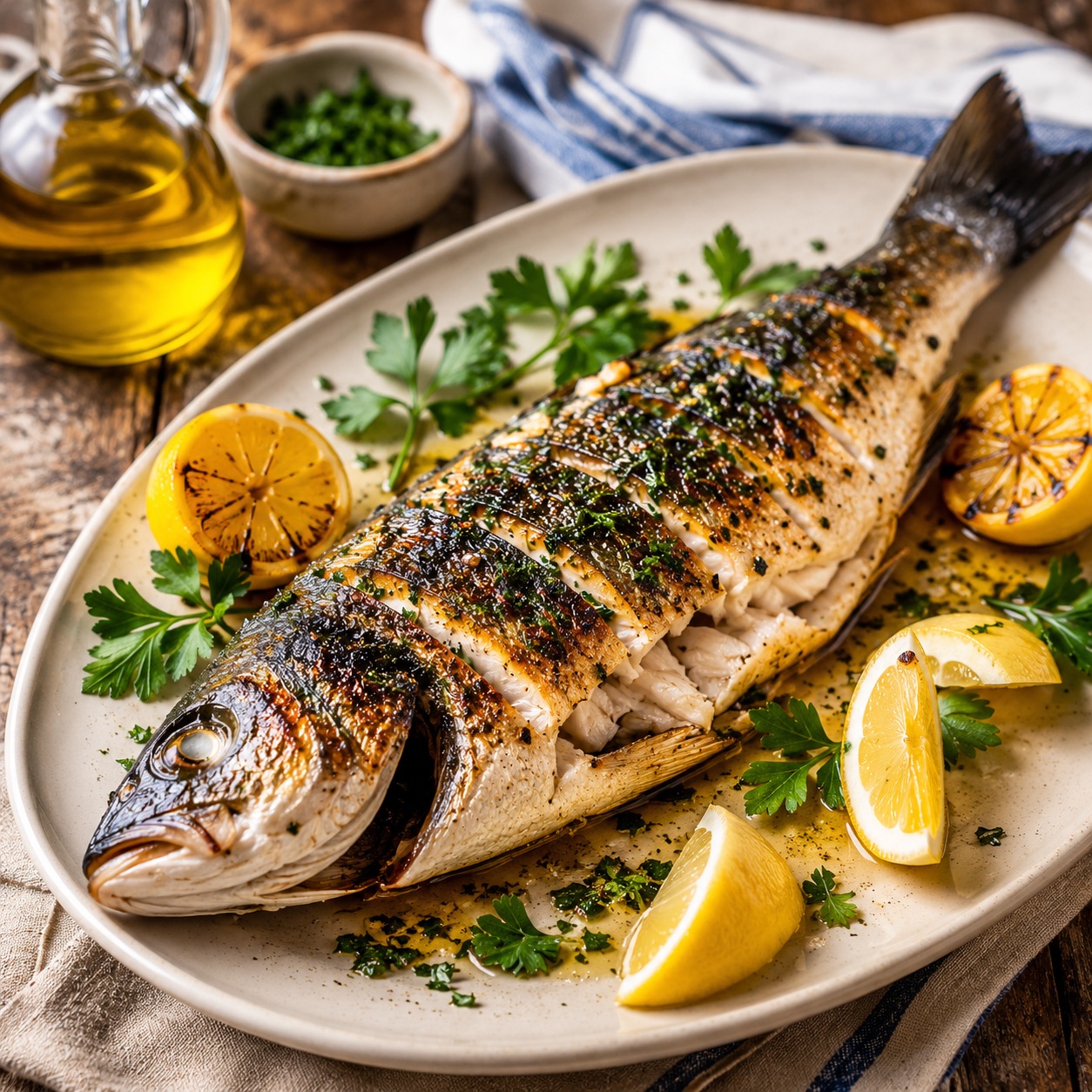
The most direct preparation — the fish on a very hot grill, nothing between the skin and the flame. The direct heat produces a crust that no oven method can replicate: the grill marks, the slight char on the scored skin, the Maillard reaction happening at the surface in minutes rather than the gentler browning of an enclosed oven. Lemon at the table. No more than that.
My mother grilled the spigola in summer, when the fish was at its best and the kitchen was already too warm for the oven. The grill was outside when the weather permitted, inside on the stovetop grill pan when it did not. Either way the principle was the same: very high heat, a dry fish, oiled grates, and the discipline not to move the fish until the skin released naturally from the grill. A fish that sticks is a fish that is not ready to be turned. If you have to force it, wait another minute.
The scored skin is essential here in a way it is not for the oven preparations. On a grill, the skin contracts as it heats — without scoring, it buckles and pulls the fish away from the grate unevenly, and the flesh beneath cooks at different rates. The diagonal cuts through the skin every 3–4 cm allow the skin to lie flat against the grate, ensure even contact, and let the heat penetrate more quickly to the thickest part of the fish. They also produce the visual finish of a properly grilled fish: the cross-marked skin with its alternating char, distinctive enough that my mother brought it to the table without any further garnish other than a lemon half squeezed over the top.
The whole fish is better than fillets on a grill. The skin protects the flesh from the direct heat during the cooking time, keeps the fish moist, and adds its own flavor through the browning reaction on the outer surface. A fillet on a grill loses its moisture rapidly and overcooks at the edges before the center is done. The whole fish has the bone and the skin doing the work of insulation, giving you a wider window to work in.
Why grill produces a different crust from oven — radiant heat and the Maillard reaction at 300°C+
A grill surface reaches temperatures of 250–350°C — significantly higher than a conventional oven at 200°C. At these temperatures, the Maillard reaction (the series of reactions between amino acids and reducing sugars that produces browning and toasted aromatic compounds) proceeds much faster and produces a more extensive and deeply flavored crust. Additionally, grill cooking exposes the fish surface to direct radiant heat from below and convection from the hot air above simultaneously, while the grate conducts heat directly at the contact points — the grill marks. The result is a surface with three simultaneous cooking mechanisms producing a crust complexity that oven roasting at lower temperatures cannot replicate. The smoke from the fat rendering off the fish and dripping onto the heat source contributes additional aromatic compounds — polycyclic compounds from incomplete combustion and pyrolysis products — that give grilled fish its characteristic smoky character. Scoring the skin accelerates this process by creating channels for fat rendering and allowing direct heat contact with the subcutaneous layer beneath the skin, which contains the highest concentration of fatty acids and produces the most flavor when it reaches high temperature.
Recipe — serves 2
Ingredients
Method
Heat the grill to high. Whether gas, charcoal, or stovetop cast iron — the grate must be very hot and clean before the fish goes on. Brush the grates lightly with oil just before cooking.
Prepare the fish. Rinse and pat completely dry inside and out. Make 2–3 shallow diagonal cuts through the skin on each side, 3–4 cm apart. Season generously inside and out with salt and pepper. Place garlic and parsley in the cavity. Brush the outside of the fish all over with olive oil.
Grill the first side — do not move it. Place the fish on the hot grate at a 45-degree angle to the bars. Leave it entirely undisturbed for 4–5 minutes. The skin will char slightly at the grate contact points and eventually release from the grate naturally when it is ready. If it resists, wait another minute.
The fish tells you when to turn it. If it holds on, it is not ready. A fish that is forced off the grate will tear. Patience here costs nothing.
Turn carefully and grill the second side. Use a wide spatula and a fork to support the fish as you turn it. Cook the second side for 4–5 minutes. Test for doneness: insert a knife tip near the backbone — the flesh should be white and opaque throughout, flaking easily.
Rest briefly and serve immediately. Transfer to a warm plate. Squeeze lemon generously over the top. Scatter a little fresh parsley. A drizzle of raw olive oil if you like. Eat while hot — grilled fish waits for no one.
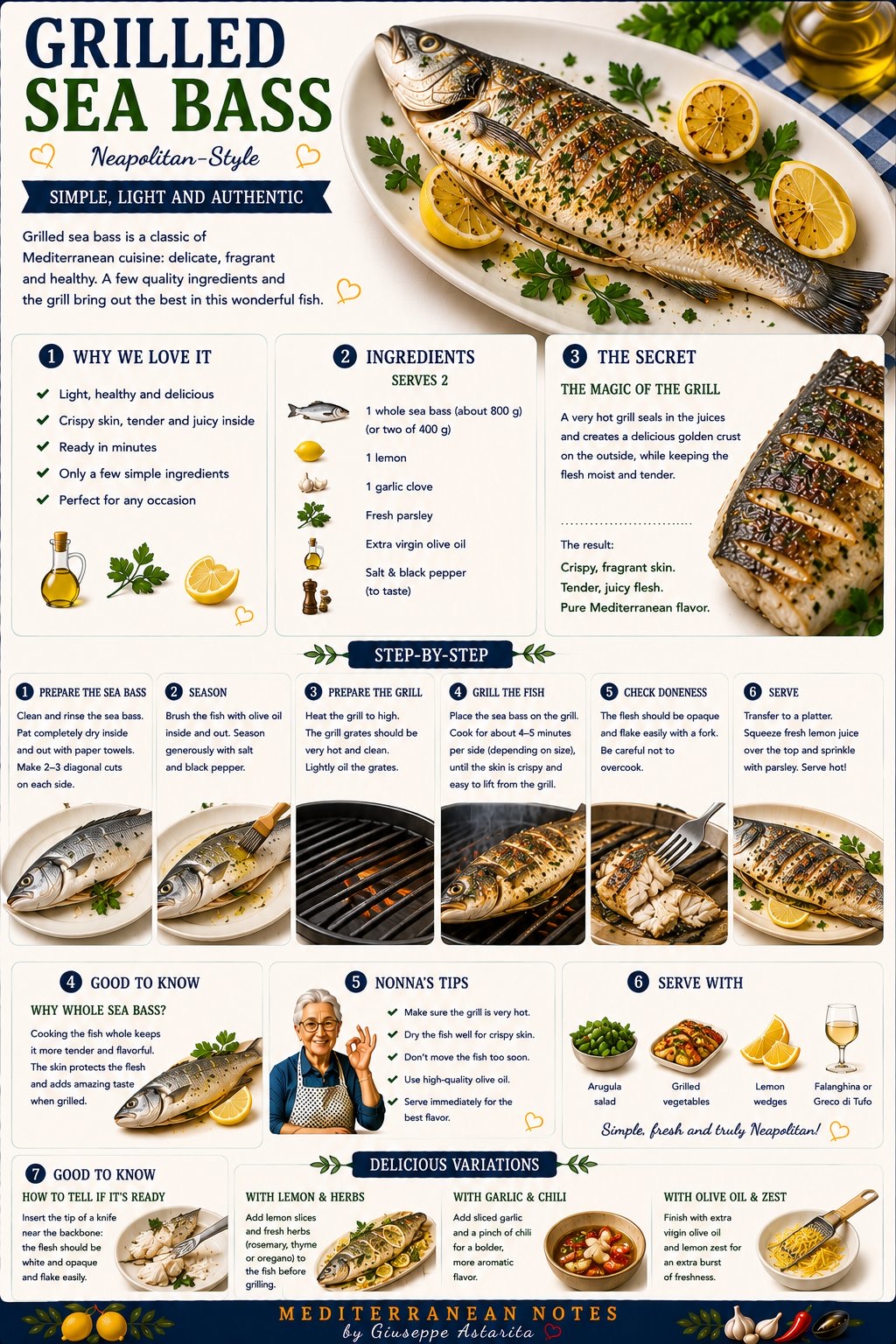
The grilled spigola is the summer fish. A hot evening, the grill outside, the smell of the fish on the grate arriving before anyone sits down. My mother served it directly from the grill to the plate without ceremony — the scored skin showing the grill marks, lemon half on the side, parsley over the top. The bones at the table, worked through with a fork and knife, the flesh coming cleanly away from the central spine. A glass of cold Falanghina. The most immediate of the six preparations, and on the right evening, the best.
Dalla griglia al piatto — subito, con il limone.