Spaghetti alle vongole: the taste of the Mediterranean sea
Telline collected by hand from the sand on the beach. Lupini, the smaller and less expensive version, for ordinary days. Vongole veraci — the real ones — for the Vigilia di Natale and the last night of the year and the long summer lunches by the sea. Always in bianco, no tomato, so the flavor of the clams stays pure and the sea comes through in every bite.
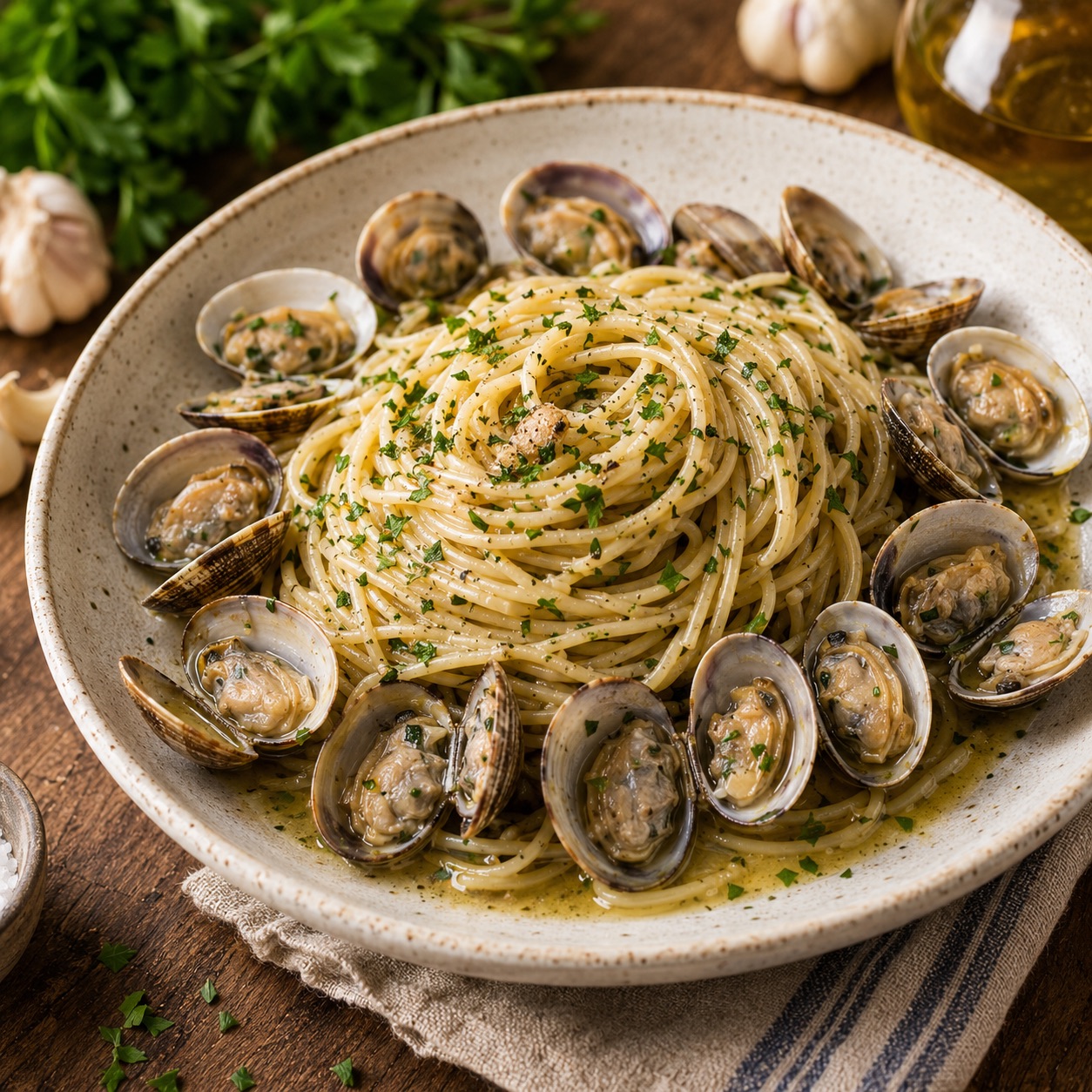
The spaghetti alle vongole is the undisputed symbol of Neapolitan seafood cooking. It appears on every Christmas Eve table across Campania — the Vigilia requires fish and seafood, and the vongole are almost always part of it. It appears at every New Year's Eve dinner. It appears in summer, at tables near the sea, eaten with a glass of cold Falanghina and the sound of the water nearby. My father ate puttanesca instead, as he did on any night the table organized around fish — the puttanesca was his reliable alternative, while the vongole were eaten by my mother and whoever else was at the table. The children opened the shells and ate the clams directly with their fingers, which is its own pleasure and the correct way to learn what a clam actually tastes like before the pasta teaches you to love the combination.
The version with tomato exists and has defenders — the in rosso version adds a small amount of tomato to the clam liquid before tossing with the pasta. It is good. But the Neapolitan original is in bianco — white, no tomato — and the reason is flavor logic: the clam liquid, filtered of its sand and reduced slightly in the pan, has a concentrated marine flavor that carries the whole dish. Tomato adds sweetness and acidity that compete with this flavor rather than supporting it. The in bianco version lets the sea speak without interruption. We used not to add tomato at all, so the flavor of the clams remained intact and predominant while eating it.
The hierarchy of Campanian clams deserves a brief note. The vongole veraci (true clams, Ruditapes decussatus) are the finest and most prized — larger, with a distinct ridged shell pattern, sweet and full-flavored, the classic for restaurant preparations. The lupini (Dosinia lupinus, or sometimes Chamelea gallina) are smaller, less expensive, widely available, and excellent in their own right — the everyday version of the same preparation, with a slightly more intense, minerally flavor per gram because of their smaller size. The telline (Donax trunculus, wedge clams) are the smallest — gathered from sandy beaches by hand, barely the size of a thumbnail, with an intensely concentrated seafood flavor that is different in character from both the vongole and the lupini. A pasta made with telline gathered from the actual beach you are standing on is a specific experience that no commercial version replicates.
Clams, complete protein, iron, B12, and the nutritional density of bivalves
Clams are one of the most nutritionally dense seafood options available in the Italian kitchen. A single 100 g serving of clam meat provides approximately 14–16 g of complete protein with an exceptionally favorable amino acid profile, including all essential amino acids. Clams are the richest known dietary source of vitamin B12 — a single serving provides 1000–2000% of the adult daily requirement, a concentration that far exceeds any other commonly consumed food including beef liver. B12 is found almost exclusively in animal products and is the primary nutrient concern for vegetarian and vegan diets; clams provide it at concentrations that would require years of supplementation to match from a single weekly serving. Clams also provide iron at very high concentration (approximately 14–28 mg per 100 g of cooked clam meat — significantly higher than red meat), in the heme iron form that is absorbed at 15–35% efficiency compared to 2–10% for non-heme plant iron. They provide zinc, selenium, and long-chain omega-3 fatty acids (EPA and DHA) at nutritionally meaningful concentrations. The clam cooking liquid — the liquid released when clams open in the pan — contains all of these water-soluble nutrients plus dissolved amino acids and organic acids that contribute to the characteristic marine flavor. This liquid is not discarded in the vongole preparation: it is filtered, retained, and used as the primary cooking medium for finishing the pasta (the risottatura step), meaning all its nutritional content is incorporated into the dish. The purging step — soaking in cold salted water for 2 hours — causes the clams to expel sand from their digestive systems by their normal filtration mechanism; it does not remove nutritional content. The in bianco preparation preserves the volatile marine aromatics (dimethyl sulfide, trimethylamine, fatty acid-derived aldehydes) that constitute the characteristic "sea" smell more completely than the tomato version, where the acidity and heat from the tomato partially degrade these compounds. This is the chemical basis for the traditional preference for the white preparation.
The three Campanian clams
Vongole veraci
The finest. Ruditapes decussatus — ridged shell, distinctly cross-hatched pattern. Sweet, full, the classic for restaurant preparations and for the Vigilia table. The one everyone means when they say vongole. Larger, more expensive, worth it.
Lupini
Smaller, less expensive, slightly more intense in flavor per gram. The everyday version — excellent for family meals when vongole veraci would be wasteful. The version we used most often for ordinary dinners. Do not dismiss them.
Telline
The smallest — gathered from sandy beaches by hand. Thumbnail-sized, with an intensely concentrated flavor. A pasta made with telline from the actual beach you collected them from is a specific experience. The memory of the exact place is in the taste.
The recipe — in bianco, the Neapolitan way
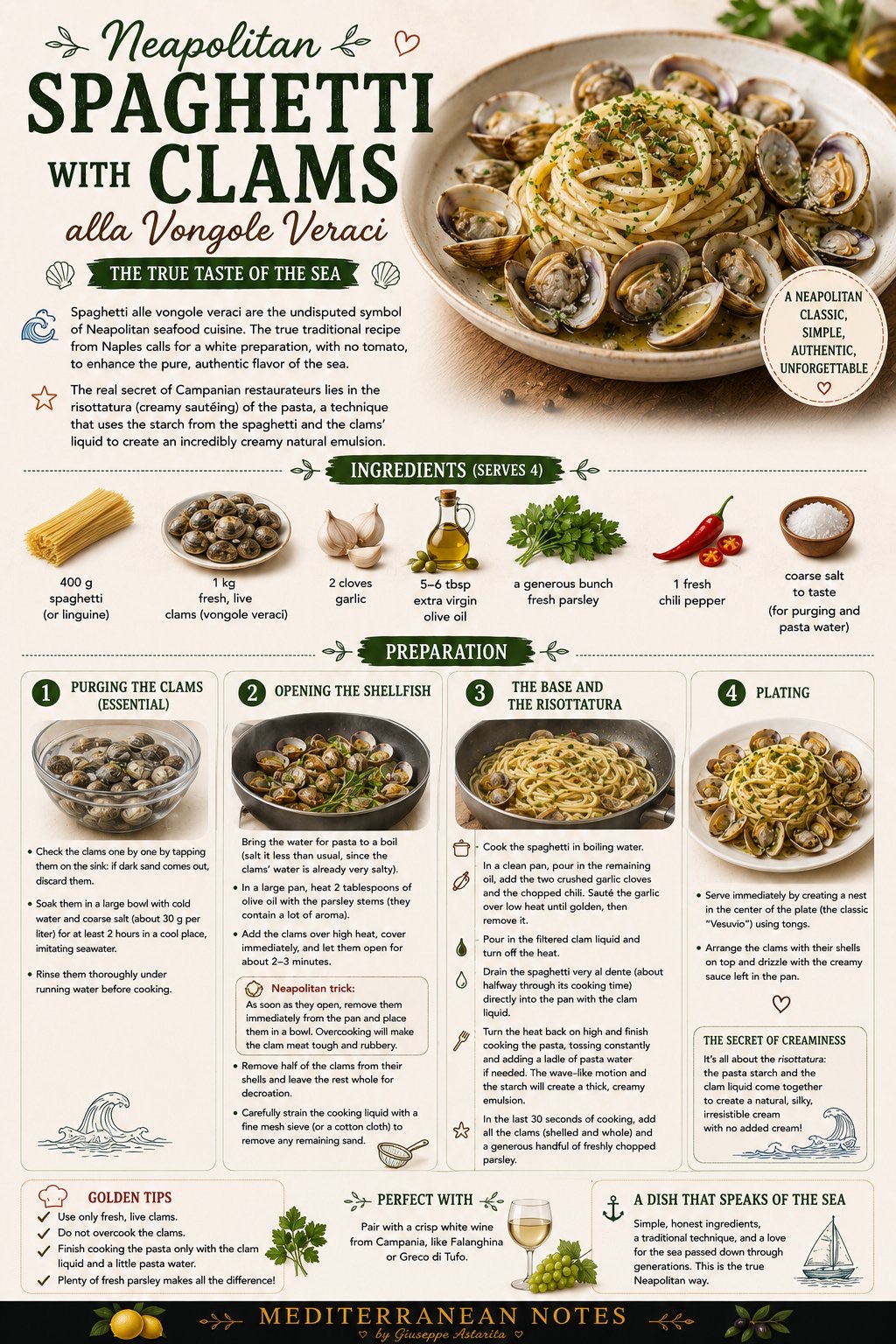
Ingredients · serves 4
Method
Purge the clams — start 2 hours before. Check each clam by tapping it on the sink — if it doesn't close, discard it. Soak the clams in a large bowl of cold water with coarse salt (30 g per litre, imitating seawater) for at least 2 hours in a cool place. They will expel any sand. Rinse thoroughly under running water before cooking.
This step cannot be rushed. Sand in the pasta is the failure condition. Two hours minimum; overnight in the refrigerator is better.
Open the clams — high heat, fast. In a large pan, heat 2 tablespoons of olive oil. Add the parsley stems. Add the clams over high heat, cover immediately, and shake the pan. They will open in 2–3 minutes. As soon as they open, remove them immediately — overcooked clams become tough and rubbery. Remove half from their shells and leave the rest whole for decoration. Strain the cooking liquid through a fine-mesh sieve lined with a cloth to remove any remaining sand. Reserve this liquid — it is the soul of the dish.
Build the base. In a clean wide pan, heat the remaining olive oil over low heat. Add the crushed garlic and chili. Sauté gently until golden, then remove the garlic. Pour in the filtered clam liquid and turn off the heat.
The risottatura — the secret of creaminess. Cook the spaghetti in lightly salted water (the clam liquid is already very salty) until about halfway through its cooking time. Drain and add directly to the pan with the clam liquid. Turn the heat to high and finish cooking the pasta in the clam liquid, tossing constantly and adding a ladle of pasta water if needed. The wave-like tossing motion creates the emulsion between the pasta starch and the clam liquid — the natural creaminess of the dish, with no cream added. In the last 30 seconds, add all the clams (shelled and whole) and a generous handful of chopped fresh parsley.
The pasta absorbs the clam liquid as it finishes cooking. This is the same principle as the orecchiette con cime di rapa and the pasta e cavolfiore — cooking in the flavored liquid rather than neutral water. The pasta tastes of the sea because it cooked in it.
Plate and serve. Create a nest in the centre of the plate with tongs — the classic Vesuvio presentation. Arrange the whole clams with their shells on top. Drizzle with the creamy sauce remaining in the pan. A final scattering of fresh parsley. Serve immediately. No Parmigiano — ever. No bread to dip — the sauce is for the pasta. Eat while hot, with a glass of Falanghina or Greco di Tufo.
On Christmas Eve, the vongole were always there. My father ate his puttanesca. My mother and I ate the vongole, and the children opened the shells one by one and ate the clams with their fingers before the pasta was even ready. The clam liquid was filtered and reserved and went into the pan, and the pasta absorbed it, and what came out tasted of the sea — the Mediterranean, the specific sea of Campania, the sea we had grown up near and that was part of everything we ate when fish was on the table.
The telline gathered from the beach by hand — pressing your fingers into the wet sand just at the waterline, feeling the small hard shells, collecting them in a bucket — produced a pasta that tasted of the exact beach they came from. No restaurant version tastes quite like that. The flavor of a place is in the food that comes from it, and the vongole alle has always been, more than almost anything else in this collection, the taste of a specific sea.
Buon appetito — e buon mare.