Spaghetti con Scampi e Gamberi
Alla Napoletana — A True Taste of the Naples Tradition
One of my mother's favorites — together with pasta e vongole. A rich, fragrant, creamy seafood pasta: the secret is extracting every drop of flavor from the shells to create a sauce, enhanced by sweet tomatoes, garlic, chili, and olive oil. My father ate spaghetti puttanesca while the rest of us had this. Two completely different pasta dishes at the same table.
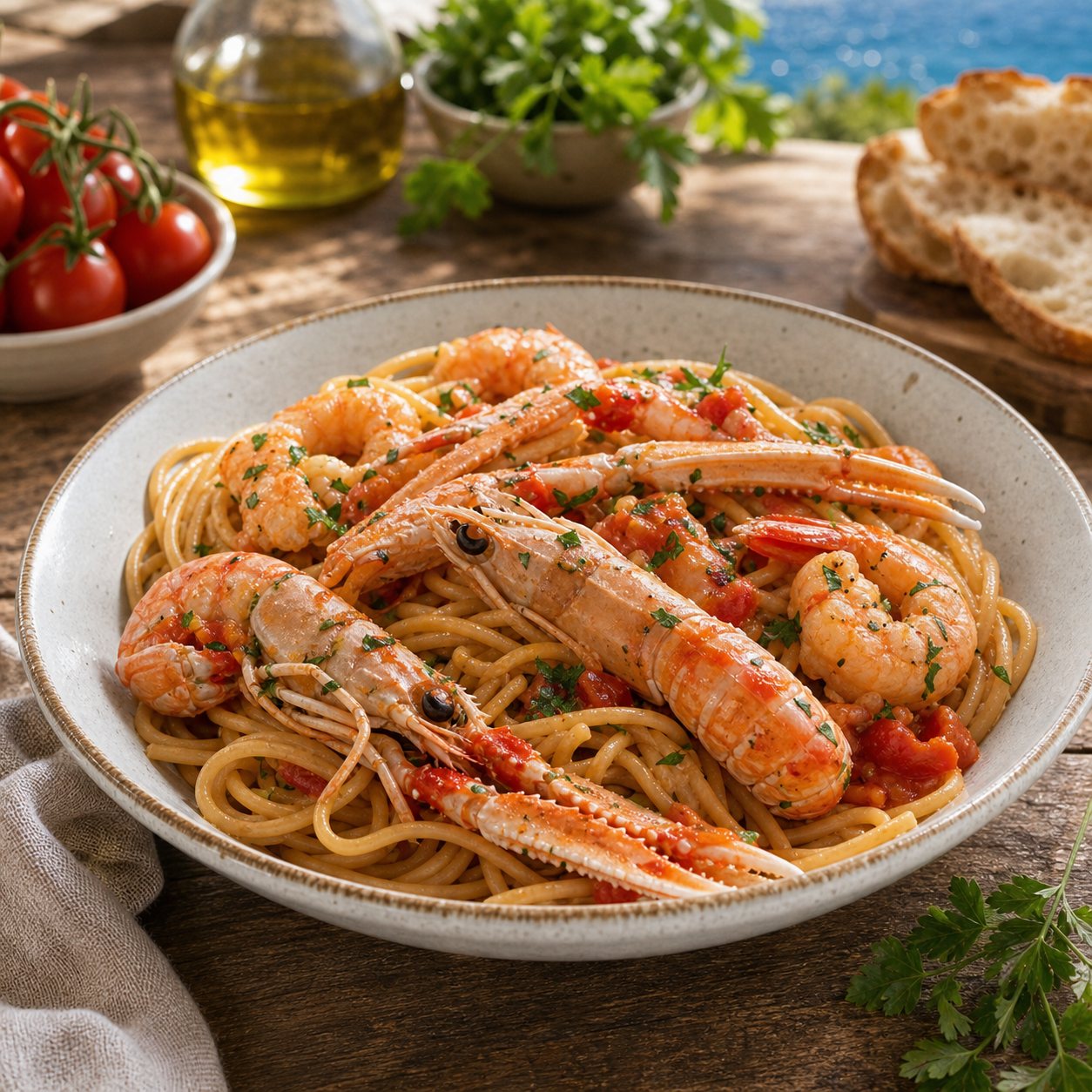
Two pots of pasta on the stove at the same time — the scampi and gamberi for my mother and the rest of us, and the puttanesca for my father. This is the most concise portrait of our family kitchen available in a single sentence. The puttanesca is intensely savory with its olives, capers, and anchovies — the anchovies being one of the few fish preparations my father actually ate, in sauce form where the fish dissolves into the background. The scampi pasta is the Neapolitan sea itself: sweet shellfish, their shells crushed to extract every drop of flavor into a stock, tomatoes barely cooked, olive oil generous, parsley bright at the end. My mother chose this when she could choose. It appeared at home when it was a special occasion, or at a restaurant when going out was one of those rare events that gave her the food she wanted. It is here now as her dish, alongside the grilled branzino, the pasta e vongole — the fish and seafood that the Campanian sea offered and that her table, shaped by my father's preferences, offered less often than she might have wished.
The technique of this pasta is built on a single insight: the shells and heads of scampi and prawns contain more concentrated flavor than the flesh itself. The sweet, iodine-rich liquid inside the heads, the aromatic fat under the shell, the minerals of the carapace — all of this is wasted if you discard the shells before cooking. The correct method extracts this flavor first: the heads and shells go into a hot pan with oil, garlic, and chili, are crushed with a wooden spoon to release their interior liquid, deglazed with white wine, and strained into a concentrated shellfish stock. This stock becomes the base of the sauce that the pasta finishes in. Every drop of flavor from every part of the animal — this is the logic of Neapolitan seafood cooking, which has always understood that the shell is not packaging to be discarded but an ingredient to be used.
The stock from the shells is the soul of the sauce. Without it you have pasta with shrimp. With it you have pasta that tastes of the sea — a specific, concentrated, irreplaceable flavor that no amount of additional seasoning can substitute. Do not skip the step of crushing the shells and heads. It takes five minutes and it is the difference between a good pasta and the version that makes my mother choose this over everything else on the menu.
Why the shells and heads — the chemistry of shellfish flavor
The heads and shells of scampi and prawns contain several classes of flavor compounds that the flesh alone does not. The hepatopancreas (the organ inside the head, the soft paste that runs out when you crush it) contains high concentrations of free amino acids — particularly glycine, alanine, and glutamic acid — that contribute sweetness and umami respectively. The shells contain chitin (which contributes no flavor but contributes body to the stock), melanoidins formed during sautéing (Maillard compounds from the amino acids and sugars in the shell surface), and carotenoid pigments (primarily astaxanthin) that contribute color and carry fat-soluble aromatic compounds.
When the heads and shells are crushed in hot oil and deglazed with white wine, two things happen simultaneously: the fat-soluble compounds dissolve into the olive oil, and the water-soluble compounds (amino acids, mineral salts) dissolve into the wine and its water content. The resulting liquid, strained, contains both fat-soluble and water-soluble flavor compounds — a more complete extraction than either oil or water alone would achieve. This is why the technique of crushing-and-deglazing produces a stock that tastes more complete than simply simmering the shells in water. The pasta water added at the final toss — starchy from the cooking pasta — emulsifies this stock with the olive oil into the silky, coating sauce that distinguishes a properly made seafood pasta from one where the sauce sits separately from the pasta.
The recipe — serves 4
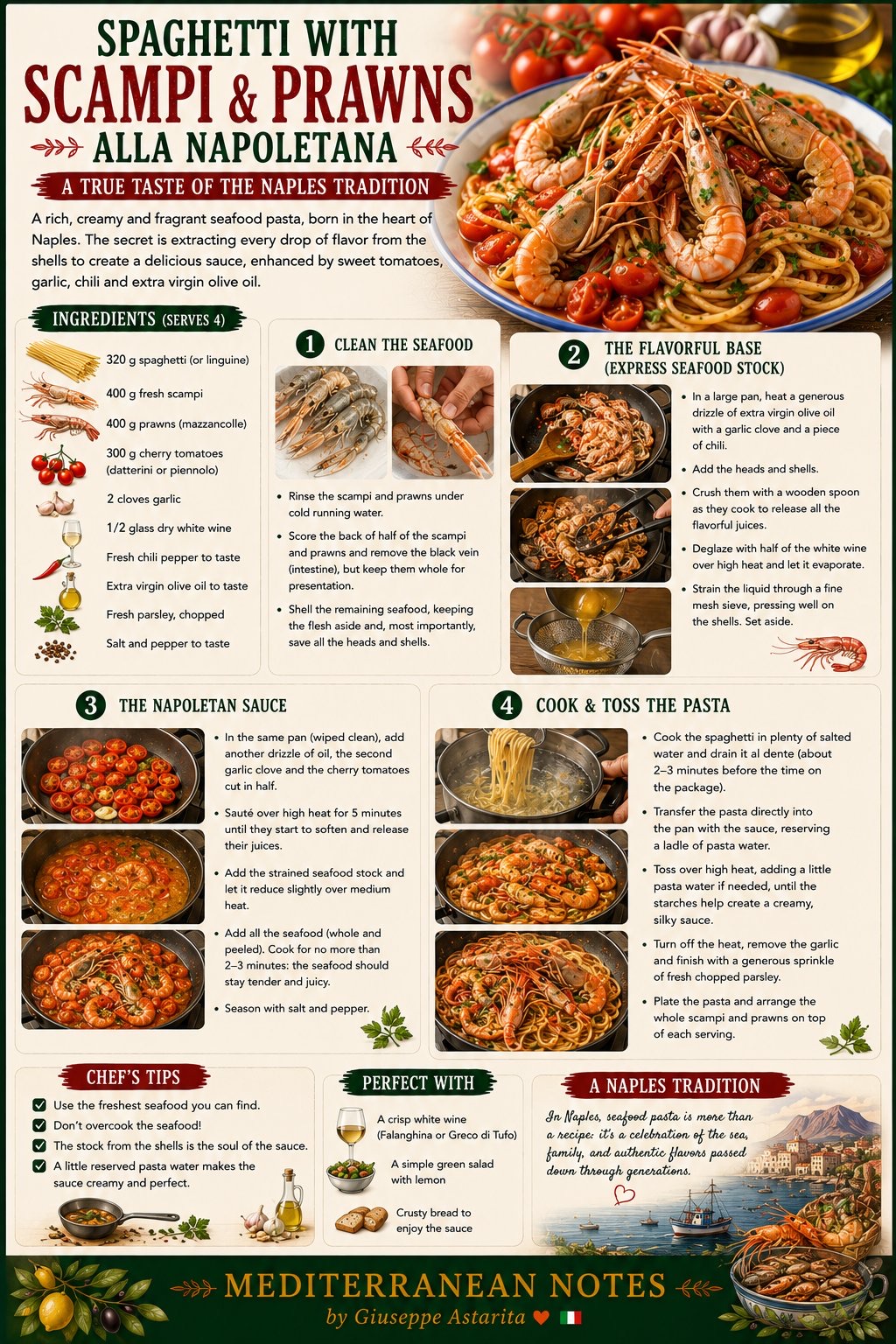
Spaghetti con scampi e gamberi alla napoletana — il vero sapore del mare di Napoli. Click to enlarge.
320 gSpaghetti or linguine
400 g, whole — heads and shells reservedFresh scampi (langoustines)
400 g, whole — heads and shells reservedPrawns (mazzancolle or large gamberi)
300 g, halvedCherry tomatoes (datterini or piennolo)
2 clovesGarlic
½ glassDry white wine — Falanghina or Greco di Tufo
to tasteFresh chili pepper
generousExtra-virgin olive oil
to finishFresh parsley, chopped
reserved ladlePasta cooking water — essential for the final emulsion
Step 1 — Clean and prep the seafood
1
Rinse the scampi and prawns under cold water. Score the back of half of them and remove the black vein (intestinal tract) — but keep these whole for presentation. Shell the rest completely, saving every head and shell. Set the flesh aside. The heads and shells are the most important ingredient in this recipe.
Step 2 — The express shellfish stock (the soul of the sauce)
2
Heat a generous pour of olive oil in a large pan with one garlic clove and a piece of chili over medium-high heat. Add all the heads and shells. Crush them vigorously with a wooden spoon — press hard, twist, push — to release the liquid from the heads and the fat from under the shells. Cook for 3–4 minutes, crushing continuously. Deglaze with half the white wine and let it evaporate completely over high heat. Strain the liquid through a fine mesh sieve, pressing the shells firmly to extract every drop. Set the stock aside.
This step produces what looks like a small amount of orange-tinted liquid. It contains more flavor than anything else in the pan. Do not rush it and do not leave any liquid in the shells when you strain.
Step 3 — The Neapolitan tomato sauce base
3
Wipe the pan clean. Heat olive oil with the second garlic clove and cherry tomatoes, halved. Sauté over high heat for 5 minutes until the tomatoes soften and begin releasing their juice. Add the strained shellfish stock and let it reduce slightly over medium heat for 2–3 minutes. The sauce should be fragrant, slightly concentrated, lightly tomato-colored.
Step 4 — Cook the seafood (no more than 2–3 minutes)
4
Add all the seafood — both the whole presentation pieces and the shelled flesh — to the sauce. Cook for no more than 2–3 minutes. The moment the scampi turn from translucent to opaque and the prawns turn pink, they are done. Remove immediately. Overcooked shellfish becomes rubbery within seconds and cannot be corrected.
Step 5 — Toss the pasta and serve
5
Cook the spaghetti in well-salted water, draining it 2–3 minutes before the package time. Transfer directly into the sauce pan, reserving a ladle of pasta water. Toss over high heat, adding pasta water as needed — the starch in the water emulsifies with the oil and shellfish stock into a silky, coating sauce. Turn off the heat, remove the garlic, finish with chopped parsley and a final drizzle of raw olive oil. Arrange the whole scampi and prawns on top of each serving. Serve immediately.
Serve with crusty bread alongside to soak up the sauce from the plate. The sauce from this pasta is among the best things the Campanian sea produces. Do not waste it.
In Naples, seafood pasta is more than a recipe: it is a celebration of the sea, family, and authentic flavors passed down through generations. The infographic's closing statement is the correct one. The pasta e vongole that was my mother's other favorite — the clams, the white wine, the parsley — will have its own post. This one is the scampi: the sweet shellfish, the orange-tinted stock from the crushed heads, the cherry tomatoes barely cooked, the parsley at the end. My father had the puttanesca. My mother had this.
Buon appetito — e sempre il mare nel piatto.