Spaghetti con i Moscardini
The taste of the sea in a simple bowl of pasta
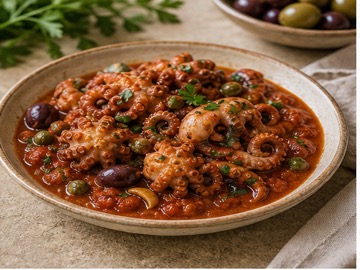
One of my mother's and sister's favorite dishes. Moscardini — the small curly octopus of the Tyrrhenian coast — simmered slowly in tomato sauce until tender, served over spaghetti. Some dishes live only in specific geographic places, and you have to go there to have them. Others live in memory, made by someone who is no longer at the stove. This one lives in both.
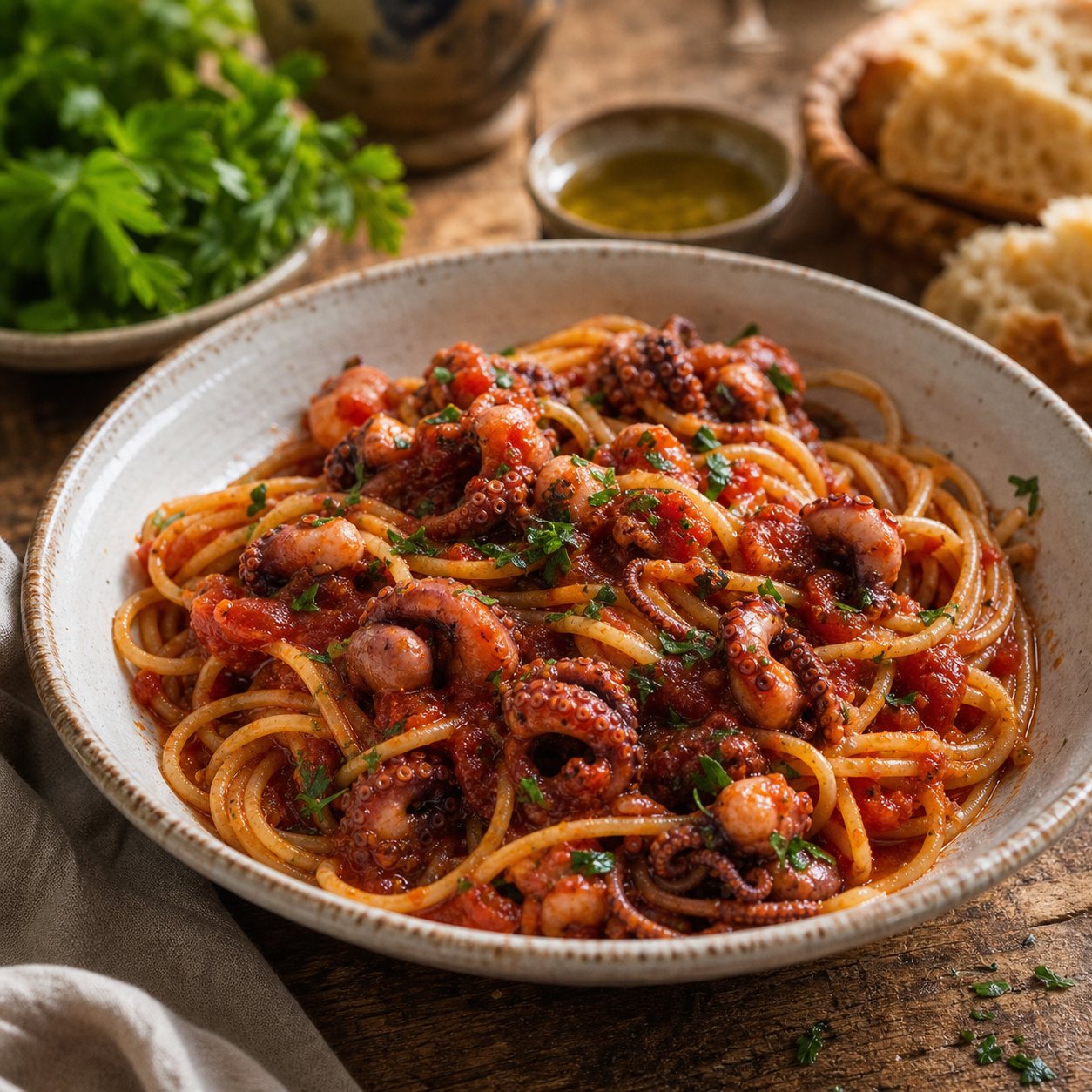
The moscardino — Eledone moschata, the musky octopus — is a small cephalopod found throughout the Mediterranean but particularly associated with the Tyrrhenian coast of Campania. It is smaller than the common octopus, with a single row of suckers on each arm rather than two, and a distinctive musky aroma that gives it both its name and its specific flavor. In Campania it is eaten as a secondo on its own — boiled, marinated, dressed with oil and lemon — or braised in tomato sauce and served over pasta. The pasta version is the more domestic preparation, the one that appeared at family tables rather than in restaurants, made on the days the market had fresh moscardini and someone at home was willing to put in the forty minutes of slow simmering.
This is a genuinely place-bound dish. Outside of coastal Campania, fresh moscardini are difficult to find — they are not a globally traded commodity and they do not travel well. In American cities with good Italian fishmongers (primarily the Northeast) they appear occasionally, sometimes frozen. In most of the United States they do not exist in any form. This is one of those dishes in the collection that you may need to travel to taste properly — or to find the right fishmonger, or to make do with a substitute. But the recipe is here because it was part of the family table, and because the flavor of the Campanian coast deserves to be documented even when the ingredient that carries it is difficult to source.
The recipe — serves 4
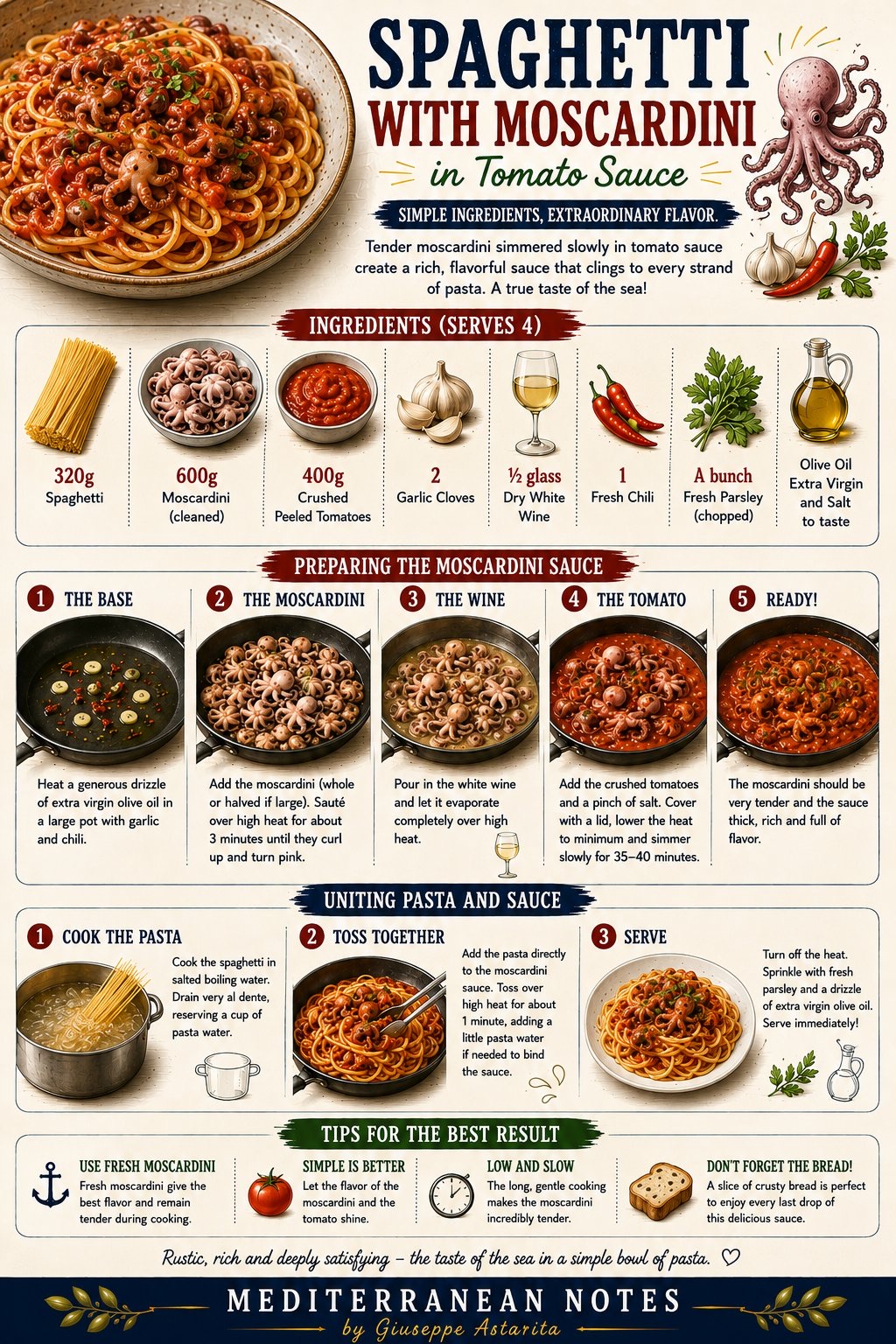
Cephalopods — octopus, moscardini, squid — have a high proportion of collagen in their muscle tissue compared to fish, which is why they become rubbery when cooked quickly and tender when cooked slowly. Collagen is a fibrous protein that provides structural strength; at temperatures above approximately 70°C it begins to denature and convert to gelatin, a process that requires sustained heat over time. In a braise at low simmer (approximately 85–90°C), this conversion proceeds gradually over 35–40 minutes: the muscle fibers relax as the collagen that held them together dissolves into the surrounding liquid, the flesh becomes tender throughout, and the cooking liquid is enriched with the dissolved gelatin — producing the characteristic thick, slightly unctuous quality of a well-made moscardini sauce that does not come from adding thickeners or reducing aggressively but from the ingredient itself releasing its own structural proteins into the broth.
The musky aroma that gives Eledone moschata its name comes from a compound called muscone and related macrocyclic musks produced in the animal's ink and skin glands. These compounds are fat-soluble and dissolve into the olive oil during cooking, distributing the characteristic aroma through the sauce. This is the smell of this dish — deeper and more marine than common octopus, specifically coastal, specifically Campanian. It is the smell my mother and sister knew as the smell of this preparation, and which I cannot reproduce with any substitute ingredient.
Some dishes live only in specific places. The moscardini are on menus along the Campanian coast — in the trattorie of Pozzuoli, in the fish restaurants of the Mergellina waterfront in Naples, in the coastal villages south toward the Cilento. In those places the ingredient is fresh and inexpensive and ordinary, which is the correct relationship to have with it. Elsewhere it is a specialty item, expensive when available, absent when not. This is simply the nature of a coastal cuisine: the sea gives what it gives to the people who live beside it, and the people who move away carry the memory of the taste more reliably than they carry access to the ingredient.
My mother and sister loved this dish. It is here as a record of what was on the table, of the flavors that defined that kitchen for the people for whom the sea was not a memory but a smell in the market on a Friday morning. If you find fresh moscardini — at a good Italian fishmonger, or on the Campanian coast — make this. If you cannot find them, make the insalata di polpo instead and go to Campania when you can.
Il sapore del mare — in una semplice ciotola di pasta.
And always bread for the scarpetta at the end.