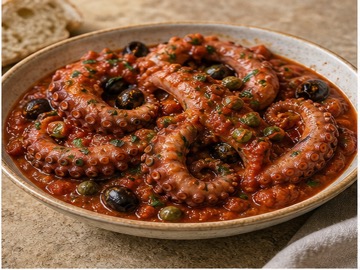
Moscardini alla Luciana
Il sapore autentico di Napoli — the smaller cousin of polpo alla Luciana
Same name, same neighborhood, same tradition — but not the same dish. Moscardini are baby octopus, small and delicate, and they demand a different technique entirely. No pre-boiling, no tenderizing. They go into the pan directly and cook slowly in their own liquid until they become something tender, fragrant, and deeply Neapolitan. A Napule 'o sapore è 'na cosa seria.
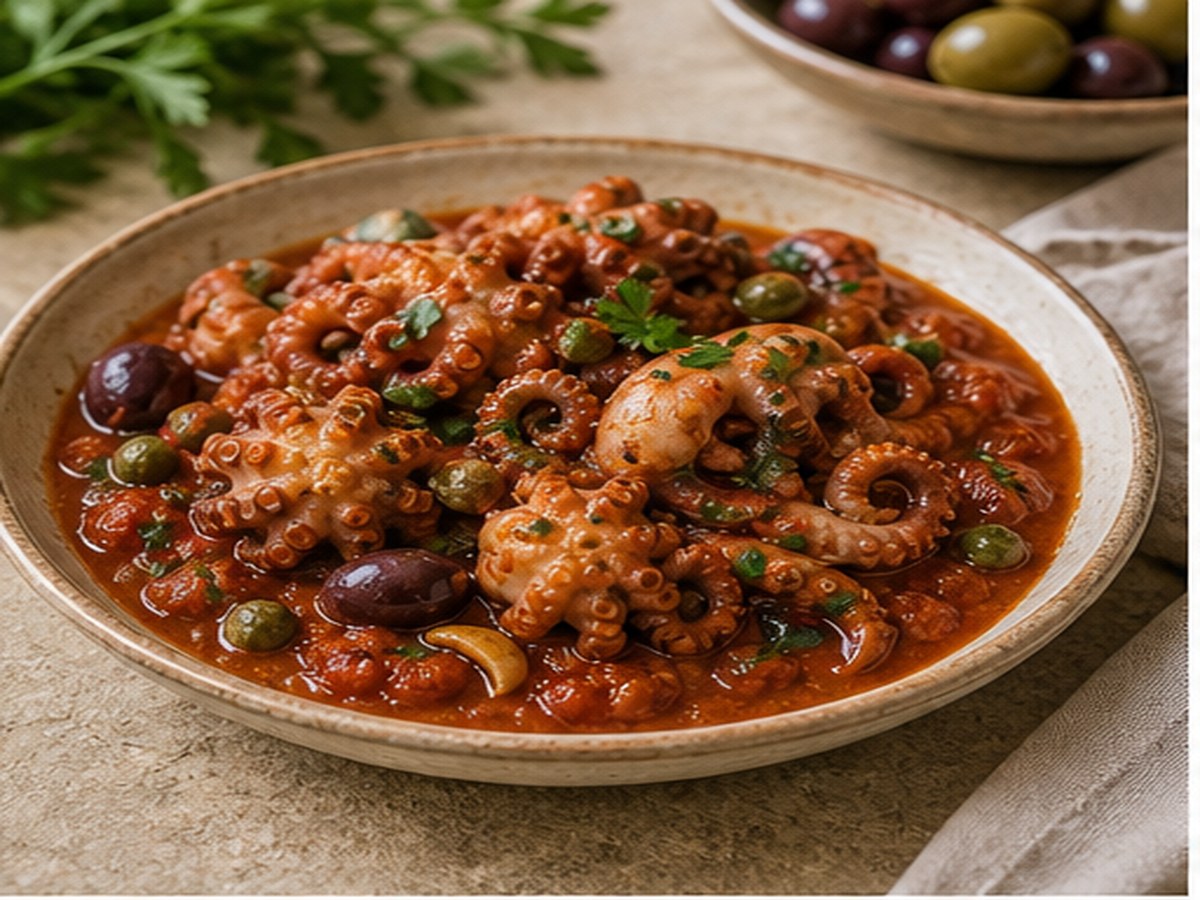
If you have read the polpo alla Luciana post on this blog, you know about the Santa Lucia fishing quarter of Naples, about the fishermen who cooked whatever the sea gave them that day with the simplest ingredients they had on board, and about the slow cooking that transforms a tough cephalopod into something tender and rich. All of that applies here too. But the moscardino is not the polpo, and the preparation that makes a large octopus tender would destroy a small one. The moscardino requires a different logic: no beating, no dipping in boiling water, no pre-cook. It goes directly into the pan, whole and fresh, and it cooks slowly in its own released liquid and in the tomato. That liquid is the point. The nonna tip on the infographic states it plainly: no added water. The moscardini release everything they need themselves.
The moscardino — Eledone moschata, the musky octopus — is a small species of octopus with a single row of suckers on each arm rather than the double row of the common octopus. It is smaller, more delicate in flavor, and has a specific fragrance described as musky or slightly herbal that gives it the name. In Naples it is sold cleaned and ready at the fishmonger in spring and summer, the tentacles already trimmed, the eyes and beak removed, the mantle pale and small enough to hold comfortably in one hand. What you want is the small ones — the infographic says it directly: piccola taglia, small size. They stay tender and absorb the flavors of the sauce better than the larger specimens, which need longer cooking and even then retain a slight chewiness that the small moscardini avoid entirely.
The tomato here is not incidental. The polpo alla Luciana uses peeled canned tomatoes, crushed by hand, in a proper sauce. The moscardini version uses fresh cherry tomatoes — the piennolo del Vesuvio if you can find them, which are the small, intensely sweet and slightly acidic tomatoes grown on the slopes of Vesuvius and sold in clusters on the vine. They are a DOP product and they are difficult to find outside Italy in their true form. A good cherry tomato or grape tomato of genuine sweetness and firmness is the correct substitute. The tomatoes go into the pan early, cook briefly to release their liquid, and then the moscardini are added. What follows is forty to fifty minutes of very gentle cooking during which the moscardini and the tomatoes and the olives and the capers and the olive oil negotiate their flavors into a dense, unified sauce that requires no reduction at the end — it arrives at the right consistency on its own, through the natural evaporation of the moscardini's released liquid and the reduction of the tomato juice.
Moscardini versus polpo alla Luciana — the key differences
The moscardino's small size means its muscle fibers are shorter and its collagen content lower than those of a large octopus. The collagen-to-muscle ratio in a small cephalopod is favorable for slow pan cooking without pre-treatment: given sufficient time at a gentle simmer, the collagen converts to gelatin and the muscle softens adequately without the beating and pre-boiling that a large octopus requires to reach the same result. The beating technique used for large octopus breaks down sarcomere structure mechanically before cooking begins; in a small moscardino, the heat alone over 40–50 minutes achieves this without mechanical intervention. The "no added water" rule has a precise basis: moscardini contain approximately 78–82% water by weight, held within their muscle cells. When heated, the proteins denature and contract, expelling this cellular water into the pan. In the first 10–15 minutes of cooking, a kilogram of moscardini releases roughly 150–200 ml of liquid — enough to keep the pan moist and to begin forming the sauce, working together with the liquid released by the cherry tomatoes. Adding external water before this release has happened dilutes the concentrated, iodine-rich, slightly gelatinous liquid that the moscardini produce, which is specifically what gives the dish its characteristic flavor. The gelatin that the moscardini release — from their small quantity of collagen — also contributes to the final sauce consistency, thickening it naturally in the same way that polpo gelatin thickens the Luciana sauce, but on a smaller scale and in less time.
La ricetta
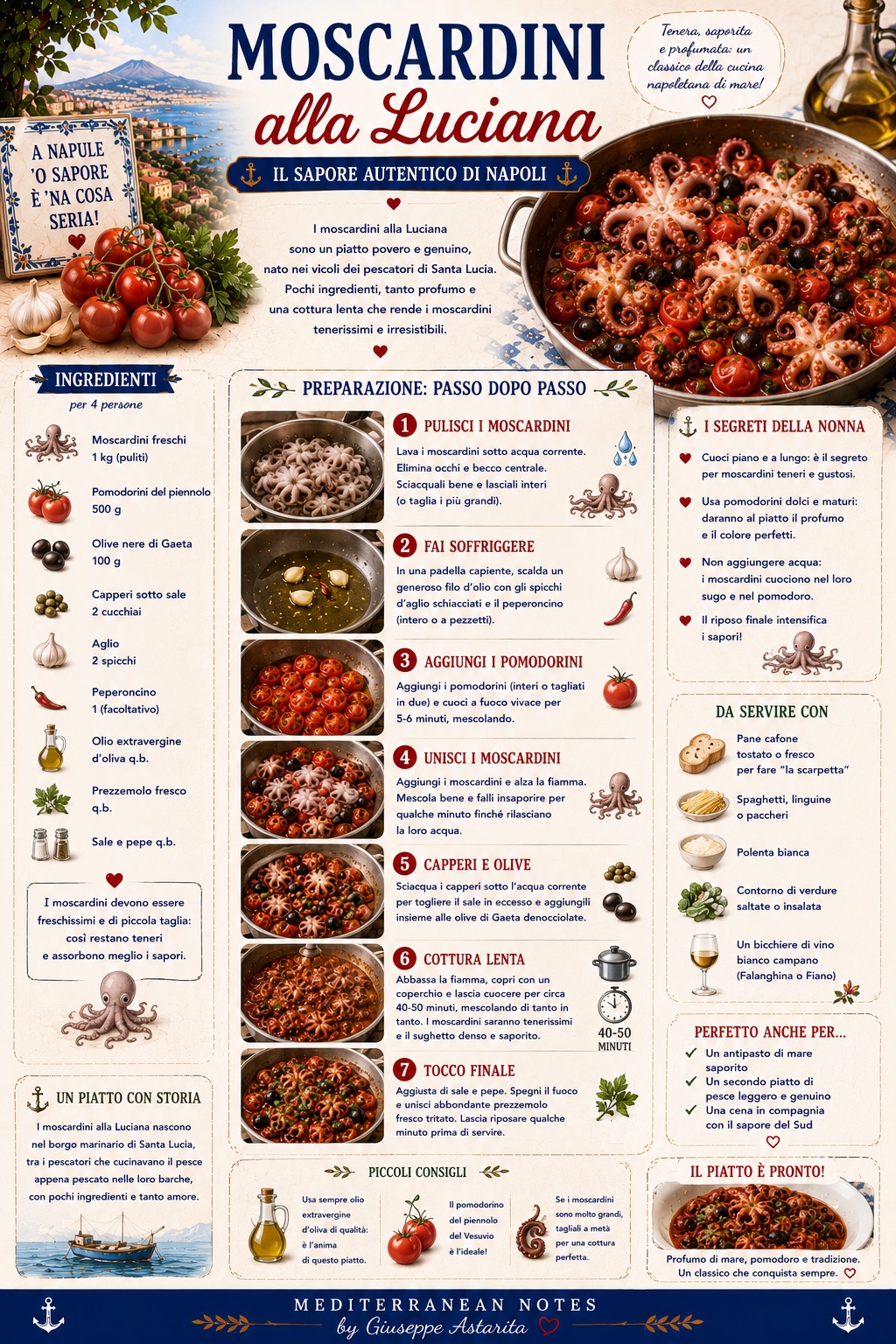
Come servirli
The pasta version deserves its own note. If you are using the moscardini alla Luciana as a sauce for pasta, cook the pasta to just under al dente, reserve a ladle of pasta water, and finish the pasta in the pan with the moscardini over high heat for the last minute, adding a splash of pasta water if needed to loosen. The starch in the pasta water emulsifies with the olive oil in the sauce, creating a unified coating rather than a sauce sitting on top of pasta. Serve immediately — this is not a dish that waits.
My mother made both the polpo and the moscardini version, and they occupied different occasions. The polpo alla Luciana was the serious Sunday preparation — the long cook, the pre-boiling, the substantial second course that followed a full pasta. The moscardini were faster, lighter, sometimes a weekday dinner or a first course before something else, sometimes the sauce for linguine on a Friday evening when there was good fish available. Both came from the same tradition and both ended with the same instruction: bread in the pan, not optional.
Buon appetito — e non aggiungere acqua.