Pasta alla Genovese: the last one my mother made
A Neapolitan pasta dish built entirely on onions — one kilogram of onions cooked for hours until they dissolve into a golden, sweet, almost caramel cream. Rich and elaborate-seeming, not a Sunday dish, often made without meat, sometimes with wine that filled the kitchen with a smell that seemed too serious for a weekday. The last really good one I ate was made by my mother. I have not had the same one since.
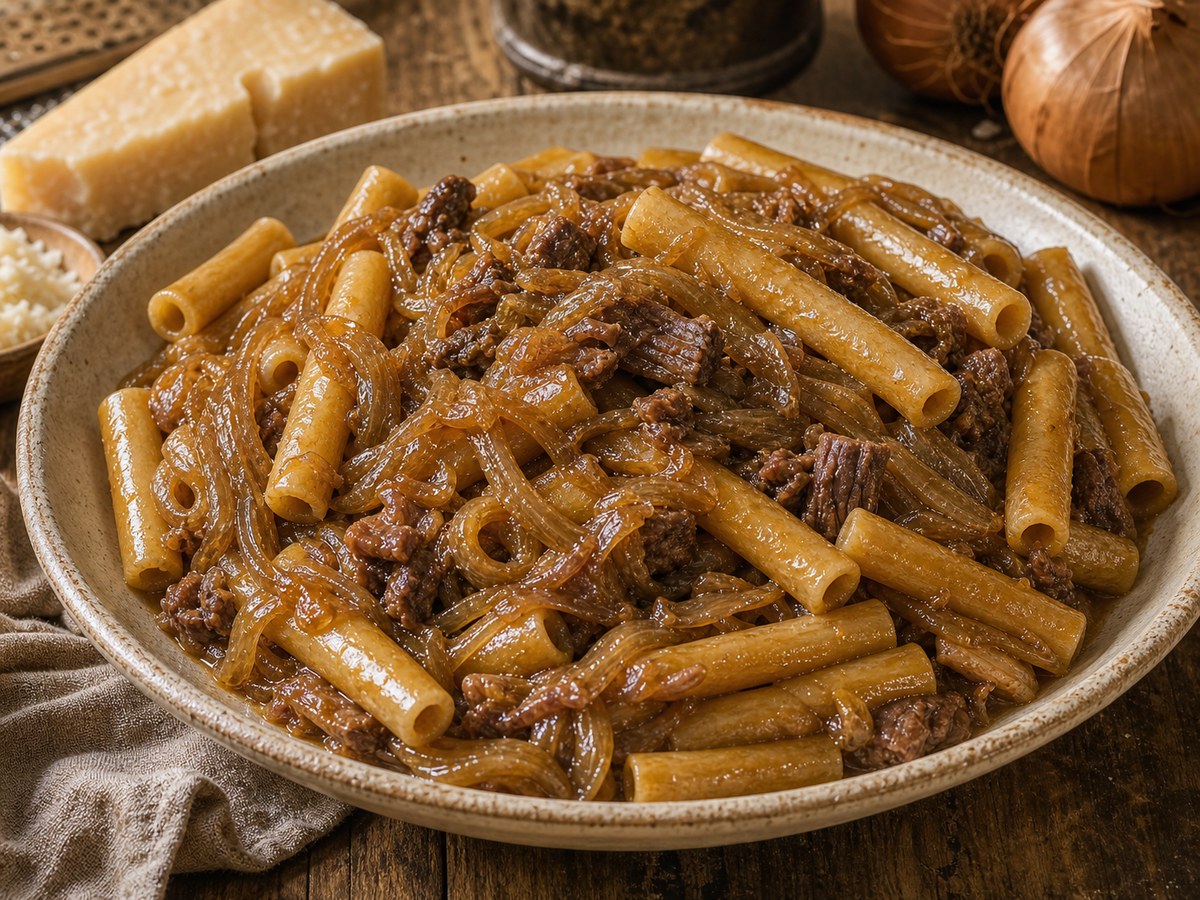
The pasta alla Genovese is one of the great paradoxes of Neapolitan cooking: a dish that has nothing to do with Genoa, that no one in Genoa makes or recognizes, whose name is debated and uncertain — possibly from Genoese merchants who brought the onion-braised meat technique to Naples in the fifteenth century, possibly from a Neapolitan cook named Genovese, possibly from somewhere else entirely. The name is a mystery. The dish is not. It is one of the most characteristically Neapolitan preparations in existence, deeply embedded in the city's culinary identity, and built on an ingredient — the onion — that most cooking treats as a supporting character and the Genovese promotes to the entire point.
The sauce is nothing but onions — a kilogram of them, sliced as thinly as possible, cooked covered with the meat or without over the lowest possible heat for one and a half to six hours depending on the version. The onions release their moisture first, then slowly caramelize, then nearly disappear, transforming from sharp and pungent to sweet and golden and soft, merging into a thick, almost jam-like cream that coats every strand of pasta. It does not look like it should taste the way it does. An onion sauce sounds simple, even uninteresting. What actually arrives in the bowl is rich, complex, sweet-savory, with a depth that seems disproportionate to the ingredient list. This is what long, slow cooking does to the onion, and it is one of the more convincing arguments available for patience as a culinary value.
The Genovese fujuta — or finta Genovese, the fake or escaped Genovese — is the meatless version, and it is the one I ate during a period of being vegetarian and the one my mother made more often at home than the full version. The name fujuta means "escaped" in Neapolitan dialect — the version where the meat has escaped the pot, leaving only the onions. It sounds like a joke or a poverty version, but it is a genuinely excellent preparation in its own right, not a lesser version of the original. The onions without the meat cook slightly differently — more moisture must be added, usually broth, and the sauce is a little looser — but the result is the same fundamental transformation: the raw onion becomes something barely recognizable from what it started as, concentrated to sweetness, indistinguishable from elaborate in a way that is difficult to explain without tasting it.
It is not a Sunday dish. In Campania the Sunday lunch requires red sauce — tomato in some form, whether the long-cooked ragù of the previous post or a quick fresh tomato, but something red that signals Sunday. The Genovese is a weekday dish, a Wednesday dish perhaps, or a Thursday, something made in the middle of the week when you have enough time — an hour and a half at minimum, three hours is better — but not the full Sunday commitment. The wine used to deglaze the meat and the onions gives it an additional smell of occasion. The kitchen smells like something elaborate is happening. What is actually happening is onions in a pan with time.
Slow onion caramelization — why time cannot be substituted with higher heat
The transformation of raw onion into the golden Genovese cream is one of the more chemically eventful processes in Italian cooking, and understanding it explains why time cannot be substituted with higher heat. Raw onion flavor is dominated by volatile sulfur compounds — syn-propanethial-S-oxide (the compound responsible for eye tearing), and allicin-related organosulfur compounds produced when the onion's cell walls are damaged. These compounds are sharp, pungent, and immediately aggressive. During the first stage of slow cooking (30–60 minutes), these volatile sulfur compounds evaporate — which is why the kitchen smells sharply of onion when cooking begins and less sharply as time passes. As moisture releases from the onion cells, the cooking environment becomes aqueous rather than dry. In the second stage (60–120 minutes), the onion's sucrose, fructose, and glucose undergo two parallel reactions: Maillard reactions between the reducing sugars and the amino acids present in the onion tissue, producing brown melanoidins and hundreds of aromatic compounds; and caramelization proper, where the sugars thermally degrade into caramel compounds at the cooking temperature. Both reactions require time and the right temperature — too high and the sugars char rather than caramelize, producing bitterness; too low and the reactions are too slow to complete in a reasonable time. The correct temperature for onion caramelization is around 150–160°C at the onion surface, which is achievable only after the initial moisture has evaporated — which takes time and cannot be rushed. The final golden cream contains melanoidins (also present in coffee, bread crust, and soy sauce), furans, pyrazines, and caramel compounds at concentrations that produce the characteristic sweet-savory-complex flavor profile of the finished sauce. The onion also provides quercetin — the same flavonoid noted in capers — at concentrations that increase significantly with cooking as cell walls break down and release the flavonoid into the cooking liquid. Nutritionally, a dish built primarily on onions and pasta provides quercetin, prebiotic fructooligosaccharides, B vitamins from the pasta, and protein — modest in the vegetarian version, more substantial in the meat version. The Genovese fujuta is, despite its reputation as the lesser version, nutritionally complete as a first course by any reasonable Mediterranean standard.
The recipe — Genovese fujuta (the meatless version)
The version my mother made most often. The onions are the whole dish. Serves 4. One and a half hours minimum — two is better.
Ingredients
Method
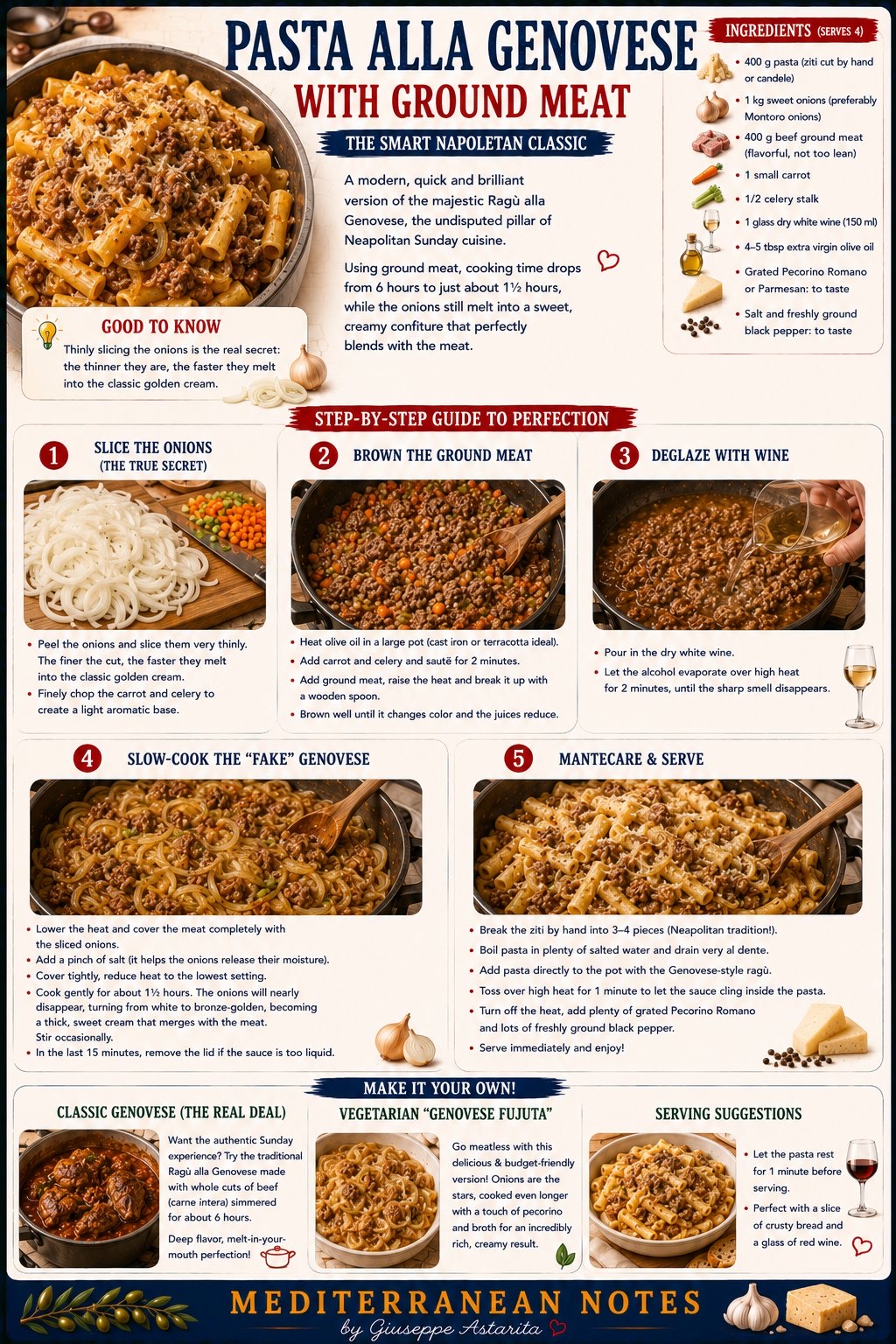
Slice the onions — very thinly. Peel and slice all the onions as thinly as possible — this is the true secret. The thinner the slice, the faster they melt into the cream and the more completely they transform. Finely chop the carrot and celery for the aromatic base.
The onion that defines this sauce is the Cipolla Ramata di Montoro (IGP, from Avellino province) — copper-skinned, intensely sweet, renowned specifically for la Genovese because it holds its shape through five hours of cooking and softens into silk without disintegrating. The Cipolla di Vatolla from the Cilento hills is also excellent here — less common for this use, but equally sweet and worth it if you find one. Any sweet white or golden onion works. Avoid red onions — they produce a different colour and a sharper flavour.
Build the base. In a large, heavy-bottomed pot — cast iron or terracotta ideal — heat the olive oil over medium heat. Add the carrot and celery and sauté for 2 minutes. Add all the sliced onions at once. They will seem like an enormous volume. They will reduce to almost nothing. Add a pinch of salt — it helps the onions release their moisture. Stir to coat everything in the oil.
Deglaze with wine. After 5 minutes, when the onions have started to soften, raise the heat slightly and pour in the wine. Let the alcohol evaporate completely over high heat — 2 minutes — until the sharp smell disappears and only the grape depth remains.
The long cook — the real work. Lower the heat to the absolute minimum. Cover tightly. Cook gently for 1½ to 2 hours, stirring occasionally. The onions will first release their moisture, then begin to collapse, then slowly turn from white to golden to bronze, becoming a thick, sweet, fragrant cream. If they start to stick, add a ladle of hot broth. In the last 15 minutes, remove the lid if the sauce is too liquid — the excess moisture should evaporate and the sauce should cling to a spoon.
Do not raise the heat to accelerate the process. Higher heat browns rather than caramelizes, producing bitterness instead of sweetness. The only path to the correct result is the correct time at the correct temperature. This cannot be shortcut.
Cook the pasta and mantecare. Break the ziti by hand into 3–4 pieces. Cook in well-salted boiling water until very al dente, reserving a generous cup of pasta water. Add the pasta directly to the pot with the Genovese sauce. Toss over high heat for 1 minute, adding pasta water as needed until the sauce clings inside every piece of pasta. Turn off the heat. Add the grated Pecorino Romano or Parmigiano generously and plenty of black pepper. Toss once more. Let rest 1 minute before serving.
The three versions
Genovese fujuta
The meatless version — onions, wine, broth, pasta, cheese. The one in this recipe. The one my mother made. Fujuta means escaped — the meat has escaped the pot. What remains is the sauce, which stands entirely on its own. The vegetarian version that tastes as elaborate as its name suggests it should not.
Genovese con macinato
The quick version with ground beef — cooking time drops to about 1½ hours while the onion cream still forms correctly. The meat browns first, then the onions cover it completely and cook down around it. Good and substantially faster than the traditional version. The infographic version.
Ragù alla Genovese — la vera
The authentic Sunday version: whole cuts of beef (carne intera — chuck or brisket), simmered for 5–6 hours until the meat falls apart and the onions have completely disappeared into the sauce. Two courses from one pot: the sauce dresses the pasta as primo, the meat is served as secondo with the remaining onion cream alongside. The version that requires a Sunday and a willingness to commit to it.
I have made the Genovese several times since my mother last made it for me and I have gotten reasonably close. The sauce is always good. It has never been the same. I am not sure whether this is a problem of technique — something specific about how she sliced the onions, how long she cooked them, which onions she used — or whether it is simply the problem that food made by someone else in a specific kitchen at a specific time cannot be exactly replicated regardless of how carefully you follow the steps. Some dishes are the dish and also the occasion that produced them, and separating the two is not possible. I keep making it, and it keeps being good, and it keeps not being the same.
Buon appetito — e buona fortuna con le cipolle.