CoursesBasicsFirst CoursesSecond CoursesSides & VegetablesSoupsSaucesEggs & FrittatePizza & BreadBreakfastSnacksStreet FoodDesserts
DietVegetarianVegan
SeasonSpringSummerAutumnWinter
MainSeafoodMeatEggs
MoreCulture & TraditionsGlossaryAbout

Risotto alla Pescatora
Il sapore autentico del mare campano — a treat, not an everyday thing

My mother made this as a special thing — not often, not for any particular occasion, but as a treat, as a gesture. Not for my father, who was not a seafood person. For the rest of us. Mussels, clams, squid, prawns, Carnaroli rice, cherry tomatoes. The risotto that smells like the Campanian sea from the first ladle of stock.
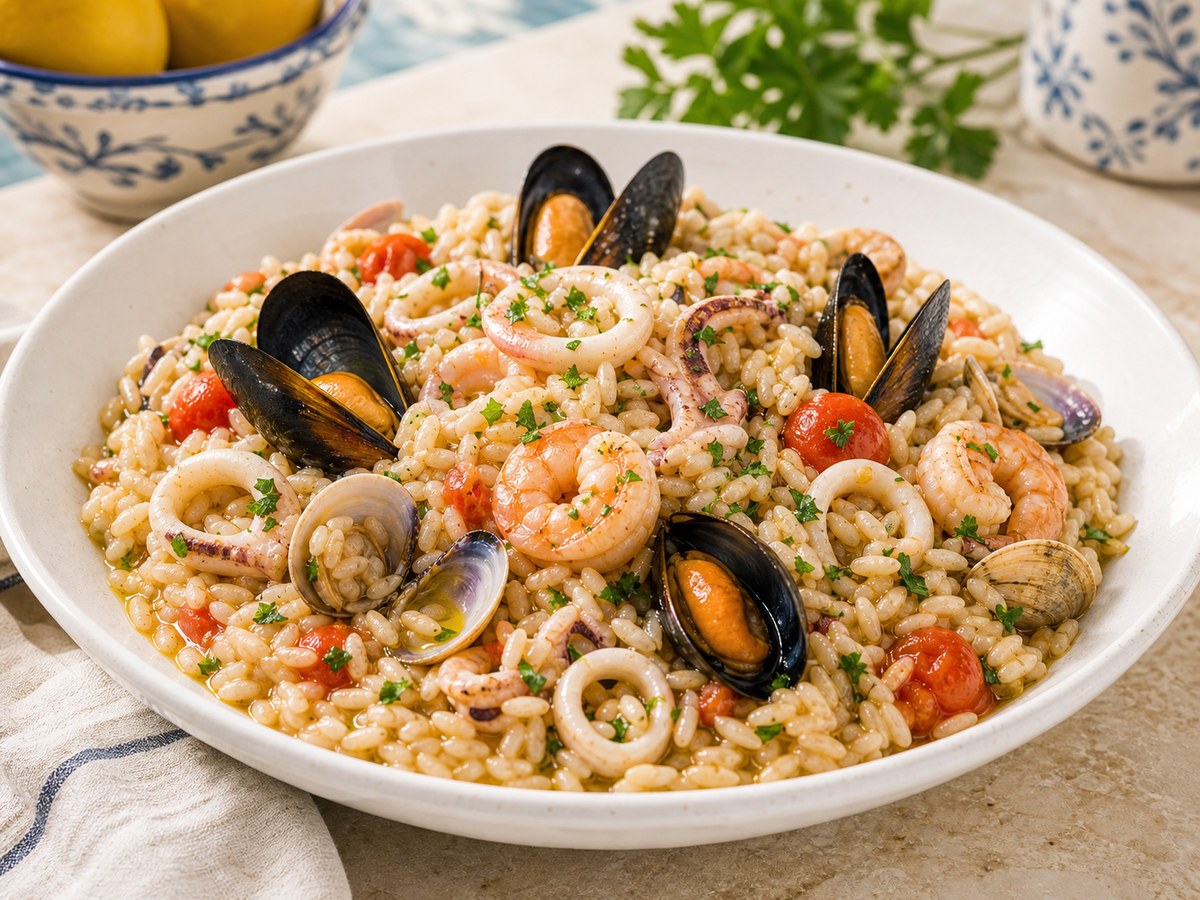
Risotto Pescatora

A risotto alla pescatora made correctly is one of the most demanding preparations in the Italian domestic repertoire. Not because any single step is technically beyond reach, but because it requires orchestrating four different types of seafood — each with its own correct cooking time and texture — while simultaneously managing the slow addition of stock to the rice, without overcooking anything. The approach that produces the best result is to cook each seafood element separately and add it to the rice at the precisely correct moment. The squid and cuttlefish go in early, because they need time. The mussels and clams go in two minutes before the rice is done. The raw prawns go in after the heat is off, cooked only by the residual heat of the rice. Each arrives at the table at the correct texture. Nothing is overcooked.

My mother made this when she decided to make it — which was not predictable and was not tied to a fixed calendar occasion the way the Christmas Eve dinner was fixed. It appeared as a surprise on a Saturday, or as a Sunday lunch that was more elaborate than usual, or on a day when the fishmonger had something particularly good and she decided to build around it. My father ate pasta with tomato on those days. The risotto alla pescatora was ours — my mother's, mine, my brother's — and we ate it with the attention it deserved, which was considerable.

The liquid is the foundation that most home cooks neglect, and it is where the flavor difference between a good risotto alla pescatora and a mediocre one is determined before any rice has been toasted. Two cooking liquids are combined: the liquid from opening the mussels and clams — strained carefully through a fine-mesh sieve lined with a clean cloth to remove every grain of sand — and an instant fish stock made from the prawn heads and shells sautéed in olive oil and pressed to release their juices, then covered with water, simmered for thirty minutes with celery, carrot, and onion, and strained. The combined liquid is kept very hot throughout the risotto cooking. Cold stock added to hot rice stops the cooking, shocks the starch, and ruins the texture. The stock must be hot. This is not a suggestion.

She made it as a treat. Not because it was someone's birthday or a fixed occasion — just because she decided to, because the fish was good that day, because she felt like it. Those were often the best meals. The ones that arrived without announcement were the ones we remembered longest.
Il segreto — the rule that separates good from extraordinary
Cook the seafood separately and add it at the right moment. The squid needs time; add it halfway through the rice. The mussels and clams are already cooked — add them two minutes before the rice is done, just to warm through. The raw prawns go in after the heat is off — the residual heat of the risotto cooks them in thirty seconds, keeping them tender. One pot with all the seafood added at the start produces overcooked shellfish and undercooked squid simultaneously. The timing is the technique.

Ingredienti

Risotto alla pescatora -- il sapore autentico della Campania, con Carnaroli, cozze, vongole, calamari e gamberi, Mediterranean Notes
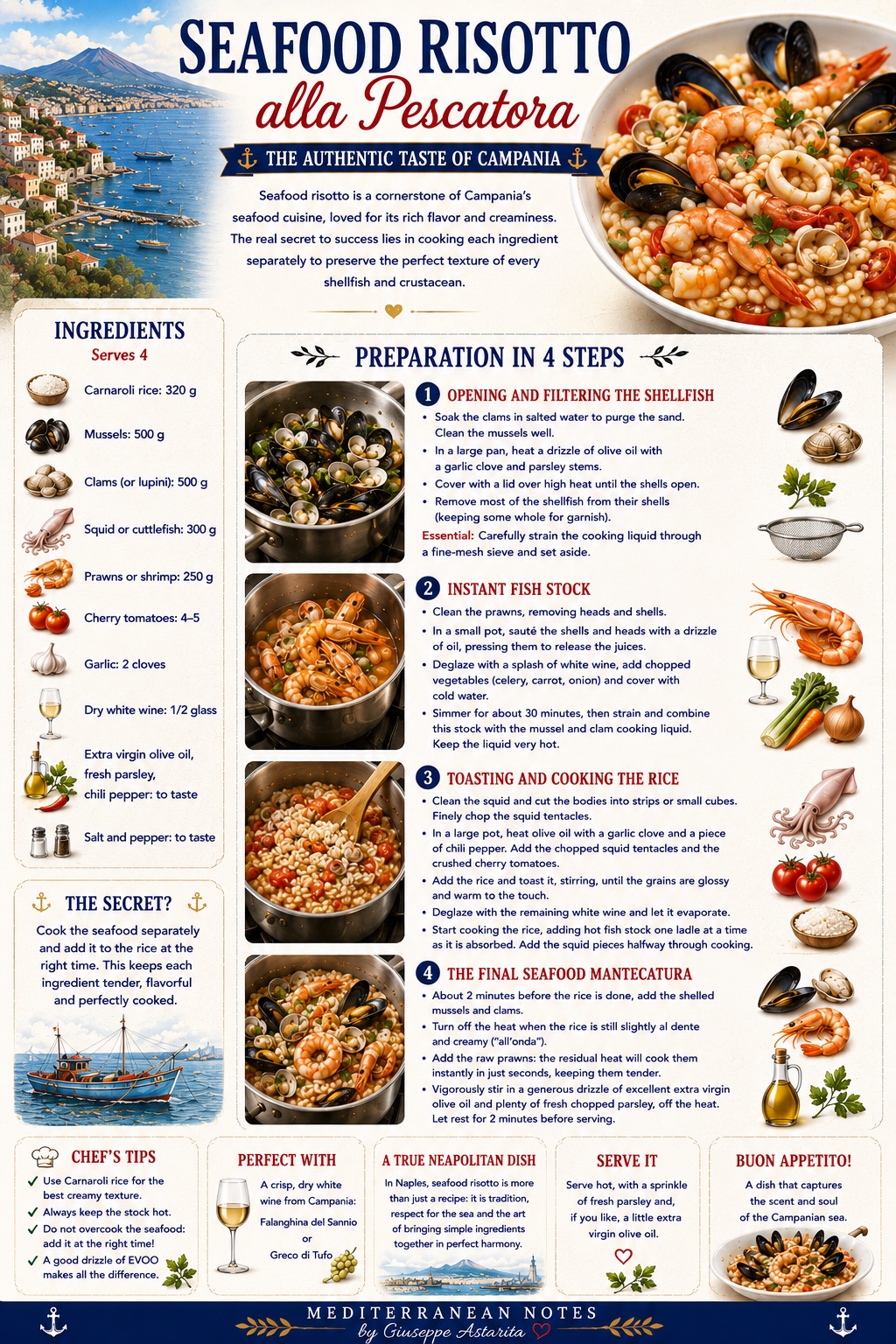
Risotto alla pescatora — preparazione in 4 fasi, tecnica professionale — click to enlarge.
320 g — Carnaroli onlyRice
500 gMussels (cozze)
500 gClams or lupini (vongole)
300 g, bodies and tentaclesSquid or cuttlefish (calamari)
250 g, heads on for stockPrawns or large shrimp
4–5, crushedCherry tomatoes
2 clovesGarlic
half a glass, dryWhite wine
generous — quality mattersExtra virgin olive oil
a handfulFresh flat-leaf parsley
optionalFresh chili pepper

La preparazione in 4 fasi

1
Opening and filtering the shellfish
Soak the clams in cold salted water for at least one hour to purge sand. Scrub the mussels and remove the beards. In a wide pan, heat a drizzle of olive oil with a garlic clove and a few parsley stems. Add the clams and mussels, cover tightly, and cook over high heat until they open — 3 to 4 minutes. Shake the pan once or twice. Remove from heat. Take most of the shellfish from their shells, keeping some whole for presentation. Strain the cooking liquid very carefully through a fine-mesh sieve lined with a clean cloth or paper towel. This liquid is gold — it is the concentrated flavor of the sea that will define the risotto. Set it aside.
Any sand that passes through the sieve will be in every bite. Line the sieve properly and strain slowly. Discard any shellfish that did not open.
2
Instant fish stock from the prawn shells
Remove the heads and shells from the prawns, keeping the flesh aside. In a small saucepan, heat a drizzle of olive oil. Add the shells and heads and sauté over medium heat, pressing them firmly with a spoon to release all their juices and tomalley — this pressing is important. Deglaze with a splash of white wine. Add roughly chopped celery, carrot, and half an onion. Cover with cold water and simmer for 30 minutes. Strain and combine this stock with the mussel and clam cooking liquid. Keep the combined liquid very hot throughout the risotto — add to a small saucepan on a back burner.
Cold stock kills the risotto. The liquid must be simmering when it hits the rice. Keep it on the heat at all times.
3
Toasting and cooking the rice
Clean the squid: pull the heads from the bodies, remove the transparent quill, cut the bodies into strips or small cubes. Finely chop the tentacles — they will dissolve into the base and flavor it. In a large heavy pot, heat olive oil with a garlic clove and the chili. Add the chopped tentacles and the crushed cherry tomatoes. Cook for 2 minutes. Add the rice and toast, stirring constantly, until each grain is glossy and warm to the touch — about 2 minutes. Deglaze with the white wine and stir until evaporated completely. Begin adding the hot stock one ladle at a time, stirring and waiting until each ladle is absorbed before adding the next. Add the squid body pieces halfway through the cooking — at around 8 minutes.
Use only Carnaroli rice. It has higher amylose content than Arborio, which means it stays al dente longer and absorbs more liquid without becoming mushy. The toasting step seals the exterior of the grain and slows starch release, producing a more controlled, creamier result.
4
The final seafood mantecatura
About 2 minutes before the rice is done — still slightly al dente, still flowing loosely (all'onda) — add the shelled mussels and clams. Stir gently. Turn off the heat when the rice is still slightly underdone and creamy. Add the raw prawns now, off the heat. The residual heat of the risotto will cook them in 30 seconds, keeping them tender and not a second more. Immediately stir in a generous drizzle of the best extra virgin olive oil you have and a generous handful of freshly chopped parsley. Stir vigorously — this is the mantecatura, the emulsification of the oil into the starchy cooking liquid that produces the cream. Cover and rest for exactly 2 minutes. Serve immediately.
The raw prawn technique is the single most important professional touch in this recipe. Prawns added to hot rice 5 minutes before the end emerge tough and rubbery. Added off the heat, they arrive at the table perfect.
Why Carnaroli, why all'onda, and what the mantecatura actually does

Carnaroli is the correct rice for seafood risotto for a specific reason: its grain contains a higher ratio of amylose to amylopectin than Arborio. Amylopectin is the branched starch that swells and gelatinizes rapidly, making a risotto creamy but also making it turn mushy quickly when overcooked. Amylose is the straight-chain starch that swells more slowly and retains the structural integrity of the grain under extended cooking. Carnaroli's higher amylose content gives a wider window of correct doneness and a grain that stays al dente even as the surrounding liquid becomes creamy — which is exactly what seafood risotto requires, since the seafood must be added at specific moments near the end and the rice must wait without overcooking. The all'onda consistency — "like a wave" — describes a risotto that is loose enough to flow when the pot is shaken, not stiff. This requires stopping the cooking while there is still enough unabsorbed liquid to allow movement. The mantecatura is the step that creates the final creaminess: the cold (or room temperature) olive oil is stirred vigorously into the hot, starchy liquid, creating an emulsion in which fat droplets are suspended in the gelatinized starch solution. This emulsion is what gives a mantecato risotto its characteristic glossy, creamy texture without any dairy — the oil is the fat phase, the starch-water is the aqueous phase, and the vigorous stirring provides the mechanical energy to form the emulsion. A risotto mantecato with olive oil rather than butter is specifically Neapolitan and specifically correct for a seafood preparation where butter's dairy notes would compete with the iodine and marine character of the shellfish.

The wine alongside should be a Campanian white — Falanghina del Sannio for its aromatic freshness, or Greco di Tufo for something more structured and mineral. Both amplify rather than compete with the iodine-and-tomato character of the risotto. I make this for my daughters on special Saturdays when I want to cook something that requires the whole afternoon and produces something worth that time. They eat it with the attention it deserves. My father would have had pasta with tomato alongside, as he always did, and he would have been perfectly happy with that arrangement. Some things do not need to change.

Buon appetito — e manteca bene, a fuoco spento.
More from my mother's kitchen
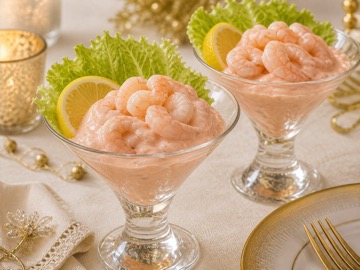
Cocktail di gamberetti
The Christmas Eve antipasto -- the pink sauce with the strange ingredient names.
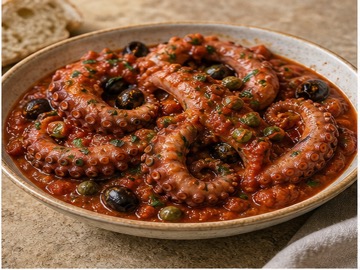
Polpo alla Luciana
The slow-cooked octopus classic -- another great seafood dish from my mother's kitchen.