Polpo alla Luciana
Il sapore autentico di Napoli — from the fishermen of Santa Lucia
One of the most iconic dishes of the Neapolitan tradition. Octopus slow-cooked in a sauce of tomato, Gaeta olives, and desalted capers until the sauce thickens and embraces the octopus rather than surrounding it. My mother made this. A maronna, 'o mare è 'na benedizione.
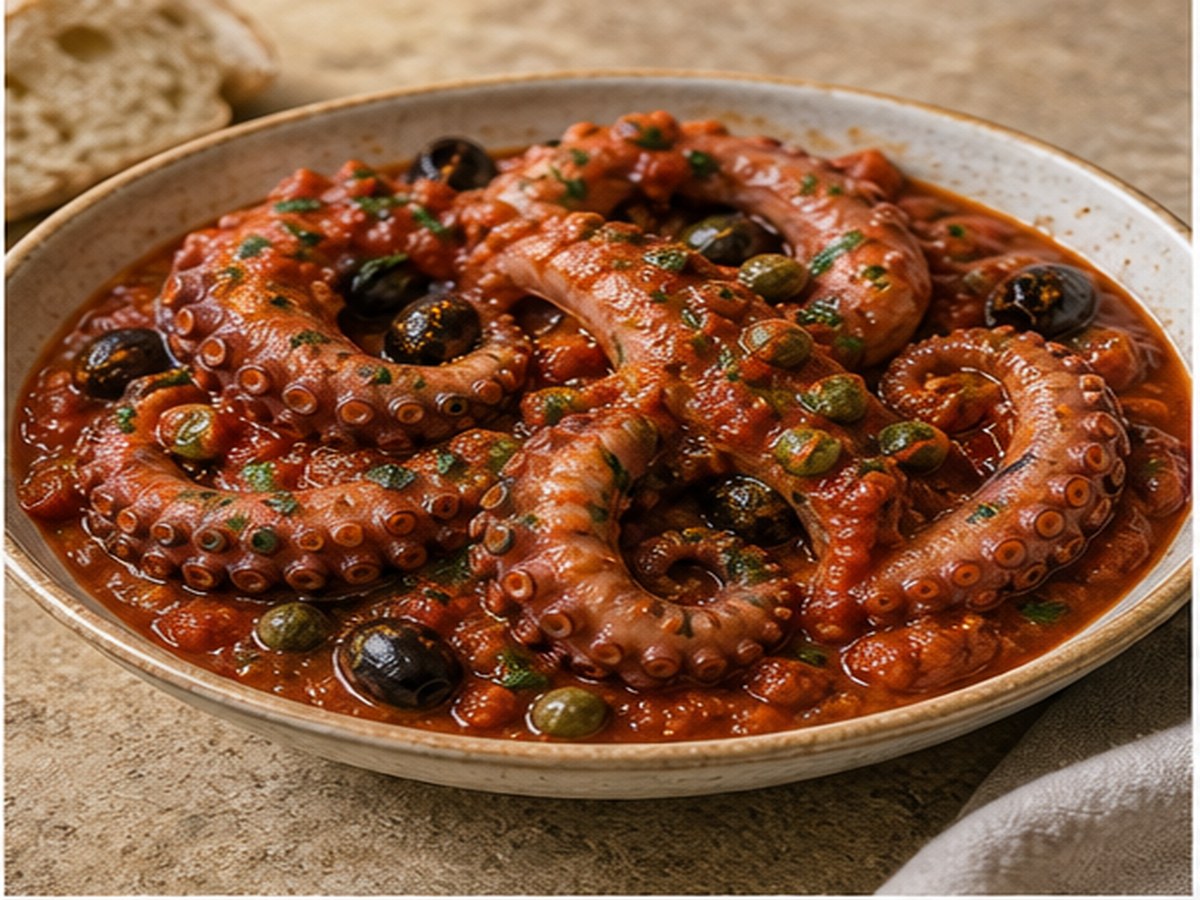
The name comes from the fishermen's quarter of Santa Lucia, the old port neighborhood of Naples where the fishermen cooked the octopus in the simplest sauce they had available on board: tomatoes, olives, capers, olive oil, whatever was there. Nothing was added for elegance. The simplicity was the point, and it produced one of the best octopus preparations in the Italian repertoire. The dish has not changed in any meaningful way since then, which is the clearest possible evidence that it was correct from the beginning.
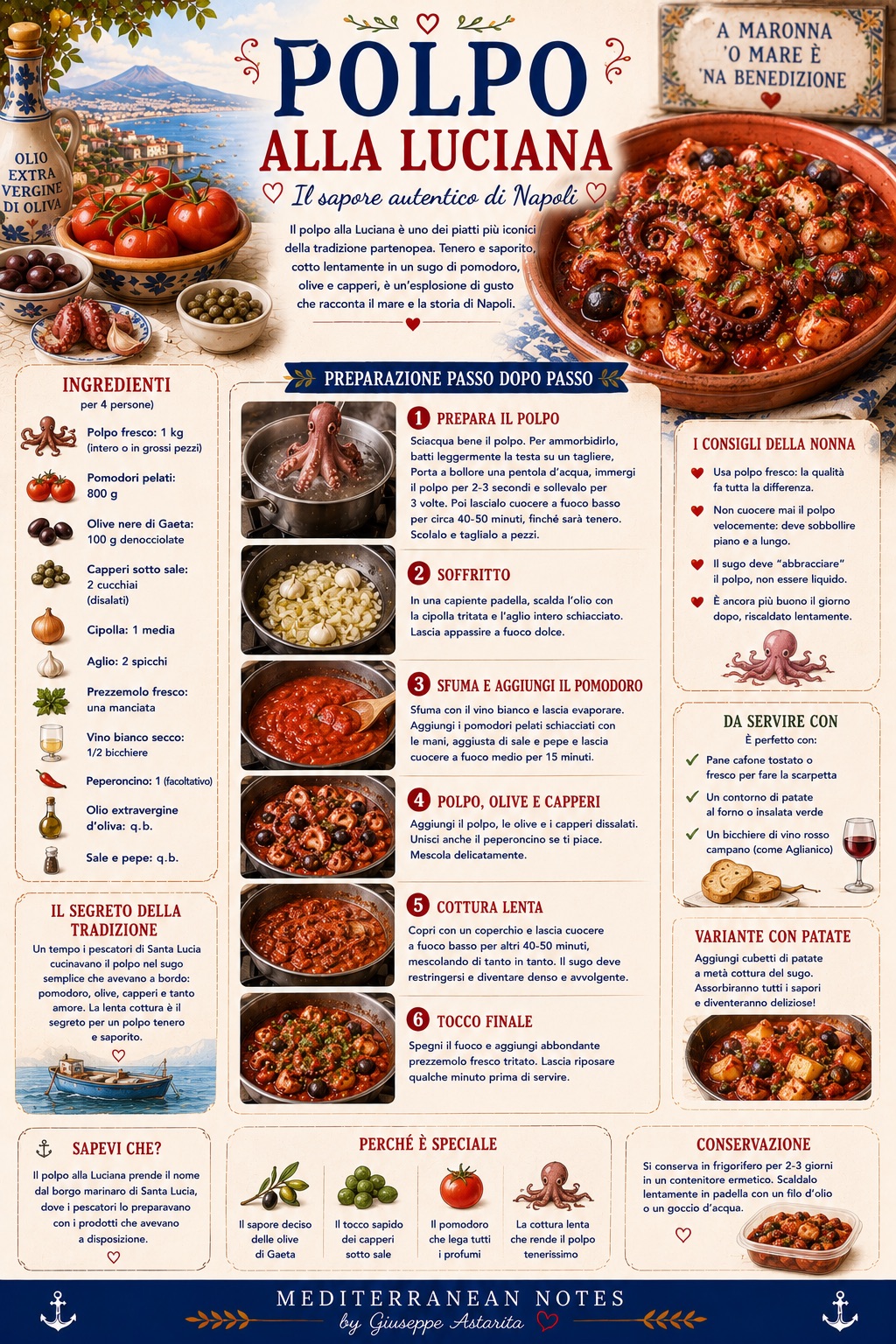
My mother made polpo alla Luciana for Sunday lunch sometimes, for special occasions, and occasionally just because good octopus was available at the fishmonger. She did not treat it as a production — she treated it as a dish she knew well and could make without tension, which is probably why it always came out well. The technique is not complicated but it requires time and a specific form of patience: the octopus must cook slowly, at a bare simmer, until it is genuinely tender, and then it must cook again in the tomato sauce until the sauce reduces to the density that the infographic describes as "abbracciare" — to embrace — the octopus. A liquid sauce is a failure of patience. A sauce that clings is the goal.
She always said it was better the next day, heated slowly in the pan with a thread of oil or a drop of water. This is true of almost all slow-cooked tomato preparations and particularly true here: overnight refrigeration allows the flavors to integrate further, the collagen in the octopus continues to redistribute through the sauce as it cools, and the reheating the next day produces something noticeably more unified and deep than the freshly cooked version. Eating it the same day is good. Eating it the next day, reheated gently, is better. This is not a consolation for leftovers. It is the correct sequence.
The tenderizing technique in step one — beating the head of the octopus lightly against a cutting board, then dipping it three times into boiling water before the final slow cook — comes from the old Neapolitan fishermen's practice and has a specific physical rationale. The beating breaks down some of the tough muscle fibers before cooking even begins. The hot-water dipping causes the tentacles to curl suddenly and then relax, beginning the process of protein denaturation in the outer layer of muscle. The subsequent slow cook at a gentle simmer — never boiling, always the barest movement of the water — finishes the tenderizing across the full thickness of the flesh without toughening the exterior. A rapidly boiling octopus tightens and toughens. A slowly simmering octopus becomes something tender and yielding that holds together when cut.
Octopus muscle is rich in collagen — the structural protein that makes connective tissue tough — in proportions significantly higher than most fish or even most shellfish. When octopus is cooked at high temperatures, the muscle proteins (primarily myosin and actin) denature and contract quickly, squeezing out water and producing a tough, rubbery texture before the collagen has had time to convert to gelatin. At low temperatures (a gentle simmer, around 80–85°C rather than a full boil at 100°C), the muscle proteins denature more slowly and the collagen conversion to gelatin — a process that requires both heat and time — can proceed without the muscle contracting violently. After 40–50 minutes at this temperature, the collagen has largely converted to gelatin, which distributes through the tissue and produces the characteristic tenderness of correctly cooked octopus: soft, yielding, with a slightly gelatinous quality that is the marker of done. The gelatin that leaches out of the octopus into the cooking liquid also contributes to the density of the final tomato sauce — it thickens it naturally, which is part of why the sauce achieves the "abbracciante" quality without reduction alone. The Gaeta olives contribute a slightly bitter, fruity note from their phenolic compounds; the desalted capers contribute acidic and sulfurous aromatic compounds (primarily methyl isothiocyanate derivatives) that cut through the richness of the olive oil base. The combination of these with the slow tomato sauce and the octopus gelatin produces a sauce that is more complex than any of its components individually.
La ricetta
La variante con patate
Add cubed potatoes — waxy variety, about 400 g — halfway through the final slow cooking at step 5. They absorb the flavors of the sauce completely as they cook and become one of the better things in the pan. The potato variant is common and entirely legitimate. Serve with pane cafone, toasted or fresh, for the scarpetta — wiping the last of the sauce from the pan is not optional, it is the correct ending to this meal.
Polpo alla Luciana keeps in the refrigerator in an airtight container for 2–3 days. Reheat slowly in a pan with a thread of olive oil or a drop of water over low heat — do not microwave it, which heats unevenly and toughens the octopus. The improvement on day two is not imaginary: overnight refrigeration allows the gelatin released by the octopus during cooking to redistribute evenly through the sauce, and the fat-soluble aromatic compounds from the olive oil, olives, and capers continue to dissolve into the tomato base, producing a more unified flavor. This is the same principle that makes most braises better on the second day — the equilibration of flavor between the solid and liquid components continues slowly at refrigerator temperature in a way that cooking time alone cannot achieve.
My mother served this with pane cafone and nothing else needed. The bread for the scarpetta, a glass of Aglianico, and the time to eat slowly. The octopus alla Luciana is not a quick dish in any sense — not in the cooking, not in the eating. Both require the right amount of time, and both reward it.
Buon appetito — e scarpetta obbligatoria.