Baccalà fritto
The purest form: bite-sized pieces in flour or a light sparkling-water batter, dropped into very hot oil. No sauce, no accompaniment. Outside crisp, inside moist and saline. Eat hot, straight from the oil. Once it cools, the moment has passed.
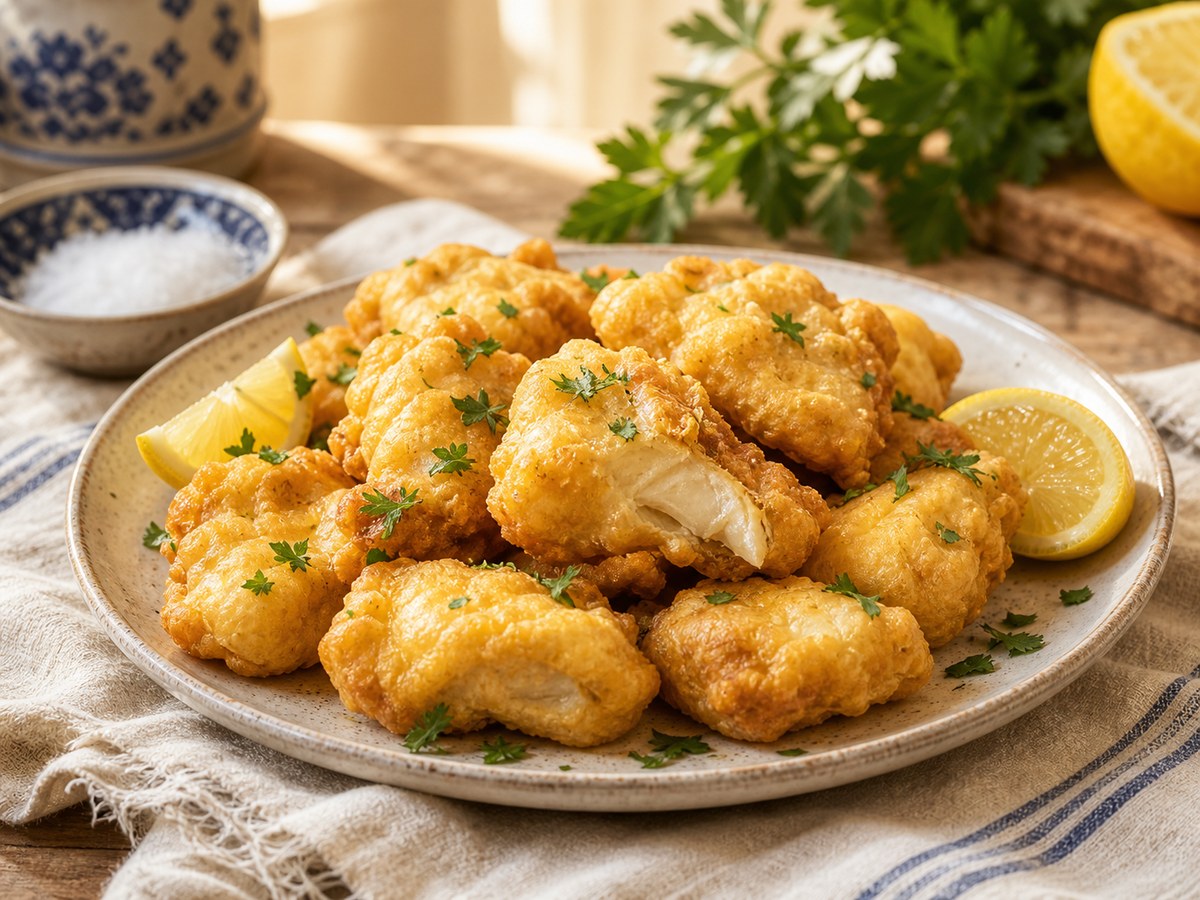
In December in Naples, the friggitorie — the small fry shops that have existed in every neighborhood for as long as anyone can remember — start selling baccalà fritto in paper cones. You stand outside, in the cold if December is cold, and eat them hot from the oil while cars pass behind you and the smell of frying fills the street. This is the correct context for baccalà fritto: outdoor, standing, eaten immediately, no plate, no utensil, no waiting. It is the version that does not translate to a sit-down dinner in quite the same way, though it can be done.
At home my mother made it as an appetizer during the Christmas Eve cenone della Vigilia and New Year's Eve — the long fish dinners where the courses came out slowly over several hours. The fried baccalà appeared first, while people were settling in and the first wine was being poured, passed around on a plate lined with paper to absorb the oil. It was gone before most people had their glass half finished. This is still the right occasion for it at home: something to eat before the table is formally set, something that disappears quickly and creates the expectation for the rest of the meal.
Two versions are given here. The flour-only version is the one my mother made: simpler, more austere, the crust thin and close to the fish. The sparkling-water batter version is closer to what the friggitorie sell: puffier, crispier, slightly lighter in character. Both are correct. The choice depends on the occasion — flour for a home dinner, batter if you want the street-food effect at home.
Why hot oil and sparkling water both produce a crisp crust — different paths, same mechanism
When baccalà hits oil at 180°C, the surface water vaporizes instantly, creating a steam barrier that prevents oil from penetrating the fish tissue. Simultaneously, the proteins in the flour coating denature and the starch gelatinizes, then rapidly dries out as the steam escapes — forming the crust. The flour-only version produces a thin, tight crust with good adherence to the fish. The sparkling-water batter uses dissolved CO₂ differently: as the batter hits the hot oil, the CO₂ gas expands and escapes rapidly, creating tiny air pockets in the coating before it sets. These pockets produce a lighter, more open crust with greater crunch. Both mechanisms require high oil temperature: below 175°C, the steam barrier fails and oil penetrates the coating, making it greasy rather than crisp. Above 190°C, the crust browns too fast before the interior heats through. The correct window is 175–185°C.
Recipe — serves 4 as appetizer
This recipe assumes the baccalà has already been soaked for 48 hours with water changed twice daily. The same soaked baccalà serves all three preparations — soak enough for multiple uses.
Ingredients — both versions
Method — version 1: flour only (home version)
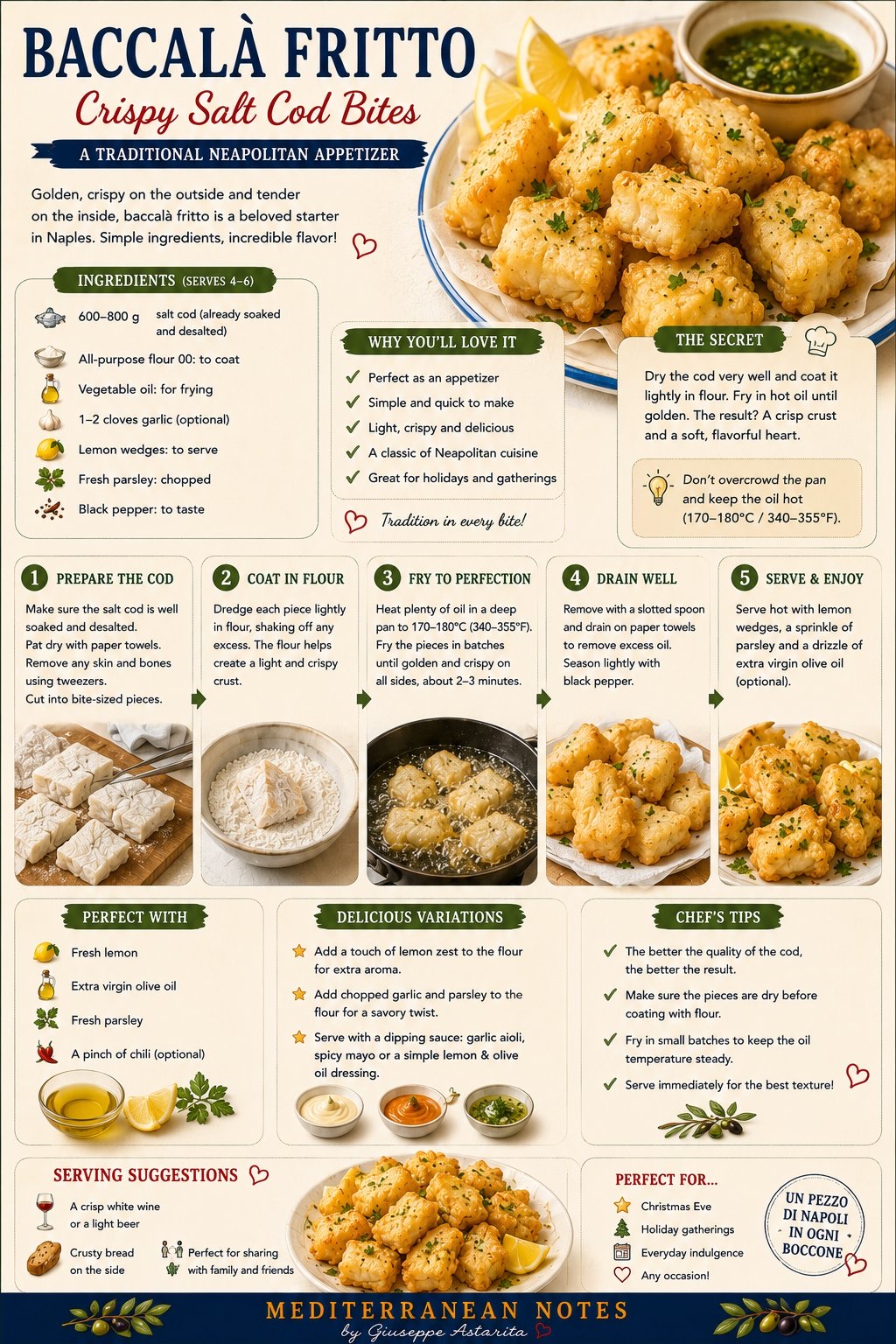
Pat the fish dry. Dry the baccalà pieces very thoroughly with kitchen paper. Any surface moisture will cause the oil to spit violently and the crust to fail. Dry twice if needed.
Flour and fry. Heat the frying oil to 180°C. Dust each piece of fish in flour, shaking off all excess. Lower carefully into the hot oil. Fry 3–4 minutes, turning once, until golden and crisp on all sides. Work in small batches — never crowd the oil.
Crowding drops the oil temperature below the critical threshold. Small batches keep the temperature stable and the crust crisp.
Drain and serve immediately. Remove with a slotted spoon to a plate lined with paper. Salt is not necessary — the fish carries its own. Serve with lemon wedges on the side. Eat hot. This dish does not wait.
Method — version 2: sparkling water batter (friggitoria version)
Make the batter just before frying. Combine the flour and a pinch of salt in a bowl. Pour in the ice-cold sparkling water and stir minimally — lumps are fine; overmixing develops gluten and makes the batter heavy. The batter should be the consistency of thin cream. Use immediately.
The batter must be made at the last moment from very cold sparkling water. A batter that has sat for even 10 minutes will lose its lightness.
Dip and fry. Heat the oil to 180°C. Dip each piece of dry baccalà in the batter, let excess drip off for a second, then lower into the oil. Fry 3–4 minutes until the batter is puffed and golden. Drain on paper and serve immediately.
The other preparations
Caldo e subito — non c'è altro modo.